Request Free Sample ×

Kindly complete the form below to receive a free sample of this Report

* Please use a valid business email

Leading companies partner with us for data-driven Insights

clients tt-cursor
Hero Background

Amphibious Aircraft Market

ID: MRFR/AD/21178-HCR
128 Pages
Shubham Munde, Sejal Akre
Last Updated: May 28, 2026
Amphibious Aircraft Market Size, Share, Industry Trend & Analysis Research Report By Engine Type (Piston, Turboprop, Turbine, Hybrid/Electric), By Seating Capacity (Less Than 10 Seats, 10 to 20 Seats, More Than 20 Seats), By End Use (Passenger Transport, Cargo and Logistics, Firefighting/SAR, Maritime Patrol and Surveillance), By Geography (North America, Europe, Asia-Pacific, South America, Middle East & Africa) - Forecast to 2035.
Download PDF ×

We do not share your information with anyone. However, we may send you emails based on your report interest from time to time. You may contact us at any time to opt-out.


Amphibious Aircraft Market Summary

The amphibious aircraft Market reached USD 268.45 Million in 2025 and is positioned to climb to roughly USD 301.20 Million as the 2026 forecast period opens, before extending to USD 838.20 Million by 2035 at a 12.65% CAGR. Two catalysts anchor that trajectory: China's June 2025 production certification of the AG600, which made the country the only mass producer of 60-tonne airframes for firefighting and maritime patrol, and coordinated European agency procurement programs targeting 2028 fleet deliveries. Tight supply and long lead times have pushed operators toward early deposits and multi-year service contracts.

Propulsion is where the amphibious aircraft Market is changing fastest. Legacy piston and older turboprop platforms are giving way to modern turboprop airframes and, increasingly, hybrid/electric powertrains that promise lower operating costs for short inter-island hops. Manufacturers have committed capital toward certification of cleaner powertrains, and several seaplane floatplane amphibious programs now feature electrified demonstrators. Public firefighting budgets exceeding USD 1 billion across European member states underpin near-term airframe demand.

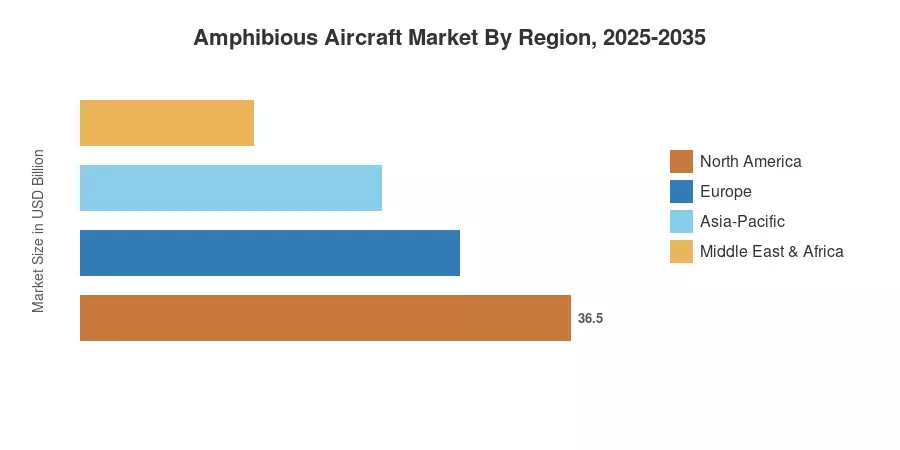
North America holds the dominant position with a 38.6% share of the amphibious aircraft Market, supported by mature utility amphibious aircraft design ecosystems and bush operations. Asia-Pacific is the fastest-growing region at a 13.4% CAGR, driven by inter-island connectivity. Europe ranks second on the strength of firefighting fleet renewal. Momentum should hold as supply normalizes.

Key Report Takeaways

• By Engine Type

  • Turboprop platforms led the amphibious aircraft Market with a 42.8% share in 2025, reflecting their balance of payload and reliability for lake water landing aircraft missions
  • Hybrid/electric propulsion is the fastest-expanding technology, projected at a 16.4% CAGR through 2035 as electrified seaplane floatplane amphibian demonstrators mature

• By Seating Capacity

  • Passenger transport accounted for a 34.6% share of the amphibious aircraft Market in 2025, anchored by amphibious air transport service routes across island geographies
  • Firefighting and search-and-rescue are forecast to grow at a 15.1% CAGR through 2035 as public agencies expand aerial response fleets

• By Region

  • North America retained USD 103.62 Million of the amphibious aircraft Market in 2025, the largest regional pool
  • Asia-Pacific is projected to record a 13.4% CAGR through 2035, the fastest among all regions

Market Size and Forecast (2021–2035)

Market sizing draws on MRFR's bottom-up modeling of fleet deliveries, operator order books, and service-contract revenue, triangulated against published aerospace estimates and regulatory certification records. Historical values reflect actual delivery data; forecast years apply a calibrated 12.65% CAGR.
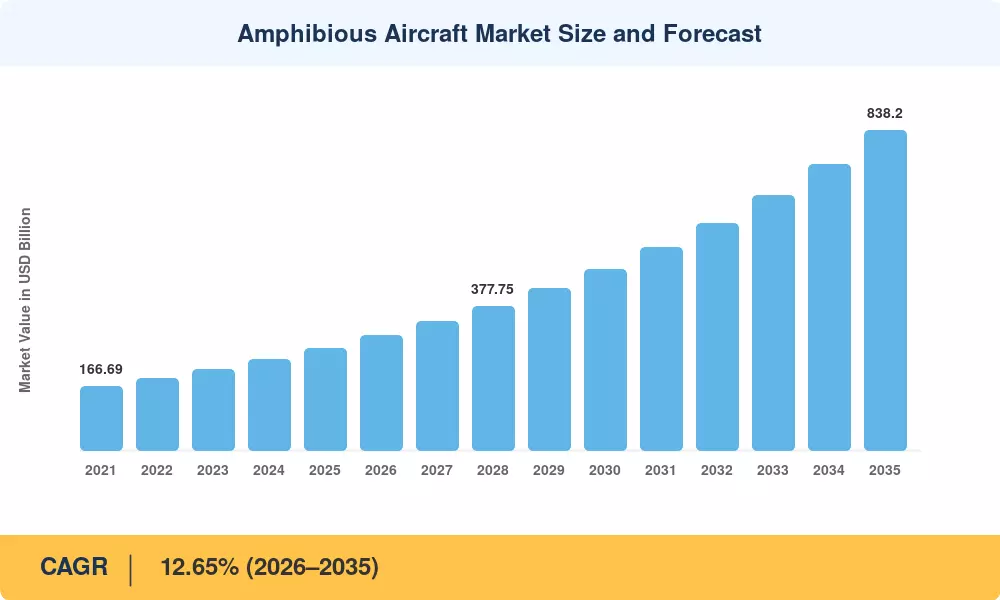
Amphibious Aircraft Market Size and Forecast
Our Impact
Enabled $4.3B Revenue Impact for Fortune 500 and Leading Multinationals
Partnering with 2000+ Global Organizations Each Year
30K+ Citations by Top-Tier Firms in the Industry
 

Driver Impact Analysis

Driver ~% Impact on CAGR Geographic Relevance Impact Timeline
Firefighting fleet renewal ~22% Europe, North America Short-term (≤2 yr)
Inter-island connectivity programs ~19% Asia-Pacific Medium-term (2–4 yr)
AG600 production capacity ramp ~17% Asia-Pacific Short-term (≤2 yr)
Hybrid/electric propulsion progress ~14% Global Long-term (≥4 yr)
Tourism and seaplane operator orders ~12% Global Medium-term (2–4 yr)
Maritime patrol and surveillance demand ~10% Asia-Pacific, MEA Long-term (≥4 yr)
Bush operations route expansion ~6% North America Medium-term (2–4 yr)


Firefighting Fleet Renewal

With member-state aerial firefighting costs exceeding USD 1.2 billion yearly, European agencies have reserved delivery slots for coordinated firefighter fleet plans for 2028. The imbalance in supply forces public buyers to make early commitments and maintains stable pricing for available airframes. Because firefighting tasks require specially designed water-scooping airframes, which few manufacturers can produce in large quantities, this driver has the most near-term weight in the amphibious aircraft market.


Inter-Island Connectivity Programs

Asia-Pacific airport investments and connectivity initiatives are expanding the opportunity set for amphibious air transport services across archipelagic geographies. Regional governments have channeled an estimated USD 800 million into small-airport and waterway infrastructure, attracting new operator orders. Utility amphibious aircraft design suited to short, unimproved water surfaces directly benefits.

AG600 Production Capacity Ramp

China's certification of the AG600 in June 2025 strengthened the short-term availability for public agencies by establishing the only mass-production line for 60-ton firefighting and marine patrol airframes. Public purchasers in the amphibious aircraft market have already started making reservations through multi-year contracts due to the program's planned capacity ramp, which adds quantifiable supply.


Restraints Impact Analysis

Restraint ~% Impact on CAGR Geographic Relevance Impact Timeline
Long delivery lead times ~28% Global Short-term (≤2 yr)
High acquisition and maintenance cost ~24% Global Medium-term (2–4 yr)
Limited certified pilot pool ~19% North America, Europe Medium-term (2–4 yr)
Stringent water operations certification ~17% Global Long-term (≥4 yr)
Weather and seasonal utilization limits ~12% Global Long-term (≥4 yr)


Long Delivery Lead Times

Tight production capacity has stretched delivery lead times well beyond two years for most platforms, forcing operators to place early deposits. This constraint is the single largest brake on the amphibious aircraft Market, since route launches and fleet plans hinge on airframe availability that manufacturers cannot accelerate quickly.

High Acquisition and Maintenance Cost

The purchase costs of amphibious airframes are 20–30% more than those of comparable land aircraft due to their dual landing systems and corrosion-resistant hulls. A barrier for smaller seaplane, floatplane amphibian operators evaluating fleet increases against tighter margins is the increased maintenance expenditure caused by saltwater exposure.


Amphibious Aircraft Market Opportunities

Electrified Short-Haul Routes

Hybrid/electric powertrains open a path to lower operating costs on short inter-island hops, where battery range limits matter less. Operators running amphibious air transport service across compact route networks could capture meaningful fuel savings as certified electric variants enter service

Emerging-Market Connectivity Gaps

For many villages in the archipelagic economies of Southeast Asia and the Pacific, lake water landing aircraft are the only viable alternative due to the lack of permanent transportation linkages. For operators eager to create additional routes, this unmet demand offers a stable expansion pool


Service and Subscription Models

Beyond airframe sales, manufacturers can monetize maintenance, parts, and fleet-management subscriptions. Bundling utility amphibious aircraft design support into multi-year service agreements creates recurring revenue and deepens operator relationships

Maritime Patrol Modernization

Coastal states upgrading surveillance capability can deploy amphibious platforms for patrol missions that combine endurance with water-landing flexibility. Defense and coast-guard budgets across Asia-Pacific present a concrete opening

Tourism-Linked Bush Operations

Premium eco-tourism continues to lift demand for amphibious bush pilot operations into remote lakes and coastlines. Operators pairing experiential travel with amphibious access can command pricing power that offsets higher airframe costs


Amphibious Aircraft Market Future Outlook

Autonomous and Assisted Operations

Avionics suppliers are advancing assisted-landing and obstacle-detection systems tuned for water surfaces, where glassy conditions challenge pilot depth perception. Over the forecast decade, these systems should reduce accident rates and widen the certified pilot pool, easing one of the market's structural constraints.

Electrification Supercycle

Hybrid and fully electric powertrains will move from demonstrators to certified production within the forecast window. With short inter-island missions well-suited to current battery energy density, the amphibious aircraft Market is positioned as an early commercial proving ground for electrified regional aviation.

Platform Economics and Services

Manufacturers increasingly compete on total cost of ownership rather than airframe price alone. Subscription-based maintenance, predictive analytics, and fleet-management platforms will reshape revenue mix, with aftermarket services capturing a growing slice of operator spend.

Sustainability and Climate Response

Intensifying wildfire seasons and disaster-response needs tie amphibious demand directly to climate adaptation budgets. Global spending on aerial firefighting capacity is projected to rise steadily, reinforcing firefighting and SAR as a structural growth pillar.


Amphibious Aircraft Market Segmentation

By Engine Type

The engine type structure of the amphibious aircraft Market spans piston, turboprop, turbine, and hybrid/electric platforms.

Segment Metric Primary Demand Driver
Piston 18.4% share Light recreational and training use
Turboprop 42.8% share Payload-reliability balance
Turbine 22.9% share Heavy firefighting and patrol
Hybrid/Electric 16.4% CAGR Low-cost short-haul operations


Turboprop platforms dominate because they balance payload, range, and proven reliability for lake water landing aircraft missions. Hybrid/electric propulsion, though small today, grows fastest as certified electrified variants reach operators seeking lower fuel and maintenance costs.

By Seating Capacity

Segment Metric Primary Demand Driver
Less Than 10 Seats 50.2% share Bush operations and air taxi
10 to 20 Seats USD 78.40 Million Regional passenger routes
More Than 20 Seats 15.6% CAGR High-density firefighting payloads


Sub-10-seat aircraft hold the largest pool, reflecting amphibious bush pilot operations and small-charter demand. Larger 20-plus-seat variants grow quickest as firefighting and high-capacity passenger missions scale.

By End Use

Segment Metric Primary Demand Driver
Passenger Transport 34.6% share Inter-island connectivity
Cargo and Logistics USD 41.20 Million Remote-region freight
Firefighting/SAR 15.1% CAGR Climate-driven response needs
Maritime Patrol and Surveillance 11.8% share Coastal security programs


Passenger transport leads the amphibious aircraft Market as amphibious air transport service expands across archipelagic routes. Firefighting and SAR grow fastest, pulled by intensifying wildfire seasons and public-agency fleet renewal.


Regional Market Share Analysis

Region Market Share (2025) Primary Investment Themes
North America 38.6% Bush operations, utility fleets
Europe 27.4% Firefighting fleet renewal
Asia-Pacific 24.1% Inter-island connectivity
South America 5.8% Remote-region access
Middle East & Africa 4.1% Maritime patrol
Total 100.0%

The amphibious aircraft Market shows clear regional concentration, with mature ecosystems in North America and Europe balanced against rapid Asia-Pacific expansion.


North America

Country Share of Region Key Driver
US 74.5% Mature bush and utility operations
Canada 21.0% Remote lake access missions
Mexico 4.5% Coastal tourism routes


North America anchors the amphibious aircraft Market through deep operator experience and a large installed base of utility amphibious aircraft design platforms. US bush operations across Alaska and the Pacific Northwest sustain steady replacement demand, while Canadian operators rely on amphibious access to thousands of inland lakes.

Europe

Country Market Size (USD Million) Key Driver
Germany 12.10 Civil protection fleets
UK 9.80 Coastal SAR operations
France 14.60 Aerial firefighting leadership
Italy 11.20 Mediterranean fire response
Spain 10.40 Wildfire suppression
Nordic Countries 6.90 Lake-region utility flights
Russia 5.70 Remote-region logistics
Rest of Europe 2.85 Mixed civil missions


European demand centers on aerial firefighting, where coordinated procurement keeps 2028 delivery slots reserved. France leads with established water-bomber operations, and southern member states drive seasonal wildfire-response purchasing.

Asia-Pacific

Country CAGR (2026–2035) Key Driver
China 14.8% AG600 production and deployment
India 13.6% Coastal connectivity programs
Japan 11.2% Disaster response fleets
South Korea 11.9% Maritime surveillance
ASEAN 14.1% Inter-island passenger routes
Rest of Asia-Pacific 12.4% Tourism and logistics


Asia-Pacific is the growth engine of the amphibious aircraft Market, with China's AG600 program reshaping regional supply. ASEAN nations invest in amphibious air transport service to link island communities lacking runways.

South America

Country Share of Region Key Driver
Brazil 58.0% Amazon basin access
Argentina 24.0% Patagonian lake routes
Rest of South America 18.0% Remote logistics


South America's demand stems from river and lake networks where amphibious platforms reach communities beyond road infrastructure. Brazil leads on the strength of the Amazon region connectivity needs.

Middle East & Africa

Country Share of Region Key Driver
Saudi Arabia 31.0% Coastal patrol initiatives
UAE 27.0% Tourism and VIP transport
South Africa 22.0% Conservation and SAR
Egypt 12.0% Nile and coastal operations
Rest of MEA 8.0% Mixed utility missions


The Middle East and Africa demand is nascent but rising, led by Gulf states deploying amphibious platforms for maritime patrol and premium tourism along coastal corridors.

Amphibious Aircraft Market By Region, 2025-2035
 

Competitive Benchmarking

The amphibious aircraft Market is moderately fragmented with low concentration; the top five players hold an estimated 52–58% combined share, and the HHI sits in the low-to-mid range, signaling room for both incumbents and new entrants.

Company Est. Revenue Share Range Key Offerings for Amphibious Aircraft Market Strategic Positioning
Viking Air (De Havilland Canada) ~13–16% Twin Otter amphibian, utility platforms Utility-segment leader
AVIC (AG600 program) ~12–15% AG600 large firefighting amphibian Sole 60-tonne mass producer
Textron Aviation ~10–13% Caravan amphibian variants Broad utility distribution
ICON Aircraft ~7–10% A5 light sport amphibian Recreational segment focus
Dornier Seawings ~6–9% Seastar composite amphibian Premium multi-role niche
Aviat Aircraft ~5–8% Husky amphibious floatplanes Bush operations specialist
Quest Aircraft ~5–7% Kodiak amphibian configurations Rugged utility platforms
Piper Aircraft ~4–6% Floatplane-equipped models General aviation reach
Lake Aircraft ~3–5% Dedicated amphibian designs Heritage amphibian brand
Beriev Aircraft ~3–5% Be-200 firefighting amphibian Heavy-lift fire response


Recent News & Developments

  • AVIC (June 2025): Secured production certification for the AG600, establishing China as the only mass producer of 60-tonne firefighting amphibians [5].
  • De Havilland Canada (March 2025): Announced expanded Twin Otter amphibian production slots to address multi-year order backlogs [4].
  • European Civil Protection (November 2024): Confirmed 2028 delivery timelines for coordinated aerial firefighter fleet procurement [8].
  • ICON Aircraft (September 2024): Released an upgraded A5 variant with improved corrosion protection for saltwater operations [16].
  • Dornier Seawings (May 2024): Partnered with a regional operator to develop electrified Seastar demonstrators [12].
  • Textron Aviation (February 2024): Expanded Caravan amphibian service network across Asia-Pacific [11].
  • Beriev (October 2023): Completed firefighting trials of the Be-200 under intensified Mediterranean wildfire conditions [19].
  • Aviat Aircraft (April 2023): Launched a refreshed Husky amphibious float package for bush operators [17].
 

Amphibious Aircraft Market Report Scope

Parameter Detail
Market Scope Global amphibious aircraft, all engine types, seating capacities, and end uses
Study Period 2021–2035
CAGR 12.65% (2026–2035)
Market Size Checkpoints USD 268.45 Million (2025); USD 301.20 Million (2026); USD 838.20 Million (2035)
Fastest Growing Segments Hybrid/electric propulsion; firefighting/SAR; Asia-Pacific
Companies Profiled 10+, including Viking Air, AVIC, Textron, ICON, Dornier Seawings
Valuation Currency USD Million
CAGR Driver Disclaimer Driver impact percentages are directional, not additive to headline CAGR


FAQs

What should buyers prioritize when evaluating an amphibious aircraft Market purchase?

Lead time and aftermarket support outweigh sticker price. With deliveries stretching past two years, securing a production slot early matters more than negotiating airframe discounts. Verify corrosion-warranty terms before committing [4].

How does saltwater operation affect long-term ownership economics?

Saltwater corrosion raises maintenance spending 20–30% above freshwater use, concentrated in hull and control surfaces. Operators should budget for frequent rinse protocols and inspection intervals. Composite-hull designs reduce but do not eliminate this cost [16].

Which financing structures suit the amphibious aircraft Market today?

Multi-year service contracts bundled with airframe deposits are now common, letting operators lock pricing against supply tightness. Operating leases remain limited because residual values are hard to model. Direct purchase still dominates [7].

How do hybrid and turboprop platforms compare for new operators?

Turboprop offers proven reliability and a deep parts network, while hybrid promises lower fuel cost on short routes but carries certification uncertainty. New entrants on established routes typically choose turboprop first [12].

What regulatory nuances complicate water-based operations?

Water aerodromes often fall outside standard airport oversight, creating jurisdictional gaps. Operators must navigate maritime and aviation rules simultaneously, and glassy-water landing certification adds training requirements [18].

Where are the emerging use cases beyond firefighting and tourism?

Coastal infrastructure inspection, offshore energy support, and conservation monitoring are gaining traction in the amphibious aircraft Market. These niche missions value water access more than speed [9].

What integration challenges arise when adding amphibious aircraft to mixed fleets?

Pilot cross-training is the main hurdle, since water operations demand distinct skills. Maintenance facilities also need corrosion-handling capability. Operators should phase amphibious additions gradually to build the amphibious aircraft Market expertise internally [17].

Author
Author
Author Profile
Shubham Munde LinkedIn
Team Lead - Research
Shubham brings over 7 years of expertise in Market Intelligence and Strategic Consulting, with a strong focus on the Automotive, Aerospace, and Defense sectors. Backed by a solid foundation in semiconductors, electronics, and software, he has successfully delivered high-impact syndicated and custom research on a global scale. His core strengths include market sizing, forecasting, competitive intelligence, consumer insights, and supply chain mapping. Widely recognized for developing scalable growth strategies, Shubham empowers clients to navigate complex markets and achieve a lasting competitive edge. Trusted by start-ups and Fortune 500 companies alike, he consistently converts challenges into strategic opportunities that drive sustainable growth.
Co-Author
Co-Author Profile
Sejal Akre LinkedIn
Senior Research Analyst
She has over 5 years of rich experience, in market research and consulting providing valuable market insights to client. Hands on expertise in management consulting, and extensive knowledge in domain including ICT, Automotive & Transportation and Aerospace & Defense. She is skilled in Go-to market strategy, industry analysis, market sizing, in depth company profiling, competitive intelligence & benchmarking and value chain amongst others.

Research Approach


Secondary Research

The secondary research process involved comprehensive analysis of regulatory databases, peer-reviewed aerospace journals, defense publications, and authoritative aviation organizations. Key sources included the Federal Aviation Administration (FAA), European Union Aviation Safety Agency (EASA), International Civil Aviation Organization (ICAO), National Aeronautics and Space Administration (NASA) Aeronautics Research, US Department of Defense (DoD) Procurement Reports, NATO Standardization Office, International Air Transport Association (IATA), General Aviation Manufacturers Association (GAMA), Flight Safety Foundation, National Transportation Safety Board (NTSB), Aviation Week & Space Technology, Jane's All the World's Aircraft, Aerospace Industries Association (AIA), Canadian Transportation Agency, Civil Aviation Administration of China (CAAC), Japan Civil Aviation Bureau (JCAB), Australian Civil Aviation Safety Authority (CASA), Russian Federal Air Transport Agency (Rosaviatsiya), Brazilian National Civil Aviation Agency (ANAC), and national defense ministry reports from key markets. These sources were used to collect aircraft certification data, military procurement statistics, production volume analysis, regulatory approval timelines, and market landscape analysis for fixed wing, tiltrotor, convertible, and VTOL amphibious aircraft technologies.


Primary Research

In order to gather both qualitative and quantitative insights, supply-side and demand-side stakeholders were interviewed during the primary research process. CEOs, VPs of engineering, chief test pilots, heads of certification, and program directors from amphibious aircraft OEMs, component suppliers, and avionics makers were examples of supply-side sources. Fleet managers from commercial operators, coast guard commanders, defense procurement officers, search and rescue coordinators, private aviation advisors, and tourism board aviation directors were among the demand-side sources. Market segmentation, aircraft development schedules, operational deployment patterns, purchase cost structures, and maintenance lifecycle economics were all corroborated by primary research.

Primary Respondent Breakdown:

By Designation: C-level Primaries (28%), Director Level (35%), Others (37%)

By Region: North America (32%), Europe (30%), Asia-Pacific (25%), Rest of World (13%)


Market Size Estimation

Global market valuation was derived through production volume analysis and order backlog assessment. The methodology included:

Identification of 35+ key manufacturers across North America, Europe, Asia-Pacific, and Latin America

Product mapping across fixed wing, tiltrotor, convertible, and VTOL aircraft categories

Analysis of reported and modeled annual revenues specific to amphibious aircraft portfolios

Coverage of manufacturers representing 75-80% of global market share in 2024

Extrapolation using bottom-up (unit deliveries × ASP by aircraft type and region) and top-down (manufacturer revenue validation) approaches to derive segment-specific valuations

Download Free Sample

Kindly complete the form below to receive a free sample of this Report
















