Request Free Sample ×

Kindly complete the form below to receive a free sample of this Report

* Please use a valid business email

Leading companies partner with us for data-driven Insights

clients tt-cursor
Hero Background

Amphibious Aircraft Market

ID: MRFR/AD/21178-HCR
128 Pages
Shubham Munde
Last Updated: May 28, 2026
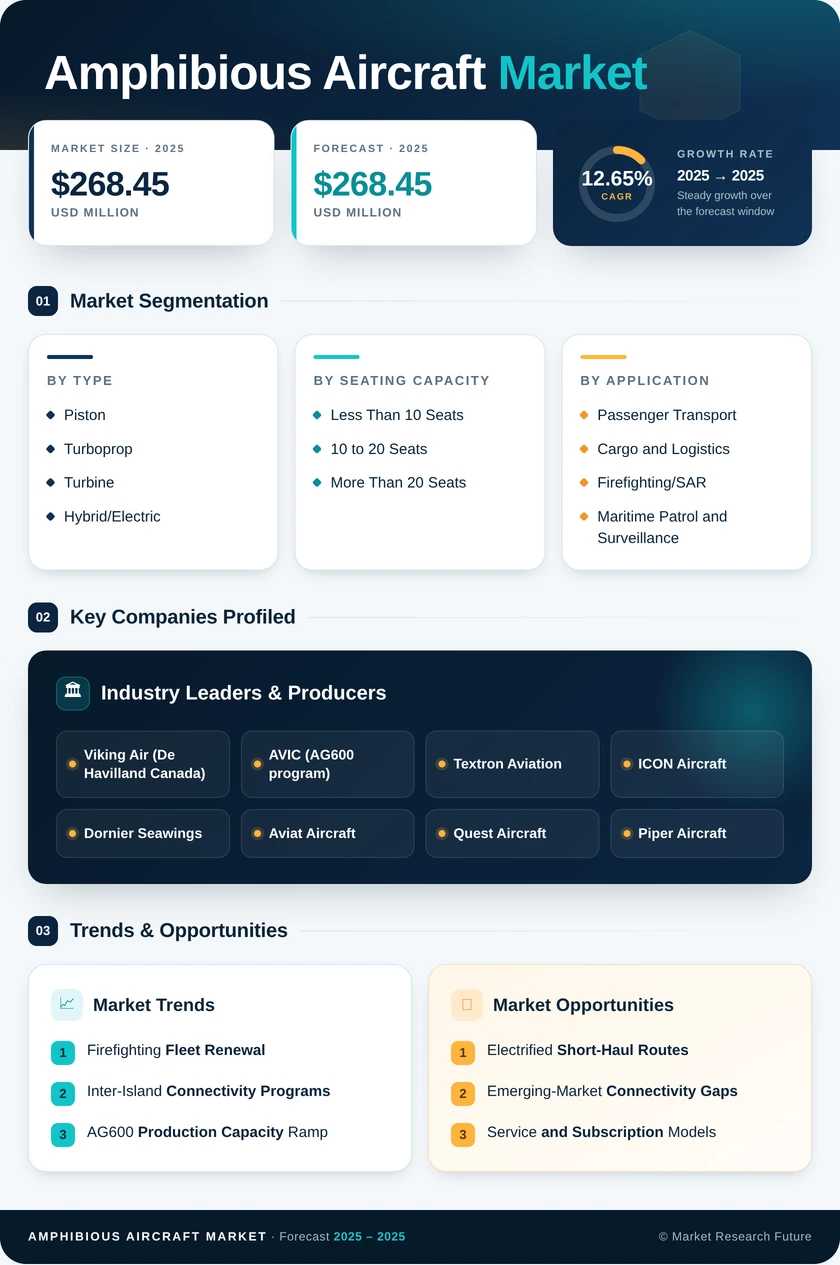
Amphibious Aircraft Market Size, Share, Industry Trend & Analysis Research Report By Engine Type (Piston, Turboprop, Turbine, Hybrid/Electric), By Seating Capacity (Less Than 10 Seats, 10 to 20 Seats, More Than 20 Seats), By End Use (Passenger Transport, Cargo and Logistics, Firefighting/SAR, Maritime Patrol and Surveillance), By Geography (North America, Europe, Asia-Pacific, South America, Middle East & Africa) - Forecast to 2035.
Download PDF ×

We do not share your information with anyone. However, we may send you emails based on your report interest from time to time. You may contact us at any time to opt-out.

  1. 1 Market Overview |
    1. 1.1 Study Assumptions & Market Definition |
    2. 1.2 Scope of the Study |
    3. 1.3 Research Methodology
  2. 2 Market Summary & Key Takeaways
  3. 3 Market Dynamics |
    1. 3.1 Market Drivers Analysis | |
      1. 3.1.1 Firefighting Fleet Renewal | |
      2. 3.1.2 Inter-Island Connectivity Programs | |
      3. 3.1.3 AG600 Production Capacity Ramp | |
      4. 3.1.4 Hybrid/Electric Propulsion Progress | |
      5. 3.1.5 Tourism & Seaplane Operator Orders |
    2. 3.2 Market Restraints Analysis | |
      1. 3.2.1 Long Delivery Lead Times | |
      2. 3.2.2 High Acquisition & Maintenance Cost | |
      3. 3.2.3 Limited Certified Pilot Pool | |
      4. 3.2.4 Stringent Water-Operations Certification |
    3. 3.3 Market Opportunity Analysis | |
      1. 3.3.1 Electrified Short-Haul Routes | |
      2. 3.3.2 Emerging-Market Connectivity Gaps | |
      3. 3.3.3 Service & Subscription Models | |
      4. 3.3.4 Maritime Patrol Modernization | |
      5. 3.3.5 Tourism-Linked Bush Operations |
    4. 3.4 Industry Value Chain Analysis |
    5. 3.5 Porter's Five Forces Analysis
  4. 4 Amphibious Aircraft Market Size & Forecast (2021–2035) |
    1. 4.1 Historical Market Size (2021–2025) |
    2. 4.2 Current & Forecast Market Size (2026–2035) |
    3. 4.3 Market Size by Revenue (USD Million) |
    4. 4.4 Year-over-Year Growth Analysis
  5. 5 Segmentation Analysis |
    1. 5.1 By Engine Type | |
      1. 5.1.1 Piston | |
      2. 5.1.2 Turboprop | |
      3. 5.1.3 Turbine | |
      4. 5.1.4 Hybrid/Electric |
    2. 5.2 By Seating Capacity | |
      1. 5.2.1 Less Than 10 Seats | |
      2. 5.2.2 10 to 20 Seats | |
      3. 5.2.3 More Than 20 Seats |
    3. 5.3 By End Use | |
      1. 5.3.1 Passenger Transport | |
      2. 5.3.2 Cargo and Logistics | |
      3. 5.3.3 Firefighting/Search and Rescue | |
      4. 5.3.4 Maritime Patrol and Surveillance
  6. 6 Regional Analysis |
    1. 6.1 North America | |
      1. 6.1.1 United States | |
      2. 6.1.2 Canada | |
      3. 6.1.3 Mexico |
    2. 6.2 Europe | |
      1. 6.2.1 Germany | |
      2. 6.2.2 United Kingdom | |
      3. 6.2.3 France | |
      4. 6.2.4 Italy | |
      5. 6.2.5 Spain | |
      6. 6.2.6 Nordic Countries | |
      7. 6.2.7 Russia | |
      8. 6.2.8 Rest of Europe |
    3. 6.3 Asia-Pacific | |
      1. 6.3.1 China | |
      2. 6.3.2 India | |
      3. 6.3.3 Japan | |
      4. 6.3.4 South Korea | |
      5. 6.3.5 ASEAN | |
      6. 6.3.6 Rest of Asia-Pacific |
    4. 6.4 South America | |
      1. 6.4.1 Brazil | |
      2. 6.4.2 Argentina | |
      3. 6.4.3 Rest of South America |
    5. 6.5 Middle East & Africa | |
      1. 6.5.1 Saudi Arabia | |
      2. 6.5.2 UAE | |
      3. 6.5.3 South Africa | |
      4. 6.5.4 Egypt | |
      5. 6.5.5 Rest of Middle East & Africa
  7. 7 Competitive Landscape |
    1. 7.1 Market Share Analysis (2026) |
    2. 7.2 Competitive Benchmarking Matrix |
    3. 7.3 Company Profiles | |
      1. 7.3.1 Viking Air (De Havilland Canada) | |
      2. 7.3.2 AVIC | |
      3. 7.3.3 Textron Aviation | |
      4. 7.3.4 ICON Aircraft | |
      5. 7.3.5 Dornier Seawings | |
      6. 7.3.6 Aviat Aircraft | |
      7. 7.3.7 Quest Aircraft | |
      8. 7.3.8 Piper Aircraft | |
      9. 7.3.9 Lake Aircraft | |
      10. 7.3.10 Beriev Aircraft
  8. 8 Future Outlook & Strategic Recommendations (2026–2035) |
    1. 8.1 Near-Term Outlook (2026–2028) |
    2. 8.2 Medium-Term Outlook (2029–2031) |
    3. 8.3 Long-Term Outlook (2032–2035)
  9. 9 Recent Developments & News
  10. 10 Frequently Asked Questions (FAQs)
  11. 11 Report Scope & Methodology |
    1. 11.1 Study Period & Base Year |
    2. 11.2 Data Sources & Citations |
    3. 11.3 Abbreviations
  12. 12 LIST OF TABLES |
  13. TABLE 1 Global Amphibious Aircraft Market Size & Forecast, by Revenue (USD Million), 2021–2035 |
  14. TABLE 2 Global Amphibious Aircraft Market – Year-over-Year Growth Analysis, 2021–2035 |
  15. TABLE 3 Driver Impact Analysis – Global Amphibious Aircraft Market |
  16. TABLE 4 Restraint Impact Analysis – Global Amphibious Aircraft Market |
  17. TABLE 5 Global Amphibious Aircraft Market Size, by Engine Type, 2021–2035 (USD Million) |
  18. TABLE 6 Global Amphibious Aircraft Market Size, by Seating Capacity, 2021–2035 (USD Million) |
  19. TABLE 7 Global Amphibious Aircraft Market Size, by End Use, 2021–2035 (USD Million) |
  20. TABLE 8 Global Amphibious Aircraft Market Size, by Region, 2021–2035 (USD Million) |
  21. TABLE 9 North America Amphibious Aircraft Market Size, by Country, 2021–2035 (USD Million) |
  22. TABLE 10 Europe Amphibious Aircraft Market Size, by Country, 2021–2035 (USD Million) |
  23. TABLE 11 Asia-Pacific Amphibious Aircraft Market Size, by Country, 2021–2035 (USD Million) |
  24. TABLE 12 South America Amphibious Aircraft Market Size, by Country, 2021–2035 (USD Million) |
  25. TABLE 13 Middle East & Africa Amphibious Aircraft Market Size, by Country, 2021–2035 (USD Million) |
  26. TABLE 14 Competitive Benchmarking Matrix – Global Amphibious Aircraft Market, 2026 |
  27. TABLE 15 Company Profiles – Key Players, Global Amphibious Aircraft Market |
  28. TABLE 16 Recent Developments & Strategic Announcements, 2023–2025 |
  29. TABLE 17 Report Scope & Methodology – Global Amphibious Aircraft Market |
  30. TABLE 18 Detailed Sources & Citations – Global Amphibious Aircraft Market
  31. 13 LIST OF FIGURES |
  32. FIGURE 1 Global Amphibious Aircraft Market – Market Dynamics Overview |
  33. FIGURE 2 Industry Value Chain Analysis – Amphibious Aircraft Market |
  34. FIGURE 3 Porter's Five Forces Analysis – Amphibious Aircraft Market |
  35. FIGURE 4 Global Amphibious Aircraft Market Size Trend, 2021–2035 (USD Million) |
  36. FIGURE 5 Amphibious Aircraft Market Share, by Engine Type, 2025 |
  37. FIGURE 6 Amphibious Aircraft Market Share, by Seating Capacity, 2025 |
  38. FIGURE 7 Amphibious Aircraft Market Share, by End Use, 2025 |
  39. FIGURE 8 Amphibious Aircraft Market Share, by Region, 2025 |
  40. FIGURE 9 Asia-Pacific Amphibious Aircraft Market – Country Growth Comparison |
  41. FIGURE 10 Competitive Landscape – Market Share Analysis, 2026

Segmentation Quick Reference

DimensionSub-SegmentsDominant SegmentFastest Growing Segment
By Engine TypePiston, Turboprop, Turbine, Hybrid/ElectricTurbopropHybrid/Electric
By Seating CapacityLess Than 10 Seats, 10 to 20 Seats, More Than 20 SeatsLess Than 10 SeatsMore Than 20 Seats
By End UsePassenger Transport, Cargo and Logistics, Firefighting/SAR, Maritime Patrol and SurveillancePassenger TransportFirefighting/SAR
By GeographyNorth America, Europe, Asia-Pacific, South America, Middle East & AfricaNorth AmericaAsia-Pacific


Market Segmentation Overview

By Engine Type

Sub-SegmentKey Trend
PistonStable demand from light recreational and training aircraft
TurbopropPreferred platform for utility and firefighting missions
TurbineConcentrated in heavy-lift patrol and fire-response roles
Hybrid/ElectricFastest-growing class of electrified demonstrators reaches certification


Engine type remains the most strategically significant segmentation lens for the amphibious aircraft Market. Turboprop platforms hold the dominant position on proven reliability, while hybrid/electric propulsion attracts rising investment as operators pursue lower operating costs on short routes.

By Seating Capacity

Sub-SegmentKey Trend
Less Than 10 SeatsAnchored by bush operations and small-charter demand
10 to 20 SeatsTied to regional inter-island passenger growth
More Than 20 SeatsExpanding fastest in firefighting and high-density payloads


Seating capacity segmentation reflects how mission profiles shape airframe choice. Smaller aircraft dominate the amphibious aircraft Market through versatility, while larger variants grow quickest as firefighting and high-capacity passenger needs scale.

By End Use

Sub-SegmentKey Trend
Passenger TransportDriven by inter-island amphibious air transport service routes
Cargo and LogisticsServing remote-region freight beyond road networks
Firefighting/Search and RescueFastest-growing use case amid climate-driven demand
Maritime Patrol and SurveillanceRising in coastal security investment


End use segmentation captures the breadth of amphibious aircraft demand. Passenger transport leads, while firefighting and SAR expand fastest as intensifying wildfire seasons push public agencies toward fleet renewal.