Anal Cancer Market Summary
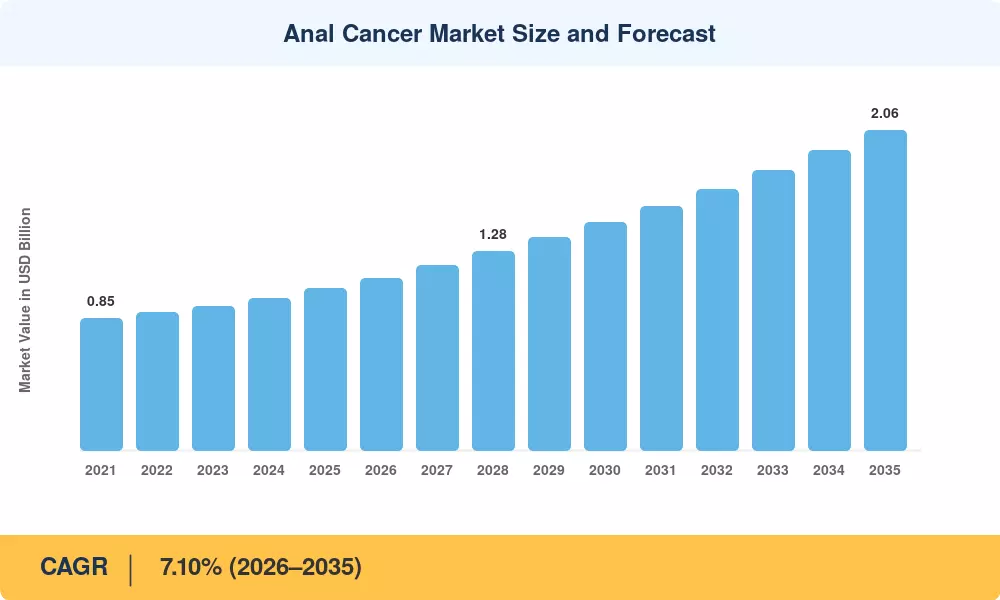
The Anal Cancer Market reached an estimated USD 1.04 Billion in 2025 and is projected to grow from USD 1.11 Billion in 2026 to USD 2.06 Billion by 2035, registering a CAGR of 7.10% across the forecast period. Two catalysts are accelerating this trajectory: the FDA's 2025 approval of retifanlimab-dlwr (Zynyz) as the first checkpoint inhibitor specifically indicated for advanced anal canal carcinoma, and ASTRO's inaugural radiation therapy guideline for anal cancer, which standardizes intensity-modulated radiation across community oncology practices [1][2]. These regulatory milestones have unlocked a wave of pipeline investment and payer acceptance that the Anal Cancer Market had not previously experienced.
Treatment paradigms are shifting away from conventional cytotoxic-only regimens toward integrated immuno-oncology protocols. Immunotherapy agents now enter first-line combination trials, and high-resolution anoscopy screening is expanding clinical detection windows — particularly in populations with elevated HPV prevalence. The National Cancer Institute committed over USD 48 million in anal cancer–specific grants during 2024, signaling sustained federal research interest [3]. The Anal Cancer Market stands to benefit as these investments translate into approved therapies.
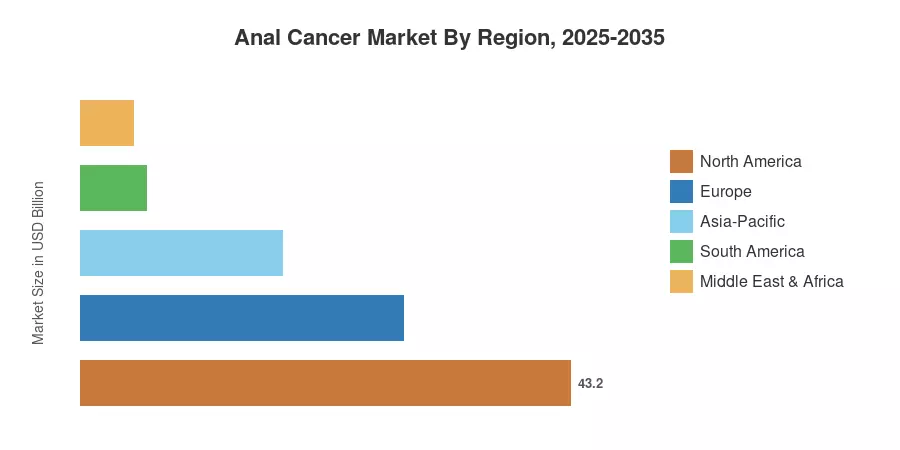
North America commands approximately 43.2% of the Anal Cancer Market, driven by broad commercial-payer reimbursement for checkpoint inhibitors and established screening infrastructure. Asia-Pacific is the fastest-growing region at an 8.01% CAGR, propelled by improving HPV vaccination coverage in Japan, China, and South Korea. Europe holds the second-largest share, anchored by national health system formulary adoptions across Germany, France, and the UK. As pipeline candidates advance through Phase III trials, the Anal Cancer Market is positioned for sustained double-digit expansion in emerging economies through 2035.
Key Report Takeaways
• By Cancer Type
- Squamous cell carcinoma captured 74.2% of revenue in the Anal Cancer Market during 2025, reflecting its dominance in clinical incidence.
- Carcinoma in situ is forecast to register a 7.72% CAGR through 2035, the fastest among cancer-type segments.
• By Disease Stage
- Stage III disease accounted for 47.3% of the Anal Cancer Market share in 2025, as late-stage diagnoses remain prevalent in underserved populations.
• By Treatment
- Radiation therapy is advancing at a 7.78% CAGR, driven by guideline-aligned intensity-modulated techniques.
• By Region
- North America led the Anal Cancer Market with a 43.2% share in 2025.
- Asia-Pacific is set to expand at an 8.01% CAGR through 2035, the highest among all regions.
Market Size and Forecast (2021–2035)
Market sizing integrates bottom-up revenue modeling across approved therapies, diagnostic procedures, and surgical interventions, triangulated against top-down epidemiological incidence data from WHO GLOBOCAN and NCI SEER databases. Historical values (2021–2024) reflect actual product-level sales, while the forecast (2026–2035) applies a calibrated compound growth rate anchored to pipeline maturation timelines and regulatory approval probabilities.