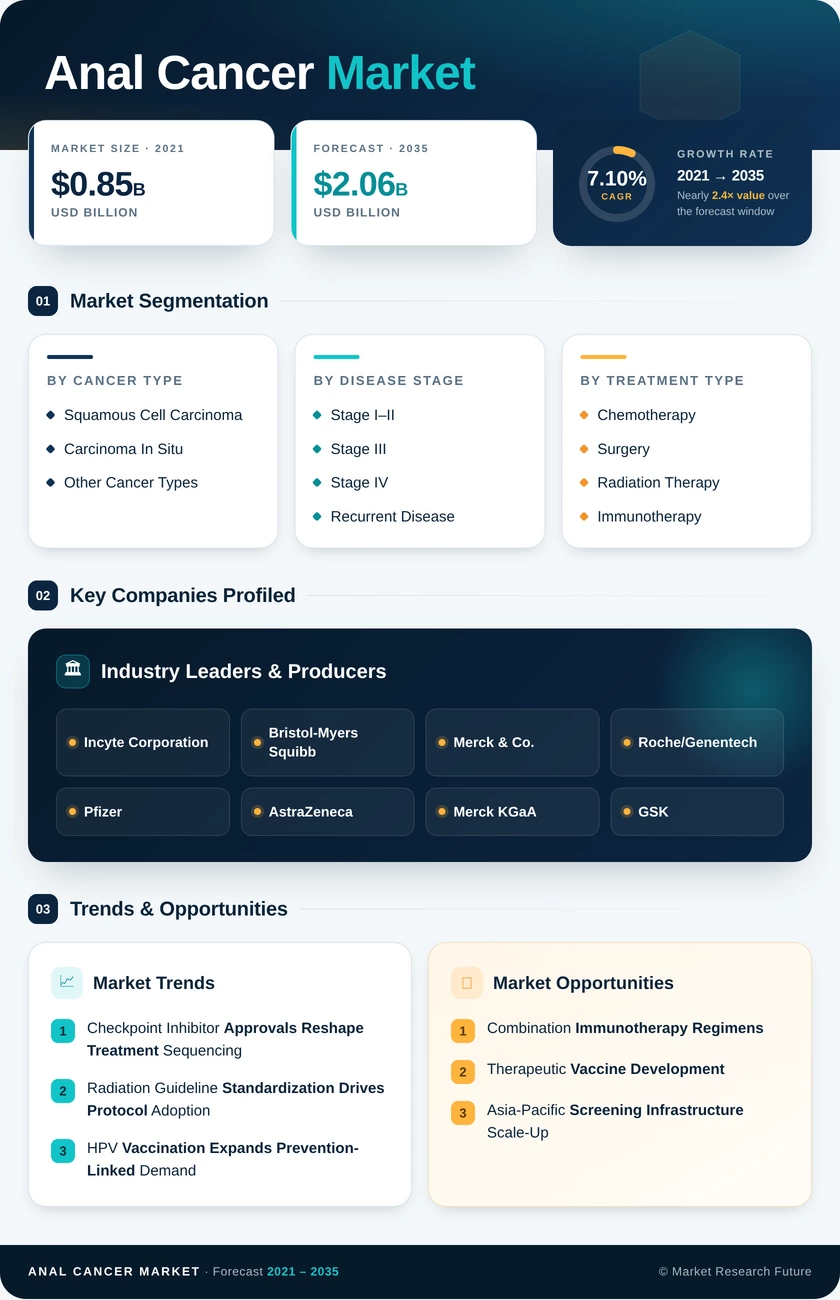
Anal Cancer Market (2026 - 2035)

ID: MRFR/MED/1001-HCR
130 Pages
Satyendra Maurya
Last Updated: July 22, 2026
Anal Cancer Market Research Report Information by Cancer Type (Carcinoma in Situ, Squamous Cell Carcinoma, Adenocarcinoma, Basal Cell Carcinoma, Melanoma and others), Treatment Type (Chemotherapy, Surgery, Radiation Therapy and Immunotherapy), End User (Hospitals & Clinics, Research & Academic Institutes and others) - Forecast till 2035
Anal Cancer Market
Market Size
Forecast Period2026-2035
CAGR (2026-2035)7.10%
2025 Market SizeUSD 1.04 Billion
2035 Market SizeUSD 2.06 Billion
Key Players
Incyte Corporation
Bristol-Myers Squibb
Merck & Co.
Roche/Genentech
Pfizer
AstraZeneca
Opportunities
  • Combination Immunotherapy Regimens
  • Therapeutic Vaccine Development
  • Asia-Pacific Screening Infrastructure Scale-Up
  1. 1 Market Overview |
    1. 1.1 Study Assumptions & Market Definition |
    2. 1.2 Scope of the Study |
    3. 1.3 Research Methodology
  2. 2 Market Summary & Key Takeaways
  3. 3 Market Dynamics |
    1. 3.1 Market Drivers Analysis | |
      1. 3.1.1 Checkpoint Inhibitor Approvals & Pipeline Expansion | |
      2. 3.1.2 ASTRO Radiation Guideline Harmonization | |
      3. 3.1.3 HPV Vaccination Coverage Expansion | |
      4. 3.1.4 High-Resolution Anoscopy Screening Adoption | |
      5. 3.1.5 Biomarker-Driven Patient Stratification | |
      6. 3.1.6 Real-World Evidence & Registry Data Integration | |
      7. 3.1.7 Payer Reimbursement Expansion for IO Therapies |
    2. 3.2 Market Restraints Analysis | |
      1. 3.2.1 Radiation Oncology Staffing Shortages | |
      2. 3.2.2 Low Screening Rates in Low-Income Countries | |
      3. 3.2.3 Social Stigma & Delayed Diagnosis | |
      4. 3.2.4 High Cost of Immuno-Oncology Regimens | |
      5. 3.2.5 Limited Phase III Data in Rare Subtypes |
    3. 3.3 Market Opportunity Analysis | |
      1. 3.3.1 Combination Immunotherapy Regimens | |
      2. 3.3.2 Therapeutic Vaccine Development | |
      3. 3.3.3 Asia-Pacific Screening Infrastructure Scale-Up | |
      4. 3.3.4 Real-World Data Monetization and Registry Platforms | |
      5. 3.3.5 Emerging-Market Biosimilar Entry |
    4. 3.4 Industry Value Chain Analysis |
    5. 3.5 Porter's Five Forces Analysis
  4. 4 Global Anal Cancer Market Size & Forecast (2021–2035) |
    1. 4.1 Historical Market Size (2021–2025) |
    2. 4.2 Current & Forecast Market Size (2026–2035) |
    3. 4.3 Market Size by Revenue (USD Billion) |
    4. 4.4 Year-over-Year Growth Analysis
  5. 5 Segmentation Analysis |
    1. 5.1 By Cancer Type | |
      1. 5.1.1 Squamous Cell Carcinoma | |
      2. 5.1.2 Carcinoma In Situ | |
      3. 5.1.3 Other Cancer Types |
    2. 5.2 By Disease Stage | |
      1. 5.2.1 Stage I–II | |
      2. 5.2.2 Stage III | |
      3. 5.2.3 Stage IV | |
      4. 5.2.4 Recurrent Disease |
    3. 5.3 By Treatment Type | |
      1. 5.3.1 Chemotherapy | |
      2. 5.3.2 Surgery | |
      3. 5.3.3 Radiation Therapy | |
      4. 5.3.4 Immunotherapy |
    4. 5.4 By End User | |
      1. 5.4.1 Hospitals and Clinics | |
      2. 5.4.2 Research and Academic Institutes | |
      3. 5.4.3 Other End Users
  6. 6 Regional Analysis |
    1. 6.1 North America | |
      1. 6.1.1 United States | |
      2. 6.1.2 Canada | |
      3. 6.1.3 Mexico |
    2. 6.2 Europe | |
      1. 6.2.1 Germany | |
      2. 6.2.2 United Kingdom | |
      3. 6.2.3 France | |
      4. 6.2.4 Italy | |
      5. 6.2.5 Spain | |
      6. 6.2.6 Nordic Countries | |
      7. 6.2.7 Russia | |
      8. 6.2.8 Rest of Europe |
    3. 6.3 Asia-Pacific | |
      1. 6.3.1 China | |
      2. 6.3.2 India | |
      3. 6.3.3 Japan | |
      4. 6.3.4 South Korea | |
      5. 6.3.5 ASEAN | |
      6. 6.3.6 Rest of Asia-Pacific |
    4. 6.4 South America | |
      1. 6.4.1 Brazil | |
      2. 6.4.2 Argentina | |
      3. 6.4.3 Rest of South America |
    5. 6.5 Middle East & Africa | |
      1. 6.5.1 Saudi Arabia | |
      2. 6.5.2 UAE | |
      3. 6.5.3 South Africa | |
      4. 6.5.4 Egypt | |
      5. 6.5.5 Rest of MEA
  7. 7 Competitive Landscape |
    1. 7.1 Market Share Analysis (2025) |
    2. 7.2 Competitive Benchmarking Matrix |
    3. 7.3 Company Profiles | |
      1. 7.3.1 Incyte Corporation | |
      2. 7.3.2 Bristol-Myers Squibb | |
      3. 7.3.3 Merck & Co. | |
      4. 7.3.4 Roche/Genentech | |
      5. 7.3.5 Pfizer | |
      6. 7.3.6 AstraZeneca | |
      7. 7.3.7 Merck KGaA | |
      8. 7.3.8 GSK | |
      9. 7.3.9 Regeneron/Sanofi | |
      10. 7.3.10 Inovio Pharmaceuticals
  8. 8 Future Outlook & Strategic Recommendations (2026–2035) |
    1. 8.1 Immuno-Oncology Sequencing and Adaptive Therapy |
    2. 8.2 AI-Driven Pathology and Diagnostic Precision |
    3. 8.3 Global HPV Elimination and Incidence Trajectory |
    4. 8.4 Health Technology Assessment and Value-Based Contracting
  9. 9 Recent Developments & News
  10. 10 Frequently Asked Questions (FAQs)
  11. 11 Report Scope & Methodology |
    1. 11.1 Study Period & Base Year |
    2. 11.2 Data Sources & Citations |
    3. 11.3 Abbreviations
  12. 1 LIST OF TABLES |
  13. TABLE 1 Global Anal Cancer Market Size & Forecast, by Revenue (USD Billion), 2021–2035 |
  14. TABLE 2 Global Anal Cancer Market – Year-over-Year Growth Analysis, 2021–2035 |
  15. TABLE 3 Driver Impact Analysis – Global Anal Cancer Market |
  16. TABLE 4 Restraint Impact Analysis – Global Anal Cancer Market |
  17. TABLE 5 Global Anal Cancer Market Size, by Cancer Type, 2021–2035 (USD Billion) |
  18. TABLE 6 Global Anal Cancer Market Size, by Disease Stage, 2021–2035 (USD Billion) |
  19. TABLE 7 Global Anal Cancer Market Size, by Treatment Type, 2021–2035 (USD Billion) |
  20. TABLE 8 Global Anal Cancer Market Size, by End User, 2021–2035 (USD Billion) |
  21. TABLE 9 Global Anal Cancer Market Size, by Region, 2021–2035 (USD Billion) |
  22. TABLE 10 North America Anal Cancer Market Size, by Country, 2021–2035 (USD Billion) |
  23. TABLE 11 Europe Anal Cancer Market Size, by Country, 2021–2035 (USD Billion) |
  24. TABLE 12 Asia-Pacific Anal Cancer Market Size, by Country, 2021–2035 (USD Billion) |
  25. TABLE 13 South America Anal Cancer Market Size, by Country, 2021–2035 (USD Billion) |
  26. TABLE 14 Middle East & Africa Anal Cancer Market Size, by Country, 2021–2035 (USD Billion) |
  27. TABLE 15 Competitive Benchmarking Matrix – Global Anal Cancer Market, 2025 |
  28. TABLE 16 Company Profiles – Key Players, Global Anal Cancer Market |
  29. TABLE 17 Recent Developments & Strategic Announcements, 2023–2025 |
  30. TABLE 18 Report Scope & Methodology Summary |
  31. TABLE 19 Detailed Sources and Citations
  32. 2 LIST OF FIGURES |
  33. FIGURE 1 Global Anal Cancer Market Dynamics – Drivers, Restraints, and Opportunities |
  34. FIGURE 2 Industry Value Chain Analysis – Global Anal Cancer Market |
  35. FIGURE 3 Porter's Five Forces Analysis – Global Anal Cancer Market |
  36. FIGURE 4 Global Anal Cancer Market Size Trend (USD Billion), 2021–2035 |
  37. FIGURE 5 Global Anal Cancer Market Share, by Cancer Type, 2025 (%) |
  38. FIGURE 6 Global Anal Cancer Market Share, by Disease Stage, 2025 (%) |
  39. FIGURE 7 Global Anal Cancer Market Share, by Treatment Type, 2025 (%) |
  40. FIGURE 8 Global Anal Cancer Market Share, by End User, 2025 (%) |
  41. FIGURE 9 Global Anal Cancer Market Share, by Region, 2025 (%) |
  42. FIGURE 10 North America Anal Cancer Market Share, by Country, 2025 (%) |
  43. FIGURE 11 Europe Anal Cancer Market Share, by Country, 2025 (%) |
  44. FIGURE 12 Asia-Pacific Anal Cancer Market Share, by Country, 2025 (%) |
  45. FIGURE 13 South America Anal Cancer Market Share, by Country, 2025 (%) |
  46. FIGURE 14 Middle East & Africa Anal Cancer Market Share, by Country, 2025 (%) |
  47. FIGURE 15 Competitive Landscape – Global Anal Cancer Market, 2025

Segmentation Quick Reference

DimensionSub-SegmentsDominant SegmentFastest Growing Segment
Cancer TypeSquamous Cell Carcinoma, Carcinoma In Situ, Other Cancer TypesSquamous Cell CarcinomaCarcinoma In Situ
Disease StageStage I–II, Stage III, Stage IV, Recurrent DiseaseStage IIIRecurrent Disease
Treatment TypeChemotherapy, Surgery, Radiation Therapy, ImmunotherapyChemotherapyImmunotherapy
End UserHospitals and Clinics, Research and Academic Institutes, Other End UsersHospitals and ClinicsResearch and Academic Institutes
GeographyNorth America, Europe, Asia-Pacific, South America, Middle East & AfricaNorth AmericaAsia-Pacific


Market Segmentation Overview

By Cancer Type

Sub-SegmentKey Trend
Squamous Cell CarcinomaIO approvals concentrate on squamous histology, reinforcing dominance
Carcinoma In SituHRA screening expansion drives earlier detection and intervention
Other Cancer TypesAdenocarcinoma and melanoma subtypes addressed through basket trials


Squamous cell carcinoma defines the therapeutic landscape, with every approved immunotherapy targeting this subtype. Carcinoma in situ is gaining commercial attention as screening identifies treatable precancerous lesions at scale.

By Disease Stage

Sub-SegmentKey Trend
Stage I–IICurative chemoradiation with high complete response rates
Stage IIIMultimodal treatment generates highest per-patient spend
Stage IVImmunotherapy extends overall survival in metastatic setting
Recurrent DiseaseSalvage IO regimens replace best-supportive-care paradigm


Late-stage and recurrent disease segments are driving growth as novel agents demonstrate survival benefit in populations previously limited to palliative options.

By Treatment Type

Sub-SegmentKey Trend
Chemotherapy5-FU/mitomycin backbone remains standard first-line care
SurgeryAbdominoperineal resection reserved for treatment-refractory cases
Radiation TherapyIMRT guideline standardization accelerates adoption
ImmunotherapyCheckpoint inhibitor approvals create new treatment class


The treatment mix is evolving as immunotherapy enters earlier lines of therapy and radiation techniques become more precise, but chemotherapy retains the largest absolute revenue share.

By End User

Sub-SegmentKey Trend
Hospitals and ClinicsIntegrated oncology departments deliver multimodal care
Research and Academic InstitutesNCI-designated centers lead clinical trial enrollment
Other End UsersSpecialty pharmacies and home infusion services emerge


Hospital-based care remains dominant given the complexity of concurrent chemoradiation delivery, while academic centers accelerate pipeline development through investigator-initiated studies.


 

Download PDF ×

We do not share your information with anyone. However, we may send you emails based on your report interest from time to time. You may contact us at any time to opt-out.