Download Free Sample
Kindly complete the form below to receive a free sample of this Report
Animal Anti-Rabies Vaccine Market Research Report By Type (Inactivated Virus Vaccine, Live Attenuated Vaccine, Recombinant Vaccine), By Animal Type (Dogs, Cats, Cattle, Wild Animals), By Administration Route (Subcutaneous, Intramuscular, Oral), By End Use (Veterinary Clinics, Animal Hospitals, Research Organizations) and By Regional (North America, Europe, South America, Asia Pacific, Middle East and Africa) - Growth & Industry Forecast 2025 To 2035
As per Market Research Future analysis, the Animal Anti-Rabies Vaccine Market Size was estimated at 0.9897 USD Billion in 2024. The Animal Anti-Rabies Vaccine industry is projected to grow from USD 1.05 Billion in 2025 to USD 1.887 Billion by 2035, exhibiting a compound annual growth rate (CAGR) of 6.04% during the forecast period 2025 - 2035
The Animal Anti-Rabies Vaccine Market is experiencing robust growth driven by rising awareness and technological advancements.
| 2024 Market Size | 0.9897 (USD Billion) |
| 2035 Market Size | 1.887 (USD Billion) |
| CAGR (2025 - 2035) | 6.04% |
The Animal Anti-Rabies Vaccine Market is currently experiencing notable growth, driven by increasing awareness regarding rabies prevention among pet owners and livestock caretakers. The rising incidence of rabies in various regions has prompted governments and health organizations to implement vaccination programs, thereby enhancing the demand for effective vaccines. Furthermore, advancements in vaccine technology and formulation are likely to improve efficacy and safety profiles, which may attract more stakeholders to invest in this sector. As a result, the market appears poised for expansion, with a focus on both domestic and wild animal populations. In addition, the Animal Anti-Rabies Vaccine Market is influenced by the growing trend of pet ownership and the rising expenditure on animal healthcare. Pet owners are increasingly prioritizing the health and well-being of their animals, leading to a surge in vaccination rates. Moreover, the collaboration between veterinary services and pharmaceutical companies is expected to foster innovation and accessibility in vaccine distribution. This collaborative approach may enhance public health initiatives aimed at controlling rabies transmission, ultimately contributing to a more robust market landscape.
There is a growing emphasis on educating pet owners and livestock handlers about the importance of rabies vaccination. This trend is likely to enhance public understanding of rabies transmission and prevention, potentially leading to increased vaccination rates.
Innovations in vaccine development are emerging, focusing on improving the safety and efficacy of anti-rabies vaccines. These advancements may include new formulations and delivery methods, which could attract more veterinary professionals to adopt these products.
The partnership between veterinary clinics and pharmaceutical companies is becoming more pronounced. This collaboration may facilitate better access to vaccines and promote comprehensive vaccination programs, thereby strengthening the overall market.
The growing trend of pet ownership is emerging as a significant driver for the Animal Anti-Rabies Vaccine Market. As more households adopt pets, particularly dogs and cats, the need for vaccination against rabies becomes increasingly critical. Pet owners are becoming more aware of their responsibilities regarding animal health and public safety, leading to higher vaccination rates. According to recent surveys, a substantial percentage of pet owners prioritize vaccinations as part of their pet care regimen. This trend is likely to continue, as the human-animal bond strengthens and pet owners seek to protect their animals from preventable diseases. Consequently, the Animal Anti-Rabies Vaccine Market is expected to benefit from this growing demand, as veterinary clinics and animal health organizations ramp up their vaccination efforts to meet the needs of pet owners.
The rising incidence of rabies cases in various regions appears to be a critical driver for the Animal Anti-Rabies Vaccine Market. Rabies remains a significant public health concern, particularly in areas where vaccination rates are low. According to health authorities, rabies causes thousands of deaths annually, primarily in developing regions. This alarming statistic underscores the necessity for effective vaccination programs. As awareness of rabies transmission through animal bites increases, the demand for anti-rabies vaccines is likely to surge. Furthermore, governments and health organizations are likely to implement more stringent vaccination policies, thereby propelling the market forward. The urgency to control rabies outbreaks may lead to increased funding for vaccination initiatives, further stimulating the Animal Anti-Rabies Vaccine Market.
Advancements in vaccine technology are significantly influencing the Animal Anti-Rabies Vaccine Market. Innovations such as recombinant vaccines and improved delivery systems are enhancing the efficacy and safety of rabies vaccines. These technological improvements not only increase the immunogenicity of the vaccines but also reduce the incidence of adverse reactions in animals. The introduction of oral rabies vaccines has also shown promise in wildlife populations, which are often reservoirs for the virus. As veterinary practices adopt these advanced vaccines, the market is likely to witness a shift towards more effective vaccination strategies. Furthermore, the development of combination vaccines that protect against multiple diseases may also contribute to the growth of the Animal Anti-Rabies Vaccine Market, as pet owners seek comprehensive health solutions for their animals.
The increased focus on zoonotic diseases is likely to drive the Animal Anti-Rabies Vaccine Market. Rabies, being a zoonotic disease, poses a significant threat not only to animal health but also to human health. The recognition of the interconnectedness between animal and human health has led to a more integrated approach to disease prevention. Public health campaigns aimed at controlling zoonotic diseases often emphasize the importance of vaccinating pets against rabies. This heightened awareness may lead to increased funding for vaccination programs and research into more effective vaccines. Additionally, the collaboration between veterinary and public health sectors is expected to strengthen, further promoting the importance of rabies vaccination. As a result, the Animal Anti-Rabies Vaccine Market is poised for growth as stakeholders recognize the critical role of vaccination in preventing zoonotic diseases.
Government initiatives and regulations play a pivotal role in shaping the Animal Anti-Rabies Vaccine Market. Many countries have established mandatory vaccination programs for pets, particularly dogs, which are the primary carriers of rabies. These regulations are often enforced through licensing requirements and public health campaigns aimed at educating pet owners about the importance of vaccination. The World Health Organization has also advocated for rabies elimination strategies, which include widespread vaccination. As a result, the market is likely to experience growth driven by compliance with these regulations. Additionally, government funding for vaccination programs can enhance accessibility and affordability, further boosting the Animal Anti-Rabies Vaccine Market. The collaboration between public health authorities and veterinary services is essential in ensuring that vaccination efforts are effective and widespread.
The Animal Anti-Rabies Vaccine Market is primarily segmented into three main types: Inactivated Virus Vaccines, Live Attenuated Vaccines, and Recombinant Vaccines. Inactivated Virus Vaccines hold the largest market share due to their established efficacy and long-standing usage in both domestic and wild animals. This segment has gained traction as traditional and reliable solutions for preventing rabies, reflecting the preferences of veterinary practices and pet owners alike. On the other hand, Live Attenuated Vaccines are recognized as the fastest-growing segment owing to their superior immunogenic response and lower dosage requirements, reducing the cost of vaccination programs. The increasing awareness of rabies prevention and vaccination campaigns in developing regions have significantly contributed to the rising demand for this category, alongside ongoing innovation and improvement in vaccine formulations.
Inactivated Virus Vaccine (Dominant) vs. Live Attenuated Vaccine (Emerging)
The Inactivated Virus Vaccine segment is characterized by its reliability and effectiveness, solidifying its position as the dominant player in the Animal Anti-Rabies Vaccine Market. These vaccines have been around for decades and are backed by extensive research and regulatory approval, making them a trustworthy option for veterinarians. However, the Live Attenuated Vaccine is emerging rapidly, valued for its ability to elicit a strong immune response from a single dose, thus proving to be cost-effective over time. This innovation not only appeals to veterinary professionals but also paves the way for widespread vaccination efforts in high-risk areas. As global initiatives to curb rabies intensify, both vaccine types demonstrate unique advantages that cater to varying needs within the market.
In the Animal Anti-Rabies Vaccine Market, the distribution of market share among different animal types reveals that dogs hold the largest segment, predominantly driven by their significant population and the increasing awareness regarding rabies prevention among dog owners. Cats follow as a considerable segment, with a notable share, reflecting the growing pet ownership culture and vaccination drives among cat owners seeking to protect their pets from rabies.
Dogs (Dominant) vs. Cats (Emerging)
Dogs remain the dominant segment in the Animal Anti-Rabies Vaccine Market due to their extensive population and the proactive approach of pet owners towards vaccination. The rising trend in pet ownership and advocacy for pet health fuels the demand for vaccines in this category. In contrast, cats are emerging as a rapidly growing segment, propelled by increasing awareness and campaigns promoting cat vaccination. Their growing popularity among pet enthusiasts and a higher inclination towards preventive healthcare are key factors contributing to this upward trend, positioning cats as a significant focus area for vaccine manufacturers.
In the Animal Anti-Rabies Vaccine Market, subcutaneous administration holds the largest market share among the administration routes. This method is preferred due to its ease of use and the ability to minimize stress for the animals. Meanwhile, intramuscular administration is gaining traction and is recognized as the fastest-growing segment. This shift can be attributed to its ability to elicit a faster immune response compared to subcutaneous administration, making it a preferred choice for some veterinarians.
Administration Route: Subcutaneous (Dominant) vs. Intramuscular (Emerging)
Subcutaneous administration remains the dominant route in the Animal Anti-Rabies Vaccine Market, largely due to its practicality and the low stress it imposes on animals. This method allows vaccines to be administered just beneath the skin, which facilitates absorption and minimizes discomfort. Intramuscular administration is emerging and is characterized by its rapid vaccination delivery and effectiveness, appealing to veterinarians seeking immediate responses in vaccination protocols. Oral administration, while less common due to vaccine formulation challenges, is also being explored as an alternative for ease of administration, especially in young or difficult-to-handle animals.
In the Animal Anti-Rabies Vaccine Market, the distribution of market share among end-use segments reveals Veterinary Clinics as the dominant player. They account for a significant portion of the demand due to their accessible services and the prevalence of rabies in various animal populations. Animal Hospitals, while still a substantial player, are emerging as a rapidly growing segment, driven by the increasing awareness of rabies prevention and the overall health of pets and livestock. The growth trends within this segment highlight a robust movement towards the establishment of more Animal Hospitals, presenting an effective response to the rising cases of rabies. Research Organizations are also contributing to growth by focusing on innovations in vaccine formulations and effective deployment strategies. As consumers and governments prioritize animal health, the demand for reliable vaccination options is anticipated to rise, particularly in areas with higher incidences of rabies.
Veterinary Clinics (Dominant) vs. Research Organizations (Emerging)
Veterinary Clinics play a crucial role in administering anti-rabies vaccines, leveraging their established trust and accessibility for pet owners and farmers. These clinics typically offer a range of veterinary services, and their familiarity with local conditions makes them pivotal in rabies prevention efforts. On the other hand, Research Organizations are becoming increasingly significant, focusing on developing new vaccine technologies and improving delivery methods. They are seen as essential in the fight against rabies not only for their innovative approaches but also for conducting critical research that informs vaccine strategies. The symbiotic relationship between clinical practice and research is expected to enhance overall vaccine efficacy and deployment, positioning both segments as vital in the market.
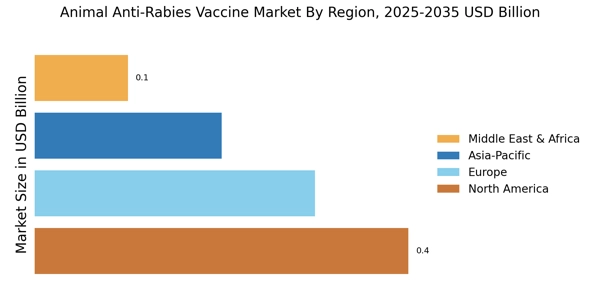
The Animal Anti-Rabies Vaccine Market is showing growth across several regions, with a total market valuation of 0.89 USD Billion in 2023 and a projected increase by 2032. North America is a significant player, generating 0.3 USD Billion in 2023, with expectations to reach 0.5 USD Billion, demonstrating a majority holding in the market. Europe follows closely behind, valued at 0.25 USD Billion in 2023 and anticipated to grow to 0.4 USD Billion, indicating a strong demand for vaccination programs. The Asia-Pacific (APAC) region, with a value of 0.18 USD Billion, is also witnessing an upward trend, aiming for 0.3 USD Billion by 2032, driven by increased awareness and vaccination initiatives.South America and the Middle East Africa (MEA) are smaller segments; South America stood at 0.1 USD Billion in 2023, moving to 0.15 USD Billion, while MEA had a value of 0.06 USD Billion, expected to rise to 0.1 USD Billion. The variations in these market valuations reflect the differing levels of investment in public health initiatives and animal health infrastructure across these regions. Overall, the Animal Anti-Rabies Vaccine Market data reveals varied growth opportunities influenced by regional health policies and public health campaigns aimed at rabies prevention.
The Animal Anti-Rabies Vaccine Market is characterized by its strategic competition among various stakeholders, driven by increasing awareness of rabies prevention and control among pet owners and veterinarians. As countries ramp up their efforts to diminish the incidence of rabies, the demand for effective vaccination solutions is experiencing significant growth. The market landscape comprises pharmaceutical companies, research institutions, and regulatory bodies, all contributing to the evolving dynamics of vaccine development and distribution. Companies are engaged in constant research and development to introduce innovative formulations that ensure higher efficacy and provide extended protection against rabies in animals. Market players are also focusing on expanding their distribution channels and establishing partnerships to enhance their geographical reach, thereby facilitating greater accessibility to animal anti-rabies vaccines across various regions.Virbac stands out in the Animal Anti-Rabies Vaccine Market due to its strong commitment to veterinary health and expertise in vaccine development. The company's established reputation as a dedicated player in animal health gives it a competitive edge, allowing Virbac to leverage its extensive experience in manufacturing high-quality vaccines that comply with global standards. With a diverse product portfolio targeting various animal species, Virbac's capabilities in research and development drive continuous improvement in vaccine formulations. The company’s focus on education and assisting veterinarians in implementing vaccination protocols further reinforces its market presence. In addition, Virbac’s global footprint and robust distribution networks enable it to efficiently meet the increasing demands for anti-rabies vaccines, particularly in regions where rabies remains a public health concern.Vetoquinol has carved out a notable position within the Animal Anti-Rabies Vaccine Market through its unwavering commitment to animal healthcare and a strong emphasis on research-driven solutions. The company differentiates itself with a comprehensive approach to product development, focusing not only on the efficacy of its vaccines but also on their safety for both animals and humans. Vetoquinol’s strategic emphasis on innovation has led to enhanced formulations that cater to diverse market needs. Additionally, Vetoquinol’s proactive engagement with veterinarians plays a critical role in promoting vaccination practices and awareness surrounding rabies prevention. The company's expanding market presence is bolstered by a network of subsidiaries and partnerships that facilitate effective distribution and localized support, ensuring that veterinarians and pet owners have access to necessary vaccination resources. Overall, Vetoquinol's strengths in research, development, and distribution underscore its significant role within the competitive landscape of the anti-rabies vaccine market.


The Animal Anti-Rabies Vaccine Market is experiencing significant developments, with major companies actively expanding their operations and portfolios. Virbac and Vetoquinol have notably enhanced their product lines with advanced vaccines that address evolving rabies strains in various geographical regions. Indian Immunologicals is also gaining traction, emphasizing its commitment to increasing vaccine availability in developing economies. Zoetis and Merck Animal Health continue to focus on strategic collaborations to enhance research and development initiatives in the rabies vaccine domain. Meanwhile, Ferro Pharma and Haffkiene Biopharmaceutical have reported growth in regional markets, bolstering their production capacities to meet rising demand. Recent merger and acquisition activities have emerged, with certain companies evaluating partnerships to expand market reach and distribution channels, reflecting a competitive landscape. For instance, Zydus Cadila's recent technological advancements in vaccine production indicate a strategic shift towards enhancing quality and efficacy. The market is witnessing an overall growth trend, with increased investments in research contributing to improved vaccine developments, thus positively impacting animal health standards across various regions. This dynamism underscores a strong demand for effective rabies prevention measures in veterinary medicine.
The Animal Anti-Rabies Vaccine Market is projected to grow at a 6.04% CAGR from 2025 to 2035, driven by increasing pet ownership, rising awareness, and government initiatives.
New opportunities lie in:
By 2035, the market is expected to be robust, reflecting sustained growth and innovation.
| MARKET SIZE 2024 | 0.9897(USD Billion) |
| MARKET SIZE 2025 | 1.05(USD Billion) |
| MARKET SIZE 2035 | 1.887(USD Billion) |
| COMPOUND ANNUAL GROWTH RATE (CAGR) | 6.04% (2025 - 2035) |
| REPORT COVERAGE | Revenue Forecast, Competitive Landscape, Growth Factors, and Trends |
| BASE YEAR | 2024 |
| Market Forecast Period | 2025 - 2035 |
| Historical Data | 2019 - 2024 |
| Market Forecast Units | USD Billion |
| Key Companies Profiled | Boehringer Ingelheim (DE), Merck Animal Health (US), Zoetis (US), Elanco Animal Health (US), Virbac (FR), Heska Corporation (US), Vetoquinol (FR), Ceva Santé Animale (FR) |
| Segments Covered | Type, Animal Type, Administration Route, End Use, Regional |
| Key Market Opportunities | Emerging technologies in vaccine delivery systems enhance efficacy in the Animal Anti-Rabies Vaccine Market. |
| Key Market Dynamics | Rising demand for animal anti-rabies vaccines drives innovation and regulatory scrutiny in veterinary healthcare. |
| Countries Covered | North America, Europe, APAC, South America, MEA |
The projected market valuation for the Animal Anti-Rabies Vaccine Market by 2035 is 1.887 USD Billion.
The overall market valuation of the Animal Anti-Rabies Vaccine Market in 2024 was 0.9897 USD Billion.
The expected CAGR for the Animal Anti-Rabies Vaccine Market during the forecast period 2025 - 2035 is 6.04%.
Key players in the Animal Anti-Rabies Vaccine Market include Boehringer Ingelheim, Merck Animal Health, Zoetis, Elanco Animal Health, and Virbac.
In 2024, the Inactivated Virus Vaccine segment had the highest valuation at 0.3948 USD Billion.
In 2024, the market valuation for dogs was 0.5 USD Billion, whereas for cats it was 0.2 USD Billion.
The projected valuation for the Live Attenuated Vaccine segment by 2035 is 0.5545 USD Billion.
The Oral administration route is expected to show significant growth, with a projected valuation of 0.5891 USD Billion by 2035.
The veterinary clinics segment is projected to reach a valuation of 0.7435 USD Billion by 2035.
In 2024, the market for wild animals was valued at 0.1397 USD Billion, while the market for cattle was valued at 0.15 USD Billion.


Kindly complete the form below to receive a free sample of this Report

“This is really good guys. Excellent work on a tight deadline. I will continue to use you going forward and recommend you to others. Nice job”


“Thanks. It’s been a pleasure working with you, please use me as reference with any other Intel employees.”


“Thanks for sending the report it gives us a good global view of the Betaïne market.”


“Thank you, this will be very helpful for OQS.”


“We found the report very insightful! we found your research firm very helpful. I'm sending this email to secure our future business.”


“I am very pleased with how market segments have been defined in a relevant way for my purposes (such as "Portable Freezers & refrigerators" and "last-mile"). In general the report is well structured. Thanks very much for your efforts.”


“I have been reading the first document or the study, ,the Global HVAC and FP market report 2021 till 2026. Must say, good info! I have not gone in depth at all parts, but got a good indication of the data inside!”


“We got the report in time, we really thank you for your support in this process. I also thank to all of your team as they did a great job.”


“The Automotive 48V ECU Components Procurement Intelligence Study” was a complex project, but the Market Research Future (MRFR) team handled it with quality, agility, and customer-centricity. They delivered all requested data on time and within the agreed scope. The team, including Shubhendra Anand and Rahul Gotadki, was always readily available to clarify questions and swiftly implement necessary adjustments, driving the project to a successful conclusion within a very demanding timeframe.
I would also like to specifically commend Akshay Agarwal for his responsiveness and support at every stage—from our initial inquiry on May 6th through to final delivery on June 18th. His dedication made the entire process seamless.”



