Anxiety Disorders and Depression Treatment Market (2026 - 2035)

Anxiety Disorders And Depression Treatment Market Research Report By Treatment Type (Pharmacological Treatment, Psychotherapy, Combined Treatment), By Type of Anxiety Disorder (Generalized Anxiety Disorder, Social Anxiety Disorder, Panic Disorder, Phobias, Obsessive-Compulsive Disorder), By Type of Depression (Major Depressive Disorder, Persistent Depressive Disorder, Bipolar Disorder, Seasonal Affective Disorder), By Patient Age Group (Adults, Adolescents, Children), By Severity of Condition (Mild, Moderate, Severe) and By Regional (North America, Europe, South America, Asia Pacific, Middle East and Africa) - Growth & Industry Forecast 2025 To 2035

Forecast Period
2026-2035
CAGR
5.42%
2025 Market Size
USD 24.24 Billion
2035 Market Size
USD 40.99 Billion
Healthcare ● Updated August 25, 2026 Report ID: MRFR/HC/20824-HCR | Pages: 100 | Author: Satyendra Maurya, Rahul Gotadki

Anxiety Disorders and Depression Treatment Market Summary

The Anxiety Disorders and Depression Treatment Market reached USD 24.24 billion in 2025 and opens the forecast window at USD 25.47 billion in 2026, climbing to USD 40.99 billion by 2035 at a 5.42% CAGR. Two catalysts anchor that trajectory. The first is the September 2024 U.S. final rule on mental health parity, which forces commercial plans to demonstrate comparable network access and prior-authorization treatment for behavioural care [5]. The second is the FDA's Additional Condition for Nonprescription Use framework, which for the first time creates a credible regulatory path for selected serotonergic agents to move beyond the prescription pad [2].

Therapeutic substitution is reshaping the revenue base. Monoamine chemistry that has carried the category since the late 1980s is ceding ground to rapid-acting mechanisms — esketamine, neuroactive steroids such as zuranolone, and glutamatergic candidates in late-stage development — alongside FDA-cleared prescription digital therapeutics like Rejoyn [7][9]. Global venture and corporate funding into neuropsychiatry exceeded USD 4.1 billion across 2023–2025, a decisive reversal after a decade of large-pharma retreat [12].

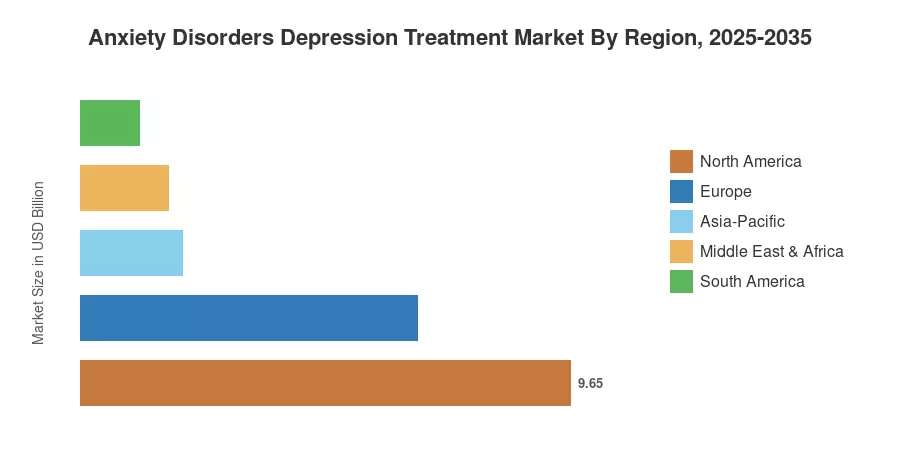
Geographically, North America holds 39.8% of the Anxiety Disorders and Depression Treatment Market on a 2025 basis, while Asia-Pacific compounds fastest at 8.30% through 2035. Europe sits second, supported by NICE and G-BA reimbursement decisions that increasingly recognise digital and blended-care modalities [8]. The next decade rewards companies that pair molecule with measurement.


Key Report Takeaways

• By Drug Class

  • Selective Serotonin Reuptake Inhibitors (SSRIs) held 43.9% of the Anxiety Disorders and Depression Treatment Market in 2025
  • Atypical antipsychotics are forecast to expand at a 7.21% CAGR through 2035
  • Serotonin–norepinephrine reuptake inhibitors (SNRIs) generated roughly USD 4.51 billion in 2025

• By Indication

  • Major depressive disorder accounted for 40.9% of the Anxiety Disorders and Depression Treatment Market in 2025
  • PTSD-directed treatment posts the steepest indication CAGR at 7.37%


• By Therapy

  • Digital therapeutics advance at 6.57% CAGR, the fastest of any therapy modality

• By Region

  • North America commanded 39.8% revenue share in 2025
  • Asia-Pacific grows at 8.30% CAGR, the fastest regional rate to 2035
  • Europe contributed USD 6.64 billion in 2025


Market Size and Forecast (2021–2035)

Estimates blend prescription-volume audits, payer claims aggregates, WHO and OECD burden-of-disease datasets, and reported segment revenue from twenty publicly listed manufacturers, triangulated against clinic and pharmacy channel checks across fourteen countries. Historical years are actuals; forecast years apply the calibrated Anxiety Disorders and Depression Treatment Market growth rate to a 2025 base.
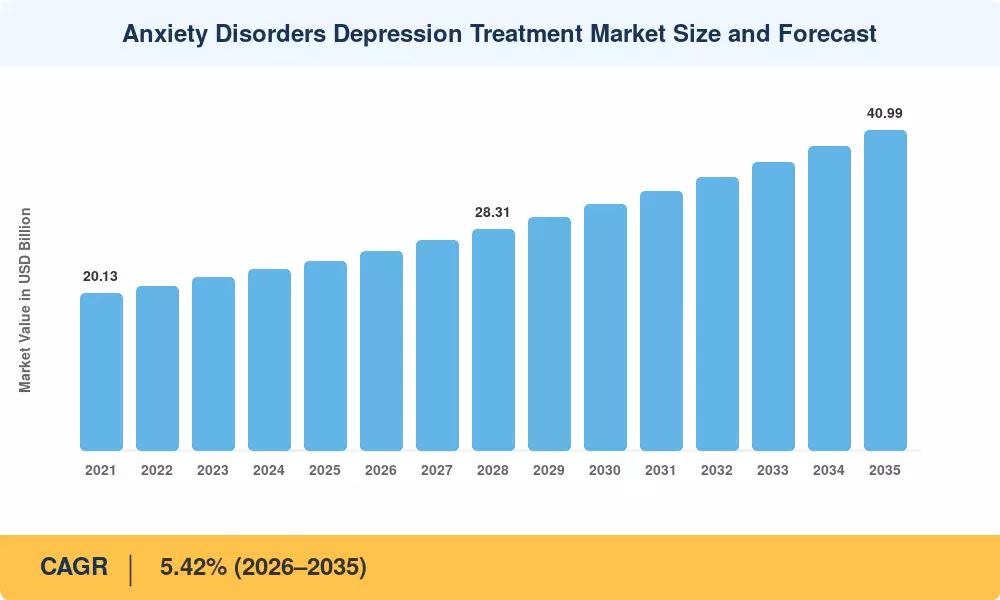
Anxiety Disorders Depression Treatment Market Size and Forecast
Our Impact
Enabled $4.3B Revenue Impact for Fortune 500 and Leading Multinationals
Partnering with 2000+ Global Organizations Each Year
30K+ Citations by Top-Tier Firms in the Industry

Driver Impact Analysis

Driver ~% Impact on CAGR Geographic Relevance Impact Timeline
Rising diagnosed prevalence and destigmatisation +1.10 Global Medium-term (2–4 yr)
Parity enforcement and reimbursement expansion +0.85 North America, Europe Short-term (≤2 yr)
Rapid-acting antidepressant commercialisation +0.72 NA, Europe, Japan Medium-term (2–4 yr)
Asia-Pacific primary-care screening scale-up +0.61 Asia-Pacific Long-term (≥4 yr)
Nonprescription pathway for select serotonergics +0.55 United States Long-term (≥4 yr)
Prescription digital therapeutic coverage +0.48 NA, Germany Medium-term (2–4 yr)
Geriatric and adolescent cohort expansion +0.39 Global Long-term (≥4 yr)


Prevalence and Destigmatisation

Over 570 million individuals worldwide suffer from depression and anxiety disorders, and according to WHO modeling, the two diseases together cause almost USD 1 trillion in lost productivity each year [1]. The majority of incremental volume is driven by diagnosis rates rather than underlying incidence. Following the 2023 USPSTF Grade B recommendation for anxiety screening in adults under 65, U.S. adult depression screening in primary care increased significantly, turning silent burden into billable visits [3].


Parity Enforcement and Reimbursement

In September 2024, regulators finalized comparative-analysis standards that require group health plans to demonstrate non-quantitative treatment limitation parity. The rules will be phased in between 2025 and 2026 [5]. Plans that previously kept behavioral networks at about 40% of the density of medical networks now have to deal with established remediation timetables, increasing the number of covered treatment episodes, and increasing the realized net price per script.


Rapid-Acting Mechanisms

Approval of esketamine as a standalone treatment for treatment-resistant depression in January 2025 removed the oral-antidepressant co-administration requirement, materially widening the addressable pool [7]. Neuroactive steroid and glutamatergic entrants command premium pricing several multiples above generic SSRI therapy, so even modest volume conversion lifts category value disproportionately.

Digital and Blended Care

FDA clearance of the first prescription digital therapeutic for adjunctive major depressive disorder in April 2024 established a reimbursable software category inside psychiatry [9]. Germany's DiGA directory has since listed multiple depression applications with statutory-fund coverage, creating a replicable payer template that supports 6.57% modality growth.


Restraints Impact Analysis

Restraint ~% Impact on CAGR Geographic Relevance Impact Timeline
Generic erosion and price deflation −0.95 Global Short-term (≤2 yr)
Efficacy plateau of monoamine chemistry −0.62 Global Medium-term (2–4 yr)
Prescriber and psychiatrist shortages −0.48 APAC, MEA, South America Long-term (≥4 yr)
REMS and clinic infrastructure burden −0.41 North America, Europe Medium-term (2–4 yr)
Regulatory setbacks in psychedelic-assisted therapy −0.35 United States Short-term (≤2 yr)


Generic Price Deflation

The average net cost per 30-day supply of antidepressants has dropped below USD 5 for high-volume compounds, and more than 85% of antidepressant prescriptions written in the US are generic [10]. As a result, manufacturers are increasingly defending margin through long-acting formulations, fixed-dose combos, and branded adjuncts rather than core medicines because volume increase does not convert well into value growth across established channels.


Efficacy Plateau

Approximately one-third of patients do not attain remission after several sufficient trials, according to sequenced-treatment evidence [13]. This therapeutic ceiling increases payer skepticism about incremental line expansions, decreases persistence rates, and transfers bargaining power in favor of outcomes-linked contracts.


Access Infrastructure

Workforce density remains the binding constraint outside high-income markets: several Asia-Pacific and African systems report fewer than one psychiatrist per 100,000 population [4]. Esketamine and comparable supervised therapies additionally require certified administration sites and observation periods, limiting the practical footprint of the highest-value products.


Anxiety Disorders and Depression Treatment Market Opportunities

Nonprescription Conversion in the United States

The FDA's additional-condition framework allows sponsors to pair an established molecule with an app-based self-selection tool, opening a consumer channel that never previously existed in psychiatry [2]. First movers that clear the actual-use study bar could unlock a retail tier worth low single-digit billions by the early 2030s.

Asia-Pacific Primary-Care Integration

India's national mental health programme and China's expanded county-hospital psychiatry network are pushing screening into general practice rather than specialist referral [4]. Because Asia-Pacific compounds at 8.30%, even modest formulary additions produce outsized absolute gains.

Outcomes Data as a Revenue Line

Remote symptom capture through validated instruments generates longitudinal response datasets that payers will pay to access. Manufacturers running measurement-based care platforms can monetise de-identified real-world evidence, license adherence analytics to plans, and underwrite risk-share contracts — a business model closer to services than to pills.

Adolescent and Perinatal Niches

Perinatal depression alone affects roughly one in eight U.S. mothers, and the 2023 oral neuroactive steroid approval demonstrated that a tightly defined population can support premium pricing [7]. Adolescent-labelled formulations remain conspicuously thin relative to disease burden [6].

Emerging-Market Local Manufacturing

Brazil, Saudi Arabia, and Egypt are each tying public tender eligibility to domestic fill-finish capacity, rewarding partners willing to localise [15]. Licensing plus technology transfer is now the cheapest route into these tenders.


Anxiety Disorders and Depression Treatment Market Future Outlook

Precision Psychiatry

Pharmacogenomic panels and digital phenotyping will move response prediction from trial-and-error toward stratification. Payer pilots already report reduced switching costs when CYP2D6 and CYP2C19 genotyping precedes first prescription, and adoption should broaden as panel costs fall below USD 100 [14].

Measurement-Based Contracting

Contracts tied to PHQ-9 and GAD-7 response thresholds are moving from pilot to procurement. Manufacturers with instrumented care platforms will capture premium pricing that unmeasured competitors cannot defend, restructuring how the Anxiety Disorders and Depression Treatment Market prices innovation.

The Neuroplastogen Question

Non-hallucinogenic plasticity-promoting compounds are entering mid-stage trials, promising rapid onset without supervised dosing infrastructure. Success would collapse the administrative cost that currently limits rapid-acting therapy, though the first pivotal readouts are unlikely before 2029 [12].

Workforce Automation

Triage and documentation automation is the pragmatic near-term application of AI in psychiatry, not diagnosis. OECD analysis links administrative burden to roughly a fifth of clinician time; recovering even half of it materially expands treatment capacity in supply-constrained systems [16].


Anxiety Disorders and Depression Treatment Market Segmentation

Segment structure across the Anxiety Disorders and Depression Treatment Market reflects a mature pharmacological core with rapidly compounding adjacencies.

By Drug Class

Segment Metric (2025) Primary Demand Driver
Selective Serotonin Reuptake Inhibitors (SSRIs) 43.9% share First-line guideline status
Serotonin–Norepinephrine Reuptake Inhibitors (SNRIs) USD 4.51 Billion Comorbid pain and anxiety indications
Benzodiazepines 12.4% share Acute anxiolysis, short-course use
Atypical Antipsychotics 7.21% CAGR Adjunctive treatment-resistant depression
Tricyclic Antidepressants (TCAs) USD 1.50 Billion Low-cost second-line therapy
Monoamine Oxidase Inhibitors (MAOIs) 3.1% share Atypical depression niche
Others (NMDA antagonists, neuroactive steroids) 8.90% CAGR Rapid-onset premium segment

SSRIs remain the volume backbone of the Anxiety Disorders and Depression Treatment Market, yet their revenue contribution erodes annually as patent-free molecules deflate. Atypical antipsychotics tell the opposite story: adjunctive labelling in treatment-resistant depression, supported by branded agents still under exclusivity, converts modest script growth into strong value growth at 7.21% CAGR.

By Indication

Segment Metric (2025) Primary Demand Driver
Major Depressive Disorder 40.9% share Largest diagnosed population
Generalized Anxiety Disorder USD 5.16 Billion Primary-care screening uptake
Panic Disorder 9.8% share Emergency presentation pathways
Post-Traumatic Stress Disorder 7.37% CAGR Veteran and trauma-care funding
Obsessive-Compulsive Disorder USD 1.79 Billion High-dose SSRI protocols
Social Anxiety Disorder 6.5% share Adolescent diagnosis growth
Other Indications 5.80% CAGR Perinatal and seasonal subtypes

Major depressive disorder underwrites the Anxiety Disorders and Depression Treatment Market's scale, but PTSD is the segment worth watching. Dedicated federal research funding and repeated late-stage attempts at a first approved PTSD-specific therapy — including the 2024 setback for MDMA-assisted treatment — keep pipeline intensity high relative to a comparatively small current base [11].

By Therapy Type

Segment Metric (2025) Primary Demand Driver
Pharmacotherapy 64.1% share Accessibility and cost per episode
Psychotherapy USD 5.99 Billion Guideline first-line positioning
Digital Therapeutics 6.57% CAGR Reimbursed software prescriptions
Neuromodulation & Others USD 1.07 Billion Refractory case referral

Pharmacotherapy retains majority share of the Anxiety Disorders and Depression Treatment Market because it scales without clinician hours. Digital therapeutics grow fastest from a small base, and their strategic value lies less in standalone revenue than in the adherence and outcomes data they generate around drug regimens.

By End User

Segment Metric (2025) Primary Demand Driver
Hospitals & Clinics 55.5% share Diagnosis initiation and supervised dosing
Specialty Mental Health Centres USD 5.14 Billion Treatment-resistant referral volume
Homecare Settings 7.42% CAGR Telepsychiatry and self-administered regimens
Others 8.6% share Academic and correctional settings


Regional Market Share Analysis

Region Metric (2025) Primary Investment Themes
North America 39.8% share Parity enforcement, rapid-acting launches, digital reimbursement
Europe USD 6.64 Billion HTA-driven pricing, DiGA coverage, blended care
Asia-Pacific 8.30% CAGR Primary-care screening, local generics, teleconsultation
South America USD 1.16 Billion Public tenders, generic scale, urban clinic build-out
Middle East & Africa 7.15% CAGR National mental health strategies, localisation mandates
Total USD 24.24 Billion

Regional performance in the Anxiety Disorders and Depression Treatment Market tracks payer sophistication more closely than disease prevalence, which is why high-burden regions are not automatically high-value ones.


North America

Country Metric (2025) Key Driver
US 86.4% of region Parity final rule enforcement [5]
Canada USD 0.78 Billion Provincial psychotherapy coverage expansion
Mexico 6.10% CAGR IMSS formulary broadening

North America anchors the Anxiety Disorders and Depression Treatment Market on payer economics rather than volume. Medicare Part D redesign capped beneficiary out-of-pocket costs at USD 2,000 from 2025, improving persistence on branded adjuncts, while certified esketamine treatment centres surpassed 4,000 U.S. sites [7]. Canada's provincial funding of structured psychotherapy has quietly shifted spend toward blended-care bundles.

Europe

Country Metric (2025) Key Driver
Germany 21.8% of region DiGA statutory reimbursement [9]
UK USD 1.14 Billion NHS Talking Therapies expansion [8]
France 14.6% of region MonSoutienPsy session funding
Italy 5.85% CAGR Regional psychiatry investment
Spain 8.9% of region National mental health action plan
Nordic Countries USD 0.49 Billion Digital-first care pathways
Russia 6.2% of region Domestic generic substitution
Rest of Europe 5.40% CAGR EU4Health co-funding

Europe converts clinical guidelines into purchasing rules faster than any other region. NICE positions structured psychological intervention as first-line for less severe depression, which caps early pharmacological volume yet concentrates drug spend on moderate-to-severe cohorts where willingness to pay is higher [8]. Germany's statutory listing of depression applications remains the most bankable digital precedent globally.

Asia-Pacific

Country Metric (2025) Key Driver
China 30.4% of region County-hospital psychiatry expansion
India 9.20% CAGR Tele-MANAS national helpline scale-up [4]
Japan USD 1.29 Billion Ageing cohort and safer formulations
South Korea 10.2% of region Post-2024 suicide prevention funding
ASEAN 8.80% CAGR Urban private clinic growth
Rest of Asia-Pacific USD 0.56 Billion Insurance penetration gains

Asia-Pacific is where the Anxiety Disorders and Depression Treatment Market changes are taking shape. India's national tele-mental-health service logged more than two million calls within its first two years, generating a referral funnel that outpaces specialist supply [4]. Japan's demand skews toward tolerability in elderly patients, favouring agents with cleaner cardiac and anticholinergic profiles.

South America

Country Metric (2025) Key Driver
Brazil 54.2% of region SUS tender volumes [15]
Argentina USD 0.22 Billion Private insurance mental health mandates
Rest of South America 7.40% CAGR Urban clinic and pharmacy density

Brazil dominates through sheer public procurement scale, with ANVISA-registered generics supplying the majority of dispensed volume. Currency volatility keeps branded penetration low, so growth accrues mainly to local manufacturers and licensing partners willing to price in reais [15].

Middle East & Africa

Country Metric (2025) Key Driver
Saudi Arabia 26.4% of region Vision 2030 health sector transformation
UAE USD 0.19 Billion Mandatory insurance mental health cover
South Africa 21.3% of region Public sector treatment gap closure
Egypt 8.10% CAGR National mental health programme funding
Rest of MEA USD 0.18 Billion Donor-funded service expansion

Gulf states are buying capability rather than volume, funding specialist hospitals and importing care models wholesale. Sub-Saharan systems face a treatment gap exceeding 85% for severe depressive episodes, which frames the region as a long-horizon opportunity contingent on workforce investment [1].


Anxiety Disorders Depression Treatment Market By Region, 2025-2035

Competitive Benchmarking

Concentration is moderate. The estimated top-five combined share sits near 34%, with an HHI in the 480–620 band — fragmented enough that no single manufacturer sets category pricing, concentrated enough that branded innovation clusters among a dozen firms. Generic houses compete on cost and supply reliability; innovators compete on mechanism novelty and payer evidence.

Company Est. Revenue Share Range Key Offerings for Anxiety Disorders and Depression Treatment Market Strategic Positioning
Pfizer Inc. ~7–10% Sertraline, venlafaxine, pregabalin franchises Scale incumbent, broad primary-care reach
Eli Lilly and Company ~6–9% Duloxetine, fluoxetine legacy portfolio Neuroscience re-entry via targeted assets
H. Lundbeck A/S ~6–8% Escitalopram, vortioxetine, brexpiprazole Pure-play CNS specialist
Otsuka Holdings ~5–8% Brexpiprazole, prescription digital therapeutic Drug-plus-software integration leader
Johnson & Johnson ~5–7% Esketamine nasal spray Rapid-acting category pioneer
Viatris Inc. ~5–7% Broad generic antidepressant portfolio Cost leadership, emerging-market depth
Teva Pharmaceutical Industries ~4–6% Generic SSRIs, SNRIs, long-acting injectables Volume supply and tender specialist
Takeda Pharmaceutical ~3–5% Vortioxetine co-commercialisation Asia-Pacific commercial strength
Bristol Myers Squibb ~3–5% Muscarinic agonist neuroscience platform Mechanism diversification play
AbbVie Inc. ~3–5% Cariprazine adjunctive therapy Adjunctive treatment-resistant focus
Sun Pharmaceutical Industries ~2–4% Generic and branded generic range India and emerging-market anchor
Biogen Inc. ~1–3% Neuroactive steroid for perinatal depression Niche premium indication


Recent News & Developments

Development flow across the Anxiety Disorders and Depression Treatment Market has been unusually dense, with both landmark approvals and instructive failures.

  • Biogen and Sage Therapeutics (August 2023): FDA approved the first oral neuroactive steroid for postpartum depression, validating rapid-onset oral dosing in a defined population [7]
  • Fabre-Kramer Pharmaceuticals (September 2023): FDA approved an extended-release azapirone for major depressive disorder, the first new oral mechanism in the category in years [7]
  • Otsuka and Click Therapeutics (April 2024): FDA cleared the first prescription digital therapeutic as adjunctive treatment for major depressive disorder, establishing a reimbursable software class [9]
  • Lykos Therapeutics (August 2024): FDA issued a complete response letter for MDMA-assisted therapy in PTSD, requiring an additional Phase 3 trial and resetting psychedelic timelines [11]
  • U.S. Departments of Labor, HHS and Treasury (September 2024): Final mental health parity rules issued, mandating comparative analyses of non-quantitative treatment limitations [5]
  • Bristol Myers Squibb (September 2024): Approval of a muscarinic agonist in schizophrenia signalled renewed large-pharma commitment to novel CNS mechanisms [12]
  • Johnson & Johnson (January 2025): FDA approved esketamine as monotherapy for treatment-resistant depression, removing the oral co-administration requirement [7]
  • Neumora Therapeutics (January 2025): Lead kappa-opioid antagonist missed its primary endpoint in a pivotal depression trial, tempering near-term pipeline expectations [12]


Anxiety Disorders and Depression Treatment Market Report Scope

Parameter Detail
Market Scope Global Anxiety Disorders and Depression Treatment Market by drug class, indication, therapy type, end user, and geography
Study Period 2021–2035 (Historical 2021–2024; Base Year 2025; Forecast 2026–2035)
CAGR 5.42% (2026–2035)
Market Size Checkpoints USD 24.24 Billion (2025); USD 25.47 Billion (2026); USD 40.99 Billion (2035)
Fastest Growing Segments Atypical antipsychotics (drug class); PTSD (indication); digital therapeutics (therapy); homecare settings (end user); Asia-Pacific (region)
Companies Profiled Pfizer, Eli Lilly, H. Lundbeck, Otsuka Holdings, Johnson & Johnson, Viatris, Teva, Takeda, Bristol Myers Squibb, AbbVie, Sun Pharmaceutical, Biogen
Valuation Currency USD Billion

FAQs

What due-diligence red flags should investors screen for when evaluating assets in the Anxiety Disorders and Depression Treatment Market?
Placebo response rates above 35% in prior trials are the single strongest predictor of pivotal failure. Check whether the sponsor has run an adequately powered second trial before assuming approvability [12].
How should procurement teams structure formulary tenders for antidepressants?
Split awards across at least two suppliers per molecule to hedge nitrosamine-related recalls and API concentration risk. Weight supply reliability and audit history above headline unit price [10].
Does the Anxiety Disorders and Depression Treatment Market face meaningful biosimilar disruption?
No. The category is overwhelmingly small-molecule, so competitive pressure arrives through conventional generics rather than biosimilars. Only a handful of pipeline biologics could change that after 2032 [18].
What integration challenges arise when combining prescription software with drug therapy?
EHR interoperability and prescriber workflow are the real barriers, not clinical evidence. Programmes without native e-prescribing integration see activation rates fall below 40% [9].
How does prescriber liability differ across the Anxiety Disorders and Depression Treatment Market?
Supervised therapies such as esketamine shift liability toward the administering site through certification and monitoring obligations. Standard oral agents keep responsibility with the prescriber [7].
Which reimbursement code changes matter most for new market entrants?
Behavioural health integration and collaborative care management codes determine whether primary-care practices can bill for coordinated treatment. Entrants that map products to existing codes reach scale faster [5].
Are pharmacogenomic panels a commercial threat or an enabler for the Anxiety Disorders and Depression Treatment Market?
An enabler. Genotype-guided selection reduces early discontinuation, improving persistence and lifetime revenue per patient even where it narrows initial candidate pools [14].    
Author
Author
Author Profile
Satyendra Maurya LinkedIn
Research Analyst
An accomplished research analyst with high proficiency in market forecasting, data visualization, competitive benchmarking, and others. He holds a pronounced track record in research and consulting projects for sectors such as life sciences, medical devices, and healthcare IT. His capabilities in qualitative and quantitative analysis have resulted in positive client outcomes. Working on niche market trends, opportunities, sales, and forecasted value is part of his skill set.
Co-Author
Co-Author Profile
Rahul Gotadki LinkedIn
Research Manager
He holds an experience of about 9+ years in Market Research and Business Consulting, working under the spectrum of Life Sciences and Healthcare domains. Rahul conceptualizes and implements a scalable business strategy and provides strategic leadership to the clients. His expertise lies in market estimation, competitive intelligence, pipeline analysis, customer assessment, etc.
Share::
Request Free Sample
Download Free Sample

Kindly complete the form below to receive a free sample of this Report

* Please use a valid business email

Share::
Request Free Sample
Download PDF ×

We do not share your information with anyone. However, we may send you emails based on your report interest from time to time. You may contact us at any time to opt-out.
















