×
Request Free Sample ×

Kindly complete the form below to receive a free sample of this Report

* Please use a valid business email

Leading companies partner with us for data-driven Insights

clients tt-cursor
Hero Background

APAC Bunker Fuel Market

ID: MRFR/CnM/42451-HCR
200 Pages
Chitranshi Jaiswal
October 2025

APAC Bunker Fuel Market Research Report By Fuel Type Outlook (High Sulfur Fuel Oil, Low Sulfur Fuel Oil, Marine Gasoil, Others), By Commercial Distributor Outlook (Oil Majors, Large Independent Distributor, Small Independent Distributor) andBy Application Outlook (Container, Bulk Carrier, Oil Tanker, General Cargo, Chemical Tanker, Fishing Vessels, Gas Tanker, Others)- Forecast to 2035

Share:
Download PDF ×

We do not share your information with anyone. However, we may send you emails based on your report interest from time to time. You may contact us at any time to opt-out.

APAC Bunker Fuel Market Infographic
Purchase Options

APAC Bunker Fuel Market Summary

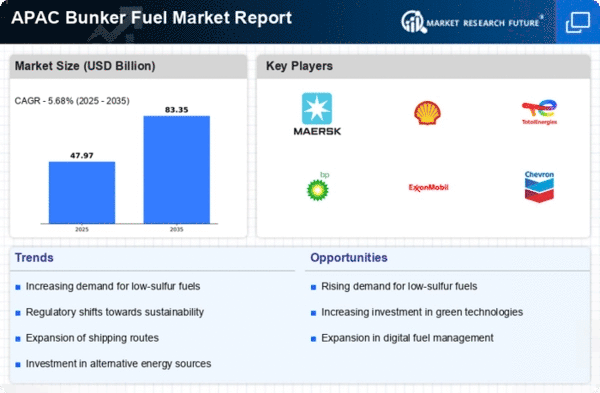
As per MRFR analysis, the APAC bunker fuel market Size was estimated at 45.39 USD Billion in 2024. The APAC bunker fuel market is projected to grow from 47.97 USD Billion in 2025 to 83.35 USD Billion by 2035, exhibiting a compound annual growth rate (CAGR) of 5.68% during the forecast period 2025 - 2035.

Key Market Trends & Highlights

The APAC bunker fuel market is experiencing a transformative shift towards sustainability and efficiency.

  • The market is witnessing a pronounced shift towards low-sulfur fuels, driven by stringent regulatory compliance.
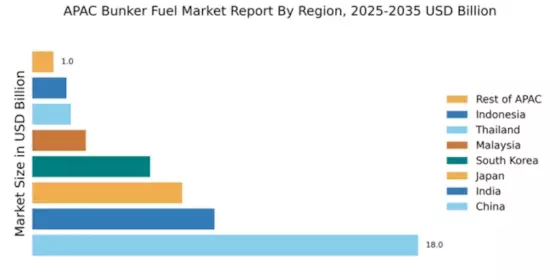
  • China remains the largest market for bunker fuel, while India is recognized as the fastest-growing region in the APAC sector.
  • Digital technologies are increasingly influencing operational efficiencies and supply chain management within the bunker fuel market.
  • Key market drivers include regulatory compliance and environmental standards, alongside economic growth and trade activities.

Market Size & Forecast

2024 Market Size 45.39 (USD Billion)
2035 Market Size 83.35 (USD Billion)
CAGR (2025 - 2035) 5.68%

Major Players

A.P. Moller - Maersk (DK), Shell (GB), TotalEnergies (FR), BP (GB), ExxonMobil (US), Chevron (US), Gazprom (RU), Hellenic Petroleum (GR), World Fuel Services (US)

APAC Bunker Fuel Market Trends

The bunker fuel market is currently experiencing a dynamic phase characterized by evolving regulations and shifting demand patterns. In recent years, the maritime industry has faced increasing pressure to reduce emissions, leading to the adoption of stricter environmental standards. This has prompted a transition towards low-sulfur fuels, which are perceived as more environmentally friendly. As a result, the market is witnessing a gradual shift in fuel types, with a growing emphasis on sustainable alternatives. Furthermore, the rise of digital technologies is influencing operational efficiencies within the sector, potentially enhancing supply chain management and reducing costs. In addition, geopolitical factors are playing a crucial role in shaping the bunker fuel market landscape. Trade tensions and regional conflicts can disrupt supply chains, affecting fuel availability and pricing. The demand for bunker fuel is also closely linked to shipping activity, which is influenced by economic conditions across the region. As the APAC region continues to be a hub for maritime trade, fluctuations in trade volumes may lead to variations in bunker fuel consumption. Overall, the market appears poised for transformation, driven by regulatory changes, technological advancements, and geopolitical dynamics.

Shift Towards Low-Sulfur Fuels

The bunker fuel market is witnessing a notable transition towards low-sulfur fuels, driven by stringent environmental regulations. These regulations aim to reduce sulfur emissions from ships, prompting operators to adopt cleaner fuel alternatives. This shift not only aligns with The bunker fuel market.

Impact of Digital Technologies

The integration of digital technologies is reshaping the bunker fuel market by enhancing operational efficiencies. Innovations such as data analytics and blockchain are being utilized to streamline supply chain processes, improve inventory management, and reduce operational costs. This technological advancement may lead to a more responsive and agile market.

Geopolitical Influences on Supply Chains

Geopolitical factors are significantly impacting the bunker fuel market, as regional conflicts and trade tensions can disrupt supply chains. These disruptions may lead to fluctuations in fuel availability and pricing, affecting overall market stability. As the APAC region remains a critical maritime trade hub, these influences are likely to shape future market dynamics.

APAC Bunker Fuel Market Drivers

Economic Growth and Trade Activities

The bunker fuel market in APAC is significantly driven by the region's robust economic growth and increasing trade activities. As economies in countries like China, India, and Southeast Asian nations expand, the demand for shipping services rises correspondingly. According to recent data, the shipping industry in APAC is projected to grow at a CAGR of approximately 4.5% over the next five years. This growth translates into higher consumption of bunker fuels, as more vessels are required to transport goods across the region. Additionally, the rise in e-commerce and global supply chains further fuels this demand. Consequently, the bunker fuel market is poised to benefit from the economic dynamism in APAC, as increased trade volumes necessitate a reliable supply of marine fuels.

Shifts in Shipping Routes and Logistics

The bunker fuel market in APAC is also affected by shifts in shipping routes and logistics strategies. Changes in global trade patterns, influenced by factors such as geopolitical tensions and economic agreements, can lead to the re-routing of shipping lanes. For example, the emergence of new trade agreements in the Asia-Pacific region may open up alternative routes, impacting fuel consumption patterns. Additionally, the increasing focus on just-in-time logistics requires shipping companies to optimize their operations, which can affect bunker fuel demand. As shipping routes evolve, the bunker fuel market must adapt to these changes, ensuring that fuel supply aligns with the new logistical frameworks. This dynamic environment presents both challenges and opportunities for stakeholders in the bunker fuel market.

Technological Advancements in Fuel Efficiency

Technological advancements in fuel efficiency are reshaping the bunker fuel market in APAC. Innovations such as the development of more efficient engines and fuel management systems are enabling shipping companies to optimize fuel consumption. These technologies not only reduce operational costs but also align with the growing emphasis on sustainability within the industry. For instance, the adoption of scrubbers allows vessels to continue using high-sulfur fuels while complying with emission regulations. Furthermore, the integration of digital technologies for monitoring fuel usage can lead to reductions in fuel consumption by up to 10%. As these technologies become more prevalent, they are likely to drive changes in fuel purchasing decisions, thereby influencing the bunker fuel market in the region.

Investment in Infrastructure and Port Facilities

Investment in infrastructure and port facilities is a crucial driver for the bunker fuel market in APAC. As countries in the region enhance their port capabilities to accommodate larger vessels and improve efficiency, the demand for bunker fuels is likely to increase. Recent investments in port infrastructure, such as the expansion of terminals and the development of new facilities, are expected to facilitate higher shipping volumes. For instance, major ports in China and Singapore are undergoing significant upgrades to handle the growing maritime traffic. This infrastructure development not only supports the shipping industry but also creates a more competitive environment for bunker fuel suppliers. Consequently, the bunker fuel market stands to benefit from these investments, as improved port facilities can lead to increased fuel sales and enhanced service offerings.

Regulatory Compliance and Environmental Standards

The bunker fuel market in APAC is increasingly influenced by stringent regulatory compliance and environmental standards. Governments across the region are implementing regulations aimed at reducing sulfur emissions from marine fuels. For instance, the International Maritime Organization (IMO) has mandated a reduction in sulfur content to 0.5% by 2020, which has led to a shift in demand towards low-sulfur fuels. This regulatory landscape compels shipping companies to adapt their fuel sourcing strategies, thereby impacting the bunker fuel market. The compliance costs associated with these regulations can be substantial, potentially reaching millions of dollars for large shipping fleets. As a result, the bunker fuel market is witnessing a transformation, with a growing emphasis on cleaner fuel alternatives and innovative technologies to meet these environmental mandates.

Market Segment Insights

By Type: High Sulfur Fuel Oil (Largest) vs. Low Sulfur Fuel Oil (Fastest-Growing)

In the APAC bunker fuel market, High Sulfur Fuel Oil (HSFO) continues to hold a dominant position, accounting for a significant share due to its widespread use in traditional shipping practices. Conversely, Low Sulfur Fuel Oil (LSFO) is gaining traction as regulatory pressures drive ship operators to seek compliant fuels, resulting in a notable rise in demand in various ports across the region. The growth trends indicate that while HSFO remains prevalent, the fastest growth is witnessed in LSFO, fueled by impending regulations aimed at reducing sulfur emissions and environmental impacts. This shift is further accelerated by increasing investments in cleaner technologies and a strong push from shipping companies to adopt more sustainable practices, thereby driving market dynamics significantly in favor of LSFO.

High Sulfur Fuel Oil (Dominant) vs. Low Sulfur Fuel Oil (Emerging)

High Sulfur Fuel Oil is characterized by its relatively lower cost and established availability, making it a go-to choice for many operators lacking compliance requirements. It remains vital for older vessels and those in regions with less stringent regulations. On the other hand, Low Sulfur Fuel Oil is becoming increasingly important as environmental regulations tighten, catering to vessels that are looking to comply with new emission standards. The transition from HSFO to LSFO is seen as essential for the shipping industry to align with global sustainability goals, positioning LSFO as an emerging choice for future maritime fuel solutions. With continuous advancements in refining technologies, LSFO's market presence is anticipated to grow, making it essential for operators to adjust to this emerging trend.

By Commercial Distributor: Oil Majors (Largest) vs. Large Independent Distributor (Fastest-Growing)

The Commercial Distributor segment in the APAC bunker fuel market is characterized by a strong competitive landscape, with Oil Majors commanding the largest share. Their established infrastructure, substantial resources, and long-term relationships with shipping companies position them as the key players in the market. In contrast, Large Independent Distributors are rapidly gaining ground, leveraging their flexibility and ability to adapt to changing market needs. This dynamic creates a diverse marketplace catering to various customer preferences. Growth trends within the segment indicate that Large Independent Distributors are poised for significant expansion due to increased demand for customized services and the pursuit of more competitive pricing. This is particularly evident in emerging markets where smaller players are capitalizing on specific niches. Meanwhile, Oil Majors continue to focus on maintaining their dominance by improving operational efficiencies and investing in new technologies, which helps to sustain their market leadership amidst evolving dynamics.

Oil Majors (Dominant) vs. Large Independent Distributor (Emerging)

Oil Majors represent the dominant force in the bunker fuel distribution landscape, characterized by their extensive logistical networks and comprehensive service offerings. Their capabilities allow them to meet the diverse needs of large shipping companies effectively, ensuring dependable fuel supply even amidst fluctuating market conditions. In contrast, Large Independent Distributors are emerging as significant players by focusing on niche markets and personalized customer service. Their agility enables them to respond swiftly to customer demands, making them a popular choice for clients seeking tailored solutions. Together, these distributors illustrate the breadth of options available within the Commercial Distributor segment, catering to varying business requirements and contributing to the overall health of the industry.

By Application: Container (Largest) vs. Bulk Carrier (Fastest-Growing)

In the APAC bunker fuel market, the application segment comprises various categories, with Container vessels holding the largest share due to the consistent growth in global trade and container shipping. Bulk Carriers follow closely, supported by the demand for raw materials and agricultural products transportation within the region. Other categories, such as Oil Tankers and Chemical Tankers, also contribute to the market, but their shares are smaller compared to Containers and Bulk Carriers. The growth trends in this segment are driven by the increase in maritime trade and the expansion of port facilities across APAC countries. Additionally, a surge in e-commerce activities has further bolstered the need for Container shipping. Environmental regulations and the shift towards cleaner fuels are also influencing the market, promoting advancements in fuel efficiency and emission reduction technologies, especially in the Bulk Carrier segment as it emerges as the fastest-growing category.

Container (Dominant) vs. Bulk Carrier (Emerging)

Container vessels dominate the APAC bunker fuel market due to their essential role in facilitating trade across the rapidly growing economies in the region. These vessels are typically larger and more fuel-efficient, allowing them to cater to the high demand for shipping services. On the other hand, Bulk Carriers, while currently an emerging segment, are gaining traction as they transport critical commodities such as coal, grain, and iron ore. Their operational efficiency is being improved through innovations in hull design and fuel technology. With increasing consumption of raw materials in developing economies, Bulk Carriers are positioned to expand significantly, making them an attractive focus for investments in the bunker fuel market.

Get more detailed insights about APAC Bunker Fuel Market

Regional Insights

China : China's Strategic Maritime Hub

Key markets in China include major ports like Shanghai, Ningbo, and Guangzhou, which are critical for bunker fuel consumption. The competitive landscape features significant players such as Sinopec and China National Petroleum Corporation (CNPC), alongside international giants like Shell and BP. The local market is characterized by a mix of state-owned and private enterprises, fostering a dynamic business environment. The shipping industry, particularly container shipping and bulk carriers, drives demand for bunker fuel, with a growing emphasis on sustainability and compliance with international regulations.

India : India's Growing Maritime Demand

Key markets in India include Mumbai, Chennai, and Visakhapatnam, which are vital for bunker fuel consumption. The competitive landscape features major players such as Indian Oil Corporation and Bharat Petroleum, alongside international firms like ExxonMobil. The local market is characterized by a growing number of private players entering the sector, enhancing competition. The shipping industry, particularly in the oil and gas sector, is a significant consumer of bunker fuel, with increasing investments in infrastructure and technology to meet rising demand.

Japan : Japan's Advanced Shipping Sector

Key markets in Japan include Tokyo, Yokohama, and Osaka, which are essential for bunker fuel consumption. The competitive landscape features major players like Nippon Oil and JX Nippon Oil & Energy, alongside international companies such as TotalEnergies. The local market is characterized by a high level of technological advancement, with a focus on eco-friendly solutions. The shipping industry, particularly in container shipping and bulk carriers, drives demand for bunker fuel, with a growing emphasis on reducing emissions and improving efficiency.

South Korea : South Korea's Maritime Leadership

Key markets in South Korea include Busan, Incheon, and Ulsan, which are critical for bunker fuel consumption. The competitive landscape features major players like SK Energy and GS Caltex, alongside international firms such as Chevron. The local market is characterized by a focus on technological innovation and sustainability, fostering a dynamic business environment. The shipping industry, particularly in container and bulk shipping, drives demand for bunker fuel, with increasing investments in eco-friendly technologies and practices.

Malaysia : Malaysia's Strategic Maritime Position

Key markets in Malaysia include Port Klang, Penang, and Johor, which are vital for bunker fuel consumption. The competitive landscape features players like Petronas and Dialog Group, alongside international companies such as World Fuel Services. The local market is characterized by a mix of state-owned and private enterprises, fostering competition. The shipping industry, particularly in oil and gas transportation, drives demand for bunker fuel, with increasing investments in infrastructure and sustainability initiatives.

Thailand : Thailand's Expanding Maritime Sector

Key markets in Thailand include Bangkok, Laem Chabang, and Songkhla, which are essential for bunker fuel consumption. The competitive landscape features players like PTT and Bangchak Corporation, alongside international firms such as Shell. The local market is characterized by a growing number of private players entering the sector, enhancing competition. The shipping industry, particularly in tourism and trade, drives demand for bunker fuel, with increasing investments in infrastructure and technology to meet rising demand.

Indonesia : Indonesia's Growing Maritime Industry

Key markets in Indonesia include Jakarta, Surabaya, and Makassar, which are critical for bunker fuel consumption. The competitive landscape features players like Pertamina and state-owned enterprises, alongside international companies such as ExxonMobil. The local market is characterized by a mix of state-owned and private enterprises, fostering competition. The shipping industry, particularly in inter-island trade and fishing, drives demand for bunker fuel, with increasing investments in infrastructure and sustainability initiatives.

Rest of APAC : Varied Dynamics Across APAC

Key markets in the Rest of APAC include smaller nations like Vietnam, the Philippines, and Singapore, which are essential for bunker fuel consumption. The competitive landscape features a mix of local and international players, with companies like World Fuel Services and local distributors. The local market is characterized by varying levels of development and regulatory frameworks, impacting competition. The shipping industry, particularly in tourism and trade, drives demand for bunker fuel, with a focus on sustainability and compliance with international regulations.


APAC Bunker Fuel Market Regional Image

Key Players and Competitive Insights

The bunker fuel market is currently characterized by a dynamic competitive landscape, driven by increasing demand for marine fuels and a growing emphasis on sustainability. Major players such as A.P. Moller - Maersk (DK), Shell (GB), and TotalEnergies (FR) are actively shaping the market through strategic initiatives aimed at enhancing operational efficiency and reducing carbon footprints. A.P. Moller - Maersk (DK) has positioned itself as a leader in sustainability, focusing on decarbonization strategies that align with global environmental goals. Shell (GB) continues to leverage its extensive supply chain capabilities to optimize fuel delivery, while TotalEnergies (FR) emphasizes innovation in low-carbon technologies, collectively influencing the competitive dynamics of the market.

Key business tactics employed by these companies include localizing manufacturing and optimizing supply chains to enhance responsiveness to market demands. The bunker fuel market appears moderately fragmented, with a mix of established players and emerging companies. The collective influence of these key players fosters a competitive environment where innovation and sustainability are paramount, potentially reshaping customer preferences and operational standards.

In October 2025, A.P. Moller - Maersk (DK) announced a partnership with a leading technology firm to develop advanced digital solutions for fuel management. This strategic move is likely to enhance operational efficiency and reduce emissions, aligning with the company's long-term sustainability goals. The integration of digital technologies into fuel management systems may provide a competitive edge by optimizing fuel consumption and minimizing waste.

In September 2025, Shell (GB) launched a new range of low-sulfur bunker fuels aimed at meeting the stringent regulatory requirements set by the International Maritime Organization (IMO). This initiative underscores Shell's commitment to sustainability and positions the company favorably in a market increasingly focused on compliance and environmental responsibility. The introduction of these fuels may attract environmentally conscious customers and enhance Shell's market share.

In August 2025, TotalEnergies (FR) expanded its operations in the Asia-Pacific region by acquiring a local bunker fuel supplier. This acquisition is expected to strengthen TotalEnergies' market presence and enhance its ability to provide tailored solutions to regional customers. The strategic importance of this move lies in the potential for increased market penetration and the ability to offer competitive pricing through localized supply chains.

As of November 2025, current trends in the bunker fuel market indicate a strong shift towards digitalization, sustainability, and the integration of artificial intelligence (AI) in operational processes. Strategic alliances among key players are shaping the competitive landscape, fostering innovation and collaboration. The evolution of competitive differentiation appears to be moving away from traditional price-based competition towards a focus on technological advancements, sustainability initiatives, and supply chain reliability. This shift may redefine customer expectations and operational benchmarks in the bunker fuel market.

Key Companies in the APAC Bunker Fuel Market market include

Industry Developments

The APAC Bunker Fuel Market continues to experience dynamic changes, marked by a notable increase in demand driven by the resurgence in maritime trade following pandemic-related disruptions. Recent developments indicate Chevron and BP ramping up efforts to enhance their supply chains in key locations such as Singapore, which remains the world’s leading bunkering hub. In October 2023, Cargill announced the expansion of its bunker fuel services in Asia, aligning with the region's growing energy needs while adhering to stricter emissions regulations.

Amidst these developments, World Fuel Services has been actively optimizing its operational strategies to bolster market share in the APAC region. Moreover, Shell remains committed to sustainability initiatives by investing in low sulfur bunkering options. While no significant mergers or acquisitions have been reported recently, past years showed that PetroChina acquired multiple regional supply firms in 2022, further consolidating their position in the market. Over the last few years, the APAC Bunker Fuel Market has also reacted to fluctuations in global oil prices, significantly impacting profit margins across companies like TotalEnergies and ExxonMobil.

Overall, the focus on compliance and sustainability continues to shape the future of the APAC Bunker Fuel Market.

Future Outlook

APAC Bunker Fuel Market Future Outlook

The bunker fuel market is projected to grow at a 5.68% CAGR from 2024 to 2035, driven by increasing maritime trade and regulatory changes.

New opportunities lie in:

  • Development of low-sulfur fuel alternatives for compliance with emissions regulations.
  • Investment in digital fuel management systems to optimize consumption and reduce costs.
  • Expansion of bunker delivery services in emerging APAC ports to capture new market segments.

By 2035, the bunker fuel market is expected to be robust, driven by innovation and strategic investments.

Market Segmentation

APAC Bunker Fuel Market Type Outlook

  • High Sulfur Fuel Oil
  • Low Sulfur Fuel Oil
  • Marine Gasoil
  • Others

APAC Bunker Fuel Market Application Outlook

  • Container
  • Bulk Carrier
  • Oil Tanker
  • General Cargo
  • Chemical Tanker
  • Fishing Vessels
  • Gas Tanker
  • Others

APAC Bunker Fuel Market Commercial Distributor Outlook

  • Oil Majors
  • Large Independent Distributor
  • Small Independent Distributor

Report Scope

MARKET SIZE 202445.39(USD Billion)
MARKET SIZE 202547.97(USD Billion)
MARKET SIZE 203583.35(USD Billion)
COMPOUND ANNUAL GROWTH RATE (CAGR)5.68% (2024 - 2035)
REPORT COVERAGERevenue Forecast, Competitive Landscape, Growth Factors, and Trends
BASE YEAR2024
Market Forecast Period2025 - 2035
Historical Data2019 - 2024
Market Forecast UnitsUSD Billion
Key Companies Profiled["A.P. Moller - Maersk (DK)", "Shell (GB)", "TotalEnergies (FR)", "BP (GB)", "ExxonMobil (US)", "Chevron (US)", "Gazprom (RU)", "Hellenic Petroleum (GR)", "World Fuel Services (US)"]
Segments CoveredType, Commercial Distributor, Application
Key Market OpportunitiesAdoption of low-sulfur fuels driven by stringent environmental regulations and sustainability initiatives.
Key Market DynamicsRegulatory shifts and environmental standards drive innovation and competition in the bunker fuel market.
Countries CoveredChina, India, Japan, South Korea, Malaysia, Thailand, Indonesia, Rest of APAC

Leave a Comment

FAQs

What is the expected market size of the APAC Bunker Fuel Market in 2024?

The APAC Bunker Fuel Market is expected to be valued at 51.88 USD Billion in 2024.

What will be the market size of the APAC Bunker Fuel Market by 2035?

By 2035, the overall market is projected to reach 82.44 USD Billion.

What is the expected compound annual growth rate (CAGR) for the APAC Bunker Fuel Market from 2025 to 2035?

The market is expected to witness a CAGR of 4.3 percent from 2025 to 2035.

Which fuel type is projected to have the largest market share in the APAC Bunker Fuel Market in 2024?

High Sulfur Fuel Oil is projected to have the largest market share, valued at 20.0 USD Billion in 2024.

What is the market value of Low Sulfur Fuel Oil in the APAC Bunker Fuel Market for 2024?

Low Sulfur Fuel Oil is expected to be valued at 15.0 USD Billion in 2024.

Who are the key players in the APAC Bunker Fuel Market?

Major players in the market include Chevron, Equinor, PetroChina, TotalEnergies, and ExxonMobil.

What market value is Marine Gasoil projected to have in 2035?

Marine Gasoil is projected to reach a market value of 15.0 USD Billion by 2035.

What opportunities are driving the growth of the APAC Bunker Fuel Market?

The market growth is driven by increasing maritime trade and regulatory changes in fuel specifications.

What is the market value estimation for the 'Others' segment in the APAC Bunker Fuel Market for 2024?

'Others' is expected to be valued at 6.88 USD Billion in 2024.

How does the growth of the APAC Bunker Fuel Market compare with global trends?

The APAC Bunker Fuel Market is expected to grow steadily, reflecting a positive trend in maritime fuel consumption.

What is the market size of the APAC Bunker Fuel Market expected to be in 2024?

The APAC Bunker Fuel Market is expected to be valued at 51.88 USD Billion in 2024.

What will be the projected market value of the APAC Bunker Fuel Market by 2035?

By 2035, the APAC Bunker Fuel Market is expected to reach a value of 73.24 USD Billion.

What is the expected CAGR for the APAC Bunker Fuel Market during the forecast period from 2025 to 2035?

The expected CAGR for the APAC Bunker Fuel Market from 2025 to 2035 is 3.185%.

Which fuel type in the APAC Bunker Fuel Market will have the highest value in 2024?

High Sulfur Fuel Oil will have the highest value, estimated at 20.0 USD Billion in 2024.

What is the estimated market value for Low Sulfur Fuel Oil in 2024?

The estimated market value for Low Sulfur Fuel Oil in 2024 is 15.0 USD Billion.

Who are the major players in the APAC Bunker Fuel Market?

Some major players include Chevron, Shell, BP, and ExxonMobil.

What is the market value of Marine Gasoil in the APAC Bunker Fuel Market for 2024?

Marine Gasoil is valued at 11.0 USD Billion in the APAC Bunker Fuel Market for 2024.

What will be the market size for 'Other' fuel types in the APAC Bunker Fuel Market by 2035?

'Other' fuel types are projected to reach a market size of 13.24 USD Billion by 2035.

What are the growth drivers for the APAC Bunker Fuel Market?

Growth drivers include increased shipping activities and regulatory changes in fuel standards.

How does the APAC Bunker Fuel Market respond to emerging trends and challenges?

The market is adapting through innovation in fuel technology and investment in cleaner fuel options.

Download Free Sample

Kindly complete the form below to receive a free sample of this Report

Compare Licence

×
Features License Type
Single User Multiuser License Enterprise User
Price $4,950 $5,950 $7,250
Maximum User Access Limit 1 User Upto 10 Users Unrestricted Access Throughout the Organization
Free Customization
Direct Access to Analyst
Deliverable Format
Platform Access
Discount on Next Purchase 10% 15% 15%
Printable Versions