×
Request Free Sample ×

Kindly complete the form below to receive a free sample of this Report

* Please use a valid business email

Leading companies partner with us for data-driven Insights

clients tt-cursor
Hero Background

India Bunker Fuel Market

ID: MRFR/CnM/42450-HCR
200 Pages
Chitranshi Jaiswal
October 2025

India Bunker Fuel Market Research Report By Fuel Type Outlook (High Sulfur Fuel Oil, Low Sulfur Fuel Oil, Marine Gasoil, Others), By Commercial Distributor Outlook (Oil Majors, Large Independent Distributor, Small Independent Distributor) andBy Application Outlook (Container, Bulk Carrier, Oil Tanker, General Cargo, Chemical Tanker, Fishing Vessels, Gas Tanker, Others)- Forecast to 2035

Share:
Download PDF ×

We do not share your information with anyone. However, we may send you emails based on your report interest from time to time. You may contact us at any time to opt-out.

India Bunker Fuel Market Infographic
Purchase Options

India Bunker Fuel Market Summary

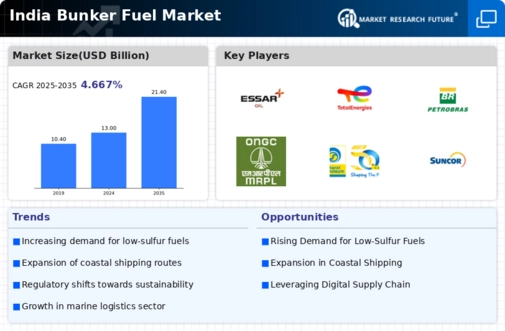
As per analysis, the India bunker fuel market is projected to grow from USD 10.82 Billion in 2025 to USD 16.49 Billion by 2035, exhibiting a compound annual growth rate (CAGR) of 4.3% during the forecast period (2025 - 2035).

Key Market Trends & Highlights

The India bunker fuel market is currently experiencing a transformative shift towards sustainability and technological innovation.

  • The market is witnessing a significant shift towards low-sulfur fuels, driven by stringent regulatory compliance and environmental standards.
  • Marine transportation remains the largest segment, while offshore support vessels are emerging as the fastest-growing segment in the bunker fuel market.
  • High sulfur fuel oil continues to dominate in volume, yet low sulfur fuel oil is rapidly gaining traction due to changing regulations.
  • Key market drivers include the growth of maritime trade and shipping activities, alongside rising demand for alternative fuels.

Market Size & Forecast

2024 Market Size 10.38 (USD Billion)
2035 Market Size 16.49 (USD Billion)
CAGR (2025 - 2035) 4.3%

Major Players

Indian Oil Corporation Limited (IN), Bharat Petroleum Corporation Limited (IN), Hindustan Petroleum Corporation Limited (IN), Reliance Industries Limited (IN), Shell India Markets Private Limited (IN), TotalEnergies Marketing India Private Limited (IN), ExxonMobil Asia Pacific Pte Ltd (SG), Chevron Marine Products (US)

India Bunker Fuel Market Trends

The India bunker fuel market is currently experiencing a dynamic phase characterized by evolving regulations and increasing demand for cleaner fuels. The government has been actively promoting the use of low-sulfur fuels to comply with international maritime standards, which has led to a gradual shift in the types of bunker fuels being utilized. This transition is not only aimed at reducing emissions but also at enhancing the overall sustainability of the shipping industry in India. Furthermore, the strategic location of Indian ports along major shipping routes positions the country as a potential hub for bunker fuel supply in the region. In addition to regulatory changes, the India bunker fuel market is witnessing a rise in competition among suppliers. This competitive landscape is fostering innovation and efficiency in service delivery, as companies strive to meet the diverse needs of their clients. The increasing focus on digitalization and automation within the sector is also noteworthy, as it enhances operational efficiency and transparency. As the market continues to evolve, stakeholders must remain vigilant to adapt to these changes and leverage emerging opportunities for growth.

Shift Towards Low-Sulfur Fuels

The India bunker fuel market is undergoing a notable transition towards low-sulfur fuels. This shift is primarily driven by stringent regulations aimed at reducing sulfur emissions from ships. The adoption of these cleaner fuels is expected to align with international standards, thereby enhancing the environmental performance of the maritime sector.

Emergence of Digital Solutions

Digitalization is becoming increasingly prevalent in the India bunker fuel market. Suppliers are adopting advanced technologies to streamline operations, improve customer service, and enhance supply chain management. This trend indicates a move towards greater efficiency and transparency in fuel procurement and delivery.

Increased Competition Among Suppliers

The competitive landscape within the India bunker fuel market is intensifying. As more players enter the market, existing suppliers are compelled to innovate and improve their service offerings. This competition is likely to benefit end-users through better pricing and enhanced service quality.

Market Segment Insights

By Application: Marine Transportation (Largest) vs. Offshore Support Vessels (Fastest-Growing)

In the India bunker fuel market, the 'Marine Transportation' segment holds the largest share, reflecting the significant role of shipping in the country's economy. This segment includes cargo ships and tankers that facilitate trade both domestically and internationally. Conversely, 'Offshore Support Vessels', which provide support services to the oil and gas industry, represent the fastest-growing application, spurred by increased energy exploration in offshore fields.

Marine Transportation (Dominant) vs. Offshore Support Vessels (Emerging)

The Marine Transportation sector is characterized by its extensive network of shipping routes and infrastructure, making it a dominant force in the India bunker fuel market. This segment serves a variety of vessels engaged in trade, underscoring India's strategic geographical position. On the other hand, Offshore Support Vessels are redefining their market presence as they cater to the expanding offshore oil and gas exploration activities. Increased investments in renewable energy and offshore installations contribute to their emerging status, as these vessels become vital for the support and logistics of drilling activities, thereby showcasing a growing demand for bunker fuel.

By Fuel Type: High Sulfur Fuel Oil (Largest) vs. Low Sulfur Fuel Oil (Fastest-Growing)

In the India bunker fuel market, High Sulfur Fuel Oil (HSFO) holds the largest market share due to its extensive use in various sectors, particularly among older vessels that are not equipped for low sulfur alternatives. This segment is traditionally favored due to its lower cost relative to low sulfur options, making it a popular choice for shipping companies. Conversely, Low Sulfur Fuel Oil (LSFO), although smaller in volume, is rapidly gaining traction as regulations tighten on sulfur emissions, prompting an increased adoption of cleaner fuels in India's maritime industry.

Fuel Type: HSFO (Dominant) vs. LSFO (Emerging)

High Sulfur Fuel Oil (HSFO) is known for its high viscosity and thick consistency, making it suitable for older ships that operate under less stringent emissions regulations. However, with growing environmental concerns and regulatory frameworks, its dominance is being challenged by Low Sulfur Fuel Oil (LSFO), which offers a cleaner combustion profile and aligns with international standards. The increasing pressure on shipping companies to reduce emissions is driving the demand for LSFO, making it an emerging fuel choice within the India bunker fuel market. Additionally, LSFO's compatibility with newer engines enhances its market appeal, prompting operators to transition towards more sustainable practices as they typically seek to balance regulations with economic viability.

By End Use: Commercial Shipping (Largest) vs. Naval Operations (Fastest-Growing)

In the India's bunker fuel market, the end-use segments are characterized by a diverse range of applications. Among these, commercial shipping holds the largest share, driven primarily by the expansive trade routes and increasing international shipping activities. It plays a critical role in transportation logistics, serving both domestic and global markets. Naval operations are emerging as a significant segment, driven by the growing focus on defense capabilities and the modernization of naval fleets. This segment is witnessing robust demand as government initiatives to enhance naval capabilities come into place.

Commercial Shipping (Dominant) vs. Naval Operations (Emerging)

Commercial shipping remains the dominant force in the India bunker fuel market, underpinned by robust imports and exports through maritime routes. This segment thrives on the country's strategic geographic advantage, facilitating trade with key global partners. In contrast, naval operations are rapidly emerging due to increased investments in defense, leading to naval expansions and modernization efforts. The government’s initiatives, including the 'Make in India' program, are aimed at boosting indigenous naval capabilities. While commercial shipping is essential for economic activities, naval operations are being prioritized, reflecting the interplay between security and economic growth in maritime affairs.

By Distribution Channel: Bunker Fuel Suppliers (Largest) vs. Direct Sales (Fastest-Growing)

In the India bunker fuel market, the distribution channel segment is characterized by diverse avenues, with bunker fuel suppliers leading in market share. This segment has benefited from established relationships with shipping companies and frequent usage, thus solidifying their competitive edge over other channels. Meanwhile, direct sales are emerging rapidly, transforming how businesses approach procurement and distribution of bunker fuels. This shift also indicates a growing acceptance of personalized services and tailored contracts fostering higher customer loyalty.

Direct Sales (Fastest-Growing) vs. Fuel Brokers (Dominant)

Direct sales in the India bunker fuel market have been recognized as the fastest-growing segment due to evolving customer preferences towards more personalized service options. Businesses now prefer entrenched relationships with fewer intermediaries, facilitating smoother transactions and enhanced communication. This model allows for improved pricing strategies and tailored solutions, accommodating specific needs and reducing the time taken for fuel procurement. Conversely, fuel brokers remain a dominant force in this ecosystem, leveraging their extensive networks to secure competitive pricing and providing access to various suppliers. They play a pivotal role in connecting suppliers with end customers and often manage complex transactions, contributing to their strong market position.

By Vessel Type: Tankers (Largest) vs. Tugboats (Fastest-Growing)

In the India bunker fuel market, the segment distribution reveals that tankers hold the largest market share, effectively dominating the bunker fuel demand. This can be attributed to India’s expansive coastline and robust trade activities that rely heavily on tankers for the transportation of crude oil and refined products. Conversely, tugboats, while smaller in terms of share, demonstrate the fastest growth as they play a crucial role in assisting larger vessels during berthing, unberthing, and navigating congested ports and harbors. The growth trends within this segment underscore a more strategic focus on efficiency and safety within the maritime industry. Tankers are expected to continue their prevalence, driven by ongoing oil trade and enhanced industrial activity. On the other hand, tugboats are gaining traction due to increasing port activities and the rise in shipping traffic, particularly with new port developments aimed at improving infrastructure in India.

Tankers (Dominant) vs. Tugboats (Emerging)

Tankers are the cornerstone of the India's marine trade, efficiently moving large volumes of oil and other bulk commodities across regions. Their size and capacity enable them to capitalize on economies of scale, making them integral to the supply chain, particularly for crude oil imports. On the other hand, tugboats are small yet highly crucial assets in the maritime industry, facilitating the smooth operation of larger vessels. As emerging assets, their significance grows with increasing shipping activities and port modernization initiatives. Tugboats enhance safety and maneuverability within congested ports, positioning them as essential support vessels that complement the tankers' operational framework in the Indian bunker fuel landscape.

Get more detailed insights about India Bunker Fuel Market

Key Players and Competitive Insights

The bunker fuel market in India is characterized by a competitive landscape that is increasingly shaped by strategic initiatives aimed at enhancing operational efficiency and sustainability. Key players such as Indian Oil Corporation Limited (IN), Bharat Petroleum Corporation Limited (IN), and Reliance Industries Limited (IN) are actively pursuing strategies that emphasize innovation and regional expansion. These companies are not only focusing on optimizing their supply chains but are also investing in digital transformation to improve service delivery and customer engagement. The collective efforts of these firms contribute to a moderately fragmented market structure, where competition is driven by both price and service quality.

In terms of business tactics, localizing manufacturing and optimizing supply chains appear to be pivotal for companies operating in this sector. The competitive structure is moderately fragmented, with several players vying for market share. The influence of major companies is significant, as they leverage their extensive networks and resources to enhance their market positions. This dynamic fosters a competitive environment where agility and responsiveness to market demands are crucial for success.

In November 2025, Indian Oil Corporation Limited (IN) announced the launch of a new eco-friendly bunker fuel blend aimed at reducing emissions from marine vessels. This strategic move not only aligns with global sustainability goals but also positions the company as a leader in environmentally responsible fuel solutions. The introduction of this product is likely to attract environmentally conscious shipping companies, thereby enhancing Indian Oil's market share.

In October 2025, Reliance Industries Limited (IN) entered into a strategic partnership with a leading technology firm to develop AI-driven solutions for optimizing bunker fuel logistics. This collaboration is expected to streamline operations and reduce costs, thereby improving overall efficiency. The integration of AI into their logistics framework may provide Reliance with a competitive edge, allowing for more precise demand forecasting and inventory management.

In September 2025, Bharat Petroleum Corporation Limited (IN) expanded its bunker fuel distribution network by establishing new supply points in key ports across India. This expansion is indicative of the company's commitment to enhancing its service capabilities and meeting the growing demand for bunker fuel. By increasing its geographical footprint, Bharat Petroleum is likely to strengthen its competitive position in the market.

As of December 2025, the competitive trends in the bunker fuel market are increasingly defined by digitalization, sustainability, and the integration of advanced technologies. Strategic alliances among key players are shaping the landscape, fostering innovation and collaboration. The shift from price-based competition to a focus on technological advancement and supply chain reliability is becoming evident. Companies that prioritize innovation and sustainability are likely to differentiate themselves in this evolving market.


Key Companies in the India Bunker Fuel Market market include

Industry Developments

The India Bunker Fuel Market has recently witnessed significant developments, particularly in terms of environmental regulations and fuel supply dynamics. In September 2023, the Indian government announced stricter guidelines aimed at reducing sulfur emissions from marine fuels, prompting companies like Indian Oil Corporation and Bharat Petroleum Corporation to innovate low-sulfur fuel options. Meanwhile, Essar Oil and TotalEnergies have been actively seeking to expand their supply networks in key ports, such as Mumbai and Chennai, to accommodate growing demand. The market saw increased competition with an uptick in bunker prices influenced by global crude oil rates rising in mid-2023.

In terms of mergers and acquisitions, there were no notable recent reports regarding the companies mentioned. Over the past two to three years, Reliance Industries has been investing in expanding its refining capacities to enhance its bunker fuel offerings. Additionally, the Maritime and Port Authority of Singapore has been collaborating with Indian stakeholders to increase efficiency in shipping routes, subsequently impacting the bunker fuel market's logistics. The evolving scenario emphasizes the strategic shifts companies like Chevron India and Shell India Markets are implementing to adapt to both regulatory pressures and market demands.

Future Outlook

India Bunker Fuel Market Future Outlook

The India bunker fuel market is projected to grow at a 4.3% CAGR from 2024 to 2035, driven by increasing maritime trade, regulatory changes, and technological advancements.

New opportunities lie in:

  • Development of low-sulfur fuel alternatives to meet regulatory standards.
  • Investment in digital fuel management systems for efficiency.
  • Expansion of bunker delivery services in emerging ports.

By 2035, the India bunker fuel market is expected to be robust, driven by innovation and strategic investments.

Market Segmentation

India Bunker Fuel Market End Use Outlook

  • Commercial Shipping
  • Naval Operations
  • Recreational Boating
  • Industrial Applications

India Bunker Fuel Market Fuel Type Outlook

  • High Sulfur Fuel Oil
  • Low Sulfur Fuel Oil
  • Marine Gas Oil
  • Liquefied Natural Gas

India Bunker Fuel Market Application Outlook

  • Marine Transportation
  • Offshore Support Vessels
  • Fishing Vessels
  • Cruise Ships

India Bunker Fuel Market Vessel Type Outlook

  • Bulk Carriers
  • Container Ships
  • Tankers
  • Tugboats

India Bunker Fuel Market Distribution Channel Outlook

  • Direct Sales
  • Bunker Fuel Suppliers
  • Online Platforms
  • Fuel Brokers

Report Scope

MARKET SIZE 202410.38(USD Billion)
MARKET SIZE 202510.82(USD Billion)
MARKET SIZE 203516.49(USD Billion)
COMPOUND ANNUAL GROWTH RATE (CAGR)4.3% (2024 - 2035)
REPORT COVERAGERevenue Forecast, Competitive Landscape, Growth Factors, and Trends
BASE YEAR2024
Market Forecast Period2025 - 2035
Historical Data2019 - 2024
Market Forecast UnitsUSD Billion
Key Companies ProfiledIndian Oil Corporation Limited (IN), Bharat Petroleum Corporation Limited (IN), Hindustan Petroleum Corporation Limited (IN), Reliance Industries Limited (IN), Shell India Markets Private Limited (IN), TotalEnergies Marketing India Private Limited (IN), ExxonMobil Asia Pacific Pte Ltd (SG), Chevron Marine Products (US)
Segments CoveredApplication, Fuel Type, End Use, Distribution Channel, Vessel Type
Key Market OpportunitiesAdoption of cleaner bunker fuels driven by stringent environmental regulations in the India bunker fuel market.
Key Market DynamicsRising regulatory pressures and environmental standards are reshaping the India bunker fuel market dynamics.
Countries CoveredIndia

Leave a Comment

FAQs

What is the projected market size of the India Bunker Fuel Market in 2024?

The projected market size of the India Bunker Fuel Market in 2024 is expected to be valued at 12.97 USD Billion.

What is the expected market growth rate of the India Bunker Fuel Market from 2025 to 2035?

The India Bunker Fuel Market is expected to grow at a CAGR of 4.3% from 2025 to 2035.

What will be the value of High Sulfur Fuel Oil in the India Bunker Fuel Market by 2035?

The value of High Sulfur Fuel Oil in the India Bunker Fuel Market is expected to reach 6.45 USD Billion by 2035.

Which fuel type is projected to have a value of 5.8 USD Billion by 2035?

Low Sulfur Fuel Oil is projected to have a value of 5.8 USD Billion by 2035 in the India Bunker Fuel Market.

Who are the major players in the India Bunker Fuel Market?

Major players include Shell India Markets Private Limited, ExxonMobil Asia Pacific Pte Ltd, and Indian Oil Corporation Limited among others.

What is the expected value of Marine Gasoil in 2024?

The expected value of Marine Gasoil in the India Bunker Fuel Market is 3.0 USD Billion in 2024.

How much will the Others segment of the India Bunker Fuel Market be worth in 2035?

The Others segment is projected to be worth 3.56 USD Billion by 2035.

What is the expected value of the Low Sulfur Fuel Oil segment in 2024?

The expected value of the Low Sulfur Fuel Oil segment in 2024 is 3.5 USD Billion.

What are the growth drivers for the India Bunker Fuel Market?

Growth drivers include increasing maritime trade and the regulatory push for low-sulfur fuels.

How will global environmental regulations impact the India Bunker Fuel Market?

Global environmental regulations will likely drive demand for Low Sulfur Fuel Oil, influencing market dynamics significantly.

What is the expected market size of the India Bunker Fuel Market in 2024?

The India Bunker Fuel Market is expected to be valued at 12.97 billion USD in 2024.

What is the projected market valuation for the India Bunker Fuel Market by 2035?

By 2035, the India Bunker Fuel Market is expected to reach a valuation of 21.42 billion USD.

What is the expected CAGR for the India Bunker Fuel Market from 2025 to 2035?

The India Bunker Fuel Market is anticipated to grow at a CAGR of 4.667% from 2025 to 2035.

Which fuel type is expected to have the largest market share in 2024?

High Sulfur Fuel Oil is valued at 4.57 billion USD in 2024, making it the largest segment.

What will be the market value of Low Sulfur Fuel Oil by 2035?

The market value of Low Sulfur Fuel Oil is expected to reach 5.76 billion USD by 2035.

What is the expected market size for Marine Gasoil in 2024?

Marine Gasoil is expected to be valued at 2.65 billion USD in 2024.

What challenges may impact the growth of the India Bunker Fuel Market?

Challenges may include fluctuations in global oil prices and regulatory changes affecting fuel standards.

How much is the 'Others' segment projected to grow from 2024 to 2035?

The 'Others' segment is projected to grow from 2.3 billion USD in 2024 to 3.84 billion USD by 2035.

What key trends are shaping the India Bunker Fuel Market?

Emerging trends include a shift towards low sulfur fuels in response to environmental regulations.

Download Free Sample

Kindly complete the form below to receive a free sample of this Report

Compare Licence

×
Features License Type
Single User Multiuser License Enterprise User
Price $4,950 $5,950 $7,250
Maximum User Access Limit 1 User Upto 10 Users Unrestricted Access Throughout the Organization
Free Customization
Direct Access to Analyst
Deliverable Format
Platform Access
Discount on Next Purchase 10% 15% 15%
Printable Versions