APAC Mobile Cloud Market
APAC Mobile Cloud Market Summary
As per Market Research Future analysis, the APAC mobile cloud market Size was estimated at 18.75 USD Billion in 2024. The APAC mobile cloud market is projected to grow from 20.9 USD Billion in 2025 to 62.04 USD Billion by 2035, exhibiting a compound annual growth rate (CAGR) of 11.4% during the forecast period 2025 - 2035
Key Market Trends & Highlights
The APAC mobile cloud market is experiencing robust growth driven by technological advancements and evolving consumer needs.
- The APAC mobile cloud market is witnessing increased adoption of hybrid cloud solutions, particularly in China and India.
- A heightened focus on security and compliance is shaping the mobile cloud landscape across the region.
- Integration of AI and automation technologies is becoming a pivotal trend in enhancing mobile cloud services.
- Rising mobile device penetration and growing demand for remote work solutions are key drivers propelling market expansion.
Market Size & Forecast
| 2024 Market Size | 18.75 (USD Billion) |
| 2035 Market Size | 62.04 (USD Billion) |
| CAGR (2025 - 2035) | 11.49% |
Major Players
Amazon (US), Microsoft (US), Google (US), IBM (US), Oracle (US), Salesforce (US), Alibaba (CN), Tencent (CN), SAP (DE)
APAC Mobile Cloud Market Trends
The mobile cloud market is experiencing notable growth in the Asia-Pacific region, driven by increasing smartphone penetration and the rising demand for cloud-based services. Businesses are increasingly adopting mobile cloud solutions to enhance operational efficiency and improve customer engagement. This trend is further supported by advancements in mobile network infrastructure, which facilitate faster and more reliable access to cloud applications. As organizations seek to leverage the benefits of mobility and cloud computing, the mobile cloud market is poised for continued expansion. Moreover, the shift towards remote work and digital transformation initiatives has accelerated the adoption of mobile cloud technologies. Companies are recognizing the importance of flexibility and scalability in their operations, leading to a surge in investments in mobile cloud solutions. The integration of artificial intelligence and machine learning into mobile cloud services is also emerging as a key driver, enabling businesses to harness data analytics for better decision-making. Overall, the mobile cloud market in the Asia-Pacific region appears to be on a robust growth trajectory, with various factors contributing to its evolution and increasing relevance in the digital landscape.
Increased Adoption of Hybrid Cloud Solutions
Organizations are increasingly opting for hybrid cloud models, combining public and private cloud services. This approach allows businesses to maintain control over sensitive data while leveraging the scalability of public cloud resources. The flexibility offered by hybrid solutions is particularly appealing to enterprises in the mobile cloud market, as it enables them to adapt to changing demands and optimize their IT infrastructure.
Focus on Security and Compliance
As mobile cloud services gain traction, there is a heightened emphasis on security and regulatory compliance. Companies are investing in advanced security measures to protect sensitive information and ensure compliance with local regulations. This trend reflects the growing awareness of potential risks associated with mobile cloud adoption, prompting organizations to prioritize robust security frameworks.
Integration of AI and Automation
The integration of artificial intelligence and automation technologies into mobile cloud services is becoming increasingly prevalent. Businesses are leveraging AI-driven analytics to enhance user experiences and streamline operations. This trend indicates a shift towards more intelligent mobile cloud solutions, which can adapt to user needs and improve overall efficiency.
APAC Mobile Cloud Market Drivers
Emergence of IoT Applications
The mobile cloud market in APAC is being propelled by the emergence of Internet of Things (IoT) applications. As more devices become interconnected, the demand for cloud solutions that can manage and analyze the data generated by these devices is increasing. By November 2025, it is estimated that the number of IoT devices in the region will surpass 10 billion, creating vast opportunities for mobile cloud services. This growth is particularly evident in sectors such as healthcare and manufacturing, where IoT applications are transforming operations. The mobile cloud market is thus likely to see substantial growth as businesses seek to harness the power of IoT through cloud-based platforms.
Rising Mobile Device Penetration
The mobile cloud market in APAC is experiencing a surge due to the increasing penetration of mobile devices. As of November 2025, mobile device usage in the region has reached approximately 80% of the population, facilitating greater access to cloud services. This trend is particularly pronounced in countries like India and China, where smartphone adoption is rapidly growing. The proliferation of affordable smartphones and improved internet connectivity has enabled users to leverage mobile cloud solutions for various applications, including storage, computing, and collaboration. Consequently, this driver is likely to enhance the mobile cloud market by expanding the user base and increasing demand for cloud-based applications tailored for mobile devices.
Increased Focus on Data Analytics
The mobile cloud market in APAC is witnessing a heightened focus on data analytics. Organizations are increasingly recognizing the value of data-driven decision-making, leading to a surge in demand for cloud-based analytics tools. As of November 2025, it is projected that the market for cloud analytics in the region will grow by approximately 25% annually. This trend is particularly relevant for sectors such as retail and finance, where insights derived from data can significantly influence business strategies. Consequently, the mobile cloud market is likely to expand as companies seek to integrate advanced analytics capabilities into their mobile applications, enhancing their ability to respond to market dynamics.
Advancements in Network Infrastructure
The mobile cloud market in APAC is benefiting from significant advancements in network infrastructure. The rollout of 5G technology is transforming the landscape, providing faster data speeds and lower latency. As of November 2025, several countries in the region have made substantial progress in 5G deployment, with coverage expected to reach over 50% of urban areas. This enhanced connectivity is likely to drive the adoption of mobile cloud services, as users demand real-time access to applications and data. The improved network capabilities enable businesses to leverage mobile cloud solutions for critical operations, thereby fostering innovation and enhancing competitiveness in the market.
Growing Demand for Remote Work Solutions
The mobile cloud market in APAC is significantly influenced by the rising demand for remote work solutions. As organizations increasingly adopt flexible work arrangements, the need for cloud-based tools that facilitate collaboration and productivity has intensified. In November 2025, it is estimated that around 60% of companies in the region have implemented mobile cloud solutions to support their remote workforce. This shift not only enhances operational efficiency but also allows businesses to tap into a broader talent pool. The mobile cloud market is thus poised for growth as companies seek to invest in technologies that enable seamless communication and project management across dispersed teams.
Market Segment Insights
By Service Model: Software as a Service (Largest) vs. Infrastructure as a Service (Fastest-Growing)
In the mobile cloud market, the service model segment is characterized by a significant market share distribution among three main service types: Infrastructure as a Service (IaaS), Platform as a Service (PaaS), and Software as a Service (SaaS). Currently, SaaS holds the largest share, driven by increasing demand for cloud-based applications. Meanwhile, IaaS is rapidly gaining traction, attracting businesses looking for flexible computing resources that are easily scalable. Growth trends in the service model segment are propelled by the digital transformation initiatives across various industries in the region. Enterprises are increasingly adopting SaaS solutions for their ease of deployment and management. On the other hand, IaaS is considered the fastest-growing segment, as it offers cost-effective solutions and enhances operational efficiency. Factors such as the rise in remote work and innovation in cloud technologies continue to drive this rapid expansion.
Software as a Service (Dominant) vs. Infrastructure as a Service (Emerging)
Software as a Service (SaaS) is recognized as the dominant player in the mobile cloud market due to its widespread adoption and comprehensive offerings that cater to diverse enterprise needs. Businesses favor SaaS for its subscription-based model, reducing upfront costs and simplifying updates. This segment supports various applications, enhancing collaboration and productivity. Conversely, Infrastructure as a Service (IaaS) is emerging as a vital component, attracting organizations aiming for scalable and cost-efficient IT infrastructure. As more companies shift to cloud computing, IaaS is becoming increasingly appealing, providing essential resources for enterprise-level solutions while accommodating growth and innovation.
By Deployment Model: Hybrid Cloud (Largest) vs. Private Cloud (Fastest-Growing)
The market share distribution within the Deployment Model segment is predominantly led by Hybrid Cloud solutions, which cater to businesses seeking a balance between on-premise infrastructure and public cloud services. Private Cloud follows, gaining traction among organizations that prioritize data security and compliance. Public Cloud occupies a significant portion but is overshadowed by the tailored options provided by Hybrid and Private Cloud. Growth trends indicate a robust trajectory for Hybrid Cloud as organizations increasingly adopt flexible and scalable solutions to meet dynamic workloads. Meanwhile, Private Cloud is rapidly emerging, driven by rising concerns over data privacy and regulatory requirements. Both segments are bolstered by technological advancements and growing investments in cloud infrastructure, positioning them favorably for future expansion.
Hybrid Cloud (Dominant) vs. Private Cloud (Emerging)
Hybrid Cloud solutions are characterized by their ability to integrate on-premise infrastructure with public cloud services, offering businesses the flexibility and scalability needed to optimize their operations. This segment is dominant due to its versatility, catering to diverse workloads and providing a seamless transition for companies looking to enhance their cloud strategy. In contrast, Private Cloud has emerged as a compelling alternative for organizations focused on maximizing security and compliance with stringent regulations. By maintaining dedicated resources, Private Cloud fosters greater control over data, making it attractive for industries such as finance and healthcare. Together, these segments reflect the evolving needs of organizations within the mobile cloud landscape.
By Application: Data Storage (Largest) vs. Cloud Gaming (Fastest-Growing)
In the APAC mobile cloud market, the application segment is witnessing diverse distribution among its values. Data Storage holds the largest market share, driven by the increased digital transformation initiatives and the need for efficient data management. Following closely are Content Delivery and Mobile Application Development, which show promising growth as businesses enhance their digital presence. Cloud Gaming, while a smaller segment, is rapidly gaining traction as gaming on mobile devices becomes more popular. The growth trends within this segment are fueled by several factors, including the rising smartphone penetration and the demand for high-speed internet connectivity. As more users shift towards mobile-based services, companies are investing significantly in cloud infrastructure to support applications like Cloud Gaming. Additionally, innovations in mobile technologies and user experience enhancements further drive the adoption of both established and emerging applications in the market.
Data Storage (Dominant) vs. Cloud Gaming (Emerging)
Data Storage is characterized by its essential role in the APAC mobile cloud market, serving as a critical backbone for businesses that require robust and scalable solutions for storing vast amounts of data. This segment benefits from the increasing demand for data analytics and backup solutions, making it the dominant player. In contrast, Cloud Gaming is an emerging segment that is rapidly evolving due to advancements in streaming technology and mobile device capabilities. It caters to a growing audience of gamers seeking immersive experiences, leading to significant investments from major players in the gaming industry. While Data Storage remains vital for operational efficiency, Cloud Gaming is set to revolutionize entertainment consumption in the region.
By End Use: Small and Medium Enterprises (Largest) vs. Individual Users (Fastest-Growing)
In the mobile cloud market, Small and Medium Enterprises (SMEs) hold the largest share, driven by the increasing need for scalable solutions and remote accessibility. These businesses benefit from mobile cloud services, which allow them to leverage advanced technologies without significant infrastructure investments. Individual Users are witnessing rapid growth as more consumers adopt mobile cloud solutions for personal use, enabling a seamless integration of their devices with cloud platforms. The growth trends in this segment are largely influenced by the rising smartphone penetration and the shift towards digital lifestyles among individuals. As mobile applications and cloud services continue to evolve, both SMEs and individual users are expected to drive significant innovations. Key drivers include the demand for improved connectivity, flexible work environments, and the increasing adoption of IoT applications that require mobile cloud services to function effectively.
Small and Medium Enterprises (Dominant) vs. Individual Users (Emerging)
Small and Medium Enterprises (SMEs) are dominating this segment due to their agility and transformative ability to adapt cloud solutions into their operations. SMEs benefit significantly from mobile cloud services, allowing them to compete with larger enterprises by reducing overhead costs and enhancing operational efficiency. In contrast, Individual Users, classified as an emerging segment, are rapidly adopting mobile cloud solutions for their personal needs, particularly for data storage and mobile applications. This growing trend is fueled by consumer demand for seamless access to information across devices, which is compelling service providers to innovate continuously. As these two segments evolve, their unique characteristics and needs will shape the broader landscape of the mobile cloud market.
Regional Insights
China : Unmatched Growth and Innovation
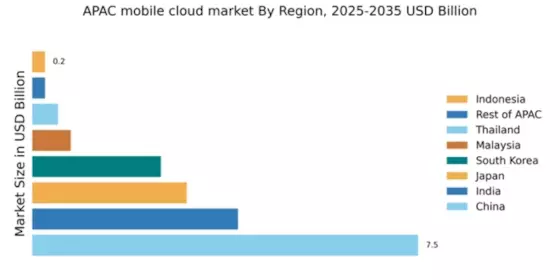
China holds a commanding 7.5% market share in the mobile cloud sector, valued at approximately $30 billion. Key growth drivers include rapid digital transformation, increased internet penetration, and government initiatives promoting cloud adoption. The demand for mobile cloud services is surging, particularly in e-commerce and fintech, supported by robust infrastructure and significant investments in technology parks and data centers.
India : Tech Adoption and Start-up Boom
India's mobile cloud market is valued at 4.0%, approximately $16 billion, driven by a burgeoning start-up ecosystem and increasing smartphone penetration. Government initiatives like Digital India are propelling cloud adoption across sectors such as healthcare and education. The demand for scalable solutions is rising, particularly in urban areas, as businesses seek to enhance operational efficiency and customer engagement.
Japan : Innovation in Cloud Solutions
Japan's mobile cloud market accounts for 3.0%, valued at around $12 billion. The growth is fueled by advancements in AI and IoT, with businesses increasingly adopting cloud solutions for data analytics and automation. Regulatory support for data privacy and security is also a significant factor. The demand for hybrid cloud solutions is particularly strong, reflecting a shift towards more flexible IT infrastructures.
South Korea : Digital Transformation in Enterprises
South Korea holds a 2.5% market share, valued at approximately $10 billion. The growth is driven by the rapid digital transformation of enterprises and government initiatives promoting smart city projects. The demand for mobile cloud services is particularly high in sectors like gaming and e-commerce. The competitive landscape features strong local players alongside global giants, fostering innovation and service diversification.
Malaysia : Government Support and Infrastructure Growth
Malaysia's mobile cloud market is valued at 0.75%, approximately $3 billion. Key growth drivers include government initiatives like the Malaysia Digital Economy Blueprint, which encourages cloud adoption across various sectors. The demand for mobile cloud services is rising, particularly in SMEs seeking cost-effective solutions. Infrastructure development, especially in urban centers like Kuala Lumpur, is enhancing service delivery and accessibility.
Thailand : Focus on Digital Economy
Thailand's mobile cloud market accounts for 0.5%, valued at around $2 billion. The growth is driven by the government's focus on the digital economy and initiatives to enhance internet connectivity. Demand for mobile cloud services is increasing in sectors like tourism and retail, as businesses seek to leverage data for better customer experiences. The competitive landscape includes both local and international players, fostering a dynamic market environment.
Indonesia : Potential for Future Growth
Indonesia's mobile cloud market is valued at 0.25%, approximately $1 billion. The growth is supported by increasing smartphone adoption and government initiatives aimed at enhancing digital infrastructure. Demand for mobile cloud services is emerging, particularly in e-commerce and logistics. The competitive landscape is evolving, with local start-ups gaining traction alongside established global players, indicating a promising future for the market.
Rest of APAC : Varied Growth Across Regions
The Rest of APAC holds a 0.25% market share, valued at around $1 billion. Growth drivers vary significantly across countries, influenced by local regulations and market maturity. Demand for mobile cloud services is emerging in sectors like education and healthcare, with varying levels of infrastructure development. The competitive landscape features a mix of local and international players, adapting to diverse market needs.
Key Players and Competitive Insights
Key Companies in the APAC Mobile Cloud Market include
Industry Developments
The APAC Mobile Cloud Market has showcased significant momentum in recent months, with notable advancements among major companies including Microsoft, Amazon Web Services, Tencent Cloud, and Alibaba Cloud. In September 2023, Microsoft unveiled new public cloud capabilities tailored to the unique needs of Asian businesses, aiming to enhance operational efficiency throughout the region. Concurrently, Alibaba Cloud is expanding its service offerings to strengthen its foothold among startups and SMEs in Southeast Asia, reflecting a broader trend of supporting local innovation.
Future Outlook
APAC Mobile Cloud Market Future Outlook
The mobile cloud market is projected to grow at 11.49% CAGR from 2025 to 2035, driven by increased mobile device usage, enhanced connectivity, and demand for scalable solutions.
New opportunities lie in:
- Development of AI-driven mobile cloud applications for real-time data analytics.
- Expansion of mobile cloud services tailored for small and medium enterprises.
- Integration of advanced security protocols in mobile cloud platforms to enhance user trust.
By 2035, the mobile cloud market is expected to achieve substantial growth, reflecting evolving technological demands.
Market Segmentation
APAC Mobile Cloud Market End Use Outlook
- Individual Users
- Small and Medium Enterprises
- Large Enterprises
APAC Mobile Cloud Market Application Outlook
- Content Delivery
- Data Storage
- Mobile Application Development
- Cloud Gaming
APAC Mobile Cloud Market Service Model Outlook
- Infrastructure as a Service
- Platform as a Service
- Software as a Service
APAC Mobile Cloud Market Deployment Model Outlook
- Public Cloud
- Private Cloud
- Hybrid Cloud
Report Scope
| MARKET SIZE 2024 | 18.75(USD Billion) |
| MARKET SIZE 2025 | 20.9(USD Billion) |
| MARKET SIZE 2035 | 62.04(USD Billion) |
| COMPOUND ANNUAL GROWTH RATE (CAGR) | 11.49% (2025 - 2035) |
| REPORT COVERAGE | Revenue Forecast, Competitive Landscape, Growth Factors, and Trends |
| BASE YEAR | 2024 |
| Market Forecast Period | 2025 - 2035 |
| Historical Data | 2019 - 2024 |
| Market Forecast Units | USD Billion |
| Key Companies Profiled | Amazon (US), Microsoft (US), Google (US), IBM (US), Oracle (US), Salesforce (US), Alibaba (CN), Tencent (CN), SAP (DE) |
| Segments Covered | Service Model, Deployment Model, Application, End Use |
| Key Market Opportunities | Integration of advanced artificial intelligence in mobile cloud services enhances user experience and operational efficiency. |
| Key Market Dynamics | Rising demand for mobile cloud services driven by technological advancements and evolving consumer preferences in APAC. |
| Countries Covered | China, India, Japan, South Korea, Malaysia, Thailand, Indonesia, Rest of APAC |
FAQs
What was the overall market valuation of the mobile cloud market in 2024?
The overall market valuation was $18.75 Billion in 2024.
What is the projected market valuation for the mobile cloud market by 2035?
The projected valuation for 2035 is $62.04 Billion.
What is the expected CAGR for the mobile cloud market during the forecast period 2025 - 2035?
The expected CAGR for the mobile cloud market during the forecast period 2025 - 2035 is 11.49%.
Which service model segment had the highest valuation in 2024?
In 2024, the Software as a Service segment had the highest valuation at $6.75 Billion.
What is the projected valuation for the Infrastructure as a Service segment by 2035?
The projected valuation for the Infrastructure as a Service segment by 2035 is $23.0 Billion.
How does the valuation of the Public Cloud segment compare to the Private Cloud segment in 2024?
In 2024, the Public Cloud segment was valued at $7.5 Billion, whereas the Private Cloud segment was valued at $5.0 Billion.
What is the projected valuation for the Mobile Application Development segment by 2035?
The projected valuation for the Mobile Application Development segment by 2035 is $20.0 Billion.
Which end-use segment is expected to have the highest valuation in 2035?
The Large Enterprises end-use segment is expected to have the highest valuation at $30.04 Billion in 2035.
What was the valuation of the Data Storage segment in 2024?
The valuation of the Data Storage segment in 2024 was $5.0 Billion.
Who are the key players in the mobile cloud market?
Key players in the mobile cloud market include Amazon, Microsoft, Google, IBM, Oracle, Salesforce, Alibaba, Tencent, and SAP.
Kindly complete the form below to receive a free sample of this Report
Customer Stories
“This is really good guys. Excellent work on a tight deadline. I will continue to use you going forward and recommend you to others. Nice job”
“Thanks. It’s been a pleasure working with you, please use me as reference with any other Intel employees.”
“Thanks for sending the report it gives us a good global view of the Betaïne market.”
“Thank you, this will be very helpful for OQS.”
“We found the report very insightful! we found your research firm very helpful. I'm sending this email to secure our future business.”
“I am very pleased with how market segments have been defined in a relevant way for my purposes (such as "Portable Freezers & refrigerators" and "last-mile"). In general the report is well structured. Thanks very much for your efforts.”
“I have been reading the first document or the study, ,the Global HVAC and FP market report 2021 till 2026. Must say, good info! I have not gone in depth at all parts, but got a good indication of the data inside!”
“We got the report in time, we really thank you for your support in this process. I also thank to all of your team as they did a great job.”