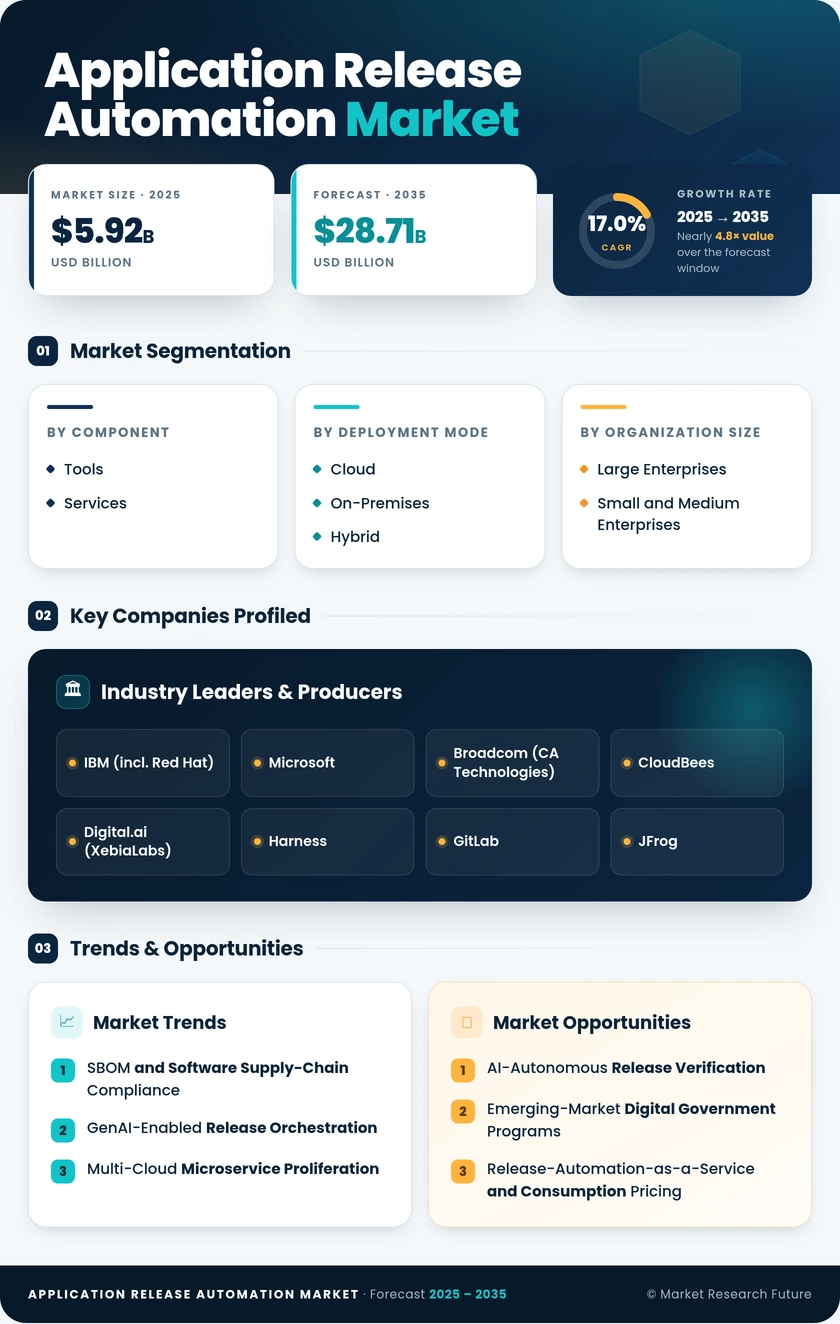
Application Release Automation Market

ID: MRFR/ICT/5660-HCR
100 Pages
Ankit Gupta
Last Updated: June 22, 2026
Application Release Automation Market Research Report By Deployment Type (On-Premises, Cloud-Based, Hybrid), By Organization Size (Small Enterprises, Medium Enterprises, Large Enterprises), By End User (IT Telecommunications, BFSI, Retail, Healthcare, Manufacturing), By Functionality (Continuous Integration, Continuous Delivery, Release Management, Deployment Automation) and By Regional (North America, Europe, South America, Asia Pacific, Middle East and Africa) - Forecast to 2035
Download PDF ×

We do not share your information with anyone. However, we may send you emails based on your report interest from time to time. You may contact us at any time to opt-out.

  1. 1 Market Overview |
    1. 1.1 Study Assumptions & Market Definition |
    2. 1.2 Scope of the Study |
    3. 1.3 Research Methodology
  2. 2 Market Summary & Key Takeaways
  3. 3 Market Dynamics |
    1. 3.1 Market Drivers Analysis | |
      1. 3.1.1 SBOM & Software Supply-Chain Compliance | |
      2. 3.1.2 GenAI-Enabled Release Orchestration | |
      3. 3.1.3 Multi-Cloud Microservice Proliferation | |
      4. 3.1.4 Platform Engineering & Internal Developer Portals | |
      5. 3.1.5 Regulatory Mandates (DORA, EO 14028) | |
      6. 3.1.6 Digital Transformation in Emerging Economies | |
      7. 3.1.7 Edge Computing Release Coordination |
    2. 3.2 Market Restraints Analysis | |
      1. 3.2.1 Integration Complexity with Legacy Systems | |
      2. 3.2.2 Toolchain Fragmentation & Vendor Lock-In | |
      3. 3.2.3 Cybersecurity Risks in Automated Pipelines | |
      4. 3.2.4 Skills Shortage in DevOps/SRE Roles | |
      5. 3.2.5 Budget Constraints Among SMEs |
    3. 3.3 Market Opportunity Analysis | |
      1. 3.3.1 AI-Autonomous Release Verification | |
      2. 3.3.2 Emerging-Market Digital Government Programs | |
      3. 3.3.3 Release-Automation-as-a-Service & Consumption Pricing | |
      4. 3.3.4 Compliance Monetization via Audit-Ready Releases | |
      5. 3.3.5 Edge and IoT Release Coordination |
    4. 3.4 Industry Value Chain Analysis |
    5. 3.5 Porter's Five Forces Analysis
  4. 4 Global Application Release Automation Market Size & Forecast (2021–2035) |
    1. 4.1 Historical Market Size (2021–2025) |
    2. 4.2 Current & Forecast Market Size (2026–2035) |
    3. 4.3 Market Size by Revenue (USD Billion) |
    4. 4.4 Year-over-Year Growth Analysis
  5. 5 Segmentation Analysis |
    1. 5.1 By Component | |
      1. 5.1.1 Tools | |
      2. 5.1.2 Services |
    2. 5.2 By Deployment Mode | |
      1. 5.2.1 Cloud | |
      2. 5.2.2 On-Premises | |
      3. 5.2.3 Hybrid |
    3. 5.3 By Organization Size | |
      1. 5.3.1 Large Enterprises | |
      2. 5.3.2 Small and Medium Enterprises |
    4. 5.4 By End-User Industry | |
      1. 5.4.1 BFSI | |
      2. 5.4.2 IT and Telecommunications | |
      3. 5.4.3 Retail and E-Commerce | |
      4. 5.4.4 Media and Entertainment | |
      5. 5.4.5 Other Verticals
  6. 6 Regional Analysis |
    1. 6.1 North America | |
      1. 6.1.1 United States | |
      2. 6.1.2 Canada | |
      3. 6.1.3 Mexico |
    2. 6.2 Europe | |
      1. 6.2.1 Germany | |
      2. 6.2.2 United Kingdom | |
      3. 6.2.3 France | |
      4. 6.2.4 Italy | |
      5. 6.2.5 Spain | |
      6. 6.2.6 Nordic Countries | |
      7. 6.2.7 Russia | |
      8. 6.2.8 Rest of Europe |
    3. 6.3 Asia-Pacific | |
      1. 6.3.1 China | |
      2. 6.3.2 India | |
      3. 6.3.3 Japan | |
      4. 6.3.4 South Korea | |
      5. 6.3.5 ASEAN | |
      6. 6.3.6 Rest of Asia-Pacific |
    4. 6.4 South America | |
      1. 6.4.1 Brazil | |
      2. 6.4.2 Argentina | |
      3. 6.4.3 Rest of South America |
    5. 6.5 Middle East & Africa | |
      1. 6.5.1 Saudi Arabia | |
      2. 6.5.2 UAE | |
      3. 6.5.3 South Africa | |
      4. 6.5.4 Egypt | |
      5. 6.5.5 Rest of MEA
  7. 7 Competitive Landscape |
    1. 7.1 Market Share Analysis (2025) |
    2. 7.2 Competitive Benchmarking Matrix |
    3. 7.3 Company Profiles | |
      1. 7.3.1 IBM (incl. Red Hat) | |
      2. 7.3.2 Microsoft | |
      3. 7.3.3 Broadcom (CA Technologies) | |
      4. 7.3.4 CloudBees | |
      5. 7.3.5 Digital.ai (XebiaLabs) | |
      6. 7.3.6 Harness | |
      7. 7.3.7 GitLab | |
      8. 7.3.8 JFrog | |
      9. 7.3.9 Puppet (Perforce) | |
      10. 7.3.10 Atlassian
  8. 8 Future Outlook & Strategic Recommendations (2026–2035) |
    1. 8.1 AI-Autonomous Operations and Self-Healing Pipelines |
    2. 8.2 Platform Economics and Developer Experience Consolidation |
    3. 8.3 Sustainability and Green Software Release Practices |
    4. 8.4 Zero-Trust Release Governance
  9. 9 Recent Developments & News
  10. 10 Frequently Asked Questions (FAQs)
  11. 11 Report Scope & Methodology |
    1. 11.1 Study Period & Base Year |
    2. 11.2 Data Sources & Citations |
    3. 11.3 Abbreviations
  12. 12 LIST OF TABLES |
  13. TABLE 1 Global Application Release Automation Market Size & Forecast, by Revenue (USD Billion), 2021–2035 |
  14. TABLE 2 Global Application Release Automation Market — Year-over-Year Growth Analysis, 2021–2035 |
  15. TABLE 3 Global Application Release Automation Market — Driver Impact Analysis |
  16. TABLE 4 Global Application Release Automation Market — Restraint Impact Analysis |
  17. TABLE 5 Global Application Release Automation Market Size, by Component, 2021–2035 (USD Billion) |
  18. TABLE 6 Global Application Release Automation Market Size, by Deployment Mode, 2021–2035 (USD Billion) |
  19. TABLE 7 Global Application Release Automation Market Size, by Organization Size, 2021–2035 (USD Billion) |
  20. TABLE 8 Global Application Release Automation Market Size, by End-User Industry, 2021–2035 (USD Billion) |
  21. TABLE 9 Global Application Release Automation Market Size, by Region, 2021–2035 (USD Billion) |
  22. TABLE 10 North America Application Release Automation Market Size, by Country, 2021–2035 (USD Billion) |
  23. TABLE 11 Europe Application Release Automation Market Size, by Country, 2021–2035 (USD Billion) |
  24. TABLE 12 Asia-Pacific Application Release Automation Market Size, by Country, 2021–2035 (USD Billion) |
  25. TABLE 13 South America Application Release Automation Market Size, by Country, 2021–2035 (USD Billion) |
  26. TABLE 14 Middle East & Africa Application Release Automation Market Size, by Country, 2021–2035 (USD Billion) |
  27. TABLE 15 Competitive Benchmarking Matrix — Global Application Release Automation Market, 2025 |
  28. TABLE 16 Company Profiles — Key Players, Global Application Release Automation Market |
  29. TABLE 17 Recent Developments & Strategic Announcements, 2023–2025 |
  30. TABLE 18 North America Application Release Automation Market Size, by Component, 2021–2035 (USD Billion) |
  31. TABLE 19 North America Application Release Automation Market Size, by Deployment Mode, 2021–2035 (USD Billion) |
  32. TABLE 20 North America Application Release Automation Market Size, by Organization Size, 2021–2035 (USD Billion) |
  33. TABLE 21 North America Application Release Automation Market Size, by End-User Industry, 2021–2035 (USD Billion) |
  34. TABLE 22 Europe Application Release Automation Market Size, by Component, 2021–2035 (USD Billion) |
  35. TABLE 23 Europe Application Release Automation Market Size, by Deployment Mode, 2021–2035 (USD Billion) |
  36. TABLE 24 Europe Application Release Automation Market Size, by Organization Size, 2021–2035 (USD Billion) |
  37. TABLE 25 Europe Application Release Automation Market Size, by End-User Industry, 2021–2035 (USD Billion) |
  38. TABLE 26 Asia-Pacific Application Release Automation Market Size, by Component, 2021–2035 (USD Billion) |
  39. TABLE 27 Asia-Pacific Application Release Automation Market Size, by Deployment Mode, 2021–2035 (USD Billion) |
  40. TABLE 28 Asia-Pacific Application Release Automation Market Size, by Organization Size, 2021–2035 (USD Billion) |
  41. TABLE 29 Asia-Pacific Application Release Automation Market Size, by End-User Industry, 2021–2035 (USD Billion) |
  42. TABLE 30 South America Application Release Automation Market Size, by Component, 2021–2035 (USD Billion) |
  43. TABLE 31 South America Application Release Automation Market Size, by Deployment Mode, 2021–2035 (USD Billion) |
  44. TABLE 32 South America Application Release Automation Market Size, by Organization Size, 2021–2035 (USD Billion) |
  45. TABLE 33 South America Application Release Automation Market Size, by End-User Industry, 2021–2035 (USD Billion) |
  46. TABLE 34 Middle East & Africa Application Release Automation Market Size, by Component, 2021–2035 (USD Billion) |
  47. TABLE 35 Middle East & Africa Application Release Automation Market Size, by Deployment Mode, 2021–2035 (USD Billion) |
  48. TABLE 36 Middle East & Africa Application Release Automation Market Size, by Organization Size, 2021–2035 (USD Billion) |
  49. TABLE 37 Middle East & Africa Application Release Automation Market Size, by End-User Industry, 2021–2035 (USD Billion) |
  50. TABLE 38 Report Scope & Methodology Summary |
  51. TABLE 39 Detailed Sources and Citations
  52. 13 LIST OF FIGURES |
  53. FIGURE 1 Application Release Automation Market Dynamics — Drivers, Restraints, and Opportunities |
  54. FIGURE 2 Application Release Automation Market — Industry Value Chain Analysis |
  55. FIGURE 3 Application Release Automation Market — Porter's Five Forces Analysis |
  56. FIGURE 4 Global Application Release Automation Market Size Trend (USD Billion), 2021–2035 |
  57. FIGURE 5 Application Release Automation Market Share, by Component (2025) |
  58. FIGURE 6 Application Release Automation Market Share, by Deployment Mode (2025) |
  59. FIGURE 7 Application Release Automation Market Share, by Organization Size (2025) |
  60. FIGURE 8 Application Release Automation Market Share, by End-User Industry (2025) |
  61. FIGURE 9 Application Release Automation Market Share, by Region (2025) |
  62. FIGURE 10 North America Application Release Automation Market — Country Share (2025) |
  63. FIGURE 11 Europe Application Release Automation Market — Country Share (2025) |
  64. FIGURE 12 Asia-Pacific Application Release Automation Market — Country CAGR Comparison (2026–2035) |
  65. FIGURE 13 South America Application Release Automation Market — Country Share (2025) |
  66. FIGURE 14 Middle East & Africa Application Release Automation Market — Country Share (2025) |
  67. FIGURE 15 Competitive Landscape — Market Share of Top 10 Players (2025)

Segmentation Quick Reference

DimensionSub-SegmentsDominant SegmentFastest Growing Segment
ComponentTools, ServicesTools (73.1% share, 2025)Services (22.8% CAGR)
Deployment ModeCloud, On-Premises, HybridCloud (63.0% share, 2025)Hybrid (21.9% CAGR)
Organization SizeLarge Enterprises, Small and Medium EnterprisesLarge Enterprises (74.2% share, 2025)SMEs (23.0% CAGR)
End-User IndustryBFSI, IT and Telecommunications, Retail and E-Commerce, Media and Entertainment, Other VerticalsIT and Telecommunications (30.0% share, 2025)BFSI (21.6% CAGR)
GeographyNorth America, Europe, Asia-Pacific, South America, Middle East & AfricaNorth America (41.0% share, 2025)Asia-Pacific (22.4% CAGR)


Market Segmentation Overview

By Component

Sub-SegmentKey Trend
ToolsAI-native orchestration engines replacing legacy script-based deployment scripts; bundling of policy-as-code and compliance modules into core platform offerings
ServicesSurge in managed release operations as enterprises outsource pipeline governance to specialized MSPs; growth in compliance advisory engagements around DORA and SBOM


The tools segment commands the majority of revenue as enterprises consolidate fragmented toolchains into unified platforms. Services growth outpaces tools as implementation complexity and regulatory requirements drive demand for specialized expertise.

By Deployment Mode

Sub-SegmentKey Trend
CloudSaaS-first procurement default for mid-market; continuous platform updates without upgrade overhead
On-PremisesSustained demand in defense, intelligence, and air-gapped industrial environments
HybridFastest-growing mode as regulated industries adopt cloud control planes with on-premises data planes


Cloud remains the dominant deployment mode, but hybrid architectures are gaining ground as financial services and healthcare organizations seek to balance agility with data-residency compliance.

By Organization Size

Sub-SegmentKey Trend
Large EnterprisesMulti-application release coordination across 500+ production apps; compliance-driven procurement
Small and Medium EnterprisesConsumption-based pricing and free-tier models lowering adoption barriers; low-code pipeline builders


Large enterprises continue to invest heavily due to the operational complexity of coordinating releases across global application portfolios. SMEs represent the faster-growing segment as vendor strategies shift to capture the long tail.

By End-User Industry

Sub-SegmentKey Trend
BFSIDORA, PCI DSS 4.0, and operational resilience mandates creating compliance-driven procurement
IT and Telecommunications5G rollouts and network-function virtualization requiring coordinated multi-vendor release cycles
Retail and E-CommercePeak-season release agility demands and microservices migration driving platform adoption
Media and EntertainmentStreaming-platform feature velocity requiring daily release cadences
Other VerticalsHealthcare digitization, government modernization, and manufacturing IoT creating new demand pockets


IT and telecommunications holds the largest revenue share, but BFSI is poised to deliver the highest growth rate as regulatory compliance transforms release automation from optional tooling into a governance prerequisite.