×
Request Free Sample ×

Kindly complete the form below to receive a free sample of this Report

* Please use a valid business email

Leading companies partner with us for data-driven Insights

clients tt-cursor
Hero Background

Applied AI in Retail & E-commerce Market

ID: MRFR/ICT/10660-HCR
128 Pages
Aarti Dhapte
October 2025

Applied AI in Retail & E-commerce Market Research Report: By Technology (Machine Learning, Natural Language Processing (NLP), Computer Vision, Speech Recognition, and Predictive Analytics), Application (Customer Service & Support, Sales & Marketing, Supply Chain Management, Price Optimization, Payment Processing, and Product Search & Discovery), Deployment (On-Premise, and Cloud-Based), End-User (Retailers, E-commerce Platforms, Consumer Goods Manufacturers, Logistics & Supply Chain Companies), By Region - Forecast Till 2... read more

Share:
Download PDF ×

We do not share your information with anyone. However, we may send you emails based on your report interest from time to time. You may contact us at any time to opt-out.

Applied AI in Retail & E-commerce Market Infographic
Purchase Options

Applied AI in Retail & E-commerce Market Summary

As per MRFR analysis, the Applied AI in Retail & E-commerce Market was estimated at 44.75 USD Billion in 2024. The Applied AI industry is projected to grow from 58.57 USD Billion in 2025 to 862.56 USD Billion by 2035, exhibiting a compound annual growth rate (CAGR) of 30.86 during the forecast period 2025 - 2035.

Key Market Trends & Highlights

The Applied AI in Retail and E-commerce Market is experiencing robust growth driven by technological advancements and evolving consumer expectations.

  • Personalization and customer engagement strategies are increasingly becoming central to retail operations, particularly in North America.
  • Supply chain optimization through AI technologies is gaining traction, especially in the Asia-Pacific region, which is witnessing rapid growth.
  • Customer service automation remains the largest segment, while personalized marketing is emerging as the fastest-growing area within the market.
  • Enhanced customer insights and the automation of operations are key drivers propelling the market forward.

Market Size & Forecast

2024 Market Size 44.75 (USD Billion)
2035 Market Size 862.56 (USD Billion)
CAGR (2025 - 2035) 30.86%

Major Players

Amazon (US), Alibaba (CN), Walmart (US), JD.com (CN), eBay (US), Target (US), Zalando (DE), Shopify (CA), Rakuten (JP)

Applied AI in Retail & E-commerce Market Trends

The Applied AI in Retail & E-commerce Market is currently experiencing a transformative phase, characterized by the integration of advanced technologies that enhance customer experiences and streamline operations. Retailers are increasingly adopting AI-driven solutions to personalize shopping experiences, optimize inventory management, and improve supply chain efficiency. This shift appears to be driven by the need for businesses to remain competitive in a rapidly evolving digital landscape. As consumer expectations continue to rise, the demand for innovative applications of AI is likely to grow, prompting retailers to invest in sophisticated tools that can analyze vast amounts of data and provide actionable insights. Moreover, the market seems to be influenced by the growing emphasis on sustainability and ethical practices. Retailers are exploring AI technologies that not only enhance profitability but also contribute to environmental goals. This dual focus on efficiency and sustainability may lead to the development of new business models that prioritize responsible consumption. As the Applied AI in Retail & E-commerce Market evolves, it is expected that collaboration between technology providers and retailers will intensify, fostering an ecosystem that supports continuous innovation and adaptation to changing consumer behaviors.

Personalization and Customer Engagement

The trend towards personalization is becoming increasingly pronounced, as retailers leverage AI to tailor experiences to individual preferences. By analyzing customer data, businesses can create targeted marketing campaigns and recommend products that align with consumer interests, thereby enhancing engagement and loyalty.

Supply Chain Optimization

AI technologies are being utilized to streamline supply chain processes, enabling retailers to predict demand more accurately and manage inventory effectively. This optimization not only reduces costs but also ensures that products are available when and where they are needed, improving overall operational efficiency.

Sustainability Initiatives

There is a growing trend towards integrating sustainability into retail strategies, with AI playing a crucial role. Retailers are employing AI to analyze environmental impacts and develop strategies that promote sustainable practices, appealing to a more environmentally conscious consumer base.

Applied AI in Retail & E-commerce Market Drivers

Market Growth Projections

The Global Applied AI in Retail and E-commerce Market Industry is poised for remarkable growth, with projections indicating a market value of 44.7 USD Billion in 2024 and an anticipated surge to 862.5 USD Billion by 2035. This growth trajectory reflects a compound annual growth rate of 30.88% from 2025 to 2035, highlighting the increasing adoption of AI technologies across the retail sector. As businesses continue to recognize the transformative potential of AI, the market is likely to expand significantly, driven by advancements in technology, consumer demand for personalization, and the need for efficient supply chain management.

Enhanced Supply Chain Management

Efficient supply chain management is crucial for the success of the Global Applied AI in Retail and E-commerce Market Industry. AI technologies enable retailers to optimize inventory levels, forecast demand accurately, and streamline logistics. For example, predictive analytics can help businesses anticipate stock shortages and adjust procurement strategies accordingly. This optimization not only reduces operational costs but also enhances customer satisfaction by ensuring product availability. As the market evolves, the integration of AI in supply chain processes is expected to drive significant growth, with a projected compound annual growth rate of 30.88% from 2025 to 2035.

Rapid Technological Advancements

The Global Applied AI in Retail and E-commerce Market Industry is experiencing rapid technological advancements that enhance operational efficiency and customer experience. Innovations in machine learning, natural language processing, and computer vision are transforming how retailers interact with consumers. For instance, AI-driven chatbots are now commonplace, providing 24/7 customer service and personalized recommendations. This technological evolution is projected to drive the market's growth, with the industry expected to reach 44.7 USD Billion in 2024. As these technologies continue to evolve, they are likely to create new opportunities for retailers to optimize their supply chains and improve customer engagement.

Emergence of Omnichannel Retailing

The emergence of omnichannel retailing is reshaping the Global Applied AI in Retail and E-commerce Market Industry. Retailers are increasingly adopting a seamless approach to integrate online and offline shopping experiences, which is facilitated by AI technologies. By utilizing AI for data analysis, businesses can better understand consumer behavior across multiple channels and tailor their marketing strategies accordingly. This integration not only enhances customer engagement but also drives sales growth. As the market adapts to this omnichannel approach, it is likely to witness substantial growth, with projections indicating a market value of 862.5 USD Billion by 2035.

Growing Investment in AI Technologies

Investment in AI technologies is a key driver of the Global Applied AI in Retail and E-commerce Market Industry. Retailers are increasingly allocating resources to develop and implement AI solutions that enhance their operational capabilities. This trend is evidenced by the rising number of partnerships between technology firms and retail businesses aimed at harnessing AI for various applications, from customer service to inventory management. As companies recognize the potential return on investment from AI integration, funding for AI initiatives is expected to surge, further propelling market growth. The industry's value is anticipated to reach 44.7 USD Billion in 2024, reflecting this growing investment trend.

Increased Consumer Demand for Personalization

Consumer demand for personalized shopping experiences is a significant driver in the Global Applied AI in Retail and E-commerce Market Industry. Shoppers increasingly expect tailored recommendations and experiences that cater to their individual preferences. Retailers are leveraging AI algorithms to analyze consumer data and deliver personalized content, which has been shown to enhance customer satisfaction and loyalty. As a result, businesses that adopt AI-driven personalization strategies are likely to see increased sales and customer retention. This trend is expected to contribute to the market's growth, with projections indicating a substantial increase in market value, reaching 862.5 USD Billion by 2035.

Market Segment Insights

By Application: Customer Service Automation (Largest) vs. Personalized Marketing (Fastest-Growing)

Within the Applied AI in Retail & E-commerce market, Customer Service Automation holds the largest share among the application segments, reflecting retailers' commitment to enhancing customer interaction efficiency. This segment utilizes AI-driven chatbots and virtual assistants, allowing businesses to reduce operational costs while improving service quality. Conversely, Personalized Marketing is rapidly emerging as a key player in the industry, leveraging data analytics and machine learning to tailor marketing messages to individual customers, thereby significantly increasing conversion rates and customer engagement.

Customer Service Automation (Dominant) vs. Personalized Marketing (Emerging)

Customer Service Automation is a dominant force in the Applied AI in Retail & E-commerce market, providing crucial services such as 24/7 support, query resolution, and feedback collection. Its integration helps retailers streamline operations and significantly enhance customer experience. In contrast, Personalized Marketing represents an emerging trend, utilizing AI technologies to analyze consumer behavior and preferences to deliver personalized recommendations and advertisements. This evolving application not only boosts customer satisfaction but also drives sales growth, making it essential for retailers aiming to establish deeper connections with their clientele.

By Technology: Machine Learning (Largest) vs. Natural Language Processing (Fastest-Growing)

In the Applied AI in Retail & E-commerce Market, Machine Learning holds the largest share, leveraging large data sets to enhance customer personalization and operational efficiency. Natural Language Processing is emerging rapidly, utilizing text data to improve customer interactions and automate responses. Computer Vision, Robotic Process Automation, and Predictive Analytics also contribute, but they are yet to reach the same prominence as the top two segments.

Machine Learning: Dominant vs. Natural Language Processing: Emerging

Machine Learning (ML) stands as the cornerstone of the Applied AI segment, dominating current applications with its ability to analyze vast datasets for actionable insights, enabling retailers to optimize inventory and tailor marketing strategies. In contrast, Natural Language Processing (NLP) is gaining momentum as the fastest-growing area, transforming customer engagement through chatbots and automated support systems that comprehend and respond in human-like manners. While ML continues to refine existing processes, NLP is enhancing customer experience and operational capabilities, marking its importance in modern retail and e-commerce.

By End Use: Online Retail (Largest) vs. Marketplaces (Fastest-Growing)

The Applied AI in Retail & E-commerce market is significantly shaped by various end-use segments, with online retail holding the largest share. This segment benefits from increased consumer preference for digital shopping experiences and the enhancement of personalized recommendations driven by AI. Brick-and-mortar retail, while still relevant, lags in market share due to the shift towards online counterparts, although it maintains a crucial role in customer experience. Wholesale distribution and e-commerce platforms follow, with marketplaces rapidly gaining ground due to their ability to cater to diverse consumer needs effectively. The growth trends across these segments highlight a robust transformation in the retail landscape. Online retail continues to evolve as consumers seek seamless shopping experiences, while marketplaces are emerging as the fastest-growing due to their dynamic nature and competitive pricing strategies. Innovations in AI such as chatbots and inventory management are driving efficiency across all end-use segments, making them more appealing to both retailers and customers. As consumer habits continue to shift and technology advances, these segments will adapt to meet evolving demands, further influencing market dynamics.

E-commerce Platforms (Dominant) vs. Brick-and-Mortar Retail (Emerging)

E-commerce platforms remain dominant in the Applied AI in Retail & E-commerce market, characterized by their extensive reach and capability to leverage AI for enhancing user experience through personalized recommendations and automated customer engagement. These platforms harness vast amounts of consumer data to optimize product offerings and streamline operations. In contrast, brick-and-mortar retail is emerging, focusing on integrating AI to create a harmonious omnichannel experience for customers. Physical stores are now utilizing AI for in-store analytics and inventory management, adapting to consumer expectations in a post-pandemic world. Despite the challenges posed by online competition, brick-and-mortar retailers are striving to leverage technology to enhance customer engagement and loyalty.

Get more detailed insights about Applied AI in Retail & E-commerce Market

Regional Insights

North America : Innovation Hub for Retail AI

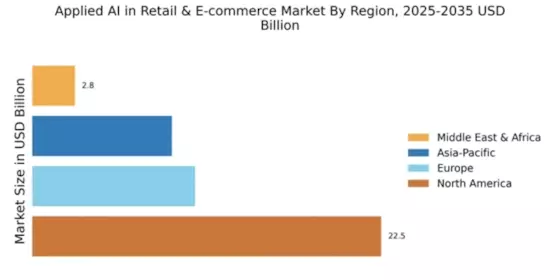
North America is poised to maintain its dominance in the Applied AI in Retail & E-commerce market, holding a significant market share of 22.5 in 2024. The region's growth is driven by rapid technological advancements, increasing consumer demand for personalized shopping experiences, and supportive regulatory frameworks. Companies are leveraging AI to enhance operational efficiency and customer engagement, making it a fertile ground for innovation. The competitive landscape is characterized by major players such as Amazon, Walmart, and eBay, who are investing heavily in AI technologies. The U.S. leads the charge, with Canada also emerging as a key player in the AI retail space. The presence of tech giants and a robust startup ecosystem further solidifies North America's position as a leader in Applied AI, fostering a culture of continuous improvement and adaptation.

Europe : Emerging Powerhouse in AI

Europe is rapidly evolving into a significant player in the Applied AI in Retail & E-commerce market, with a market size of 10.5. The region benefits from a strong regulatory environment that encourages innovation while ensuring consumer protection. Factors such as increasing online shopping trends and the demand for enhanced customer experiences are driving growth. European retailers are increasingly adopting AI solutions to optimize supply chains and personalize marketing strategies. Leading countries like Germany, the UK, and France are at the forefront of this transformation, with companies like Zalando and Shopify making substantial investments in AI technologies. The competitive landscape is diverse, with both established retailers and innovative startups vying for market share. As Europe continues to embrace AI, it is set to play a crucial role in shaping the future of retail and e-commerce.

Asia-Pacific : Dynamic Growth in Retail AI

The Asia-Pacific region is witnessing a dynamic shift in the Applied AI in Retail & E-commerce market, with a market size of 9.0. The growth is fueled by increasing internet penetration, mobile commerce, and a tech-savvy consumer base. Countries like China and Japan are leading the charge, supported by favorable government policies that promote digital transformation. The demand for AI-driven solutions is growing as retailers seek to enhance customer experiences and streamline operations. China, with giants like Alibaba and JD.com, is at the forefront of AI adoption in retail, while Japan's Rakuten is also making significant strides. The competitive landscape is characterized by rapid innovation and collaboration between tech firms and retailers. As the region continues to evolve, the integration of AI technologies is expected to reshape the retail landscape significantly.

Middle East and Africa : Emerging Market for AI Solutions

The Middle East and Africa (MEA) region is emerging as a promising market for Applied AI in Retail & E-commerce, with a market size of 2.75. The growth is driven by increasing smartphone penetration, a young population, and rising e-commerce activities. Governments in the region are also recognizing the potential of AI, implementing policies to foster innovation and attract investment in technology sectors. Countries like South Africa and the UAE are leading the way in AI adoption, with local retailers beginning to explore AI solutions for enhancing customer engagement and operational efficiency. The competitive landscape is still developing, with both local and international players entering the market. As the region continues to invest in AI technologies, it is poised for significant growth in the retail sector.

Key Players and Competitive Insights

The Applied AI in Retail & E-commerce Market is characterized by a rapidly evolving competitive landscape, driven by technological advancements and shifting consumer preferences. Major players such as Amazon (US), Alibaba (CN), and Walmart (US) are at the forefront, leveraging AI to enhance customer experiences and streamline operations. Amazon (US) continues to innovate with its AI-driven recommendation systems, while Alibaba (CN) focuses on integrating AI into its logistics and supply chain management. Walmart (US) emphasizes digital transformation through AI applications in inventory management and personalized marketing, collectively shaping a competitive environment that prioritizes efficiency and customer engagement.

The market structure appears moderately fragmented, with key players employing various business tactics to optimize their operations. Localizing manufacturing and enhancing supply chain efficiency are prevalent strategies among these companies. The collective influence of these major players fosters a competitive atmosphere where agility and responsiveness to market demands are crucial for success.

In November 2025, Amazon (US) announced the launch of its AI-powered virtual shopping assistant, designed to enhance customer interaction and streamline the purchasing process. This strategic move underscores Amazon's commitment to integrating advanced AI technologies to improve user experience and drive sales. The introduction of this assistant is likely to reinforce Amazon's market position by providing a more personalized shopping experience, which could lead to increased customer loyalty.

In October 2025, Alibaba (CN) unveiled its AI-driven smart logistics platform, aimed at optimizing delivery routes and reducing operational costs. This initiative reflects Alibaba's focus on enhancing its supply chain capabilities through AI, potentially leading to faster delivery times and improved customer satisfaction. The strategic importance of this development lies in its ability to position Alibaba as a leader in logistics efficiency, which is increasingly vital in the competitive e-commerce landscape.

In September 2025, Walmart (US) expanded its partnership with AI technology firms to enhance its predictive analytics capabilities. This collaboration aims to refine inventory management and demand forecasting, which are critical for maintaining operational efficiency. By investing in AI-driven analytics, Walmart is likely to improve its responsiveness to consumer trends, thereby solidifying its competitive edge in the retail sector.

As of December 2025, current trends in the Applied AI in Retail & E-commerce Market indicate a strong emphasis on digitalization, sustainability, and AI integration. Strategic alliances among key players are shaping the landscape, fostering innovation and collaboration. The shift from price-based competition to a focus on technological advancement and supply chain reliability is evident. Companies that prioritize innovation and customer-centric solutions are likely to thrive, as the market continues to evolve towards a more sophisticated and technology-driven future.

Key Companies in the Applied AI in Retail & E-commerce Market market include

Industry Developments

August 2023:The Singapore MIT-Alliance for Research and Technology (SMART), a research enterprise in Singapore, has launched a new interdisciplinary research group working on rise of artificial intelligence and other new technologies. 

September 2023:Zomato, a leading online meal delivery service, has introduced ‘Zomato AI’, an interactive chatbot to make food ordering process more convenient & personalized.

Future Outlook

Applied AI in Retail & E-commerce Market Future Outlook

The Applied AI in Retail & E-commerce Market is projected to grow at a 30.86% CAGR from 2024 to 2035, driven by enhanced customer personalization, operational efficiency, and data analytics advancements.

New opportunities lie in:

  • Automated inventory management systems leveraging AI for real-time stock optimization.
  • AI-driven customer insights platforms to enhance targeted marketing strategies.
  • Personalized shopping experiences through AI chatbots and virtual assistants.

By 2035, the market is expected to be a cornerstone of retail innovation and efficiency.

Market Segmentation

Applied AI in Retail & E-commerce Market End Use Outlook

  • Online Retail
  • Brick-and-Mortar Retail
  • Wholesale Distribution
  • E-commerce Platforms
  • Marketplaces

Applied AI in Retail & E-commerce Market Technology Outlook

  • Machine Learning
  • Natural Language Processing
  • Computer Vision
  • Robotic Process Automation
  • Predictive Analytics

Applied AI in Retail & E-commerce Market Application Outlook

  • Customer Service Automation
  • Personalized Marketing
  • Inventory Management
  • Fraud Detection
  • Supply Chain Optimization

Report Scope

MARKET SIZE 202444.75(USD Billion)
MARKET SIZE 202558.57(USD Billion)
MARKET SIZE 2035862.56(USD Billion)
COMPOUND ANNUAL GROWTH RATE (CAGR)30.86% (2024 - 2035)
REPORT COVERAGERevenue Forecast, Competitive Landscape, Growth Factors, and Trends
BASE YEAR2024
Market Forecast Period2025 - 2035
Historical Data2019 - 2024
Market Forecast UnitsUSD Billion
Key Companies ProfiledAmazon (US), Alibaba (CN), Walmart (US), JD.com (CN), eBay (US), Target (US), Zalando (DE), Shopify (CA), Rakuten (JP)
Segments CoveredApplication, Technology, End Use
Key Market OpportunitiesIntegration of personalized shopping experiences through advanced predictive analytics in Applied AI in Retail and E-commerce Market.
Key Market DynamicsRising integration of artificial intelligence enhances customer personalization and operational efficiency in retail and e-commerce.
Countries CoveredNorth America, Europe, APAC, South America, MEA

Market Highlights

Author
Aarti Dhapte
Team Lead - Research

She holds an experience of about 6+ years in Market Research and Business Consulting, working under the spectrum of Information Communication Technology, Telecommunications and Semiconductor domains. Aarti conceptualizes and implements a scalable business strategy and provides strategic leadership to the clients. Her expertise lies in market estimation, competitive intelligence, pipeline analysis, customer assessment, etc.

Leave a Comment

FAQs

How much is the Applied AI in Retail & E-commerce Market?

The Applied AI in Retail & E-commerce Market size was valued at USD 44.75 billion in 2024.

What is the growth rate of the Applied AI in Retail & E-commerce Market?

The global market is projected to grow at a CAGR of 30.86% during the forecast period, 2025-2034.

Which region held the largest market share in the Applied AI in Retail & E-commerce Market?

North America had the largest share in the Applied AI in Retail & E-commerce Market.

Who are the key players in the Applied AI in Retail & E-commerce Market?

The key players in the market are Quantifind, OpenAI, Accenture, DataRobot, SAS, IBM, Microsoft, Adobe, NVIDIA, Intel, Google, Amazon, and other market players.

Which Technology Type led the Applied AI in Retail & E-commerce Market?

Machine Learning dominated the market in 2024.

Which application had the largest market share in the Applied AI in Retail & E-commerce Market?

The Customer Service & Support application had the largest share in the global market.

Download Free Sample

Kindly complete the form below to receive a free sample of this Report

Compare Licence

×
Features License Type
Single User Multiuser License Enterprise User
Price $4,950 $5,950 $7,250
Maximum User Access Limit 1 User Upto 10 Users Unrestricted Access Throughout the Organization
Free Customization
Direct Access to Analyst
Deliverable Format
Platform Access
Discount on Next Purchase 10% 15% 15%
Printable Versions