×
Request Free Sample ×

Kindly complete the form below to receive a free sample of this Report

Leading companies partner with us for data-driven Insights

clients tt-cursor
Hero Background

Artificial Intelligence In Bfsi Market

ID: MRFR/BS/23083-HCR
200 Pages
Aarti Dhapte
October 2025

Artificial Intelligence in BFSI Market Research Report By Type (AI-Powered Chatbots and Virtual Assistants, Robo-Advisory and Financial Planning, Fraud Detection and Prevention, Risk Management and Compliance, Process Automation and Efficiency), By Application (Customer Service and Onboarding, Loan and Underwriting, Wealth Management and Investment, Risk and Compliance Management, Operations and Back-Office Functions), By Deployment Model (On-Premise, Cloud, Software as a Service (SaaS), Hybrid), By Technology (Machine Learning, Deep Learnin... read more

Share:
Download PDF ×

We do not share your information with anyone. However, we may send you emails based on your report interest from time to time. You may contact us at any time to opt-out.

Artificial Intelligence In Bfsi Market Infographic
Purchase Options

Artificial Intelligence In Bfsi Market Summary

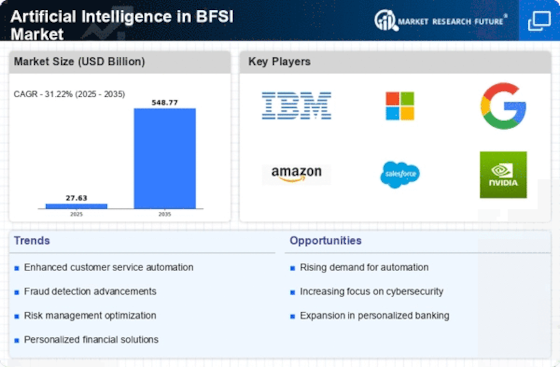
As per MRFR analysis, the Artificial Intelligence in BFSI Market was estimated at 27.63 USD Billion in 2024. The Artificial Intelligence in BFSI industry is projected to grow from 36.26 USD Billion in 2025 to 548.77 USD Billion by 2035, exhibiting a compound annual growth rate (CAGR) of 31.22 during the forecast period 2025 - 2035.

Key Market Trends & Highlights

The Artificial Intelligence in BFSI Market is experiencing robust growth driven by technological advancements and evolving customer expectations.

  • North America remains the largest market for AI in BFSI, showcasing a strong demand for innovative financial solutions.
  • AI-powered chatbots and virtual assistants dominate the market, enhancing customer service and onboarding processes.
  • The Asia-Pacific region is the fastest-growing market, reflecting a surge in digital banking and financial technology adoption.
  • Key market drivers include regulatory compliance and risk mitigation, alongside the increasing need for data-driven decision making.

Market Size & Forecast

2024 Market Size 27.63 (USD Billion)
2035 Market Size 548.77 (USD Billion)
CAGR (2025 - 2035) 31.22%

Major Players

IBM (US), Microsoft (US), Google (US), Amazon (US), Salesforce (US), NVIDIA (US), Citi (US), JP Morgan Chase (US), Accenture (IE)

Artificial Intelligence In Bfsi Market Trends

The Artificial Intelligence in BFSI Market is currently experiencing a transformative phase, characterized by the integration of advanced technologies that enhance operational efficiency and customer engagement. Financial institutions are increasingly adopting AI-driven solutions to streamline processes, mitigate risks, and personalize services. This shift appears to be driven by the need for improved decision-making capabilities and the demand for enhanced customer experiences. As organizations navigate a rapidly evolving landscape, the emphasis on data analytics and machine learning is becoming more pronounced, suggesting a potential for significant growth in this sector. Moreover, the ongoing evolution of regulatory frameworks and the increasing focus on cybersecurity are shaping the deployment of AI technologies within the BFSI sector. Institutions are likely to invest in AI solutions that not only comply with regulations but also bolster their defenses against emerging threats. This dual focus on compliance and security indicates a strategic approach to leveraging AI, which may ultimately redefine the competitive dynamics within the market. As the landscape continues to evolve, the Artificial Intelligence in BFSI Market is poised for further advancements, driven by innovation and a commitment to enhancing service delivery.

Enhanced Customer Experience

The integration of AI technologies is revolutionizing customer interactions within the BFSI sector. Financial institutions are utilizing chatbots and virtual assistants to provide real-time support, thereby improving customer satisfaction and engagement. This trend indicates a shift towards more personalized services, as AI systems analyze customer data to tailor offerings.

Risk Management and Fraud Detection

AI is playing a crucial role in enhancing risk management strategies and fraud detection mechanisms. By employing machine learning algorithms, financial institutions can identify unusual patterns and potential threats more effectively. This proactive approach to risk management suggests a growing reliance on AI to safeguard assets and maintain trust.

Operational Efficiency and Cost Reduction

The adoption of AI technologies is streamlining various operational processes within the BFSI sector. Automation of routine tasks allows institutions to allocate resources more effectively, leading to cost reductions. This trend highlights the potential for AI to transform traditional workflows, making them more efficient and responsive.

Artificial Intelligence In Bfsi Market Drivers

Data-Driven Decision Making

The proliferation of data within the BFSI sector has created an urgent need for advanced analytical tools. Artificial Intelligence in BFSI Market enables institutions to harness this data effectively, transforming it into actionable insights. By employing machine learning algorithms, financial organizations can analyze customer behavior, market trends, and operational efficiencies. This data-driven approach facilitates informed decision-making, allowing institutions to tailor their services to meet customer needs more precisely. According to recent estimates, organizations utilizing AI for data analytics have reported a 20% increase in operational efficiency. As the volume of data continues to expand, the reliance on AI for strategic decision-making is expected to intensify, further embedding Artificial Intelligence in BFSI Market into the core of financial operations.

Enhanced Cybersecurity Measures

As cyber threats continue to evolve, the BFSI sector faces increasing pressure to bolster its cybersecurity defenses. Artificial Intelligence in BFSI Market offers advanced solutions to detect and respond to potential threats in real-time. AI systems can analyze patterns in network traffic and user behavior to identify anomalies that may indicate a security breach. This proactive approach to cybersecurity not only protects sensitive financial data but also instills confidence among customers. With the global cost of cybercrime projected to reach trillions of dollars, investing in AI-driven cybersecurity measures is becoming imperative for financial institutions. The integration of AI into cybersecurity strategies is likely to redefine how the BFSI sector approaches risk management, making Artificial Intelligence in BFSI Market a cornerstone of modern security frameworks.

Operational Automation and Efficiency

The drive towards operational efficiency is a primary motivator for the adoption of Artificial Intelligence in BFSI Market. Financial institutions are increasingly leveraging AI technologies to automate routine tasks, such as data entry, transaction processing, and customer service inquiries. This automation not only reduces operational costs but also minimizes the potential for human error. For instance, chatbots powered by AI can handle customer queries 24/7, freeing up human resources for more complex tasks. Reports indicate that organizations implementing AI-driven automation have experienced a 30% reduction in processing times. As the pressure to enhance efficiency intensifies, the role of Artificial Intelligence in BFSI Market is expected to expand, driving innovation and productivity across the sector.

Personalization of Financial Services

The demand for personalized financial services is on the rise, driven by changing consumer expectations. Artificial Intelligence in BFSI Market plays a pivotal role in enabling institutions to offer tailored products and services. By analyzing customer data, AI can identify individual preferences and behaviors, allowing for the customization of financial solutions. This personalization enhances customer satisfaction and loyalty, as clients feel their unique needs are being addressed. For example, AI algorithms can recommend investment strategies based on a client's financial history and risk tolerance. As competition intensifies, the ability to deliver personalized experiences will likely become a key differentiator for financial institutions, underscoring the importance of Artificial Intelligence in BFSI Market.

Regulatory Compliance and Risk Mitigation

The increasing complexity of regulatory frameworks in the BFSI sector necessitates the adoption of Artificial Intelligence in BFSI Market. Financial institutions are compelled to comply with stringent regulations, which often require extensive data analysis and reporting. AI technologies can automate compliance processes, thereby reducing the risk of human error and enhancing accuracy. For instance, AI-driven solutions can analyze vast amounts of transaction data to identify anomalies that may indicate non-compliance. This capability not only streamlines compliance efforts but also mitigates potential financial penalties. As regulatory bodies continue to evolve their requirements, the demand for AI solutions that ensure adherence to these regulations is likely to grow, positioning Artificial Intelligence in BFSI Market as a critical component of risk management strategies.


Market Segment Insights

By Type: AI-Powered Chatbots and Virtual Assistants (Largest) vs. Robo-Advisory and Financial Planning (Fastest-Growing)

In the Artificial Intelligence in BFSI market, the segmentation reveals distinct values with varied market shares, with AI-Powered Chatbots and Virtual Assistants dominating due to their broad acceptance in customer service applications. These tools enhance efficiency and client interactions, representing a significant portion of the market. Conversely, Robo-Advisory and Financial Planning solutions are capturing attention for their rapid growth, as they offer personalized financial advice at scale, appealing particularly to tech-savvy consumers and younger demographics.

AI-Powered Chatbots and Virtual Assistants (Dominant) vs. Robo-Advisory and Financial Planning (Emerging)

AI-Powered Chatbots and Virtual Assistants have established a strong foothold in the BFSI sector by automating customer interactions and streamlining support services. Their ability to provide immediate assistance and handle inquiries efficiently has made them indispensable for financial institutions, leading to improved client satisfaction and loyalty. On the other hand, Robo-Advisory and Financial Planning is an emerging domain, primarily attracting younger consumers seeking cost-effective investment solutions. These platforms leverage algorithms for tailored financial advice, thus democratizing access to financial planning and investment management, making them increasingly relevant in today’s digital age.

By Application: Customer Service and Onboarding (Largest) vs. Risk and Compliance Management (Fastest-Growing)

In the Artificial Intelligence in BFSI Market, 'Customer Service and Onboarding' holds the largest market share, primarily due to the increasing demand for personalized customer interactions and streamlined onboarding processes. This segment leverages AI technologies such as chatbots and virtual assistants to enhance customer experiences, making it a preferred choice among financial institutions. Meanwhile, 'Risk and Compliance Management' is gaining traction as the fastest-growing segment, driven by escalating regulatory requirements and the need for automated compliance processes. Financial institutions are increasingly turning to AI solutions to efficiently manage risks and ensure compliance, leading to significant growth in this area.

Customer Service and Onboarding (Dominant) vs. Risk and Compliance Management (Emerging)

The 'Customer Service and Onboarding' application is characterized by its dominant position, being at the forefront of technological adoption within banks and financial services. AI-driven solutions in this segment facilitate enhanced customer interactions and data handling, translating into higher customer satisfaction and retention rates. Conversely, 'Risk and Compliance Management' is viewed as an emerging segment that is rapidly evolving. The rising complexity of regulations and the implementation of AI to automate detection and reporting of anomalies put this segment in a prime position for growth. The integration of machine learning models allows for predictive risk analysis, positioning financial institutions to be proactive rather than reactive in managing compliance challenges.

By Deployment Model: Cloud (Largest) vs. Hybrid (Fastest-Growing)

In the Artificial Intelligence in BFSI Market, the deployment model showcases a significant variation in market share among its key segments: On-Premise, Cloud, Software as a Service (SaaS), and Hybrid. The Cloud segment holds the largest share, driven by its flexibility and scalability, allowing financial institutions to leverage AI technologies efficiently. Meanwhile, the Hybrid model is gaining momentum, appealing to organizations that prefer a balanced approach merging on-premise solutions with cloud capabilities to meet their regulatory and operational needs. Growth trends in this segment are propelled by increasing adoption of cloud-based services that support advanced AI applications, reducing costs and improving access to data analytics. The Hybrid model is emerging as a competitive choice, providing an optimal blend of control and accessibility, while Software as a Service (SaaS) is being embraced for its ease of implementation. These trends highlight a shift towards more adaptable deployment models as organizations seek to enhance their AI capabilities while managing costs and compliance.

Cloud (Dominant) vs. Hybrid (Emerging)

The Cloud deployment model stands as the dominant player in the AI in BFSI sector, offering unmatched scalability and cost-effectiveness for financial institutions. Businesses are increasingly recognizing the value of cloud solutions, which provide the necessary infrastructure to support complex AI applications and vast data processing requirements. This segment allows for rapid deployment and innovation, aligning well with the dynamic nature of the BFSI market. On the other hand, the Hybrid deployment model is emerging as a compelling alternative, particularly for organizations that require the security of on-premise solutions combined with the flexibility of cloud-based systems. The hybrid approach enables these institutions to retain control over sensitive data while still leveraging the enhanced capabilities of cloud technology, thus fostering a strategic balance that meets both operational and regulatory needs.

By Technology: Machine Learning (Largest) vs. Deep Learning (Fastest-Growing)

In the Artificial Intelligence in BFSI market, Machine Learning leads in market share, driven by its widespread adoption for risk assessment, fraud detection, and customer service enhancements. The segment's dominance allows financial institutions to process vast amounts of data efficiently, significantly minimizing operational costs and improving decision-making capabilities. On the other hand, Deep Learning, which leverages neural networks to analyze complex data sets, is the fastest-growing segment. Its capabilities in real-time data processing and predictive analytics are increasingly sought after in the BFSI sector, enabling institutions to enhance customer experiences and optimize financial services effectively.

Machine Learning (Dominant) vs. Deep Learning (Emerging)

Machine Learning is the dominant technology in the Artificial Intelligence in BFSI market, offering robust tools for data analysis, customer insights, and operational efficiency. Financial institutions utilize Machine Learning algorithms to detect fraudulent activities and enhance customer engagement while improving their risk management processes. Meanwhile, Deep Learning is an emerging force, known for its ability to process unstructured data and derive insights from complex data patterns. Its growing application in areas such as automated trading and credit scoring is driving its rapid adoption. Together, these technologies shape the future landscape of financial services, pushing boundaries in innovation and efficiency.

By Organization Size: Large Enterprises (Largest) vs. Small and Medium-Sized Enterprises (Fastest-Growing)

In the Artificial Intelligence in BFSI market, the distribution of market share among different organization sizes reflects a significant trend towards technology adoption. Large Enterprises currently hold the largest share, leveraging their substantial resources and existing infrastructure to integrate AI solutions effectively. Meanwhile, Small and Medium-Sized Enterprises (SMEs) are rapidly embracing AI capabilities, fueled by the increasing availability of affordable solutions tailored to their needs. This shift enables SMEs to enhance operational efficiency and customer engagement, making them an essential player in the market. As AI technology becomes more accessible, SMEs are emerging as the fastest-growing segment within the BFSI landscape. Key growth drivers include advancements in cloud computing and AI-as-a-Service models, which allow smaller organizations to implement sophisticated AI tools without heavy capital investment. Moreover, the rising demand for personalized financial services among consumers fosters SME innovation, enabling them to compete with larger counterparts and capitalize on niche markets.

Large Enterprises (Dominant) vs. Financial Institutions (Emerging)

Large Enterprises in the Artificial Intelligence in BFSI market demonstrate dominance due to their extensive resources, established customer bases, and advanced technological infrastructures. These organizations invest significantly in AI initiatives, leading to improved operational efficiencies and enhanced decision-making processes. On the other hand, Financial Institutions are emerging as a pivotal player in this segment, increasingly adopting AI strategies to manage risks and optimize customer experiences. While traditionally slower to adopt new technologies, Financial Institutions are now recognizing the potential of AI to drive innovation, streamline processes, and meet evolving consumer expectations. Their commitment to thorough regulatory compliance and risk management further aligns with AI's capabilities, positioning them as a crucial segment in the future growth of AI within the BFSI sector.

Get more detailed insights about Artificial Intelligence In Bfsi Market

Regional Insights

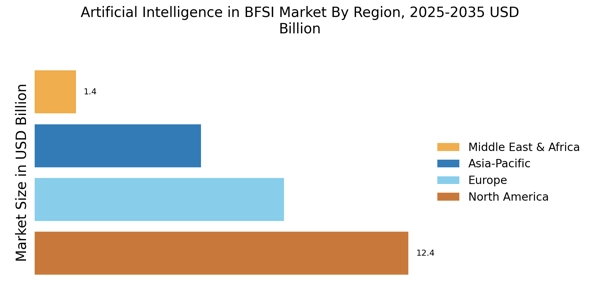
The Artificial Intelligence in BFSI Market is segmented into North America, Europe, APAC, South America, and MEA. North America is expected to hold the largest market share in 2023, with a revenue of 15.48 billion USD. The region's dominance is attributed to the presence of a large number of established financial institutions, a high adoption rate of AI technologies, and government support for innovation. Europe is expected to be the second-largest market, with a revenue of 10.32 billion USD in 2023.

The region has a strong financial sector and is home to some of the world's leading banks and insurance companies.APAC is expected to be the fastest-growing market, with a CAGR of 32.45% from 2023 to 2032. The region's growth is driven by the increasing adoption of AI in financial services, rising disposable income, and government initiatives to promote financial inclusion. South America and MEA are expected to be smaller markets, but they are also expected to experience significant growth in the coming years.

Artificial Intelligence In Bfsi Market Regional Insights

Source: Primary Research, Secondary Research, MRFR Database and Analyst Review

Artificial Intelligence In Bfsi Market Regional Image

Key Players and Competitive Insights

Major players in Artificial Intelligence In Bfsi Market industry are constantly engaging in mergers and acquisitions to gain a competitive edge in the Artificial Intelligence In Bfsi Market. Leading Artificial Intelligence in BFSI Market players are focusing on research and development to develop innovative solutions. Artificial Intelligence In Bfsi Market vendors are also investing in strategic partnerships to expand their reach and customer base. The Artificial Intelligence In Bfsi Market development is being driven by the increasing adoption of AI technologies in the financial sector. AI is being used to automate tasks, improve customer service, and detect fraud.

Artificial Intelligence in BFSI industry is expected to witness significant growth in the coming years due to the increasing demand for AI-powered solutions in the financial sector. A leading company in the Artificial Intelligence In Bfsi Market is IBM. IBM offers a comprehensive suite of AI solutions for the financial sector, including solutions for fraud detection, risk management, and customer service. IBM's AI solutions are used by leading financial institutions around the world. Another leading player in the Artificial Intelligence in BFSI Market is Infosys.

Infosys offers a range of AI solutions for the financial sector, including solutions for data analytics, machine learning, and deep learning. Infosys' AI solutions are used by leading financial institutions around the world. A competitor company in the Artificial Intelligence in BFSI Market is SAP. SAP offers a range of AI solutions for the financial sector, including solutions for financial planning and analysis, risk management, and compliance. SAP's AI solutions are used by leading financial institutions around the world. Another competitor in the Artificial Intelligence In Bfsi Market is Oracle.

Oracle offers a range of AI solutions for the financial sector, including solutions for data analytics, machine learning, and deep learning. Oracle's AI solutions are used by leading financial institutions around the world.

Key Companies in the Artificial Intelligence In Bfsi Market market include

Industry Developments

  • Q2 2024: JPMorgan launches AI-powered fraud detection tool for corporate clients JPMorgan Chase announced the rollout of a new artificial intelligence-based fraud detection platform designed to help its corporate banking clients identify and prevent suspicious transactions in real time.
  • Q2 2024: HSBC partners with Google Cloud to accelerate AI adoption in banking operations HSBC entered a strategic partnership with Google Cloud to integrate advanced AI and machine learning solutions into its global banking operations, aiming to enhance risk management and customer service.
  • Q2 2024: Mastercard acquires Swedish AI fintech Baffin Bay Networks Mastercard completed the acquisition of Baffin Bay Networks, a Swedish AI-driven cybersecurity firm, to strengthen its fraud prevention and risk management capabilities for financial institutions.
  • Q3 2024: Visa launches AI-powered credit risk assessment platform for lenders Visa introduced a new AI-based platform that enables banks and lenders to assess credit risk more accurately and efficiently, leveraging real-time data and machine learning algorithms.
  • Q3 2024: Deutsche Bank appoints new Chief AI Officer to lead digital transformation Deutsche Bank announced the appointment of a Chief AI Officer, a newly created executive role, to oversee the bank’s artificial intelligence strategy and digital transformation initiatives.
  • Q3 2024: AI fintech startup Taktile raises $65M Series B to expand in insurance underwriting Taktile, a startup specializing in AI-driven decision-making for insurance and banking, secured $65 million in Series B funding to accelerate its expansion in the insurance underwriting sector.
  • Q4 2024: Morgan Stanley launches generative AI assistant for wealth management advisors Morgan Stanley unveiled a generative AI-powered assistant designed to help its wealth management advisors automate research, client communications, and portfolio analysis.
  • Q4 2024: Goldman Sachs invests $100M in AI-driven anti-money laundering startup Goldman Sachs led a $100 million investment round in a startup developing AI-powered solutions for anti-money laundering compliance in the banking sector.
  • Q1 2025: FIS and Microsoft announce partnership to deliver AI-powered banking solutions FIS and Microsoft formed a partnership to co-develop and deliver cloud-based, AI-powered solutions for banks and financial institutions, focusing on automation and customer experience.
  • Q1 2025: Allianz launches AI-driven claims processing platform for insurance customers Allianz introduced a new AI-powered platform to automate and expedite insurance claims processing, aiming to improve efficiency and customer satisfaction.
  • Q2 2025: Barclays opens AI innovation lab in London to develop financial services applications Barclays opened a dedicated AI innovation lab in London, focusing on the development and testing of artificial intelligence applications for banking and financial services.
  • Q2 2025: Santander partners with IBM to deploy AI-powered risk analytics across global operations Santander announced a partnership with IBM to implement AI-driven risk analytics solutions across its global banking operations, aiming to enhance risk assessment and regulatory compliance.

.webp

Future Outlook

Artificial Intelligence In Bfsi Market Future Outlook

The Artificial Intelligence in BFSI Market is projected to grow at a 31.22% CAGR from 2024 to 2035, driven by advancements in data analytics, customer personalization, and regulatory compliance.

New opportunities lie in:

  • Development of AI-driven fraud detection systems for real-time transaction monitoring.
  • Implementation of personalized AI chatbots for enhanced customer service experiences.
  • Integration of predictive analytics for risk assessment in lending processes.

By 2035, the market is expected to be robust, driven by innovative AI applications and strategic investments.

Market Segmentation

Artificial Intelligence In Bfsi Market Type Outlook

  • AI-Powered Chatbots and Virtual Assistants
  • Robo-Advisory and Financial Planning
  • Fraud Detection and Prevention
  • Risk Management and Compliance
  • Process Automation and Efficiency

Artificial Intelligence In Bfsi Market Technology Outlook

  • Machine Learning
  • Deep Learning
  • Natural Language Processing (NLP)
  • Computer Vision
  • Blockchain

Artificial Intelligence In Bfsi Market Application Outlook

  • Customer Service and Onboarding
  • Loan and Underwriting
  • Wealth Management and Investment
  • Risk and Compliance Management
  • Operations and Back-Office Functions

Artificial Intelligence In Bfsi Market Deployment Model Outlook

  • On-Premise
  • Cloud
  • Software as a Service (SaaS)
  • Hybrid

Artificial Intelligence In Bfsi Market Organization Size Outlook

  • Small and Medium-Sized Enterprises (SMEs)
  • Large Enterprises
  • Financial Institutions

Report Scope

MARKET SIZE 202427.63(USD Billion)
MARKET SIZE 202536.26(USD Billion)
MARKET SIZE 2035548.77(USD Billion)
COMPOUND ANNUAL GROWTH RATE (CAGR)31.22% (2024 - 2035)
REPORT COVERAGERevenue Forecast, Competitive Landscape, Growth Factors, and Trends
BASE YEAR2024
Market Forecast Period2025 - 2035
Historical Data2019 - 2024
Market Forecast UnitsUSD Billion
Key Companies ProfiledMarket analysis in progress
Segments CoveredMarket segmentation analysis in progress
Key Market OpportunitiesIntegration of advanced analytics and machine learning enhances risk management in the Artificial Intelligence in BFSI Market.
Key Market DynamicsRising adoption of Artificial Intelligence enhances operational efficiency and customer experience in the Banking, Financial Services, and Insurance sectors.
Countries CoveredNorth America, Europe, APAC, South America, MEA

Leave a Comment

FAQs

What is the projected market valuation for Artificial Intelligence in the BFSI sector by 2035?

The projected market valuation for Artificial Intelligence in the BFSI sector is expected to reach 548.77 USD Billion by 2035.

What was the market valuation for Artificial Intelligence in BFSI in 2024?

The market valuation for Artificial Intelligence in BFSI was 27.63 USD Billion in 2024.

What is the expected CAGR for the Artificial Intelligence in BFSI market from 2025 to 2035?

The expected CAGR for the Artificial Intelligence in BFSI market during the forecast period 2025 - 2035 is 31.22%.

Which companies are considered key players in the Artificial Intelligence in BFSI market?

Key players in the Artificial Intelligence in BFSI market include IBM, Microsoft, Google, Amazon, Salesforce, NVIDIA, Citi, JP Morgan Chase, and Accenture.

What segment of Artificial Intelligence in BFSI had the highest valuation in 2024?

Fraud Detection and Prevention was the segment with the highest valuation, reaching 6.92 USD Billion in 2024.

How does the valuation of AI-Powered Chatbots and Virtual Assistants compare to Robo-Advisory and Financial Planning?

AI-Powered Chatbots and Virtual Assistants had a valuation of 5.52 USD Billion, while Robo-Advisory and Financial Planning reached 4.15 USD Billion in 2024.

What is the projected valuation for the Cloud deployment model in 2035?

The projected valuation for the Cloud deployment model is anticipated to be 165.0 USD Billion by 2035.

Which technology segment is expected to dominate the Artificial Intelligence in BFSI market by 2035?

Machine Learning is expected to dominate the Artificial Intelligence in BFSI market, with a projected valuation of 164.0 USD Billion by 2035.

What was the valuation of Large Enterprises in the Artificial Intelligence in BFSI market in 2024?

The valuation of Large Enterprises in the Artificial Intelligence in BFSI market was 10.0 USD Billion in 2024.

What application segment is projected to have the highest growth in the Artificial Intelligence in BFSI market?

Loan and Underwriting is projected to have the highest growth, with a valuation of 138.55 USD Billion anticipated by 2035.

Download Free Sample

Kindly complete the form below to receive a free sample of this Report

Compare Licence

×
Features License Type
Single User Multiuser License Enterprise User
Price $4,950 $5,950 $7,250
Maximum User Access Limit 1 User Upto 10 Users Unrestricted Access Throughout the Organization
Free Customization
Direct Access to Analyst
Deliverable Format
Platform Access
Discount on Next Purchase 10% 15% 15%
Printable Versions