×
Request Free Sample ×

Kindly complete the form below to receive a free sample of this Report

* Please use a valid business email

Leading companies partner with us for data-driven Insights

clients tt-cursor
Hero Background

Assembly Equipment Market

ID: MRFR/SEM/16224-HCR
128 Pages
Aarti Dhapte
October 2025

Assembly Equipment Market Research Report Information By Product Type (Inspection and Dicing Equipment, Die-Attach Equipment, Wire Bonding Equipment, and Plastic Equipment), By Supply Chain Process (IDM, OSAT, and Foundry), End User (Consumer Electronics, Healthcare, Automotive, IT & Telecommunication and Others) And By Region (North America, Europe, Asia-Pacific, And Rest Of The World) –Market Forecast Till 2035

Share:
Download PDF ×

We do not share your information with anyone. However, we may send you emails based on your report interest from time to time. You may contact us at any time to opt-out.

Assembly Equipment Market Infographic
Purchase Options

Assembly Equipment Market Summary

As per MRFR analysis, the Assembly Equipment Market Size was estimated at 4.266 USD Billion in 2024. The Assembly Equipment industry is projected to grow from 4.639 USD Billion in 2025 to 10.7 USD Billion by 2035, exhibiting a compound annual growth rate (CAGR) of 8.72 during the forecast period 2025 - 2035.

Key Market Trends & Highlights

The Assembly Equipment Market is experiencing a transformative shift driven by technological advancements and evolving consumer demands.

  • The integration of smart technologies is reshaping the assembly equipment landscape, enhancing efficiency and precision.
  • Customization is increasingly prioritized, allowing manufacturers to tailor solutions to specific operational needs.
  • Sustainability initiatives are gaining traction, prompting companies to adopt eco-friendly practices in their assembly processes.
  • Rising demand for automation and technological advancements in equipment are key drivers propelling growth in the North American and Asia-Pacific regions, particularly in the Inspection and Dicing Equipment segments.

Market Size & Forecast

2024 Market Size 4.266 (USD Billion)
2035 Market Size 10.7 (USD Billion)
CAGR (2025 - 2035) 8.72%

Major Players

Siemens AG (DE), Rockwell Automation (US), Fanuc Corporation (JP), KUKA AG (DE), Mitsubishi Electric Corporation (JP), ABB Ltd (CH), Yaskawa Electric Corporation (JP), Omron Corporation (JP), Schneider Electric SE (FR)

Assembly Equipment Market Trends

The Assembly Equipment Market is currently experiencing a dynamic evolution, driven by advancements in technology and increasing demand for automation across various industries. As manufacturers seek to enhance productivity and efficiency, the integration of smart technologies into assembly processes appears to be a focal point. This trend is characterized by the adoption of robotics, artificial intelligence, and the Internet of Things, which collectively contribute to streamlined operations and reduced labor costs. Furthermore, the emphasis on sustainability is prompting companies to invest in eco-friendly assembly solutions, thereby aligning with global environmental goals. In addition to technological advancements, the Assembly Equipment Market is witnessing a shift in consumer preferences towards customized solutions. This inclination towards personalization necessitates flexible assembly systems capable of adapting to diverse product specifications. As a result, manufacturers are increasingly focusing on modular equipment that can be easily reconfigured to meet varying production demands. Overall, the Assembly Equipment Market is poised for continued growth, with innovation and adaptability serving as key drivers in shaping its future landscape.

Integration of Smart Technologies

The Assembly Equipment Market is increasingly incorporating smart technologies, such as robotics and artificial intelligence, to enhance operational efficiency. This integration allows for real-time monitoring and data analysis, which can lead to improved decision-making and reduced downtime.

Shift Towards Customization

There is a notable trend towards customization within the Assembly Equipment Market, as consumers demand more personalized products. This shift necessitates the development of flexible assembly systems that can easily adapt to varying production requirements.

Focus on Sustainability

Sustainability is becoming a critical consideration in the Assembly Equipment Market. Companies are investing in eco-friendly solutions and practices, aiming to reduce their environmental impact while meeting regulatory standards and consumer expectations.

Assembly Equipment Market Drivers

Rising Demand for Automation

The Assembly Equipment Market is experiencing a notable surge in demand for automation solutions. As industries strive for enhanced efficiency and productivity, the adoption of automated assembly equipment is becoming increasingly prevalent. According to recent data, the automation segment is projected to grow at a compound annual growth rate of approximately 8% over the next five years. This trend is driven by the need to reduce labor costs and improve precision in manufacturing processes. Companies are investing in advanced robotics and automated assembly lines to streamline operations, thereby positioning themselves competitively in the market. The Assembly Equipment Market is thus witnessing a transformation as businesses prioritize automation to meet the evolving demands of consumers and maintain operational excellence.

Increasing Focus on Quality Control

Quality control remains a critical driver within the Assembly Equipment Market. As competition intensifies, manufacturers are compelled to ensure that their products meet stringent quality standards. The implementation of advanced assembly equipment equipped with quality assurance features is becoming commonplace. Data indicates that companies investing in quality control technologies can reduce defect rates by up to 30%. This focus on quality not only enhances customer satisfaction but also minimizes costs associated with returns and rework. Consequently, the Assembly Equipment Market is witnessing a shift towards equipment that integrates quality control mechanisms, thereby reinforcing the importance of maintaining high standards in production processes.

Technological Advancements in Equipment

Technological advancements are playing a pivotal role in shaping the Assembly Equipment Market. Innovations such as artificial intelligence, machine learning, and IoT integration are enhancing the capabilities of assembly equipment. These technologies enable real-time monitoring and predictive maintenance, which can significantly reduce downtime and operational costs. The market for smart assembly equipment is expected to expand, with estimates suggesting a growth rate of around 10% annually. As manufacturers seek to leverage these advancements, the Assembly Equipment Market is likely to see an influx of sophisticated machinery that not only improves efficiency but also enhances product quality. This evolution reflects a broader trend towards smarter manufacturing solutions that align with the needs of modern production environments.

Sustainability Initiatives in Manufacturing

Sustainability initiatives are becoming increasingly prominent within the Assembly Equipment Market. Manufacturers are recognizing the importance of adopting eco-friendly practices and reducing their carbon footprint. This shift is prompting investments in energy-efficient assembly equipment and sustainable materials. Data suggests that companies implementing sustainable practices can achieve cost savings of up to 20% in operational expenses. As regulatory pressures and consumer expectations regarding sustainability rise, the Assembly Equipment Market is likely to see a growing demand for equipment that aligns with these initiatives. This trend not only supports environmental goals but also enhances brand reputation, making sustainability a key driver in the evolution of assembly equipment.

Growth in E-commerce and Consumer Electronics

The Assembly Equipment Market is significantly influenced by the growth of e-commerce and the consumer electronics sector. As online shopping continues to gain traction, manufacturers are ramping up production to meet the increasing demand for electronic devices and components. This surge is expected to drive the assembly equipment market, with projections indicating a growth rate of approximately 7% in the next few years. Companies are investing in flexible assembly systems that can quickly adapt to changing product lines and consumer preferences. The Assembly Equipment Market is thus positioned to benefit from the dynamic nature of e-commerce, as manufacturers seek to optimize their assembly processes to keep pace with consumer demands.

Market Segment Insights

By Product Type: Inspection and Dicing Equipment (Largest) vs. Wire Bonding Equipment (Fastest-Growing)

In the Assembly Equipment Market, the segmentation by product type reveals that Inspection and Dicing Equipment holds the largest share, reflecting the critical role of precision and quality control in manufacturing processes. This segment benefits from the increasing demand for high-quality semiconductor products, leading to a robust market presence. Conversely, Wire Bonding Equipment, while not the largest, is recognized as the fastest-growing segment due to the expanding application of wire bonds in various electronic devices, driven by technological advancements and miniaturization trends. The growth of the Inspection and Dicing Equipment sector is significantly influenced by the rising need for advanced fabrication technologies, which emphasize precision and efficiency in production. On the other hand, the Wire Bonding Equipment segment experiences rapid expansion owing to the increasing deployment of wire bonding in packaging solutions, combined with a surge in consumer electronics and automotive applications. The integration of automation and innovative technologies further propels growth in this segment, attracting investments and driving competitive dynamics within the market.

Inspection and Dicing Equipment (Dominant) vs. Die-Attach Equipment (Emerging)

Inspection and Dicing Equipment is characterized by its critical importance in ensuring the quality and integrity of semiconductor components, thus establishing itself as a dominant force in the Assembly Equipment Market. This segment is crucial in the manufacturing process, offering technologies that ensure precision in cutting and inspecting semiconductor materials. With robust demand from industries focused on high-precision applications, Inspection and Dicing Equipment continues to evolve with advancements in technology. In contrast, Die-Attach Equipment is seen as an emerging player. This segment focuses on assembling and securing semiconductor dies, catering to growing applications in advanced packaging methodologies. As the market demands more efficient and complex assembly processes, Die-Attach Equipment is positioned to capture a portion of the market, although it currently faces strong competition from more established segments.

By Supply Chain Process: IDM (Largest) vs. OSAT (Fastest-Growing)

In the Assembly Equipment Market, the supply chain process is segmented into IDM, OSAT, and Foundry, each playing a crucial role. IDM, or Integrated Device Manufacturer, holds the largest share within this market landscape, indicating its robust structure and established presence. OSAT, or Outsourced Semiconductor Assembly and Test, follows as a significant player, while Foundry services are also integral. Together, these segments contribute to a diversified supply chain process, where IDM stands out for its comprehensive solutions and market experience. Recent trends indicate that OSAT is experiencing the fastest growth within this segment. The increasing outsourcing of semiconductor assembly and testing processes due to demand for cost-effective solutions and specialized capabilities catalyzes this growth. Additionally, advancements in packaging technologies and the rising complexity of semiconductor designs are driving OSAT providers to innovate. These factors combined are reshaping the competitive landscape of the Assembly Equipment Market, emphasizing agility and adaptability in supply chain processes.

IDM (Dominant) vs. OSAT (Emerging)

The IDM segment, characterized by integrated manufacturing and assembly processes, dominates the Assembly Equipment Market due to its established practices and comprehensive control over production. IDMs design and manufacture semiconductors, ensuring quality and reliability throughout the supply chain. In contrast, OSAT represents an emerging approach, focusing on specialized assembly and testing services that allow device manufacturers to reduce costs and enhance efficiency. As the semiconductor industry confronts rapid technological changes, OSAT providers are increasingly vital, offering flexibility and expertise in the latest packaging technologies. While IDM remains dominant, OSAT's emerging role is reshaping market dynamics, positioning it as a key player for companies aiming to leverage specialized capabilities.

By End User: Consumer Electronics (Largest) vs. Automotive (Fastest-Growing)

The Assembly Equipment Market is characterized by a diverse distribution of end users, with Consumer Electronics holding the largest share. This segment benefits from the increasing demand for smart devices and consumer gadgets, driving the need for advanced assembly technologies. Following closely, the Automotive sector emerges as a significant contributor, driven by innovations in electric and autonomous vehicles that necessitate new assembly solutions tailored to higher complexity and automation.

Consumer Electronics (Dominant) vs. Automotive (Emerging)

The Consumer Electronics segment remains dominant in the Assembly Equipment Market due to the incessant innovation and rapid production cycles in devices such as smartphones, tablets, and smart home technologies. This sector requires high precision and efficiency, leading to the adoption of automated assembly systems. In contrast, the Automotive sector, though currently emerging, shows remarkable growth potential. Increased electrification and the shift towards smart vehicles are demanding novel assembly methodologies that can manage varied components and advanced engineering, indicating a trend towards automation and streamlined processes in manufacturing.

Get more detailed insights about Assembly Equipment Market

Regional Insights

North America : Innovation and Technology Leader

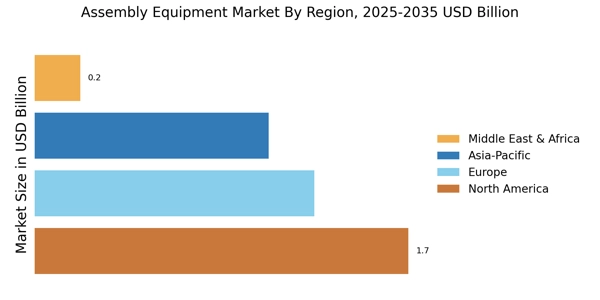
North America is the largest market for assembly equipment, holding approximately 40% of the global share. The region's growth is driven by advancements in automation technology, increased demand for efficient manufacturing processes, and supportive government regulations promoting innovation. The U.S. and Canada are the primary contributors, with a focus on integrating smart technologies into manufacturing systems. The competitive landscape is characterized by the presence of major players such as Rockwell Automation and Siemens AG, which are leading the charge in developing cutting-edge assembly solutions. The U.S. market is particularly strong in robotics and automation, with significant investments in R&D. This region's emphasis on sustainability and efficiency further propels its market growth, making it a hub for assembly equipment innovation.

Europe : Manufacturing Powerhouse

Europe is the second-largest market for assembly equipment, accounting for around 30% of the global market share. The region's growth is fueled by stringent regulations aimed at enhancing manufacturing efficiency and sustainability. Countries like Germany and France are at the forefront, with strong government initiatives supporting automation and digital transformation in manufacturing processes. Germany, as a manufacturing powerhouse, hosts key players like KUKA AG and Siemens AG, driving innovation in assembly technologies. The competitive landscape is robust, with a focus on integrating Industry 4.0 principles. The European market is also characterized by a strong emphasis on environmental sustainability, pushing companies to adopt greener technologies and practices, which is reshaping the assembly equipment landscape.

Asia-Pacific : Emerging Market Dynamics

Asia-Pacific is witnessing rapid growth in the assembly equipment market, holding approximately 25% of the global share. The region's expansion is driven by increasing industrialization, a growing middle class, and significant investments in manufacturing technologies. Countries like China and Japan are leading the charge, with a strong focus on automation and smart manufacturing solutions to meet rising consumer demand. China, as the largest market in the region, is home to key players such as Fanuc Corporation and Mitsubishi Electric Corporation. The competitive landscape is evolving, with local manufacturers increasingly adopting advanced technologies to enhance productivity. The region's emphasis on innovation and efficiency is reshaping the assembly equipment market, making it a focal point for global investments in automation technologies.

Middle East and Africa : Resource-Rich Opportunities

The Middle East and Africa region is emerging as a significant player in the assembly equipment market, holding about 5% of the global share. The growth is driven by increasing investments in infrastructure and manufacturing capabilities, particularly in countries like the UAE and South Africa. Government initiatives aimed at diversifying economies and enhancing industrial output are key catalysts for market expansion. The competitive landscape is characterized by a mix of local and international players, with companies increasingly focusing on automation to improve efficiency. The region's unique challenges, such as fluctuating oil prices, are prompting manufacturers to adopt advanced assembly technologies to remain competitive. As the market matures, the demand for innovative solutions is expected to rise, further driving growth in this region.

Assembly Equipment Market Regional Image

Key Players and Competitive Insights

Leading market players are investing heavily in the research and development in order to expand their product lines, which will help the Assembly Equipment Market grow even more. Market players are also undertaking a variety of strategic activities to spread their global footprint, with important market developments including mergers and acquisitions, new product launches, contractual agreements, higher investments, and collaboration with other organizations. To spread and survive in a more competitive and rising market climate, the Assembly Equipment industry must offer cost-effective items.

Manufacturing locally to minimize the operational costs is one of the key business tactics used by the manufacturers in the global Assembly Equipment industry to benefit the clients and increase the market sector. In recent years, the Assembly Equipment industry has offered some of the most significant advantages to several industries.

Major players in the Assembly Equipment Market, including AlsilMaterial, Applied Materials Inc., ASML Holdings N.V., Intel Corporation, Micron Technology Inc., Qualcomm Technologies, Inc., Samsung Group, Screen Holdings Co., Ltd., Teradyne Inc., Tokyo Electron Limited, and others, are trying to increase market demand by investing in the research and development operations.

ASM Pacific Technology is a multinational company that provides assembly and packaging solutions for the semiconductor and electronics industries. It is based in Hong Kong and is a leading supplier of equipment and solutions for the semiconductor and electronics assembly industries. ASM Pacific Technology is known for its focus on innovation and technological advancements in semiconductor assembly and electronics manufacturing equipment and serves a wide range of industries, including automotive, consumer electronics, the telecommunications, and industrial applications.

ASM Pacific Technology (ASMPT), a leading supplier of semiconductor assembly and packaging equipment, announced the acquisition of Xact Robotics, a developer of artificial intelligence (AI)-powered robotic solutions for the electronics manufacturing industry. The acquisition will allow ASMPT to integrate Xact Robotics' AI-powered solutions into its own products, offering customers more intelligent and automated assembly solutions.

KLA Corporation, headquartered in Milpitas, California, is a technology company that provides inspection, measurement, and control solutions for the semiconductor and electronics industries. KLA Corporation primarily serves the semiconductor industry, but its solutions also have applications in areas such as data storage, LED, and other high-tech industries. The company is known for its advanced technology and innovation in areas like optical inspection, e-beam inspection, metrology, and process control, contributing to the development of cutting-edge semiconductor manufacturing processes.

KLA Corporation and Teradyne, Inc., two leading suppliers of semiconductor manufacturing equipment, announced a partnership to develop and deploy integrated solutions for the semiconductor assembly and packaging market. The partnership will combine KLA's expertise in wafer inspection and metrology with Teradyne's expertise in test equipment to offer customers more comprehensive and efficient assembly and packaging solutions.
Key Companies in the Assembly Equipment Market market include

Industry Developments

August 2023: Lam Research Corporation and ASM Pacific Technology (ASMPT) announced a partnership to develop and deploy integrated solutions for the semiconductor assembly and packaging market. The partnership will combine Lam's expertise in semiconductor etch equipment with ASMPT's expertise in assembly and packaging equipment to offer customers more comprehensive and efficient assembly and packaging solutions.
February 2023: Applied Materials, Inc., a leading supplier of semiconductor manufacturing equipment, announced the acquisition of Kokusai Electric Co., Ltd., a Japanese manufacturer of semiconductor assembly and packaging equipment. The acquisition expands Applied Materials' product portfolio and strengthens its position in the growing semiconductor assembly and packaging market.

July 2023: Nikon Corporation announced the acquisition of Toppan Printing's mask aligner business for approximately $1.2 billion. Mask aligners are used to align masks with photoresists during the semiconductor manufacturing process. This acquisition expands Nikon's product portfolio into new markets and strengthens its position in the growing mask aligner market.

Future Outlook

Assembly Equipment Market Future Outlook

The Assembly Equipment Market is projected to grow at an 8.72% CAGR from 2024 to 2035, driven by automation, technological advancements, and increasing demand for efficiency.

New opportunities lie in:

  • Integration of AI-driven assembly line monitoring systems.
  • Development of modular assembly equipment for flexible manufacturing.
  • Expansion into emerging markets with tailored assembly solutions.

By 2035, the Assembly Equipment Market is expected to achieve robust growth, reflecting evolving industry needs.

Market Segmentation

Assembly Equipment Market End User Outlook

  • Consumer Electronics
  • Healthcare
  • Automotive
  • IT and Telecommunication
  • Others

Assembly Equipment Market Product Type Outlook

  • Inspection and Dicing Equipment
  • Die-Attach Equipment
  • Wire Bonding Equipment
  • Plastic Equipment

Assembly Equipment Market Supply Chain Process Outlook

  • IDM
  • OSAT
  • Foundry

Report Scope

MARKET SIZE 2024 4.266(USD Billion)
MARKET SIZE 2025 4.639(USD Billion)
MARKET SIZE 2035 10.7(USD Billion)
COMPOUND ANNUAL GROWTH RATE (CAGR) 8.72% (2024 - 2035)
REPORT COVERAGE Revenue Forecast, Competitive Landscape, Growth Factors, and Trends
BASE YEAR 2024
Market Forecast Period 2025 - 2035
Historical Data 2019 - 2024
Market Forecast Units USD Billion
Key Companies Profiled Market analysis in progress
Segments Covered Market segmentation analysis in progress
Key Market Opportunities Integration of automation and smart technologies enhances efficiency in the Assembly Equipment Market.
Key Market Dynamics Technological advancements drive efficiency and automation in the Assembly Equipment Market, reshaping competitive dynamics and consumer expectations.
Countries Covered North America, Europe, APAC, South America, MEA

Market Highlights

Author
Aarti Dhapte
Team Lead - Research

She holds an experience of about 6+ years in Market Research and Business Consulting, working under the spectrum of Information Communication Technology, Telecommunications and Semiconductor domains. Aarti conceptualizes and implements a scalable business strategy and provides strategic leadership to the clients. Her expertise lies in market estimation, competitive intelligence, pipeline analysis, customer assessment, etc.

Leave a Comment

FAQs

What is the projected market valuation of the Assembly Equipment Market by 2035?

The Assembly Equipment Market is projected to reach a valuation of 10.7 USD Billion by 2035.

What was the market valuation of the Assembly Equipment Market in 2024?

The market valuation of the Assembly Equipment Market was 4.266 USD Billion in 2024.

What is the expected CAGR for the Assembly Equipment Market during the forecast period 2025 - 2035?

The expected CAGR for the Assembly Equipment Market during the forecast period 2025 - 2035 is 8.72%.

Which product type segment is expected to show significant growth in the Assembly Equipment Market?

The Wire Bonding Equipment segment, with a projected growth from 1.5 to 3.5 USD Billion, appears poised for significant growth.

How does the Foundry segment perform in terms of market valuation?

The Foundry segment is projected to grow from 1.566 to 4.4 USD Billion, indicating robust performance.

What are the key players in the Assembly Equipment Market?

Key players in the Assembly Equipment Market include Siemens AG, Rockwell Automation, and Fanuc Corporation, among others.

Download Free Sample

Kindly complete the form below to receive a free sample of this Report

Compare Licence

×
Features License Type
Single User Multiuser License Enterprise User
Price $4,950 $5,950 $7,250
Maximum User Access Limit 1 User Upto 10 Users Unrestricted Access Throughout the Organization
Free Customization
Direct Access to Analyst
Deliverable Format
Platform Access
Discount on Next Purchase 10% 15% 15%
Printable Versions