Author

Rahul Gotadki

Autoinjectors Market Research Report: Size, Share, Trend Analysis By Product Type (Pre-filled Autoinjectors, Fillable Autoinjectors, Smart Autoinjectors, Biologics Autoinjectors), By Therapeutic Area (Autoimmune Disorders, Diabetes, Cancer, Anaphylaxis, Multiple Sclerosis), By End-user (Hospitals, Homecare Settings, Ambulatory Surgical Centers, Specialty Clinics), By Material (Plastic, Metal, Glass), and By Regional (North America, Europe, South America, Asia Pacific, Middle East and Africa) - Growth Outlook & Industry Forecast 2025 To 2035
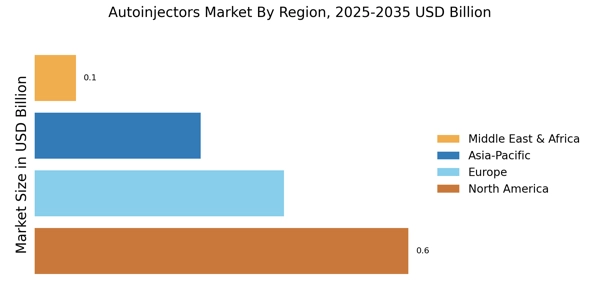
According to MRFR analysis, the Autoinjectors Market Size was valued at USD 1.3 Billion in 2024. The market is projected to grow from USD 1.461 Billion in 2025 to USD 4.712 Billion by 2035, registering a CAGR of 12.42% during the forecast period (2025–2035). North America led the market with over 46.15% share, generating around USD 0.6 billion in revenue. The Autoinjectors Market is growing due to rising prevalence of chronic diseases and increasing demand for self-administered drug delivery solutions. Key trends include advancements in pen and smart autoinjector technologies, growing adoption for biologics and emergency medications, and expanding patient awareness supporting convenience, adherence, and improved treatment outcomes globally.
The Autoinjectors Market is poised for substantial growth driven by technological advancements and increasing demand for self-administration.
| 2024 Market Size | 1.3 (USD Billion) |
| 2035 Market Size | 4.712 (USD Billion) |
| CAGR (2025 - 2035) | 12.42% |
Companies such as Amgen (US), AbbVie (US), Boehringer Ingelheim (DE), Eli Lilly (US), Sanofi (FR), Mylan (US), Teva Pharmaceutical Industries (IL), Novartis (CH), Pfizer (US) are some of the major participants in the global market.
Our Impact
Enabled $4.3B Revenue Impact for Fortune 500 and Leading Multinationals
Partnering with 2000+ Global Organizations Each Year
30K+ Citations by Top-Tier Firms in the Industry
The autoinjectors market is currently experiencing a notable transformation, driven by advancements in technology and increasing demand for self-administration of medications. This shift is largely influenced by the growing prevalence of chronic diseases, which necessitate regular treatment and management. As patients seek more convenient and efficient ways to administer their therapies, autoinjectors are emerging as a preferred option.
Chronic diseases account for over 70% of global deaths according to the World Health Organization, driving the need for regular treatments that patients can self-administer. This trend is a key factor supporting the adoption of autoinjectors.
Furthermore, the integration of smart technology into these auto injection devices is enhancing user experience, providing real-time data and connectivity that may improve adherence to treatment regimens. In addition to technological innovations, regulatory support is playing a crucial role in shaping the Autoinjectors Market. Governments and health authorities are increasingly recognizing the benefits of these auto injection devices, leading to streamlined approval processes and encouraging auto injector syringe suppliers to invest in research and development.
This supportive environment is likely to foster competition among key players, resulting in a wider array of products that cater to diverse patient needs. As the market evolves, it appears poised for sustained growth, with potential expansions into emerging markets where access to healthcare is improving.
The autoinjectors market is witnessing a surge in technological innovations, particularly with the incorporation of smart features. These advancements enhance user interaction and provide valuable data, potentially improving medication adherence and patient outcomes.
The integration of connected devices and smart features in autoinjectors is growing, enabling real-time monitoring of adherence and injection data, which improves patient compliance and treatment outcomes.
Supportive regulatory frameworks are emerging, facilitating faster approvals for new autoinjector devices. This trend encourages manufacturers to innovate and expand their product offerings, ultimately benefiting patients with diverse healthcare needs.
There is a growing preference among patients for self-administration of medications, driven by the desire for convenience and autonomy in managing health conditions. This trend is likely to propel the adoption of autoinjectors in various therapeutic areas.
Studies show that around 40% of patients on injectable therapies prefer administering medication at home, highlighting convenience and autonomy as primary drivers for autoinjector usage.
The surge in investment in biologics is significantly influencing the Autoinjectors Market. Biologics, which often require injection for administration, are becoming increasingly prevalent in the treatment of various diseases, including cancer and autoimmune disorders. As pharmaceutical companies invest heavily in the development of biologic therapies, the demand for autoinjectors that can effectively deliver these complex medications is expected to rise. Market analysis suggests that the biologics segment is one of the fastest-growing areas in the pharmaceutical industry, which in turn is likely to propel the growth of the market. This trend indicates a promising future for manufacturers who can adapt their products to meet the specific needs of biologic therapies.
Regulatory support plays a crucial role in shaping the market. Various health authorities are increasingly recognizing the importance of autoinjectors in facilitating self-administration of medications, particularly for chronic conditions. This recognition has led to streamlined approval processes for new devices, encouraging innovation and market entry. For instance, the introduction of guidelines that prioritize patient safety and device efficacy has fostered a more favorable environment for manufacturers. As a result, the number of approved autoinjectors has risen, contributing to a more competitive landscape. The regulatory framework is expected to continue evolving, which may further enhance the growth prospects of the Autoinjectors Market.
The growing trend towards self-administration of medications is a significant driver in the market. Patients increasingly prefer the convenience and autonomy that autoinjectors provide, particularly for conditions requiring regular injections, such as diabetes and rheumatoid arthritis. This shift is supported by demographic changes, including an aging population that seeks to manage their health independently. Market data indicates that the demand for self-injection devices is on the rise, with projections suggesting a substantial increase in market share for autoinjectors. This trend not only reflects changing patient preferences but also highlights the potential for manufacturers to innovate and expand their product offerings within the market.
The rising prevalence of chronic diseases is a pivotal factor driving the Autoinjectors Market. Conditions such as diabetes, multiple sclerosis, and allergies necessitate regular medication, often administered via injections. As the global burden of these diseases continues to grow, the demand for efficient and user-friendly delivery systems like autoinjectors is expected to increase. Recent statistics indicate that chronic diseases account for a significant portion of healthcare expenditures, prompting healthcare systems to seek cost-effective solutions. Consequently, the market is likely to benefit from this trend, as more patients require reliable and convenient methods for managing their conditions.
The market is experiencing rapid technological advancements that enhance the efficacy and user-friendliness of these devices. Innovations such as smart autoinjectors, which integrate connectivity features, allow for real-time monitoring and data collection. This capability not only improves patient adherence but also provides healthcare professionals with valuable insights into treatment regimens. Furthermore, advancements in needle technology and drug formulation are contributing to reduced pain and improved delivery efficiency. According to recent data, the market for smart autoinjectors is projected to grow significantly, indicating a shift towards more sophisticated solutions in the Autoinjectors Market. As these technologies evolve, they are likely to attract a broader consumer base, thereby driving market growth.
The market is segmented into Pre-filled, Fillable, Smart auto injector and Biologics Autoinjectors. Among these, Pre-filled Autoinjectors hold the largest Autoinjectors Market share due to their convenience and ease of use in self-administration, particularly for chronic conditions. Smart autoinjectors, on the other hand, are gaining attention in the market for their advanced features that enhance patient adherence and provide real-time health data, positioning them as a key player for future growth.
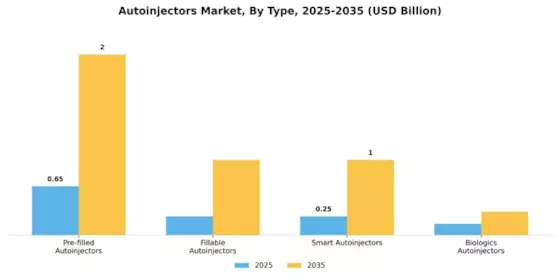
Pre-filled Autoinjectors (Dominant) vs. Smart Autoinjectors (Emerging)
Pre-filled Autoinjectors are widely recognized as the dominant force in the market. Their design offers a simplified administration process, making them ideal for patients requiring regular medication, such as those with autoimmune diseases. In contrast, Smart Autoinjectors are emerging contenders equipped with technology that can track dosage and notify users via connected devices, addressing some of the common challenges faced by patients. This innovation is driving their rapid adoption as they present a dual benefit of self-administration and digital monitoring, appealing to a tech-savvy patient demographic.
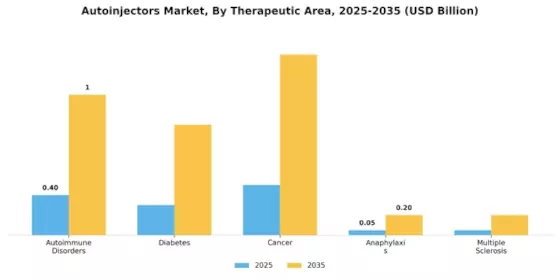
The therapeutic area segmentation showcases significant variations in Autoinjectors Market share distribution. Among these, Diabetes remains the largest segment, driven by the increasing prevalence of diabetes worldwide. Following close behind are Autoimmune Disorders and Multiple Sclerosis, which carve out substantial portions as well. Anaphylaxis, while crucial, holds a smaller share compared to these dominant areas, reflecting its specialized nature in acute allergic reactions. Growth trends indicate a robust future for the Cancer segment as it emerges as the fastest-growing area within the market. The rise in cancer cases globally is a fundamental driver for this expansion, paired with technological advancements that enhance the efficacy of autoinjectors for cancer treatments. As patient preferences shift toward more convenient and self-administered therapies, growth is fueled by innovations that make these devices more user-friendly and efficient.
Diabetes (Dominant) vs. Anaphylaxis (Emerging)
Diabetes is recognized as the dominant therapeutic area in the market. This segment benefits from the substantial and growing diabetic population, resulting in a steady demand for effective self-administration systems. The established technology and extensive market penetration of diabetes autoinjectors contribute to its leading position. On the other hand, Anaphylaxis is an emerging segment, gaining traction as awareness of severe allergic reactions increases among both healthcare providers and the general population. New formulations and designs tailored for rapid response in emergency situations are enhancing the appeal of autoinjectors for anaphylaxis, positioning it as a vital area for growth.
Hospitals hold the largest share among the end-user segments, benefiting from their centralized healthcare delivery models and high patient turnover. The demand for autoinjectors is particularly pronounced due to their ability to improve medication administration efficiency and patient compliance, which is crucial in emergency and inpatient care settings. Conversely, homecare settings are witnessing rapid growth as patients increasingly prefer self-administration of medications in comfortable environments. This shift reflects a broader trend towards home-based healthcare solutions, catalyzed by advancements in telehealth and patient education initiatives.
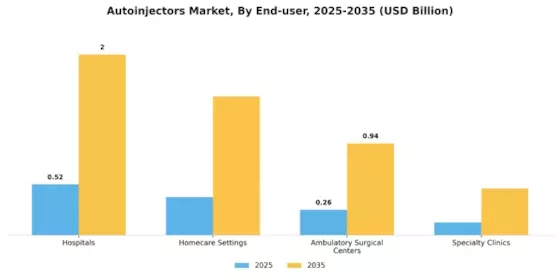
Hospitals (Dominant) vs. Homecare Settings (Emerging)
Hospitals serve as the dominant end-user of autoinjectors, primarily due to their need for efficient drug administration in acute care scenarios. They utilize autoinjectors for a variety of treatments, ranging from autoimmune diseases to emergency interventions, significantly enhancing patient care and medication adherence. In contrast, homecare settings are emerging as a vital segment due to the ongoing trend of moving treatment from institutional settings to patient homes. This shift is supported by growing patient empowerment and technological advancements that facilitate safe self-injection. Homecare offers a compelling value proposition, particularly for chronic disease management, driving innovation in autoinjector design and usability features.
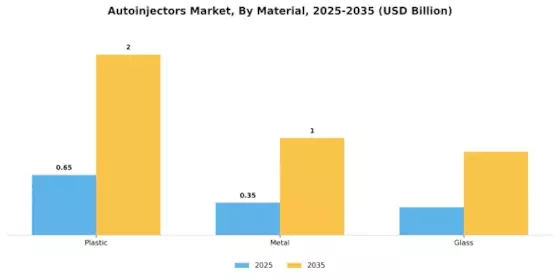
The Autoinjectors Market is characterized by a diverse material segment, comprising primarily of Plastic, Metal, and Glass. Plastic currently occupies the largest share, favored for its lightweight, affordable, and versatile properties. Metal, while smaller in market share, exhibits significant potential for growth due to increasing demand for durability and premium product appearances. Glass, although traditionally used, is experiencing a gradual decline as manufacturers pivot towards more robust materials like plastic and metal.
Plastic (Dominant) vs. Metal (Emerging)
Plastic segement dominates the market, celebrated for its ease of autoinjector manufacturing, cost-effectiveness, and ability to accommodate various designs. This material enables the autoinjector production line of lightweight and durable injectors, making it a preferred choice for many companies aiming to maintain a competitive edge. Conversely, metal is emerging as a popular choice among premium auto-injector assembly lines, appreciated for its robustness and high-end appeal. As the market evolves, manufacturers increasingly invest in developing metal autoinjectors to cater to consumers seeking more sophisticated and reliable medical delivery systems, potentially shifting the competitive landscape.
Get more detailed insights about Autoinjectors Market Request Free Sample
North America leads in the Autoinjectors Market Size, accounting for over 46.15% of the global revenue in 2024. The region's growth is driven by increasing prevalence of chronic diseases, advancements in drug delivery technologies, and supportive regulatory frameworks. The FDA's streamlined approval processes for new devices further catalyze market expansion, making it a hub for innovation in healthcare solutions.
The United States is the primary contributor, with significant investments from key players like Amgen, AbbVie, and Eli Lilly. The competitive landscape is characterized by a focus on R&D and strategic partnerships, enhancing product offerings. Canada also plays a vital role, contributing to the market with its growing healthcare infrastructure and increasing adoption of self-injection devices. Overall, the presence of major pharmaceutical companies solidifies North America's leadership in the market.
Europe Autoinjectors Market size was valued at USD 0.39 Billion in 2024, making it the second-largest regional market with a 30% share. The region's growth is propelled by rising healthcare expenditures, increasing awareness of self-administration, and favorable regulatory policies. The European Medicines Agency (EMA) has been instrumental in facilitating the approval of innovative autoinjector technologies, thus enhancing market accessibility and consumer trust.
Leading countries include Germany, France, and the UK, where the presence of major players like Boehringer Ingelheim and Sanofi strengthens the competitive landscape. The market is characterized by a mix of established companies and emerging startups focusing on innovative solutions. The emphasis on patient-centric designs and user-friendly devices is driving demand, making Europe a dynamic player in the market.
Asia-Pacific is witnessing rapid growth in the autoinjectors market, holding approximately 20% of the global share. The region's expansion is driven by increasing healthcare investments, a rising prevalence of chronic diseases, and a growing aging population. Countries like China and India are leading this growth, supported by government initiatives aimed at improving healthcare access and affordability.
China is the largest market in the region, with significant contributions from local manufacturers and international players like Pfizer and Teva. The competitive landscape is evolving, with a focus on affordability and accessibility of autoinjectors. The increasing adoption of self-injection devices among patients is further propelling market growth, making Asia-Pacific a key area for future investments in the autoinjectors sector.
The Middle East and Africa region is gradually emerging in the market, currently holding about 5% of the global share. The growth is driven by increasing healthcare investments, rising awareness of chronic diseases, and the need for efficient drug delivery systems. Governments are focusing on improving healthcare infrastructure, which is expected to enhance market penetration of autoinjectors in the coming years.
Countries like South Africa and the UAE are leading the market, with a growing number of healthcare facilities adopting advanced medical technologies. The competitive landscape is characterized by a mix of local and international players, with companies like Mylan and Novartis expanding their presence. The region's untapped potential presents significant opportunities for growth, making it an attractive market for future investments in autoinjectors.
The Autoinjectors Market is currently characterized by a dynamic competitive landscape, driven by increasing demand for self-administration devices and advancements in drug delivery technologies. Key players such as Amgen (US), AbbVie (US), and Eli Lilly (US) are strategically positioned to leverage innovation and expand their market presence. Amgen (US) focuses on enhancing patient experience through user-friendly designs, while AbbVie (US) emphasizes partnerships to broaden its product portfolio. Eli Lilly (US) is investing in digital health solutions to improve adherence and patient outcomes. Collectively, these strategies foster a competitive environment that prioritizes patient-centric solutions and technological advancements. In terms of business tactics, companies are increasingly localizing autoinjector manufacturing to reduce costs and enhance supply chain efficiency. The market appears moderately fragmented, with several players vying for market share. However, the influence of major companies is substantial, as they set industry standards and drive innovation. This competitive structure encourages smaller firms to innovate or seek partnerships to remain relevant in the market. In August 2025, Amgen (US) announced a collaboration with a leading technology firm to develop a next-generation autoinjector that integrates smart technology for real-time monitoring of medication adherence. This strategic move is likely to enhance patient engagement and provide valuable data for healthcare providers, positioning Amgen (US) as a leader in the digital health space. In September 2025, AbbVie (US) launched a new autoinjector designed for a recently approved biologic therapy, aiming to streamline the administration process for patients with chronic conditions. This launch not only expands AbbVie’s product offerings but also reinforces its commitment to addressing unmet medical needs, thereby strengthening its competitive position in the market. In July 2025, Eli Lilly (US) unveiled a partnership with a digital health startup to incorporate artificial intelligence into its auto injection devices. This collaboration is expected to enhance the functionality of their auto injection devices, providing personalized treatment options and improving patient adherence. Such innovations are indicative of a broader trend towards integrating technology into healthcare solutions. As of October 2025, the Autoinjectors Market is witnessing trends such as digitalization, sustainability, and the integration of artificial intelligence. Strategic alliances are increasingly shaping the competitive landscape, enabling companies to pool resources and expertise. Looking ahead, competitive differentiation is likely to evolve from traditional price-based competition to a focus on innovation, technological advancements, and supply chain reliability, as companies strive to meet the growing expectations of patients and healthcare providers.


A major strategic expansion in emergency preparedness deployments was marked on January 10, 2025, when Kindeva Drug Delivery's Meridian Medical Technologies won a contract worth up to USD 129 million to supply DuoDote autoinjectors, a chemical nerve agent antidote, to the U.S. Strategic National Stockpile under ASPR (Health and Human Services).In an effort to provide patients with more treatment convenience, Amneal Pharmaceuticals resubmitted its NDA to the FDA in November 2024 for a dihydroergotamine (DHE) prefilled auto injector for syringe pump that targets migraines and cluster headaches.
Teva Pharmaceuticals introduced an Amgen biosimilar etanercept autoinjector on October 15, 2024, offering an affordable alternative for treating autoimmune diseases. Eli Lilly unveiled an updated insulin autoinjector in August 2024 that is intended to provide diabetic patients with quicker delivery and enhanced use.
A rheumatoid arthritis autoinjector with improved needle-safety technology was introduced by Sandoz in June 2024 with the goal of lowering unintentional needlestick injuries. A new multiple sclerosis autoinjector with a simplified interface to improve adherence was introduced by Biogen in March 2024.
SHL Medical also revealed intentions in July 2022 to build a USD 90 million autoinjector manufacturing facility in South Carolina in order to increase the manufacture of autoinjectors, particularly biologics.Ultimately, in September 2024, SHL Medical and BD reached an agreement to combine BD's Neopak XtraFlow prefilled auto injector for syringe pump with SHL's YpsoMate 2.25 autoinjector platform, therefore promoting the self-injection administration of high-viscosity biologics.
The Autoinjectors Market size is projected to reach USD 4.712 Billion by 2035, growing at a CAGR of 12.42%, driven by technological advancements, increasing chronic diseases, and rising patient preference for self-administration.
New opportunities lie in:
By 2035, the autoinjectors market is expected to achieve substantial growth, reflecting evolving healthcare needs.By Type: Pre-filled Autoinjectors (Largest) vs. Smart Autoinjectors (Fastest-Growing)
| MARKET SIZE 2024 | 1.3(USD Billion) |
| MARKET SIZE 2025 | 1.461(USD Billion) |
| MARKET SIZE 2035 | 4.712(USD Billion) |
| COMPOUND ANNUAL GROWTH RATE (CAGR) | 12.42% (2025 - 2035) |
| REPORT COVERAGE | Revenue Forecast, Competitive Landscape, Growth Factors, and Trends |
| BASE YEAR | 2024 |
| Market Forecast Period | 2025 - 2035 |
| Historical Data | 2019 - 2024 |
| Market Forecast Units | USD Billion |
| Key Companies Profiled | Amgen (US), AbbVie (US), Boehringer Ingelheim (DE), Eli Lilly (US), Sanofi (FR), Mylan (US), Teva Pharmaceutical Industries (IL), Novartis (CH), Pfizer (US) |
| Segments Covered | Product Type, Therapeutic Area, End-user, Material, Regional |
| Key Market Opportunities | Integration of smart technology in Autoinjectors enhances patient adherence and monitoring capabilities. |
| Key Market Dynamics | Rising demand for self-administration devices drives innovation and competition in the market. |
| Countries Covered | North America, Europe, APAC, South America, MEA |
The Autoinjectors Market is projected to reach approximately 4.712 USD Billion by 2035.
In 2024, the Autoinjectors Market was valued at 1.3 USD Billion.
The expected CAGR for the Autoinjectors Market during the forecast period 2025 - 2035 is 12.42%.
The Cancer therapeutic area is expected to dominate, with a projected valuation of 1.8 USD Billion by 2035.
The key types of autoinjectors include Pre-filled Autoinjectors, Fillable Autoinjectors, Smart Autoinjectors, and Biologics Autoinjectors.
Hospitals are anticipated to have the highest market share, projected to reach 1.85 USD Billion by 2035.
Common materials used in the production of autoinjectors include Plastic, Metal, and Glass.
Leading companies in the Autoinjectors Market include Amgen, AbbVie, Boehringer Ingelheim, Eli Lilly, and Sanofi.
The projected market size for Smart Autoinjectors is expected to reach 1.0 USD Billion by 2035.
The market for Fillable Autoinjectors is projected to reach 1.0 USD Billion by 2035, compared to 2.4 USD Billion for Pre-filled Autoinjectors.


The secondary research process involved comprehensive analysis of regulatory databases for combination products, peer-reviewed biomedical engineering journals, clinical pharmacology publications, and authoritative health organizations. Key sources included the US Food & Drug Administration (FDA) Center for Devices and Radiological Health (CDRH) and Office of Combination Products, European Medicines Agency (EMA) Committee for Medicinal Products for Human Use (CHMP), International Organization for Standardization (ISO) 11608 series for needle-based injection systems, World Health Organization (WHO) Essential Medicines and Health Products Information Portal, Centers for Disease Control and Prevention (CDC) Chronic Disease Indicators, National Institutes of Health (NIH) National Institute of Diabetes and Digestive and Kidney Diseases (NIDDK), PubMed/MEDLINE databases for self-injection device studies, American Diabetes Association (ADA) Statistics Division, National Multiple Sclerosis Society (NMSS) Data Repository, American Academy of Allergy Asthma & Immunology (AAAAI) Anaphylaxis surveillance data, European Commission Medical Device Coordination Group (MDCG) guidance documents, Health Canada Medical Devices Bureau, Japan Ministry of Health Labour and Welfare (MHLW) medical device approvals, and national health statistics bureaus from key markets.
The following sources were employed to gather data on device approval, chronic disease prevalence statistics, drug-device combination product regulations, patient adherence studies, and therapeutic area demand analysis for pre-filled autoinjectors, fillable autoinjectors, smart connected devices, and biologics-specific delivery systems.
To acquire qualitative and quantitative insights regarding therapeutic adoption, regulatory pathways, and device efficacy, supply-side and demand-side stakeholders were interviewed during the primary research process. CEOs, Vice Presidents of Device Development, human factors engineering directors, combination product regulatory heads, and commercial strategy leads from autoinjector device manufacturers, pharmaceutical company device divisions, contract manufacturing organizations (CMOs), and connected health technology providers comprised supply-side sources. Endocrinologists, allergists/immunologists, neurologists specializing in multiple sclerosis, oncology infusion specialists, hospital pharmacy directors, home healthcare nurses, specialty clinic administrators, and procurement managers from hospital systems, outpatient infusion centers, and homecare medical equipment suppliers were the demand-side sources. Therapeutic area segmentation was validated, connected device development timelines were confirmed, and patient training protocols, reimbursement coding for device/drug combinations, and competitive differentiation strategies were gathered through primary research.
Primary Respondent Breakdown:
By Designation: C-level Executives (CEO, President, Managing Director): 28%; Director Level (VP, Head of Department): 35%; Managers and Subject Matter Experts: 37%
By Region: North America: 40%; Europe: 25%; Asia-Pacific: 28%; Rest of World (Latin America, Middle East & Africa): 7%
[Note: Tier classifications based on fiscal year 2024 reported revenues across pharmaceutical and medical device portfolios]
Revenue triangulation and procedure volume modeling were employed to determine the global market valuation across therapeutic indications. The methodology consisted of the following:
Identification of over 50 key manufacturers in North America, Europe, Asia-Pacific, and Latin America, including pharmaceutical companies with proprietary device portfolios (e.g., Eli Lilly, Novo Nordisk, Amgen), emerging connected health technology firms (e.g., SHL Medical, Ypsomed, oval medical), and dedicated device manufacturers (e.g., SHL Medical, Ypsomed, oval medical).
Product mapping encompasses cartridge-based fillable systems, pre-filled syringe-based autoinjectors, Bluetooth-enabled smart autoinjectors, and biologics-specific large-volume wearable injectors.
Examination of the reported segment revenues, device average selling prices (ASP), and volume shipments that are specific to the therapeutic areas of oncology, diabetes, autoimmune disorders, anaphylaxis, and multiple sclerosis
Manufacturers that account for 72-78% of the global market share in 2024 are included in the coverage.
Extrapolation is employed to derive segment-specific valuations for the disposable, reusable, and smart autoinjector categories by combining a bottom-up approach (chronic disease patient populations × diagnosis rates × self-injection adoption rates × device ASP by country) and a top-down validation (manufacturer reported medical device/combination product revenue reconciliation) method.
Kindly complete the form below to receive a free sample of this Report

“This is really good guys. Excellent work on a tight deadline. I will continue to use you going forward and recommend you to others. Nice job”


“Thanks. It’s been a pleasure working with you, please use me as reference with any other Intel employees.”


“Thanks for sending the report it gives us a good global view of the Betaïne market.”


“Thank you, this will be very helpful for OQS.”


“We found the report very insightful! we found your research firm very helpful. I'm sending this email to secure our future business.”


“I am very pleased with how market segments have been defined in a relevant way for my purposes (such as "Portable Freezers & refrigerators" and "last-mile"). In general the report is well structured. Thanks very much for your efforts.”


“I have been reading the first document or the study, ,the Global HVAC and FP market report 2021 till 2026. Must say, good info! I have not gone in depth at all parts, but got a good indication of the data inside!”


“We got the report in time, we really thank you for your support in this process. I also thank to all of your team as they did a great job.”


“The Automotive 48V ECU Components Procurement Intelligence Study” was a complex project, but the Market Research Future (MRFR) team handled it with quality, agility, and customer-centricity. They delivered all requested data on time and within the agreed scope. The team, including Shubhendra Anand and Rahul Gotadki, was always readily available to clarify questions and swiftly implement necessary adjustments, driving the project to a successful conclusion within a very demanding timeframe.
I would also like to specifically commend Akshay Agarwal for his responsiveness and support at every stage—from our initial inquiry on May 6th through to final delivery on June 18th. His dedication made the entire process seamless.”



