Automated Blood Processing Equipment Market
Automated Blood Processing Equipment Market Summary
As per Market Research Future analysis, the Automated Blood Processing Equipment Market Size was estimated at 2.094 USD Billion in 2024. The Automated Blood Processing Equipment industry is projected to grow from 2.254 USD Billion in 2025 to 4.697 USD Billion by 2035, exhibiting a compound annual growth rate (CAGR) of 7.62% during the forecast period 2025 - 2035
Key Market Trends & Highlights
The Automated Blood Processing Equipment Market is experiencing robust growth driven by technological advancements and increasing demand for blood components.
- North America remains the largest market for automated blood processing equipment, driven by advanced healthcare infrastructure.
- The Asia-Pacific region is emerging as the fastest-growing market, fueled by rising investments in healthcare and blood processing technologies.
- Blood cell separators dominate the market, while blood processing analyzers are witnessing the fastest growth due to technological innovations.
- Key market drivers include the rising incidence of blood disorders and a growing focus on safety and compliance in blood processing.
Market Size & Forecast
| 2024 Market Size | 2.094 (USD Billion) |
| 2035 Market Size | 4.697 (USD Billion) |
| CAGR (2025 - 2035) | 7.62% |
Major Players
Thermo Fisher Scientific (US), Beckman Coulter (US), Siemens Healthineers (DE), Abbott Laboratories (US), Becton Dickinson (US), Fresenius Kabi (DE), Grifols (ES), Ortho Clinical Diagnostics (US), Sysmex Corporation (JP)
Automated Blood Processing Equipment Market Trends
The Automated Blood Processing Equipment Market is currently experiencing a transformative phase, driven by advancements in technology and increasing demand for efficient blood management systems. The integration of automation in blood processing not only enhances the accuracy of results but also significantly reduces the time required for various procedures. This shift towards automation appears to be a response to the growing need for improved patient care and operational efficiency within healthcare facilities. As hospitals and laboratories seek to optimize their workflows, the adoption of automated solutions is likely to rise, indicating a robust future for this sector. Moreover, the market seems to be influenced by a heightened focus on safety and regulatory compliance. With stringent guidelines governing blood handling and processing, automated systems offer a reliable means to ensure adherence to these standards. The potential for reducing human error and enhancing traceability in blood processing is becoming increasingly appealing to healthcare providers. As the landscape evolves, it is essential for stakeholders to remain vigilant and responsive to emerging trends, ensuring that they capitalize on the opportunities presented by this dynamic market.
Technological Advancements
The Automated Blood Processing Equipment Market is witnessing rapid technological innovations that enhance the efficiency and accuracy of blood processing. Newer systems are being developed with advanced features such as artificial intelligence and machine learning, which streamline operations and improve diagnostic capabilities.
Increased Demand for Blood Components
There is a growing need for various blood components, such as plasma and platelets, which is driving the demand for automated blood processing solutions. This trend reflects a broader shift towards personalized medicine and targeted therapies, necessitating more sophisticated processing equipment.
Focus on Safety and Compliance
The emphasis on safety and regulatory compliance is shaping the Automated Blood Processing Equipment Market. Automated systems are increasingly viewed as essential tools for minimizing risks associated with blood handling, thereby ensuring adherence to stringent health regulations.
Automated Blood Processing Equipment Market Drivers
Focus on Safety and Compliance
Safety and compliance are paramount in the Automated Blood Processing Equipment Market, as regulatory bodies impose stringent guidelines to ensure the quality of blood products. Automated systems are designed to adhere to these regulations, minimizing the risk of contamination and ensuring traceability throughout the blood processing chain. The increasing emphasis on safety standards is likely to propel the adoption of automated solutions, as healthcare providers seek to mitigate risks associated with manual processing. This focus on compliance not only enhances patient safety but also fosters trust in blood transfusion practices, thereby driving market growth.
Growing Demand for Blood Components
The demand for blood components, such as platelets and plasma, is on the rise, significantly impacting the Automated Blood Processing Equipment Market. As medical practices evolve, there is a growing recognition of the therapeutic benefits of specific blood components, leading to increased utilization in various treatments. This trend is expected to drive the market for automated blood processing equipment, as facilities require advanced technology to efficiently separate and process these components. Market analysts project that the demand for blood components will grow by approximately 6% annually, further emphasizing the need for automation in blood processing.
Rising Incidence of Blood Disorders
The prevalence of blood disorders, including anemia, hemophilia, and thalassemia, is contributing to the growth of the Automated Blood Processing Equipment Market. As the number of patients requiring blood transfusions and component therapies increases, healthcare facilities are compelled to adopt automated solutions to meet this demand efficiently. According to recent statistics, the incidence of blood disorders is expected to rise by 5% annually, necessitating enhanced blood processing capabilities. This trend underscores the importance of automation in ensuring timely and safe blood supply, thereby driving the market for automated blood processing equipment.
Technological Advancements in Automation
The Automated Blood Processing Equipment Market is experiencing a surge in technological advancements that enhance efficiency and accuracy in blood processing. Innovations such as artificial intelligence and machine learning are being integrated into automated systems, allowing for real-time data analysis and improved decision-making. These advancements not only streamline operations but also reduce human error, which is critical in blood processing. The market is projected to grow at a compound annual growth rate of approximately 8% over the next five years, driven by these technological improvements. As hospitals and blood banks increasingly adopt automated solutions, the demand for sophisticated equipment is likely to rise, further propelling the market forward.
Increased Investment in Healthcare Infrastructure
Investment in healthcare infrastructure is a critical driver for the Automated Blood Processing Equipment Market. Governments and private entities are increasingly allocating funds to enhance healthcare facilities, particularly in developing regions. This investment often includes the procurement of advanced medical equipment, including automated blood processing systems. As healthcare systems expand and modernize, the demand for efficient and reliable blood processing solutions is likely to increase. This trend suggests a robust growth trajectory for the market, as enhanced infrastructure supports the integration of automated technologies in blood banks and hospitals.
Market Segment Insights
By Type: Blood Cell Separators (Largest) vs. Blood Processing Analyzers (Fastest-Growing)
In the Automated Blood Processing Equipment Market, the segment is significantly dominated by Blood Cell Separators, which hold the largest market share among the various equipment types. This dominance is primarily due to their essential role in effective blood component separation, which is critical for various clinical and laboratory applications. Following closely, Blood Processing Analyzers are gaining traction, representing an increasingly vital part of blood processing workflows due to their ability to provide rapid and accurate diagnostics, catering to the rising demand in healthcare settings. As advancements in technology continue to shape the Automated Blood Processing Equipment Market, growth trends indicate a promising future for Blood Processing Analyzers, which are being adopted at a rapid pace. Factors such as the increase in blood donation activities, coupled with the need for precise blood analysis in transfusion practices, contribute to this expansion. Additionally, the evolution of healthcare infrastructure and increasing awareness regarding blood safety and management are boosting the demand for automated solutions, positively impacting other segment values like Blood Centrifuges and Blood Storage Systems as well.
Blood Cell Separators (Dominant) vs. Blood Storage Systems (Emerging)
Blood Cell Separators hold a dominant position in the Automated Blood Processing Equipment Market due to their crucial role in separating blood components for therapeutic applications like platelets and plasma. Their established presence in hospitals and blood banks ensures a consistent demand, bolstered by technological advancements that enhance efficiency and accuracy. Conversely, Blood Storage Systems are emerging rapidly as the healthcare sector emphasizes the importance of safe blood storage methods. These systems are designed to ensure the integrity of blood products over time and are increasingly being integrated with monitoring technologies to comply with regulatory standards. While Blood Cell Separators continue to lead, the consistent innovations in Blood Storage Systems indicate a promising trajectory for future market growth.
By End Use: Hospital (Largest) vs. Blood Banks (Fastest-Growing)
In the Automated Blood Processing Equipment Market, the distribution of end-use segments reveals that hospitals represent the largest share of the market due to their extensive need for advanced blood processing solutions for patient treatment. Blood banks follow closely behind, showing a significant demand driven by the increasing emphasis on blood donation and storage capabilities. Research laboratories and diagnostic centers also contribute to the market, albeit at a slower pace, reflecting specialized needs rather than widespread application across healthcare facilities. The growth trends within this segment indicate that blood banks are poised to become the fastest-growing category as they invest in technologies to enhance blood processing efficiency and increase donor engagement. Additionally, hospitals are continually upgrading their equipment to improve patient outcomes, thus ensuring consistent demand. Research laboratories are focusing on innovations for disease research, which adds to the market dynamism. Meanwhile, diagnostic centers are evolving with the integration of automated systems to streamline testing and improve turnaround times, contributing to overall sector growth.
Hospital (Dominant) vs. Diagnostic Centers (Emerging)
In the context of the Automated Blood Processing Equipment Market, hospitals emerge as the dominant end-use segment, characterized by their substantial investments in advanced automated systems aimed at improving patient care delivery. These facilities feature high patient volumes, which necessitate the efficient processing of large quantities of blood components. On the other hand, diagnostic centers are considered an emerging segment, gradually adopting automated blood processing technologies to enhance operational efficiency and meet the growing demand for timely diagnostic services. Although smaller in scale, diagnostic centers are increasingly integrating automation to streamline workflows, reduce human error, and improve accuracy in blood test results, positioning themselves as key players in a rapidly evolving healthcare landscape.
By Application: Blood Transfusion (Largest) vs. Disease Diagnosis (Fastest-Growing)
The Automated Blood Processing Equipment Market exhibits diverse applications, with Blood Transfusion capturing the largest share due to its critical role in healthcare settings. This segment is primarily driven by the rising demand for safe and effective transfusion practices. Following closely is the Disease Diagnosis segment, which is experiencing rapid growth as more advanced diagnostic procedures necessitate efficient blood processing capabilities. Blood Component Separation and Research Purposes are also integral, though they share a smaller proportion of the market.
Blood Transfusion (Dominant) vs. Disease Diagnosis (Emerging)
The Blood Transfusion segment dominates the Automated Blood Processing Equipment Market, primarily due to its established use in hospitals and the ongoing need to ensure a safe supply of blood. This segment benefits from stringent regulatory frameworks that emphasize quality and safety standards. In contrast, the Disease Diagnosis segment is rapidly emerging, fueled by technological advancements in diagnostic tools and the heightened focus on early disease detection. Both segments are essential, but they cater to different critical needs in the healthcare environment, shaping their development trajectories.
By Accessory Equipment: Hemoglobin Analyzers (Largest) vs. Platelet Agitators (Fastest-Growing)
In the Automated Blood Processing Equipment Market, the accessory equipment segment is significantly composed of Hemoglobin Analyzers, Platelet Agitators, and Automated Blood Collection Systems. Hemoglobin Analyzers hold a large share within this segment due to their established utility and demand in various blood analysis applications. Platelet Agitators, while smaller in market share, are rapidly gaining traction, driven largely by innovations and new applications in transfusion medicine.
Hemoglobin Analyzers (Dominant) vs. Platelet Agitators (Emerging)
Hemoglobin Analyzers are well-entrenched in clinical settings, serving as crucial tools for determining hemoglobin levels with precision and efficiency. Their dominance is bolstered by a strong base of regular usage in hospitals and diagnostic labs, making them indispensable in routine blood tests. In contrast, Platelet Agitators represent an emerging technology within the market. As new research highlights their significance in maintaining the viability of platelets during storage, their growth trajectory reflects increased adoption in transfusion centers. These devices enhance the preservation of platelet components, addressing critical challenges in blood banking.
Regional Insights
North America : Market Leader in Innovation
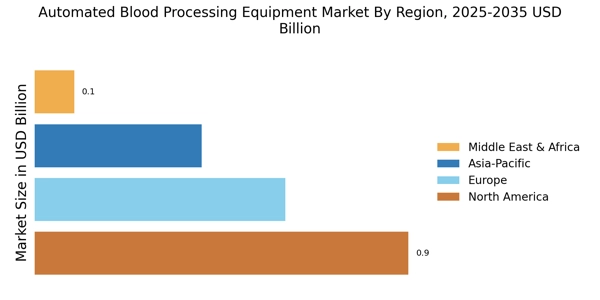
North America is the largest market for automated blood processing equipment, holding approximately 45% of the global market share. The region's growth is driven by advanced healthcare infrastructure, increasing demand for blood transfusions, and stringent regulatory standards that promote safety and efficiency. The presence of key players like Thermo Fisher Scientific and Abbott Laboratories further fuels market expansion. The United States is the leading country in this sector, followed by Canada. The competitive landscape is characterized by significant investments in R&D and technological advancements. Major companies are focusing on automation and integration of AI in blood processing, enhancing operational efficiency and accuracy. This trend is expected to continue, solidifying North America's position as a market leader.
Europe : Regulatory Framework Driving Growth
Europe is the second-largest market for automated blood processing equipment, accounting for around 30% of the global share. The region benefits from robust regulatory frameworks that ensure high standards in blood safety and processing. Increasing investments in healthcare technology and rising awareness about blood donation are key drivers of market growth. Countries like Germany and France are at the forefront of this expansion, supported by government initiatives. Germany is the leading country in Europe, with a strong presence of key players such as Siemens Healthineers and Fresenius Kabi. The competitive landscape is marked by collaborations between companies and healthcare institutions to enhance product offerings. The European market is also witnessing a shift towards automation and digitalization, which is expected to drive further growth in the coming years.
Asia-Pacific : Rapid Growth in Healthcare Sector
Asia-Pacific is witnessing rapid growth in the automated blood processing equipment market, driven by increasing healthcare expenditure and a rising population. The region holds approximately 20% of the global market share, with countries like China and India leading the charge. The demand for efficient blood processing solutions is growing due to rising incidences of chronic diseases and the need for improved healthcare services. China is the largest market in the region, followed by India and Japan. The competitive landscape is evolving, with both local and international players striving to capture market share. Companies are focusing on innovation and affordability to cater to the diverse needs of the population. The increasing adoption of advanced technologies in healthcare is expected to further boost market growth in Asia-Pacific.
Middle East and Africa : Emerging Market with Potential
The Middle East and Africa region is gradually emerging in the automated blood processing equipment market, holding about 5% of the global share. The growth is primarily driven by increasing healthcare investments and a rising demand for blood transfusion services. Countries like South Africa and the UAE are leading the market, supported by government initiatives aimed at improving healthcare infrastructure and services. South Africa is the largest market in the region, with a growing presence of key players like Grifols and Ortho Clinical Diagnostics. The competitive landscape is characterized by a mix of local and international companies, focusing on expanding their product offerings. The region's potential for growth is significant, as healthcare systems continue to evolve and modernize, paving the way for advanced blood processing technologies.
Key Players and Competitive Insights
Key Companies in the Automated Blood Processing Equipment Market include
Industry Developments
Significant developments have recently emerged in the Automated Blood Processing Equipment Market, particularly among major players such as Grifols, Roche, and Sysmex. These companies are increasingly focusing on technological advancements to enhance product efficiency and safety. For instance, Roche has integrated artificial intelligence to streamline the blood processing workflow, reducing error rates and increasing throughput. Similarly, Grifols has launched upgraded versions of their blood fractionation systems that promise higher yields and improved processing speed. Notably, recent mergers in the industry, particularly involving Fresenius Kabi and Haemonetics, are expected to create synergies that bolster product offerings and market reach.
The valuation of companies involved is on the rise, with Bloodcentra and Abbott witnessing impressive market growth attributed to their innovative solutions in automated blood processing. Furthermore, the ongoing demand for efficient blood management systems, fueled by an increasing prevalence of transfusion-dependent diseases, is driving investment and development in this sector. As a result, the market is experiencing heightened competition and a push towards more integrated and automation-driven solutions.
Future Outlook
Automated Blood Processing Equipment Market Future Outlook
The Automated Blood Processing Equipment Market is projected to grow at a 7.62% CAGR from 2025 to 2035, driven by technological advancements, increasing demand for blood components, and rising healthcare investments.
New opportunities lie in:
- Integration of AI-driven analytics for enhanced processing efficiency.
- Development of portable blood processing units for remote healthcare settings.
- Expansion into emerging markets with tailored product offerings.
By 2035, the market is expected to achieve substantial growth, solidifying its position as a critical healthcare component.
Market Segmentation
Automated Blood Processing Equipment Market Type Outlook
- Blood Cell Separators
- Blood Processing Analyzers
- Blood Centrifuges
- Blood Storage Systems
Automated Blood Processing Equipment Market End Use Outlook
- Hospital
- Blood Banks
- Research Laboratories
- Diagnostic Centers
Automated Blood Processing Equipment Market Application Outlook
- Blood Transfusion
- Disease Diagnosis
- Blood Component Separation
- Research Purposes
Automated Blood Processing Equipment Market Accessory Equipment Outlook
- Hemoglobin Analyzers
- Platelet Agitators
- Automated Blood Collection Systems
Report Scope
| MARKET SIZE 2024 | 2.094(USD Billion) |
| MARKET SIZE 2025 | 2.254(USD Billion) |
| MARKET SIZE 2035 | 4.697(USD Billion) |
| COMPOUND ANNUAL GROWTH RATE (CAGR) | 7.62% (2025 - 2035) |
| REPORT COVERAGE | Revenue Forecast, Competitive Landscape, Growth Factors, and Trends |
| BASE YEAR | 2024 |
| Market Forecast Period | 2025 - 2035 |
| Historical Data | 2019 - 2024 |
| Market Forecast Units | USD Billion |
| Key Companies Profiled | Thermo Fisher Scientific (US), Beckman Coulter (US), Siemens Healthineers (DE), Abbott Laboratories (US), Becton Dickinson (US), Fresenius Kabi (DE), Grifols (ES), Ortho Clinical Diagnostics (US), Sysmex Corporation (JP) |
| Segments Covered | Type, End Use, Application, Accessory Equipment, Regional |
| Key Market Opportunities | Integration of artificial intelligence in Automated Blood Processing Equipment enhances efficiency and accuracy in diagnostics. |
| Key Market Dynamics | Technological advancements and regulatory changes drive innovation and competition in the Automated Blood Processing Equipment market. |
| Countries Covered | North America, Europe, APAC, South America, MEA |
FAQs
What is the projected market valuation of the Automated Blood Processing Equipment Market by 2035?
The market is projected to reach approximately 4.697 USD Billion by 2035.
What was the market valuation of the Automated Blood Processing Equipment Market in 2024?
The market valuation was 2.094 USD Billion in 2024.
What is the expected CAGR for the Automated Blood Processing Equipment Market during the forecast period 2025 - 2035?
The expected CAGR for the market during this period is 7.62%.
Which companies are considered key players in the Automated Blood Processing Equipment Market?
Key players include Thermo Fisher Scientific, Beckman Coulter, Siemens Healthineers, and Abbott Laboratories.
What segment of the market is expected to grow the most in terms of blood processing analyzers?
Blood processing analyzers are projected to grow from 0.6 USD Billion in 2024 to 1.2 USD Billion by 2035.
How do blood storage systems contribute to the market's growth?
Blood storage systems are expected to increase from 0.594 USD Billion in 2024 to 1.797 USD Billion by 2035.
What is the anticipated growth for blood banks as an end-use segment?
The blood banks segment is projected to grow from 0.628 USD Billion in 2024 to 1.426 USD Billion by 2035.
What applications are driving the demand for automated blood processing equipment?
Key applications include blood transfusion, disease diagnosis, and blood component separation.
What is the expected growth for automated blood collection systems as accessory equipment?
Automated blood collection systems are anticipated to grow from 1.194 USD Billion in 2024 to 2.697 USD Billion by 2035.
How does the market for research laboratories compare to other end-use segments?
The research laboratories segment is expected to grow from 0.419 USD Billion in 2024 to 0.949 USD Billion by 2035, indicating steady growth.
Research Approach
Secondary Research
The secondary research process involved comprehensive analysis of regulatory databases, peer-reviewed medical journals, clinical publications, and authoritative health organizations. Key sources included the US Food & Drug Administration (FDA) Center for Biologics Evaluation and Research (CBER), European Medicines Agency (EMA), International Society of Blood Transfusion (ISBT), American Association of Blood Banks (AABB), Centers for Disease Control and Prevention (CDC) Blood Safety Division, National Institutes of Health (NIH) National Heart, Lung, and Blood Institute (NHLBI), National Center for Biotechnology Information (NCBI/PubMed), World Health Organization (WHO) Global Status Report on Blood Safety, EU Eurostat Healthcare Statistics, Organisation for Economic Co-operation and Development (OECD) Health Statistics, America's Blood Centers (ABC), European Blood Alliance (EBA), and national health ministry reports from key markets. These sources were used to collect blood collection and transfusion statistics, regulatory approval data for automated blood processing devices, clinical safety studies, blood donation demographic trends, and market landscape analysis for blood cell separators, blood processing analyzers, blood centrifuges, and blood storage systems.
Primary Research
In order to gather both qualitative and quantitative insights, supply-side and demand-side stakeholders were interviewed during the primary research process. CEOs, VPs of Product Development, heads of regulatory affairs, and commercial directors from automated blood processing equipment manufacturers and OEMs were examples of supply-side sources. Chief medical officers, blood bank directors, transfusion medicine specialists, lab managers, and procurement leaders from hospitals, blood banks, research labs, and diagnostic facilities were examples of demand-side sources. Primary research obtained information on clinical adoption trends, pricing tactics, and reimbursement dynamics in addition to validating market segmentation and product pipeline deadlines.
Primary Respondent Breakdown:
By Designation: C-level Primaries (32%), Director Level (30%), Others (38%)
By Region: North America (38%), Europe (25%), Asia-Pacific (28%), Rest of World (9%)
Market Size Estimation
Global market valuation was derived through revenue mapping and equipment installation volume analysis. The methodology included:
Identification of 40+ key manufacturers across North America, Europe, Asia-Pacific, and Latin America
Product mapping across blood cell separators, blood processing analyzers, blood centrifuges, blood storage systems, and accessory equipment categories
Analysis of reported and modeled annual revenues specific to automated blood processing equipment portfolios
Coverage of manufacturers representing 75-80% of global market share in 2024
Extrapolation using bottom-up (equipment installations × ASP by country/region) and top-down (manufacturer revenue validation) approaches to derive segment-specific valuations
This methodology maintains the professional structure of your original dermal fillers format while adapting it to the blood processing equipment market with appropriate regulatory bodies (FDA CBER, AABB, ISBT, etc.) and modified percentages for the primary respondent breakdown as requested.
Kindly complete the form below to receive a free sample of this Report
Customer Stories
“This is really good guys. Excellent work on a tight deadline. I will continue to use you going forward and recommend you to others. Nice job”
“Thanks. It’s been a pleasure working with you, please use me as reference with any other Intel employees.”
“Thanks for sending the report it gives us a good global view of the Betaïne market.”
“Thank you, this will be very helpful for OQS.”
“We found the report very insightful! we found your research firm very helpful. I'm sending this email to secure our future business.”
“I am very pleased with how market segments have been defined in a relevant way for my purposes (such as "Portable Freezers & refrigerators" and "last-mile"). In general the report is well structured. Thanks very much for your efforts.”
“I have been reading the first document or the study, ,the Global HVAC and FP market report 2021 till 2026. Must say, good info! I have not gone in depth at all parts, but got a good indication of the data inside!”
“We got the report in time, we really thank you for your support in this process. I also thank to all of your team as they did a great job.”