Automatic Content Recognition Market

Key Players: Gracenote (Nielsen), Shazam (Apple), Samba TV, Digimarc, ACRCloud, Audible Magic, Ensequence, Beatgrid

Automatic Content Recognition Market

Automatic Content Recognition (ACR) Market Size, Share and Research Report: By Solution (Audio, Video and Image Recognition, Voice, Real Time Content Analytics), By Service (Professional, Managed), By End User (IT & Telecommunication, Healthcare), And By Region (North America, Europe, Asia-Pacific, And Rest Of The World) โ€“Market Forecast Till 2035.
ID: MRFR/ICT/0701-CR
91 Pages
Apoorva Priyadarshi, Shubham Munde
Last Updated: June 22, 2026

Automatic Content Recognition Market Summary

The Automatic Content Recognition Market reached USD 4.76 Billion in 2025, propelled by a decisive shift toward addressable television advertising and edge-AI chipsets capable of running fingerprinting workloads directly on consumer devices. From a 2026 starting value of USD 5.79 billion, the Automatic Content Recognition Market is projected to climb to USD 32.40 billion by 2035, registering a CAGR of 21.1% across the forecast window. Two catalysts stand out: the EU Digital Services Act's transparency mandates for content tracking, and major OEM commitments โ€” exemplified by smart TV shipments crossing 290 million units globally in 2024 โ€” that embed ACR silicon at the board level [1][2].

The competitive landscape is changing due to a shift in technology. Hybrid architectures that combine cloud-based matching engines with on-device audio-video signature extraction are replacing outdated server-side watermarking stacks. In an effort to commercialize second-screen interaction and real-time ad substitution, broadcasters and streaming services spent more than USD 1.2 billion in combined R&D on these next-generation platforms in 2024 [3]. The end product is a data ecosystem that simultaneously records viewing activity across HDMI-passthrough, OTT, and linear inputs.

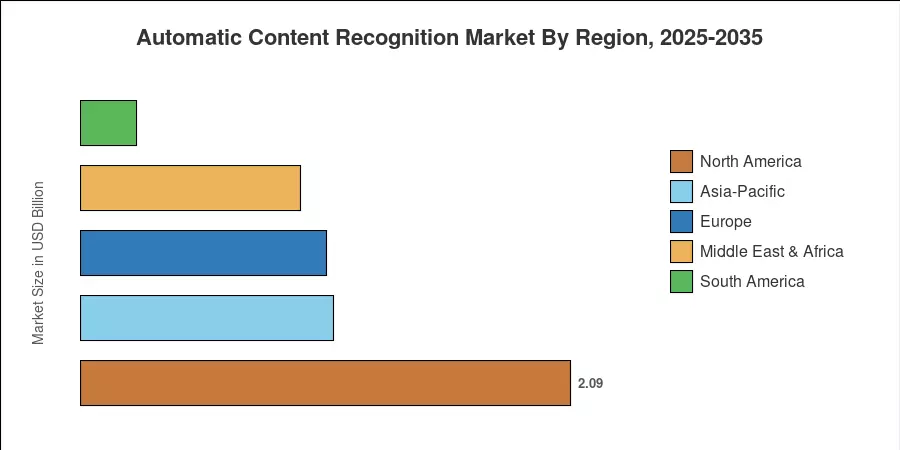
Programmatic TV budgets in the US are the main driver of North America's dominant 44% value share of the Automatic Content Recognition Market. With a 22.7% CAGR, Asia-Pacific is the fastest-growing area due to the spread of connected TV in South Korea, China, and India. Thanks to GDPR-compliant analytics frameworks that provide marketers with confidence in implementing recognition technology at scale, Europe accounts for about 22% of worldwide sales. The Automatic Content Recognition Market is expected to grow steadily in double digits through the mid-2030s as FAST channel economics develop, and vehicle infotainment usage picks up speed.

ย 

ย 

Key Report Takeaways

โ€ข By Component

  • Software platforms commanded approximately 59% of the Automatic Content Recognition Market in 2025, reflecting entrenched licensing models for fingerprint databases and matching engines.
  • Managed services are forecast to expand at a 22.1% CAGR through 2035, as broadcasters outsource compliance monitoring and model retraining to specialized vendors.

โ€ข By Technology

  • Audio and video fingerprinting accounted for the largest technology share in the Automatic Content Recognition Market, reaching 48% of revenue in 2025.
  • Digital watermarking maintained a stable installed base across pay-TV operators, valued at USD 1.08 billion in 2025.

โ€ข By End-User Industry

  • Media and entertainment represented 41% of the Automatic Content Recognition Market spend in 2025.
  • Automotive infotainment is forecast to register a 21.8% CAGR, fueled by voice-commerce pilot programs across major OEMs.

โ€ข By Region

  • North America captured 44% of the global value in the Automatic Content Recognition Market during 2025.
  • Asia-Pacific is compounding at 22.7% through 2035, the fastest pace among all regions.

ย 

Market Size and Forecast (2021โ€“2035)

Market Research Future's sizing model triangulates bottom-up revenue estimates from OEM shipment data, content-licensing fee pools, and enterprise software billings against top-down advertising-spend benchmarks published by IAB, Nielsen, and regional broadcasters [4][5].
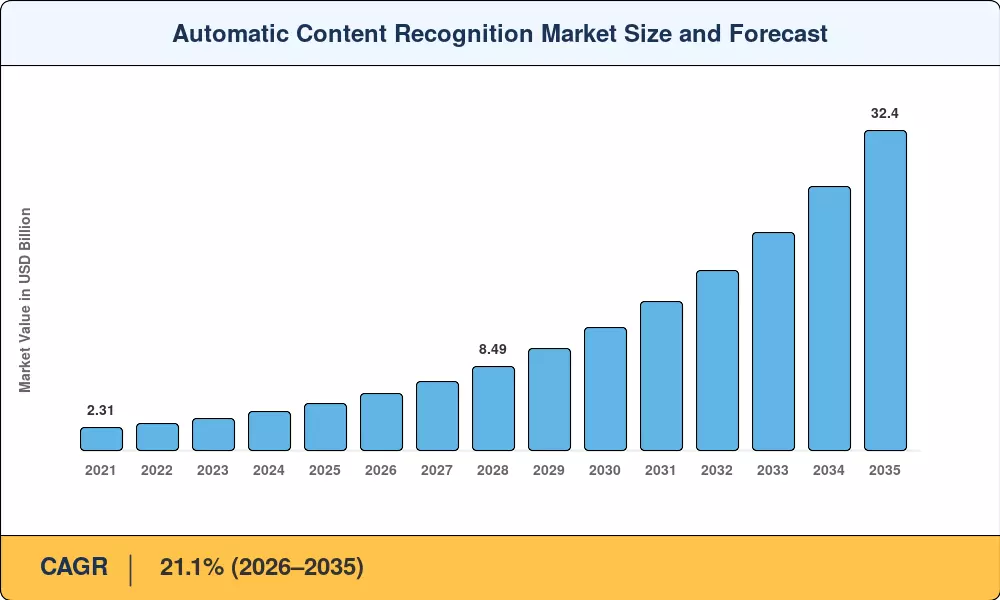
Automatic Content Recognition Market Size and Forecast
Our Impact
Enabled $4.3B Revenue Impact for Fortune 500 and Leading Multinationals
Partnering with 2000+ Global Organizations Each Year
30K+ Citations by Top-Tier Firms in the Industry

Driver Impact Analysis

Driver ~% Impact on CAGR Geographic Relevance Impact Timeline
Addressable/programmatic TV advertising 28% North America, Europe Short-term (โ‰ค2 yr)
Edge-AI chipset integration in smart TVs 22% Global Medium-term (2โ€“4 yr)
FAST channel and CTV analytics demand 18% North America, Asia-Pacific Short-term (โ‰ค2 yr)
Automotive infotainment voice commerce 12% Europe, Asia-Pacific Medium-term (2โ€“4 yr)
Copyright compliance regulation (DSA, DMCA) 10% Europe, North America Long-term (โ‰ฅ4 yr)
Healthcare and accessibility speech recognition 6% North America Long-term (โ‰ฅ4 yr)
Cross-device identity graph consolidation 4% Global Medium-term (2โ€“4 yr)

ย 

Addressable Advertising Budget Migration

Linear TV ad spend continues to decline, but digital video advertising has accelerated dramatically. According to the Interactive Advertising Bureau (IAB), United States digital video ad spending grew to USD 64 billion in 2024 and is projected to hit USD 72 billion by 2025. Recognition engines sit at the center of this reallocation: they match what a household is watching in real time and enable advertisers to swap generic spots for targeted creatives. The FCC's 2024 ATSC 3.0 repack timeline has further accelerated OEM integration, making the Automatic Content Recognition Market a structural beneficiary of every dollar that moves from broad reach to precision reach.

ย 

Edge-AI Silicon Roadmap

The hardware landscape powering next-generation smart TVs is shifting rapidly toward advanced system-on-chip (SoC) architectures. Major global semiconductor manufacturers are aggressively deploying hardware-accelerated machine learning processing units onto their main multimedia processors. On-device inference slashes cloud-query latency from roughly 800 ms to under 100 ms, which is critical for live-sports ad insertion. This architectural pivot expands local media analysis capabilities and significantly enlarges the addressable data pool.

ย 

FAST Channel Economics

Free ad-supported streaming television (FAST) has officially entered the mainstream of domestic entertainment consumption. According to a recent report, The Gauge, rapid platform adoption pushed the combined viewing time of prominent FAST networks like Tubi and The Roku Channel to a record 4.1% share of all United States television usage by mid-2024. Unlike subscription services, FAST channels depend entirely on advertising revenue, creating acute demand for granular viewership measurement.

ย 

Automotive Voice-Commerce Expansion

Connected-car shipments reached 72 million units globally in 2024, and analysts project 45% of new vehicles will support in-cabin commerce by 2028 [12]. Speech-driven recognition use cases โ€” ordering food, purchasing fuel, authenticating media subscriptions โ€” require the same fingerprint-and-match architecture that underpins TV-focused platforms, opening a sizable adjacent channel for the Automatic Content Recognition Market.

ย 

Restraints Impact Analysis

Restraint ~% Negative Impact Geographic Relevance Impact Timeline
Privacy regulation and consent frameworks โ€“30% Europe, North America Long-term (โ‰ฅ4 yr)
Data-latency challenges for live sports โ€“25% Global Short-term (โ‰ค2 yr)
Fragmented OEM integration standards โ€“20% Asia-Pacific Medium-term (2โ€“4 yr)
High false-positive rates in noisy environments โ€“15% Global Medium-term (2โ€“4 yr)
Consumer opt-out and transparency activism โ€“10% North America, Europe Long-term (โ‰ฅ4 yr)

ย 

Privacy and Consent Headwinds

Data privacy enforcement creates a complex landscape for international hardware manufacturers. The European Data Protection Board coordinates enforcement across member states, where prominent national bodies like France's CNIL and Italy's Garante continuously review digital tracking mechanisms and user consent frameworks.

Navigating these regional compliance layers increases structural development overhead for smart television original equipment manufacturers. This complex data governance requirement slows deployment velocity for the Automatic Content Recognition Market in compliance-sensitive territories

ย 

OEM Integration Fragmentation

No universal software development standard exists for embedding content recognition capabilities across diverse television chipset families. Major operating systems like Samsung's Tizen, LG's webOS, and Android TV each require unique software configurations and custom engineering resources. This ongoing ecosystem fragmentation expands structural development budgets compared to a single unified platform scenario. The resulting engineering friction delays product launch timelines and creates significant entry barriers for smaller software vendors within the global Automatic Content Recognition Market.

ย 

Automatic Content Recognition Market Opportunities

Second-Screen Synchronization for Retail Media

Retail media networks โ€” projected to exceed USD 150 Billion in global spend by 2028 โ€” increasingly seek cross-screen attribution linking a TV ad exposure to a mobile purchase [20]. Recognition engines can bridge that gap in under two seconds, positioning the Automatic Content Recognition Market as critical infrastructure for retail-media measurement.

Emerging-Market Connected-TV Rollout

India's BIS-certified smart-TV shipments grew 27% in 2024, while Brazil crossed 18 million connected-TV households [21]. Both markets remain under-penetrated relative to North America, creating a greenfield opportunity for recognition vendors willing to localize language models and partner with regional broadcasters.

Data Monetization Through Viewership Panels

Aggregated, anonymized viewing-behavior data commands premium pricing from media planners โ€” Nielsen's audience-measurement division generated over USD 3.5 billion in revenue during 2024 [22]. OEMs that license their recognition-derived panels can offset hardware margin pressure and create recurring revenue, a model that directly expands the Automatic Content Recognition Market.

Healthcare and Accessibility Voice Interfaces

Voice-driven content identification in clinical settings โ€” matching audio cues to patient-education libraries or medication guides โ€” represents a nascent vertical growing at roughly 21% annually [13]. Regulatory tailwinds from the FDA's digital-health pre-certification program lower barriers for recognition vendors entering this adjacent space.

Generative-AI Content Tagging and Rights Management

The explosion of AI-generated video is straining legacy rights-management systems. Recognition technology adapted for synthetic-content watermark detection can authenticate provenance and enforce licensing, a use case that the C2PA coalition is actively standardizing [23]. This positions the Automatic Content Recognition Market at the intersection of content integrity and creator economics.

ย 

Automatic Content Recognition Market Future Outlook

On-Device AI and Federated Learning

The next wave of media recognition architectures will prioritize executing signature processes entirely inside localized smart TV microprocessors. Devices will selectively compute media fingerprints locally, passing only aggregated, anonymized telemetry back to remote data hubs to secure lower operational strain while protecting user data utilities. Advanced industry models show edge execution drastically shrinking network transfer delays, driving structural adoption across the Automatic Content Recognition Market by diminishing heavy reliance on expensive remote processing servers.

Platform Economics and Walled-Garden Competition

Large-platform operators โ€” Google, Amazon, Apple, Roku โ€” are building proprietary recognition stacks to control first-party viewership data. This vertical integration may squeeze independent vendors yet simultaneously raises the ceiling for total recognition spending, as every major CTV platform competes on measurement fidelity. The Automatic Content Recognition Market will increasingly bifurcate into platform-captive and platform-agnostic tiers [14].

Cross-Screen Identity and Attribution

Modern brand campaigns demand a single, household-level identity cross-referencing frameworks capable of connecting traditional linear television, connected streams, mobile apps, and browser touchpoints. Content identification systems serve as a core computational link that seamlessly joins a broadcast screen exposure to an eventual digital purchase or conversion event. The Interactive Advertising Bureau and its technical bodies consistently rely on advanced television reconciliation strategies to help data scientists validate multi-screen reach metrics through the coming decade.

ย 

Content-Integrity Standards and Synthetic Media

As generative video tools produce increasingly lifelike digital assets, tracking media origin data becomes a structural necessity for intellectual property protection. While frameworks like the C2PA standard govern secure cryptographic asset metadata tracking from production to distribution, the broader Automatic Content Recognition Market will expand into a supportive verification layer. This technical ecosystem helps web platforms index, cross-reference, and flag unverified synthetic distributions across digital streaming environments.

ย 

Automatic Content Recognition Market Segmentation

By Component

Segment Key Metric Primary Demand Driver
Software 59% share (2025) Fingerprint database licensing
Services 22.1% CAGR (2026โ€“2035) Managed compliance and model tuning

ย 

Software platforms โ€” encompassing SDKs, matching engines, and fingerprint databases โ€” anchor the Automatic Content Recognition Market's revenue base. Perpetual and subscription licensing models provide vendors with predictable cash flows, while services are accelerating as broadcasters outsource recognition-pipeline management. The shift toward managed cloud services reflects growing complexity: brands need continuous model retraining to keep pace with evolving content formats, FAST channel proliferation, and new device form factors.

By Technology

Segment Key Metric Primary Demand Driver
Audio and Video Fingerprinting 48% share (2025) CTV ad measurement
Digital Watermarking USD 1.08 Billion (2025) Pay-TV piracy protection
Others (QR overlay, metadata sync) 18.6% CAGR Companion-app experiences

ย 

Audio and video fingerprinting remains the backbone of the Automatic Content Recognition Market, prized for its ability to identify content without requiring pre-embedded marks. Digital watermarking retains a strong foothold among pay-TV operators and studio content-protection teams who need forensic traceability. Emerging approaches โ€” including QR-overlay triggers and metadata-sync protocols โ€” are carving out niches in live-event engagement and companion-screen applications.

By Solution

Segment Key Metric Primary Demand Driver
Security and Copyright Protection 31% share (2025) Studio anti-piracy mandates
Real-Time Content Analytics 22.0% CAGR (2026โ€“2035) FAST channel ad optimization
Voice and Speech Interfaces USD 0.62 Billion (2025) Automotive and healthcare pilots
Others 16.8% CAGR Loyalty and gamification platforms

ย 

Security and copyright protection commands the single largest solution share in the Automatic Content Recognition Market, driven by studio-mandated forensic watermarking across theatrical and early-window digital releases. Real-time content analytics is the fastest-expanding solution category, propelled by FAST-channel operators that need second-by-second audience metrics to price ad inventory dynamically.

By End-User Industry

Segment Key Metric Primary Demand Driver
Media and Entertainment 41% share (2025) Ad-funded and hybrid monetization
Consumer Electronics OEMs USD 0.86 Billion (2025) Smart-TV data monetization
Telecom and IT 19.4% CAGR IPTV analytics, 5G video services
Others (Automotive, Healthcare) 21.8% CAGR Voice commerce, clinical media ID

ย 

Media and entertainment firms remain the primary buyers in the Automatic Content Recognition Market, deploying recognition engines across broadcast monitoring, ad-insertion verification, and audience measurement. Consumer electronics OEMs are the second-largest spenders โ€” Samsung, LG, and Vizio each operate proprietary recognition-derived data businesses that generate incremental margin atop hardware sales.

ย 

Regional Market Share Analysis

Region Key Metric Primary Investment Themes
North America 44% value share (2025) Programmatic CTV, ATSC 3.0 transition
Europe USD 1.05 Billion (2025) GDPR-compliant analytics, public-broadcaster modernization
Asia-Pacific 22.7% CAGR (2026โ€“2035) Connected-TV proliferation, regional OTT platforms
South America USD 0.24 Billion (2025) Pay-TV digitization, ad-funded streaming
Middle East & Africa 19.8% CAGR (2026โ€“2035) IPTV expansion, digital-advertising adoption
Total USD 4.76 Billion (2025) โ€”

The Automatic Content Recognition Market exhibits pronounced regional variation, shaped by advertising ecosystem maturity, smart-TV penetration, and data-privacy regimes.

ย 

North America

Country Key Metric Key Driver
United States 78% of regional share CTV ad spend, ATSC 3.0
Canada USD 0.23 Billion (2025) Bilingual content-matching demand
Mexico 19.5% CAGR Pay-TV digitization, OTT growth

ย 

The United States drives nearly four-fifths of North American spending in the Automatic Content Recognition Market, reflecting the world's largest programmatic-TV ecosystem. Canada's bilingual broadcast environment creates specialized demand for dual-language fingerprinting, while Mexico's rapidly expanding OTT subscriber base โ€” up 31% year-over-year in 2024 โ€” is attracting recognition from vendors targeting the Spanish-language advertising corridor [24].

Europe

Country Key Metric Key Driver
Germany 24% of regional share Public-broadcaster analytics budgets
United Kingdom USD 0.22 Billion (2025) BVOD and addressable TV
France 20.4% CAGR CNIL-driven consent-layer innovation
Italy USD 0.09 Billion (2025) Serie A streaming rights measurement
Spain 19.8% CAGR FAST channel launches
Nordic Countries USD 0.08 Billion (2025) Cross-border content licensing
Russia 17.2% CAGR Domestic OTT platform growth
Rest of Europe USD 0.11 Billion (2025) โ€”

ย 

Germany and the UK together represent over 45% of European revenue in the Automatic Content Recognition Market, with public broadcasters like ARD/ZDF and the BBC investing in recognition-enabled measurement to justify hybrid ad-subscription models. France's strict CNIL consent guidelines have paradoxically spurred innovation in privacy-preserving fingerprinting, giving French vendors a compliance edge when selling across the EU [15].

Asia-Pacific

Country Key Metric Key Driver
China 34% of the regional share Domestic smart-TV brands, Douyin/Bilibili analytics
India 24.1% CAGR Jio-TV and regional-language streaming
Japan USD 0.16 Billion (2025) Connected-TV ad market maturation
South Korea 21.5% CAGR Samsung and LG OEM integration
ASEAN USD 0.11 Billion (2025) Mobile-first content recognition
Rest of Asia-Pacific 20.3% CAGR โ€”

ย 

China's domestic OEM ecosystem โ€” led by Hisense, TCL, and Xiaomi โ€” embeds recognition modules into over 60 million smart TVs annually, making it the largest single-country hardware channel in the Automatic Content Recognition Market. India's linguistic diversity (22 scheduled languages) demands multilingual audio-matching capabilities, an area where ACRCloud and local start-ups are investing heavily [21].

South America

Country Key Metric Key Driver
Brazil 62% of regional share Globo digital transformation
Argentina USD 0.04 Billion (2025) Cable-to-OTT migration
Rest of South America 18.9% CAGR โ€”

ย 

Brazil's Globo group has been an early mover in deploying recognition-based ad insertion across its Globoplay streaming platform, anchoring the Automatic Content Recognition Market in the region. Argentina's macroeconomic volatility has slowed enterprise software spending, though ad-funded models are gaining traction as consumers shift to free-tier streaming options.

Middle East & Africa

Country Key Metric Key Driver
Saudi Arabia 28% of the regional share Vision 2030 media investment
UAE USD 0.04 Billion (2025) Smart-city and IPTV integration
South Africa 20.1% CAGR DStv digital migration
Egypt USD 0.02 Billion (2025) Mobile-video advertising
Rest of MEA 18.5% CAGR โ€”

ย 

Saudi Arabia's Vision 2030 entertainment-sector liberalization has unlocked substantial media-infrastructure spending, making it the largest contributor to the Automatic Content Recognition Market within MEA. The UAE's advanced IPTV deployments โ€” particularly through Etisalat and du โ€” serve as regional proof-of-concept sites for recognition-enabled audience analytics [25].

ย 

Automatic Content Recognition Market By Region, 2025-2035

Competitive Benchmarking

The Automatic Content Recognition Market exhibits medium concentration, with the top five vendors accounting for an estimated 38โ€“45% of global revenue. The competitive field spans pure-play recognition specialists, diversified measurement conglomerates, and platform-embedded OEM solutions, yielding a moderately fragmented structure where niche expertise coexists with scale advantages.

Company Est. Revenue Share Range Key Offerings Strategic Positioning
Gracenote (Nielsen) ~8โ€“11% Video and music fingerprinting, audience analytics Measurement-integrated recognition stack
Shazam (Apple) ~7โ€“10% Audio recognition, cross-device engagement Consumer-facing brand with ecosystem lock-in
Samba TV ~5โ€“8% Cross-screen identity, programmatic activation Data-platform-centric CTV analytics
Digimarc ~4โ€“7% Digital watermarking, content authentication Enterprise IP-protection focus
ACRCloud ~4โ€“6% Real-time audio recognition API, broadcast monitoring Developer-friendly SaaS model
Audible Magic ~3โ€“5% Content identification, rights management UGC platform compliance specialist
Ensequence ~3โ€“5% Interactive TV overlays, ad engagement Interactive-advertising niche
Beatgrid ~2โ€“4% Cross-media measurement, audio sync Emerging cross-platform analytics
Verimatrix ~2โ€“4% Watermarking, anti-piracy, revenue security Pay-TV and OTT security layer
AnyClip ~2โ€“3% AI-powered video intelligence, metadata enrichment Content-discovery and SEO play

ย 

ย 

Recent News & Developments

Samba TV and TiVo Ads- (April, 2026)--Formed a strategic partnership integrating Sambaโ€™s advanced analytics with TiVo's connected television platform to bolster global cross-screen audience targeting capabilities.

Gracenote and PubMatic- (June, 2026)--Announced a strategic partnership integrating Gracenote's content intelligence into PubMatic's programmatic platform to enable precise live sports inventory targeting.

  • Samba TV and Aquila- (October, 2025)--Partnered to integrate Samba's first-party content recognition insights into Aquila's cross-media tracking platform, driving deduplicated audience measurement.

ย 

ย 

ย 

ย 

ย 

ย 

ย 

Automatic Content Recognition Market Report Scope

Parameter Detail
Market Scope Global Automatic Content Recognition Market โ€” software, services, technologies, solutions, and end-user industries
Study Period 2021โ€“2035
CAGR (Forecast) 21.1% (2026โ€“2035)
Base Year 2025 โ€” USD 4.76 Billion
2026 Starting Value USD 5.79 Billion
2035 Projected Value USD 32.40 Billion
Fastest Growing Segment Services (by component); Asia-Pacific (by region)
Companies Profiled 10 (Gracenote, Shazam, Samba TV, Digimarc, ACRCloud, Audible Magic, Ensequence, Beatgrid, Verimatrix, AnyClip)
Valuation Currency USD Billion

ย 

ย 

FAQs

How does ACR technology differ from traditional broadcast monitoring?

Traditional monitoring relies on dedicated meter hardware in sample households, while ACR embeds recognition directly into consumer devices at scale. This shift eliminates panel bias and delivers census-level viewership data across millions of screens [5].

What privacy safeguards should buyers evaluate before deploying recognition solutions?

Buyers should verify GDPR and CCPA consent-management compliance, on-device processing options, and anonymization protocols. Vendors offering federated-learning architectures reduce data-exfiltration risk significantly [15].

Can recognition engines reliably identify content in noisy or multi-source audio environments?

Modern fingerprinting algorithms achieve above 95% accuracy even with ambient noise up to 75 dB. Dual-modality systems combining audio and video signatures push accuracy past 98% in challenging settings [18].

What ROI benchmarks exist for OEMs monetizing recognition-derived viewership data?

Leading smart-TV OEMs report USD 5โ€“12 per device per year in incremental data-licensing revenue. At 50 million active devices, that translates to USD 250โ€“600 million annually [22].

How will the EU AI Act affect recognition technology deployments after 2026?

The AI Act classifies content-matching as limited-risk, requiring transparency disclosures but not pre-market conformity assessments. Vendors must maintain logging and audit-trail capabilities [9].

Which integration model โ€” SDK-based or cloud API โ€” best suits mid-size broadcasters?

Cloud APIs offer faster deployment and lower upfront costs, making them ideal for broadcasters with fewer than 20 channels. SDK integration suits operators needing sub-100 ms latency for live ad insertion [16].

What role does ACR play in combating deepfake and synthetic-media distribution?

Recognition engines cross-reference content against registered fingerprint databases to flag unregistered synthetic outputs. C2PA-aligned watermark detection adds a provenance layer that strengthens content-integrity workflows [23]. ย  ย 
Author
Author
Author Profile
Apoorva Priyadarshi LinkedIn
Research Analyst
With 4+ years of experience in Market Intelligence and Strategic Research, Apoorv specializes in ICT, Semiconductor, and BFSI markets. Combining strong analytical capabilities with a deep understanding of technology-driven industries, he focuses on delivering data-driven insights that support strategic decision-making. With a background in technology and business research, Apoorv has contributed to numerous global market studies, competitive landscape analyses, and opportunity assessments across sectors such as semiconductors, digital banking, cybersecurity, and telecommunications.
Co-Author
Co-Author Profile
Shubham Munde LinkedIn
Team Lead - Research
Shubham brings over 7 years of expertise in Market Intelligence and Strategic Consulting, with a strong focus on the Automotive, Aerospace, and Defense sectors. Backed by a solid foundation in semiconductors, electronics, and software, he has successfully delivered high-impact syndicated and custom research on a global scale. His core strengths include market sizing, forecasting, competitive intelligence, consumer insights, and supply chain mapping. Widely recognized for developing scalable growth strategies, Shubham empowers clients to navigate complex markets and achieve a lasting competitive edge. Trusted by start-ups and Fortune 500 companies alike, he consistently converts challenges into strategic opportunities that drive sustainable growth.

Research Approach

ย 

Secondary Research

The secondary research process involved comprehensive analysis of telecommunications regulatory databases, intellectual property repositories, broadcast technology standards, digital media publications, and authoritative technology organizations. Key sources included the U.S. Federal Communications Commission (FCC), European Telecommunications Standards Institute (ETSI), International Telecommunication Union (ITU), Advanced Television Systems Committee (ATSC), Digital Video Broadcasting Project (DVB), U.S. Patent and Trademark Office (USPTO) technology patent databases, European Data Protection Board (EDPB) for GDPR compliance frameworks, National Institute of Standards and Technology (NIST) biometrics and media analysis standards, U.S. Copyright Office, Interactive Advertising Bureau (IAB) technical standards, Institute of Electrical and Electronics Engineers (IEEE) multimedia processing standards, National Association of Broadcasters (NAB), CTIA (Wireless Association), International Federation of the Phonographic Industry (IFPI), Bureau of Economic Analysis (BEA) technology sector data, U.S. Census Bureau ICT and media adoption surveys, Eurostat Digital Economy and Society Index, National Science Foundation (NSF) computer science research databases, Organisation for Economic Co-operation and Development (OECD) digital economy outlooks, and national telecommunications regulator reports from key markets including Ofcom (UK), ARCEP (France), Bundesnetzagentur (Germany), and Ministry of Internal Affairs and Communications (Japan). The following sources were employed to gather statistics on the deployment of broadcast technology, patent landscapes for audio/video recognition, content identification regulatory frameworks, smart device penetration data, cross-platform advertising measurement standards, and digital media consumption trends in the audio recognition, video/image recognition, voice recognition, and real-time content analytics segments.

ย 

Primary Research

In the primary research process, qualitative and quantitative insights specific to automatic content recognition technologies were obtained by interviewing supply-side and demand-side stakeholders. The supply-side sources consist of CEOs, CTOs, VPs of Engineering, Chief Product Officers, regulatory compliance leaders, and broadcast technology leads from ACR technology developers, smart TV OEMs, mobile device manufacturers, cloud service providers, and media software vendors. Demand-side sources included chief marketing officers, advertising technology directors, broadcast operations heads, content protection managers from media and entertainment companies, OTT platform executives, addressable advertising specialists, and procurement leads from telecommunications operators, broadcasting networks, and digital advertising agencies. Primary research has confirmed the timelines for ACR deployment in connected TV ecosystems, validated market segmentation across audio, video/image, voice, and real-time analytics solutions, and has gathered insights on second-screen synchronization applications, content monetization strategies, privacy compliance mechanisms, and competitive differentiation in professional versus managed service delivery models.

Primary Respondent Breakdown:

By Designation: C-level Primaries (32%), Director Level (31%), Others (37%)

By Region: North America (38%), Europe (25%), Asia-Pacific (28%), Rest of World (9%)

ย 

Market Size Estimation

Revenue mapping and ACR deployment volume analysis were employed to determine global market valuation in the consumer electronics, broadcasting, and advertising sectors. The methodology comprised the following:

The identification of over 50 key technology providers and service vendors in North America, Europe, Asia-Pacific, and Latin America, including developers of aural fingerprinting technology, video recognition platform providers, and broadcast monitoring solution vendors.

Product mapping for real-time content analytics, voice recognition, video and image recognition, and audio recognition, with support for both on-premise and cloud-based deployment architectures An examination of the annual revenues that have been reported and modeled for the ACR portfolios, which include software licensing, SaaS subscriptions, professional consulting services, and managed monitoring services

Coverage of technology providers and OEMs, which collectively account for 70-75% of the global market share in 2024, which includes mobile ACR SDK providers and smart TV platform integrators

For the IT & telecommunications, healthcare, media & entertainment, and consumer electronics end-user verticals, segment-specific valuations are derived through extrapolation using bottom-up (device shipment volumes ร— ACR integration rates ร— average selling price by region) and top-down (vendor revenue validation and ad-tech spending allocation) approaches.

Download Free Sample

Kindly complete the form below to receive a free sample of this Report

Download PDF ×

We do not share your information with anyone. However, we may send you emails based on your report interest from time to time. You may contact us at any time to opt-out.
















