Automatic Content Recognition Market

ID: MRFR/ICT/0701-CR
91 Pages
Apoorva Priyadarshi
Last Updated: June 22, 2026
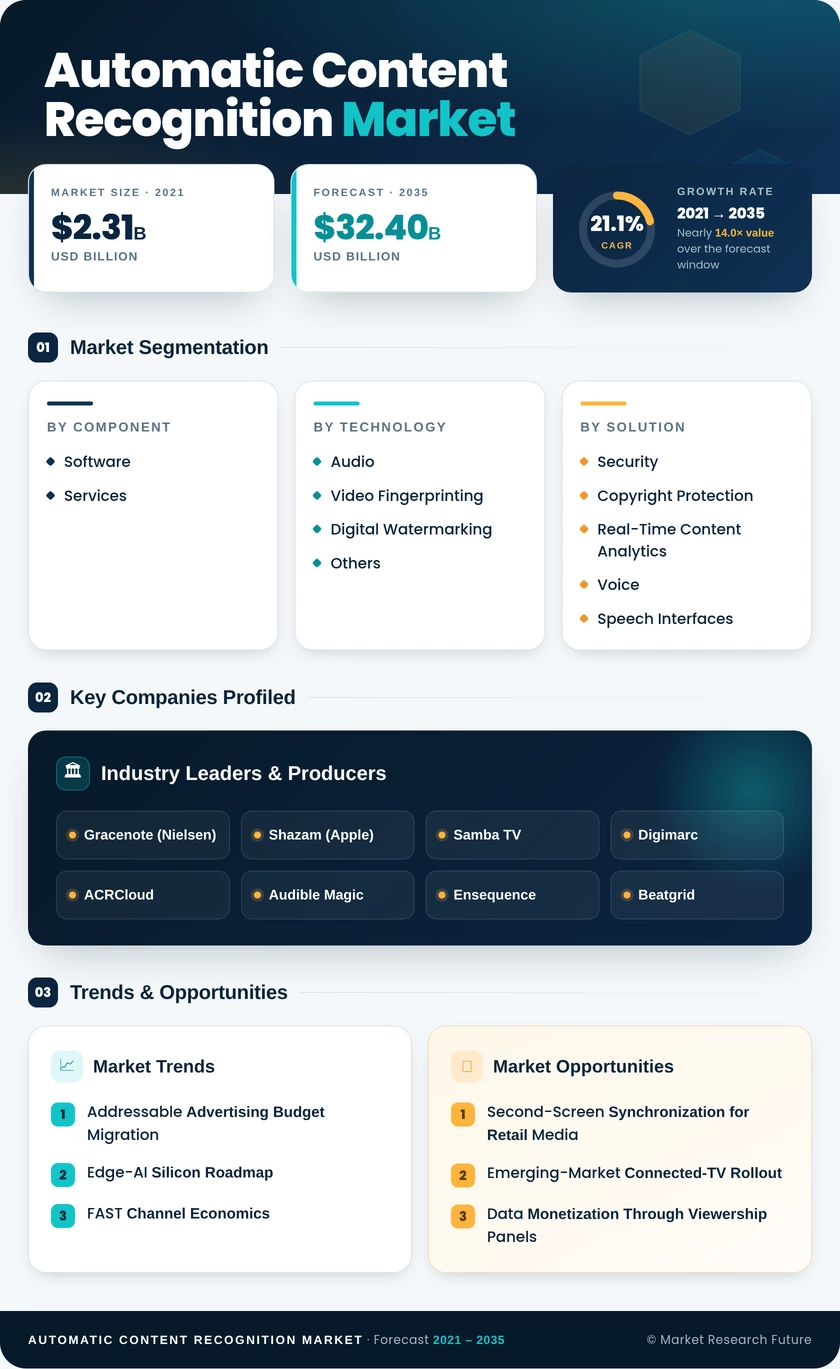
Automatic Content Recognition Market Size, Share and Research Report By Component (Software, Services), By Technology (Audio and Video Fingerprinting, Digital Watermarking, Others (QR Overlay, Metadata Sync)), By Solution (Security and Copyright Protection, Real-Time Content Analytics, Voice and Speech Interfaces, Others (Loyalty, Gamification)), By End-User Industry (Media and Entertainment, Consumer Electronics OEMs, Telecom and IT, Others (Automotive, Healthcare)) and By Regional (North America, Europe, South America, Asia Pacific, Middle East and Africa) - Industry Forecast to 2035.
Download PDF ×

We do not share your information with anyone. However, we may send you emails based on your report interest from time to time. You may contact us at any time to opt-out.

  1. 1 Market Overview |
    1. 1.1 Study Assumptions & Market Definition |
    2. 1.2 Scope of the Study |
    3. 1.3 Research Methodology
  2. 2 Market Summary & Key Takeaways
  3. 3 Market Dynamics |
    1. 3.1 Market Drivers Analysis | |
      1. 3.1.1 Addressable / Programmatic TV Advertising | |
      2. 3.1.2 Edge-AI Chipset Integration in Smart TVs | |
      3. 3.1.3 FAST Channel and CTV Analytics Demand | |
      4. 3.1.4 Automotive Infotainment Voice Commerce | |
      5. 3.1.5 Copyright Compliance Regulation (DSA, DMCA) | |
      6. 3.1.6 Healthcare and Accessibility Speech Recognition | |
      7. 3.1.7 Cross-Device Identity Graph Consolidation |
    2. 3.2 Market Restraints Analysis | |
      1. 3.2.1 Privacy Regulation and Consent Frameworks | |
      2. 3.2.2 Data-Latency Challenges for Live Sports | |
      3. 3.2.3 Fragmented OEM Integration Standards | |
      4. 3.2.4 High False-Positive Rates in Noisy Environments | |
      5. 3.2.5 Consumer Opt-Out and Transparency Activism |
    3. 3.3 Market Opportunity Analysis | |
      1. 3.3.1 Second-Screen Synchronization for Retail Media | |
      2. 3.3.2 Emerging-Market Connected-TV Rollout | |
      3. 3.3.3 Data Monetization Through Viewership Panels | |
      4. 3.3.4 Healthcare and Accessibility Voice Interfaces | |
      5. 3.3.5 Generative-AI Content Tagging and Rights Management |
    4. 3.4 Industry Value Chain Analysis |
    5. 3.5 Porter's Five Forces Analysis
  4. 4 Global Automatic Content Recognition Market Size & Forecast (2021–2035) |
    1. 4.1 Historical Market Size (2021–2025) |
    2. 4.2 Current & Forecast Market Size (2026–2035) |
    3. 4.3 Market Size by Revenue (USD Billion) |
    4. 4.4 Year-over-Year Growth Analysis
  5. 5 Segmentation Analysis |
    1. 5.1 By Component | |
      1. 5.1.1 Software | |
      2. 5.1.2 Services |
    2. 5.2 By Technology | |
      1. 5.2.1 Audio and Video Fingerprinting | |
      2. 5.2.2 Digital Watermarking | |
      3. 5.2.3 Others (QR Overlay, Metadata Sync) |
    3. 5.3 By Solution | |
      1. 5.3.1 Security and Copyright Protection | |
      2. 5.3.2 Real-Time Content Analytics | |
      3. 5.3.3 Voice and Speech Interfaces | |
      4. 5.3.4 Others (Loyalty, Gamification) |
    4. 5.4 By End-User Industry | |
      1. 5.4.1 Media and Entertainment | |
      2. 5.4.2 Consumer Electronics OEMs | |
      3. 5.4.3 Telecom and IT | |
      4. 5.4.4 Others (Automotive, Healthcare)
  6. 6 Regional Analysis |
    1. 6.1 North America | |
      1. 6.1.1 United States | |
      2. 6.1.2 Canada | |
      3. 6.1.3 Mexico |
    2. 6.2 Europe | |
      1. 6.2.1 Germany | |
      2. 6.2.2 United Kingdom | |
      3. 6.2.3 France | |
      4. 6.2.4 Italy | |
      5. 6.2.5 Spain | |
      6. 6.2.6 Nordic Countries | |
      7. 6.2.7 Russia | |
      8. 6.2.8 Rest of Europe |
    3. 6.3 Asia-Pacific | |
      1. 6.3.1 China | |
      2. 6.3.2 India | |
      3. 6.3.3 Japan | |
      4. 6.3.4 South Korea | |
      5. 6.3.5 ASEAN | |
      6. 6.3.6 Rest of Asia-Pacific |
    4. 6.4 South America | |
      1. 6.4.1 Brazil | |
      2. 6.4.2 Argentina | |
      3. 6.4.3 Rest of South America |
    5. 6.5 Middle East & Africa | |
      1. 6.5.1 Saudi Arabia | |
      2. 6.5.2 UAE | |
      3. 6.5.3 South Africa | |
      4. 6.5.4 Egypt | |
      5. 6.5.5 Rest of MEA
  7. 7 Competitive Landscape |
    1. 7.1 Market Share Analysis (2025) |
    2. 7.2 Competitive Benchmarking Matrix |
    3. 7.3 Company Profiles | |
      1. 7.3.1 Gracenote (Nielsen) | |
      2. 7.3.2 Shazam (Apple) | |
      3. 7.3.3 Samba TV | |
      4. 7.3.4 Digimarc | |
      5. 7.3.5 ACRCloud | |
      6. 7.3.6 Audible Magic | |
      7. 7.3.7 Ensequence | |
      8. 7.3.8 Beatgrid | |
      9. 7.3.9 Verimatrix | |
      10. 7.3.10 AnyClip
  8. 8 Future Outlook & Strategic Recommendations (2026–2035) |
    1. 8.1 On-Device AI and Federated Learning |
    2. 8.2 Platform Economics and Walled-Garden Competition |
    3. 8.3 Cross-Screen Identity and Attribution |
    4. 8.4 Content-Integrity Standards and Synthetic Media
  9. 9 Recent Developments & News
  10. 10 Frequently Asked Questions (FAQs)
  11. 11 Report Scope & Methodology |
    1. 11.1 Study Period & Base Year |
    2. 11.2 Data Sources & Citations |
    3. 11.3 Abbreviations
  12. 12 LIST OF TABLES |
  13. TABLE 1 Global Automatic Content Recognition Market Size & Forecast, by Revenue (USD Billion), 2021–2035 |
  14. TABLE 2 Global Automatic Content Recognition Market — Year-over-Year Growth Analysis, 2021–2035 |
  15. TABLE 3 Market Driver Impact Analysis — Automatic Content Recognition Market |
  16. TABLE 4 Market Restraint Impact Analysis — Automatic Content Recognition Market |
  17. TABLE 5 Global Automatic Content Recognition Market Size, by Component, 2021–2035 (USD Billion) |
  18. TABLE 6 Global Automatic Content Recognition Market Size, by Technology, 2021–2035 (USD Billion) |
  19. TABLE 7 Global Automatic Content Recognition Market Size, by Solution, 2021–2035 (USD Billion) |
  20. TABLE 8 Global Automatic Content Recognition Market Size, by End-User Industry, 2021–2035 (USD Billion) |
  21. TABLE 9 Global Automatic Content Recognition Market Size, by Region, 2021–2035 (USD Billion) |
  22. TABLE 10 North America Automatic Content Recognition Market Size, by Country, 2021–2035 (USD Billion) |
  23. TABLE 11 Europe Automatic Content Recognition Market Size, by Country, 2021–2035 (USD Billion) |
  24. TABLE 12 Asia-Pacific Automatic Content Recognition Market Size, by Country, 2021–2035 (USD Billion) |
  25. TABLE 13 South America Automatic Content Recognition Market Size, by Country, 2021–2035 (USD Billion) |
  26. TABLE 14 Middle East & Africa Automatic Content Recognition Market Size, by Country, 2021–2035 (USD Billion) |
  27. TABLE 15 Competitive Benchmarking Matrix — Global Automatic Content Recognition Market, 2025 |
  28. TABLE 16 Company Profiles — Key Players, Global Automatic Content Recognition Market |
  29. TABLE 17 Recent Developments & Strategic Announcements, 2024–2025 |
  30. TABLE 18 Report Scope and Methodology — Automatic Content Recognition Market |
  31. TABLE 19 Detailed Sources and Citations — Automatic Content Recognition Market
  32. 13 LIST OF FIGURES |
  33. FIGURE 1 Market Dynamics — Drivers, Restraints, and Opportunities |
  34. FIGURE 2 Industry Value Chain Analysis — Automatic Content Recognition Market |
  35. FIGURE 3 Porter's Five Forces Analysis — Automatic Content Recognition Market |
  36. FIGURE 4 Global Automatic Content Recognition Market Size Trend (USD Billion), 2021–2035 |
  37. FIGURE 5 Automatic Content Recognition Market Share, by Component (2025) |
  38. FIGURE 6 Automatic Content Recognition Market Share, by Technology (2025) |
  39. FIGURE 7 Automatic Content Recognition Market Share, by Solution (2025) |
  40. FIGURE 8 Automatic Content Recognition Market Share, by End-User Industry (2025) |
  41. FIGURE 9 Automatic Content Recognition Market Share, by Region (2025) |
  42. FIGURE 10 North America Automatic Content Recognition Market — Country Share (2025) |
  43. FIGURE 11 Europe Automatic Content Recognition Market — Country Share (2025) |
  44. FIGURE 12 Asia-Pacific Automatic Content Recognition Market — Country Share (2025) |
  45. FIGURE 13 South America Automatic Content Recognition Market — Country Share (2025) |
  46. FIGURE 14 Middle East & Africa Automatic Content Recognition Market — Country Share (2025) |
  47. FIGURE 15 Competitive Landscape — Revenue Share Distribution (2025)

Segmentation Quick Reference

DimensionSub-SegmentsDominant SegmentFastest Growing Segment
ComponentSoftware, ServicesSoftware (59% share, 2025)Services (22.1% CAGR)
TechnologyAudio and Video Fingerprinting, Digital Watermarking, OthersAudio and Video Fingerprinting (48% share, 2025)Others (18.6% CAGR)
SolutionSecurity and Copyright Protection, Real-Time Content Analytics, Voice and Speech Interfaces, OthersSecurity and Copyright Protection (31% share, 2025)Real-Time Content Analytics (22.0% CAGR)
End-User IndustryMedia and Entertainment, Consumer Electronics OEMs, Telecom and IT, OthersMedia and Entertainment (41% share, 2025)Others — Automotive, Healthcare (21.8% CAGR)
GeographyNorth America, Europe, Asia-Pacific, South America, Middle East & AfricaNorth America (44% share, 2025)Asia-Pacific (22.7% CAGR)


Market Segmentation Overview

By Component

Sub-SegmentKey Trend
SoftwareShift from perpetual licenses to subscription-based fingerprint-database access.
ServicesGrowing demand for managed compliance monitoring and continuous model retraining


Software remains the revenue anchor, with OEMs and broadcasters licensing fingerprint databases and matching SDKs under recurring subscription agreements. Services are gaining momentum as recognition pipelines become more complex, requiring specialized vendors to manage cloud infrastructure, regulatory reporting, and algorithm updates.

By Technology

Sub-SegmentKey Trend
Audio and Video FingerprintingDual-modality matching for higher accuracy in multi-screen environments
Digital WatermarkingForensic traceability mandates from major studios and pay-TV operators.
Others (QR Overlay, Metadata Sync)Companion-screen interactivity for live events and sports broadcasts


Audio and video fingerprinting leads adoption because it works on unmodified content — no pre-embedded mark is needed. Digital watermarking serves security-critical use cases where the content origin must be provably traceable. Emerging overlay and sync technologies target interactive and gamification scenarios.

By Solution

Sub-SegmentKey Trend
Security and Copyright ProtectionStudio-mandated forensic watermarking for theatrical and early-window releases
Real-Time Content AnalyticsSecond-by-second FAST channel audience measurement for dynamic ad pricing
Voice and Speech InterfacesIn-cabin commerce and clinical content identification pilots
Others (Loyalty, Gamification)Viewer-reward programs tied to content-recognition triggers


Security solutions carry the largest share, driven by anti-piracy requirements. Real-time analytics is expanding fastest as ad-supported streaming economics demand granular viewership intelligence. Voice and speech solutions are entering automotive and healthcare verticals with promising early traction.

By End-User Industry

Sub-SegmentKey Trend
Media and EntertainmentHybrid monetization models require unified audience measurement
Consumer Electronics OEMsData-licensing revenue as an incremental margin layer atop hardware
Telecom and ITIPTV analytics and 5G-enabled video service differentiation
Others (Automotive, Healthcare)Voice-commerce pilots and clinical media-identification applications


Media and entertainment buyers drive the plurality of spend, deploying recognition engines for ad verification, broadcast monitoring, and cross-platform audience analytics. OEMs increasingly view recognition-derived data as a standalone profit center, with leading brands generating meaningful per-device annual revenue from viewership-panel licensing.