Automatic Weapons Market (2026 - 2035)

Automatic Weapons Market Size, Share, Industry Trend & Analysis Research Report Information By Type (Automatic Rifles, Machine Guns, Automatic Launchers, Automatic Cannons, Gatling Guns), By Platform (Land, Airborne, Naval), By Caliber (Small Caliber, Medium Caliber, Large Caliber), By End User (Defense, Law Enforcement), By Geography (North America, Europe, Asia-Pacific, South America, Middle East & Africa) – Forecast Till 2035.
ID: MRFR/AD/6312-HCR
133 Pages
Abbas Raut, Swapnil Palwe
Last Updated: June 25, 2026
Automatic Weapons Market
Market Size
Forecast Period2026-2035
CAGR (2026-2035)6.95%
2025 Market SizeUSD 9.58 billion
2035 Market SizeUSD 18.74 billion
Key Players
FN Herstal
Heckler & Koch
Rheinmetall AG
General Dynamics Ordnance
BAE Systems
Northrop Grumman
Opportunities
  • AI-Integrated Fire-Control Systems
  • Counter-UAS Kinetic Effectors
  • Emerging-Market Force Build-Up

Automatic Weapons Market Summary

The Automatic Weapons Market stood at USD 9.58 billion in 2025 and is projected to reach USD 10.24 billion in 2026, climbing to USD 18.74 billion by 2035 at a CAGR of 6.95% during 2026–2035. Rising global defense budgets — the United States alone authorized USD 886 billion in its FY 2024 National Defense Authorization Act [1] — and accelerating force-modernization timelines across NATO and Indo-Pacific alliances are the primary spending catalysts fueling expansion of the Automatic Weapons Market.

A generational technology transition is changing procurement priorities. Cold War–era platforms chambered for outdated cartridges are making way to digitally networked, sensor-fused weapon systems capable of autonomous target tracking and real-time data interchange across joint combat networks. This shift towards higher velocity, modular-caliber platforms capable of peer-adversary engagements is seen in the U.S. Army’s Next Generation Squad Weapon (NGSW) program, which is expected to cost over USD 4.7 billion over its lifecycle [2]. EU Defense Industrial Strategy allocations [3] European states are investing in equal amounts in the Future Combat Air System and equivalent land-weapon upgrades.

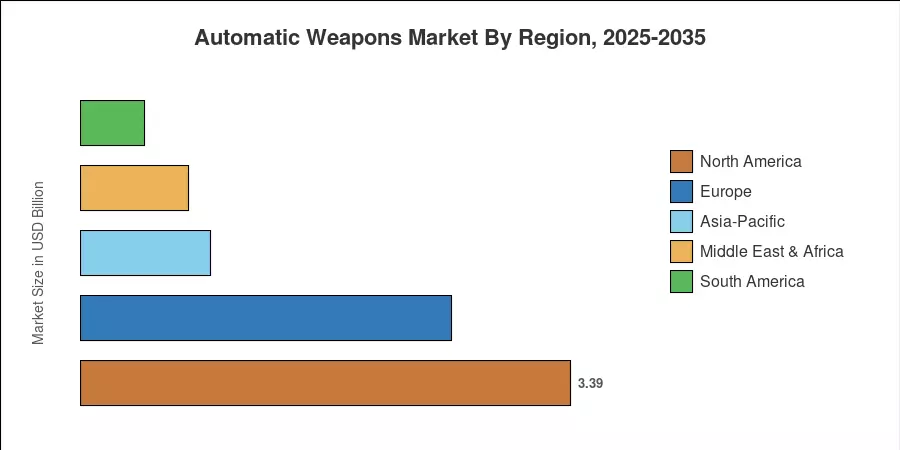
North America commanded the Automatic Weapons Market with a share of 35.40% in 2025, owing to ongoing Pentagon investment and a robust domestic industrial base. Asia-Pacific has the highest CAGR of 9.40% through 2035, with India, South Korea, and Japan in rearmament cycles. Europe was the second largest area, led by post-2022 defense spending hikes in Baltic and Nordic countries. The next decade will depend on the speed with which digitally integrated weapon stations are deployed globally to replace manually controlled older systems.

Key Report Takeaways

• By Type

  • Automatic rifles captured 38.40% of the Automatic Weapons Market in 2025, reflecting widespread infantry modernization programs across NATO and allied forces.
  • Automatic cannons are expanding at an 8.98% CAGR through 2035, driven by integration into unmanned turrets and remote weapon stations on armored vehicles.

• By Platform

  • Land platforms dominated with a 62.30% share of the Automatic Weapons Market in 2025, as ground-force upgrades continue to absorb the bulk of ordnance budgets.
  • Naval platforms exhibit the fastest growth at a 9.70% CAGR to 2035, fueled by littoral combat ship programs and corvette fleet expansions.

• By Caliber

  • Small caliber systems accounted for USD 4.20 billion in 2025, underpinned by high-volume infantry and special operations demand.
  • Large caliber weapons are growing at an 8.72% CAGR to 2035, as counter-drone and air-defense applications gain urgency.

• By End User

  • The defense segment commanded 72.90% of the 2025 Automatic Weapons Market revenue.
  • Special operations forces recorded a 10.35% CAGR to 2035, reflecting elite-unit modernization and counter-terrorism funding.

• By Geography

  • North America retained a 35.40% share in 2025, led by U.S. Army and Marine Corps weapon-system contracts.
  • Asia-Pacific posted the quickest 9.40% CAGR, with India, Japan, and South Korea driving regional acceleration in the Automatic Weapons Market.


Market Size and Forecast (2021–2035)

Market Research Future (MRFR) uses a triangulated estimation process involving top-down military budget research, bottom-up OEM shipping tracking and government procurement data across 45 nations. Historical estimates (2021–2024) are based on actual delivery and contract data, whereas future values (2026–2035) are projected from the 2025 base year using scenario-weighted CAGR modeling.
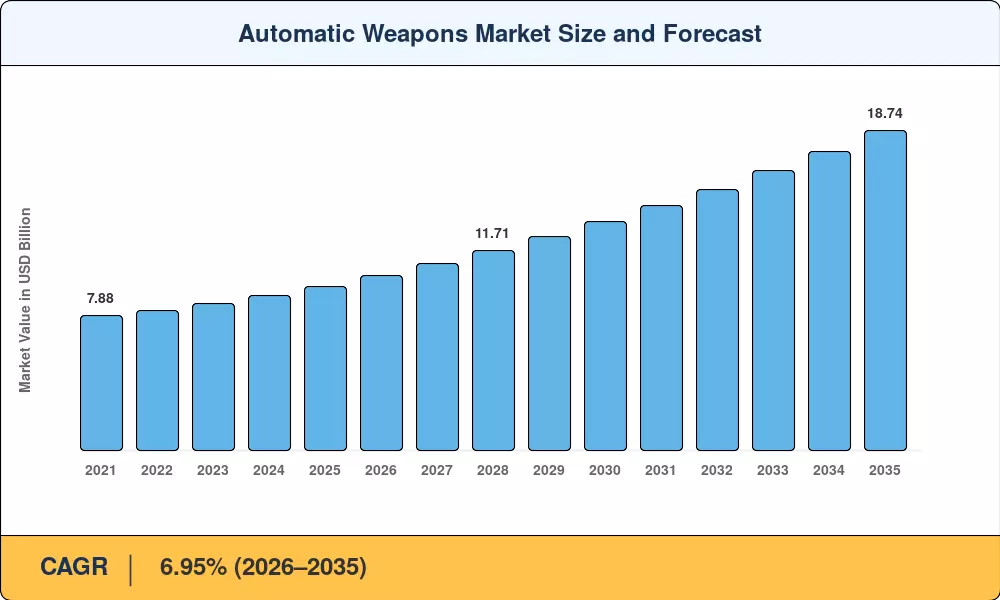
Automatic Weapons Market Size and Forecast
Our Impact
Enabled $4.3B Revenue Impact for Fortune 500 and Leading Multinationals
Partnering with 2000+ Global Organizations Each Year
30K+ Citations by Top-Tier Firms in the Industry

Driver Impact Analysis

Driver ~% Impact on CAGR Geographic Relevance Impact Timeline
Rising global defense budgets +1.8% Global Short-term
Infantry modernization programs (NGSW, FELIN) +1.4% North America, Europe Medium-term
Remote weapon station proliferation +1.1% Global Medium-term
Counter-drone / C-UAS mission requirements +0.9% Global Short-term
Indo-Pacific naval rearmament +0.7% Asia-Pacific Long-term
Modular caliber-swap platform designs +0.5% North America, Europe Medium-term
AI-enabled fire-control integration +0.4% North America Long-term


Rising Global Defense Budgets

Global military expenditure surpassed USD 2.44 Trillion in 2023, according to the Stockholm International Peace Research Institute, marking the ninth consecutive annual increase [1]. The United States accounted for roughly 37% of that total, while European NATO members collectively crossed the 2% GDP threshold for the first time. These budget floors translate directly into automatic-weapon procurement line items — from squad-level rifles to vehicle-mounted cannon systems — ensuring a durable demand baseline for the Automatic Weapons Market across the forecast decade.

Infantry Modernization Programs

The U.S. Army's NGSW initiative awarded SIG Sauer a USD 4.7 billion lifecycle contract in 2022 to replace the M4 carbine and M249 squad automatic weapon with the XM7 rifle and XM250 automatic rifle [2]. France's FELIN program and Germany's Infanterist der Zukunft pursue parallel upgrades. These multi-billion-dollar programs create cascading orders for optics, suppressors, ammunition, and training simulators, amplifying the Automatic Weapons Market well beyond headline platform costs.

Remote Weapon Station Proliferation

Remote weapon stations (RWS) transform legacy crew-served weapons into stabilized, digitally aimed turret systems operable from inside armored vehicles. The global RWS installed base exceeded 28,000 units by 2024 [10], with Kongsberg, Rafael, and Rheinmetall leading deliveries. Each station requires a compatible automatic weapon — typically a 7.62 mm or 12.7 mm machine gun — creating a pull-through demand channel that sustains growth in the Automatic Weapons Market.

Counter-Drone Mission Requirements

The proliferation of low-cost commercial drones on modern battlefields has elevated small-caliber and medium-caliber automatic weapons as frontline counter-UAS effectors. NATO's Counter-Small UAS Strategy, published in 2024, explicitly identifies rapid-firing automatic cannon and programmable air-burst munitions as key kinetic layers in layered drone defense [11]. This doctrinal shift is pulling forward procurement timelines and opening an entirely new application segment within the Automatic Weapons Market.


Restraints Impact Analysis

As with drivers, restraint-impact percentages are directional estimates and are not additive to the headline CAGR.

Restraint ~% Impact on CAGR Geographic Relevance Impact Timeline
Supply-chain constraints on specialty steel and propellants −0.6% Global Short-term
Arms export control tightening (ITAR / EU dual-use) −0.5% North America, Europe Medium-term
Budget sequestration / fiscal austerity risks −0.4% North America, Europe Long-term
Ethical and regulatory opposition to autonomous fire −0.3% Global Long-term
Skilled workforce shortages in ammunition production −0.2% North America, Europe Short-term


Supply-Chain Constraints

Specialty barrel steels, rare-earth permanent magnets for fire-control motors, and single-base propellant chemicals remain concentrated in a handful of source nations. The U.S. Department of Defense's 2024 Industrial Base Assessment flagged over 300 sole-source chokepoints in the ammunition and small-arms supply chain [15]. These bottlenecks can delay production ramp-ups by 12–18 months, constraining short-term growth in the Automatic Weapons Market even when demand signals are strong.

Arms Export Control Tightening

Stricter enforcement of the International Traffic in Arms Regulations (ITAR) and the EU's revised dual-use regulation has lengthened export-license timelines from an average of 45 days to over 90 days for select categories since 2023 [16]. While these controls serve nonproliferation objectives, they slow cross-border deliveries and raise compliance costs for OEMs, particularly mid-tier exporters targeting emerging-market buyers within the Automatic Weapons Market.

Budget Sequestration Risks

Despite historically high defense budgets, fiscal-consolidation pressures remain a structural overhang. The U.S. Congressional Budget Office projects federal debt-to-GDP ratios exceeding 115% by 2033, raising the probability of future sequestration or continuing-resolution cycles that freeze procurement accounts [17]. Any prolonged budget impasse would disproportionately affect mid-priority weapon-system line items and restrain the upside trajectory of the Automatic Weapons Market.


Automatic Weapons Market Opportunities

AI-Integrated Fire-Control Systems

Next-generation automatic weapons paired with AI-driven target-recognition modules can reduce engagement timelines from seconds to milliseconds. The U.S. Army's Project Convergence demonstrated networked automatic fire in under two seconds from sensor detection to trigger pull during 2023 live-fire exercises [14]. OEMs that embed edge-computing chipsets directly into weapon receivers will capture premium pricing as militaries pursue sensor-to-shooter automation.

Counter-UAS Kinetic Effectors

Low-cost drone swarms have outpaced missile-based defenses on cost-exchange ratios, creating a multi-billion-dollar addressable segment for rapid-firing automatic cannon and programmable ammunition. NATO estimates the counter-small-UAS effector requirement across allied forces at over 15,000 systems by 2030 [11]. This opens a high-margin growth vector in the Automatic Weapons Market for firms that can deliver caliber-flexible, software-defined turrets.

Emerging-Market Force Build-Up

Nations across Southeast Asia, the Middle East, and Sub-Saharan Africa are investing heavily in first-generation mechanized forces. India's Defence Acquisition Council cleared over USD 12 billion in land-system orders during 2023–2024 alone [6]. These greenfield procurement cycles — often unencumbered by legacy-fleet constraints — represent high-volume opportunities for exporters of automatic rifles, machine guns, and vehicle-mounted weapon stations.

Modular Weapon-Platform Licensing

Modular weapon designs that allow rapid caliber conversion (e.g., 5.56 mm to 6.8 mm) enable defense ministries to future-proof arsenals without full fleet replacement. Licensing and co-production agreements tied to these platforms create recurring revenue streams through technology-transfer fees, ammunition supply contracts, and lifecycle support packages — a business-model shift that adds long-term margin stability to the Automatic Weapons Market.

Ammunition-as-a-Service Sustainment Models

Several OEMs are piloting performance-based logistics contracts that bundle weapon-system delivery with multi-year ammunition replenishment and maintenance at fixed per-round pricing [13]. This model mirrors aerospace power-by-the-hour agreements and aligns OEM revenue with operational readiness, creating predictable cash flows and deepening customer lock-in across the Automatic Weapons Market.


Automatic Weapons Market Future Outlook

AI-Autonomous Weapon Networking

By 2030, most new-production automatic weapons integrated into vehicle and naval turrets will ship with embedded processors capable of cooperative engagement. DARPA's Autonomous Multi-Domain Adaptive Swarms program is prototyping an automatic cannon that coordinates fire autonomously across networked platforms [14]. This shift will tilt the Automatic Weapons Market toward software-defined systems where the weapon becomes a node in a combat cloud rather than a standalone tool.

Caliber Convergence and Ammunition Innovation

The transition from 5.56×45 mm NATO to modernized intermediate calibers, such as the U.S. 6.8×51 mm, is expected to drive a decade-long ammunition modernization cycle. Following the surge in global conflict since 2022, various NATO member states and procurement bodies have identified critical gaps in ammunition stocks, with many allies initiating multi-year ramp-ups to bolster industrial capacity. This requirement for increased production throughput, combined with the transition to newer, high-pressure calibers, creates a sustained demand baseline for both platform upgrades and ammunition supply chain expansion.


Directed-Energy Hybrid Platforms

The integration of Directed-Energy Weapons (DEW) represents a significant evolution in platform architecture. Programs such as the U.S. Navy's HELIOS and the UK's DragonFire are increasingly being integrated into layered combat systems alongside traditional automatic cannon turrets. Through 2035, the market for vehicle and naval weapon stations will shift toward "multi-effector" configurations, where kinetic automatic weapons and directed-energy modules operate in tandem to provide a comprehensive response to diverse threats, ranging from small-caliber ground engagements to high-speed UAS neutralization.


ESG and Responsible-Export Governance

Defense-sector ESG scrutiny is intensifying. Major institutional investors now require weapons manufacturers to disclose end-user audit trails and responsible-transfer policies as a condition of capital access [18]. OEMs that proactively adopt transparent export-compliance frameworks will secure preferential financing and broader market access, making ESG governance a competitive differentiator in the Automatic Weapons Market through 2035.


Automatic Weapons Market Segmentation

By Type

Segment Key Metric Primary Demand Driver
Automatic Rifles 38.40% share (2025) Infantry modernization programs
Machine Guns USD 2.15 billion (2025) Vehicle-mounted and dismounted fire support
Automatic Launchers 5.90% CAGR (2026–2035) Grenade-launcher integration on IFVs
Automatic Cannons 8.98% CAGR (2026–2035) Remote weapon stations, C-UAS
Gatling Guns USD 0.52 billion (2025) Close-in weapon systems, rotary-wing platforms


Automatic rifles dominate the Automatic Weapons Market by type, reflecting the sheer volume of infantry forces worldwide cycling through generational small-arms replacements. The U.S. NGSW program, India's INSAS replacement, and Germany's HK416-family procurement collectively sustain this segment's primacy. Machine guns remain the second-largest segment by absolute value, anchored by persistent demand for 7.62 mm and 12.7 mm belt-fed systems in both mounted and dismounted roles.

Automatic cannons represent the fastest-growing type segment in the Automatic Weapons Market. The 30 mm and 40 mm caliber families are central to new-generation infantry fighting vehicles — including the U.S. OMFV, the Franco-German MGCS, and South Korea's Redback — and increasingly serve as the primary kinetic layer in counter-drone architectures [10].

By Platform

Segment Key Metric Primary Demand Driver
Land 62.30% share (2025) Armored-vehicle and infantry programs
Airborne USD 1.38 billion (2025) Helicopter door guns, gunship turrets
Naval 9.70% CAGR (2026–2035) Corvette and patrol-craft fleet expansion


Land platforms account for the largest share of the Automatic Weapons Market, driven by the global installed base of armored personnel carriers, infantry fighting vehicles, and main battle tanks — each requiring at least one automatic weapon station. Naval platforms are growing fastest as Indo-Pacific and Middle Eastern navies commission corvette and offshore patrol vessel fleets fitted with stabilized automatic cannon mounts, expanding the maritime dimension of the Automatic Weapons Market.

By Caliber

Segment Key Metric Primary Demand Driver
Small Caliber (≤12.7 mm) 43.90% share (2025) Infantry rifles and light machine guns
Medium Caliber (>12.7 mm – 40 mm) USD 2.85 billion (2025) IFV turrets, RWS applications
Large Caliber (>40 mm) 8.72% CAGR (2026–2035) Naval CIWS, air-defense cannon


Small caliber systems lead by share, reflecting the volume economics of rifle and machine-gun ammunition consumed in training and operations. Large caliber systems, while smaller in absolute terms, are growing fastest within the Automatic Weapons Market as navies invest in close-in weapon systems and ground forces adopt automatic cannon for the counter-drone mission.

By End User

Segment Key Metric Primary Demand Driver
Defense 72.90% share (2025) National armed forces procurement
Law Enforcement USD 2.59 billion (2025) SWAT, border security, counter-narcotics


The defense segment overwhelmingly drives the Automatic Weapons Market, with national military budgets funding the vast majority of automatic-weapon procurement. Law enforcement demand, while smaller, is growing as paramilitary border-security and counter-narcotics missions expand in Latin America, Southeast Asia, and parts of Africa, broadening the customer base of the Automatic Weapons Market.


Regional Market Share Analysis

Region Key Metric Primary Investment Themes
North America 35.40% share (2025) NGSW rollout, C-UAS layered defense
Europe 26.80% share (2025) Post-2022 rearmament, EU defense-industrial consolidation
Asia-Pacific 9.40% CAGR (2026–2035) Fleet modernization, indigenous production
South America USD 0.44 billion (2025) Counter-narcotics, border security
Middle East & Africa 7.85% CAGR (2026–2035) Sovereignty-driven procurement, conflict theatres
Total USD 9.58 billion (2025)

The Automatic Weapons Market exhibits a clear geographic hierarchy, with mature Western defense economies anchoring current revenue and rapidly modernizing Indo-Pacific nations driving incremental growth.


North America

Country Key Metric Key Driver
United States 82.50% of regional share NGSW fielding, Marine Corps force design
Canada 9.30% of regional share NORAD modernization, C6A1 GPMG replacement
Mexico 8.20% of regional share National Guard equipment cycle


The United States remains the single largest country market within the Automatic Weapons Market, underpinned by the world's highest absolute defense budget. The NGSW transition from M4/M249 to XM7/XM250 platforms will generate follow-on orders for optics, ammunition, and training systems through at least 2032 [2]. Canada's CAD 38.6 billion defense-policy update includes small-arms modernization as a tier-one priority, while Mexico's expanding National Guard drives incremental small-caliber demand.

Europe

Country Key Metric Key Driver
Germany 7.25% CAGR (2026–2035) Bundeswehr Sondervermögen fund
United Kingdom USD 0.68 billion (2025) Future Soldier program
France 6.90% CAGR (2026–2035) SCORPION combat-vehicle weapon fit
Italy USD 0.32 billion (2025) Soldato Futuro upgrades
Spain 6.40% CAGR (2026–2035) VCR 8×8 weapon-station integration
Nordic Countries USD 0.29 billion (2025) NATO accession-driven rearmament
Russia 7.50% CAGR (2026–2035) Domestic production surge
Rest of Europe USD 0.38 billion (2025) Baltic, Polish force expansion


Europe's share of the Automatic Weapons Market expanded sharply after 2022 as governments fast-tracked defense-spending pledges. Germany's EUR 100 billion Sondervermögen special fund earmarks significant allocations for infantry and vehicle-mounted weapon systems [3]. The United Kingdom's Future Soldier transformation envisions lighter, more agile infantry formations equipped with next-generation automatic rifles. At the same time, France's SCORPION program integrates Nexter's T40 turret and CTA 40 mm automatic cannon onto the Jaguar armored vehicle [5].

Asia-Pacific

Country Key Metric Key Driver
China 28.50% of regional share PLA modernization plan
India 10.10% CAGR (2026–2035) Make in India defense mandate
Japan USD 0.34 billion (2025) National Security Strategy doubling
South Korea 9.20% CAGR (2026–2035) K-defense export push
ASEAN USD 0.27 billion (2025) Maritime-sovereignty investment
Rest of Asia-Pacific 8.50% CAGR (2026–2035) Australia, Taiwan procurement


Asia-Pacific is the fastest-growing region in the Automatic Weapons Market, driven by China's ambitious PLA force-structure overhaul, India's mandate that 75% of capital defense acquisition be sourced domestically, and Japan's historic decision to double defense spending to 2% of GDP by 2027 [9]. South Korea's defense-export strategy positions firms like Hanwha and Hyundai Rotem as competitive global suppliers of automatic-cannon-equipped fighting vehicles, adding an export multiplier dynamic to regional growth.

South America

Country Key Metric Key Driver
Brazil 54.50% of regional share IMBEL domestic production
Argentina USD 0.08 billion (2025) Infantry fleet renewal
Rest of South America 5.80% CAGR (2026–2035) Colombia and Chile border security


Brazil dominates the South American share of the Automatic Weapons Market through IMBEL's state-owned production of the IA2 assault rifle family and ongoing police force modernization funded by federal public security budgets [6]. Argentina and Colombia are pursuing selective upgrades, though constrained fiscal environments limit procurement scale relative to other regions.

Middle East & Africa

Country Key Metric Key Driver
Saudi Arabia 30.20% of regional share Vision 2030 defense-localization
UAE 7.90% CAGR (2026–2035) EDGE Group domestic production
South Africa USD 0.09 billion (2025) Denel restructuring
Egypt 8.10% CAGR (2026–2035) Fleet recapitalization
Rest of MEA USD 0.18 billion (2025) Conflict-driven procurement cycles


The Middle East & Africa region exhibits bifurcated dynamics within the Automatic Weapons Market. Gulf states — particularly Saudi Arabia and the UAE — are channeling oil revenues into defense-industrial self-sufficiency, with Saudi Arabia's GAMI targeting 50% localization of military spending by 2030 [20]. Sub-Saharan Africa's demand is more fragmented and conflict-driven, with multilateral peacekeeping mandates and counter-insurgency operations generating episodic procurement spikes.


Automatic Weapons Market By Region, 2025-2035

Competitive Benchmarking

The Automatic Weapons Market is moderately concentrated, with the top five companies projected to account for 42-48% of the global revenue. The Herfindahl–Hirschman Index is in the range of 900–1,100, which reflects a competitive but not fragmented environment with established defense primes and specialized small-arms producers. Strategic positioning is about the range of calibre, government-to-government partnerships and co-production licensing capabilities.

Company Est. Revenue Share Range Key Offerings for the Automatic Weapons Market Strategic Positioning
FN Herstal ~8–11% M240, FN MAG, FN MINIMI, FN SCAR Broadest NATO-standard portfolio
Heckler & Koch ~6–9% HK416, MG5, GMG Premium infantry-rifle franchise
Rheinmetall AG ~7–10% Oerlikon cannon family, RWS turrets Vehicle-weapon integration leader
General Dynamics Ordnance ~5–8% GAU-19, M134, Mk 44 Bushmaster Rotary and chain-gun specialist
BAE Systems ~5–7% Mk 38, Bofors 40 mm, chain guns Naval and land turret systems
Northrop Grumman ~4–6% M230 chain gun, ammunition systems Helicopter and RWS weapon supply
Textron Systems ~3–5% Fury guided munitions, weapon stations Next-gen programmable ammo
Israel Weapon Industries (IWI) ~3–5% Negev LMG, Tavor, ACE family Export-oriented small-arms maker
Kongsberg Defence ~2–4% Protector RWS family RWS market-share leader
Dillon Aero ~1–3% M134D Gatling, vehicle mounts Niche high-rate-of-fire provider


Recent News & Developments


  • Hanwha Aerospace (April 2024): Selected as preferred bidder for Australia's LAND 400 Phase 3 program, which includes the Redback IFV fitted with a 30 mm automatic cannon turret [9].
  • U.S. Department of Defense (December 2024): Released the updated Counter-Small UAS Strategy, explicitly listing rapid-fire automatic cannon among priority kinetic-defeat solutions [11].


Automatic Weapons Market Report Scope

Parameter Detail
Market Scope Global Automatic Weapons Market — automatic rifles, machine guns, automatic launchers, automatic cannons, Gatling guns
Study Period 2021–2035
CAGR (Forecast Period) 6.95% (2026–2035)
Base Year Market Size USD 9.58 billion (2025)
Forecast Year Market Size USD 18.74 billion (2035)
Fastest Growing Segment Naval platforms (by platform); Automatic cannons (by type)
Companies Profiled 10 (FN Herstal, Heckler & Koch, Rheinmetall, General Dynamics, BAE Systems, Northrop Grumman, Textron, IWI, Kongsberg, Dillon Aero)
Valuation Currency USD billion


FAQs

How does the 6.8×51 mm NATO transition affect legacy 5.56 mm supply chains?
Legacy 5.56 mm production lines will run in parallel for at least a decade as allied forces phase adoption at different speeds. Dual-caliber logistics will raise ammunition inventory costs by an estimated 15–20% during the overlap period [13].
Which automatic-weapon subsystem commands the highest aftermarket margin?
Fire-control optics and electronic trigger assemblies yield gross margins of 35–45%, significantly above the 18–22% typical for barrel and receiver groups [8]. OEMs increasingly bundle these electronics into lifecycle-support contracts.
How do remote weapon stations change procurement decision criteria?
RWS adoption shifts buyer emphasis from raw weapon weight to digital interface compatibility and stabilization precision [10]. Integration certification timelines now influence vendor selection more than unit price alone.
What role do offset agreements play in cross-border automatic weapon sales?
Offset obligations averaging 30–50% of contract value are standard in Gulf and Asian deals, requiring technology transfer or local co-production [20]. Offsets lengthen negotiations but deepen vendor lock-in.
Are directed-energy weapons likely to replace automatic cannon by 2035?
Laser and microwave systems will supplement, not replace, automatic cannon through 2035 due to power-supply constraints and atmospheric attenuation [11]. Hybrid turrets mounting both technologies are the likelier near-term architecture.
How do rising copper and steel prices affect automatic-weapon unit economics?
Raw-material inputs represent 12–18% of finished-weapon cost, so a sustained 25% commodity price increase compresses OEM margins by roughly 3–5 percentage points [15]. Most Tier-1 manufacturers hedge 6–12 months forward.
What cybersecurity risks emerge from networked automatic weapons in the Automatic Weapons Market?
Digitally networked weapons face spoofing, jamming, and unauthorized-access threats at the fire-control-network layer [14]. NATO's STANAG 4774/4778 encryption standards are being mandated to harden data links on fielded systems.    
Author
Author
Author Profile
Abbas Raut LinkedIn
Research Analyst
Abbas Raut is a Senior Research Analyst with 5+ years of experience delivering data-driven insights and strategic recommendations across the Automotive and Aerospace & Defense sectors. He specializes in emerging technologies, industry value chains, and global market dynamics shaping the future of mobility and defense. In automotive, Abbas has led studies on EVs, charging stations, BMS, superchargers, and more, guiding stakeholders through electrification and regulatory shifts. In Aerospace & Defense, he has analyzed markets for military electronics, drones, radars, and electronic warfare solutions, supporting procurement and investment strategies. With expertise in market sizing, forecasting, benchmarking, and technology adoption, Abbas is known for transforming complex datasets into actionable insights that drive strategy, innovation, and growth.
Co-Author
Co-Author Profile
Swapnil Palwe LinkedIn
Team Lead - Research
With a technical background as Bachelor's in Mechanical Engineering, with MBA in Operations Management , Swapnil has 6+ years of experience in market research, consulting and analytics with the tasks of data mining, analysis, and project execution. He is the POC for our clients, for their consulting projects running under the Automotive/A&D domain. Swapnil has worked on major projects in verticals such as Aerospace & Defense, Automotive and many other domain projects. He has worked on projects for fortune 500 companies' syndicate and consulting projects along with several government projects.

Research Approach


Secondary Research

The secondary research process involved comprehensive analysis of defense procurement databases, military journals, defense publications, and authoritative government sources. Key sources included the Stockholm International Peace Research Institute (SIPRI) Arms Transfers Database, United Nations Office for Disarmament Affairs (UNODA) Weapons Register, US Department of Defense (DoD) Budget Justification Books & Procurement Reports, Congressional Research Service (CRS) Defense Reports, NATO Standardization Office (NSO) Publications, US Defense Security Cooperation Agency (DSCA) Notifications, EU European Defence Agency (EDA) Reports, UK Ministry of Defence (MoD) Equipment Plans, French Direction Générale de l'Armement (DGA), German Federal Office of Bundeswehr Equipment (BAAINBw), Russia's Federal Service for Military-Technical Cooperation, China's State Administration of Science, Technology and Industry for National Defense (SASTIND), India's Ministry of Defence Annual Reports & Long Term Integrated Perspective Plan (LTIPP), Japan's Ministry of Defense White Papers, South Korean Defense Acquisition Program Administration (DAPA), International Institute for Strategic Studies (IISS) Military Balance, Arms Control Association Fact Sheets, World Military Expenditures and Arms Transfers (WMEAT) Reports, Defense Advanced Research Projects Agency (DARPA) Publications, Open Source Centre (OSC) Defense Analysis, Jane's Defence Industry & Intelligence Review, and national export control registers from Australia (DECO), Canada (GAC), and Japan (METI). These sources were used to collect defense procurement statistics, military modernization timelines, regulatory compliance data, interoperability standards, and force structure analysis for automatic rifles, machine guns, automatic launchers, automatic cannons, and Gatling gun systems across land, naval, and airborne platforms.


Primary Research

In order to gather both qualitative and quantitative insights, supply-side and demand-side stakeholders were interviewed during the primary research process. Supply-side sources included CEOs, Presidents of Defense divisions, VPs of Business Development, heads of Government Relations, and program directors from prime defense contractors, Tier-1 suppliers, and specialized weapon systems manufacturers. Procurement officers from Ministry of Defense acquisition branches, program managers from military ordnance corps, naval systems commanders, air force armament directors, special operations force equipment officers, and law enforcement were examples of demand-side sources. Federal law enforcement agencies and counterterrorism units are in charge of SWAT procurement. Platform-specific segmentation, next-generation weapon system development schedules, military adoption cycles, defense procurement tactics, offset agreements, and interoperability requirements were all confirmed by primary research.

Primary Respondent Breakdown:

By Designation: C-level Primaries (38%), Director Level (32%), Others (30%)

By Region: North America (38%), Europe (25%), Asia-Pacific (28%), Rest of World (9%)


Market Size Estimation

Global market valuation was derived through defense procurement mapping and platform integration analysis. The methodology included:

Identification of 50+ key defense contractors and subsystem suppliers across North America, Europe, Asia-Pacific, Middle East, and Latin America

Product mapping across automatic rifles, machine guns (light/medium/heavy), automatic launchers (grenade/missile/mortar), automatic cannons (20mm/30mm/40mm), and Gatling gun categories

Platform analysis across land (battle tanks, AFVs, light protected vehicles), naval (destroyers, frigates, corvettes, OPVs), and airborne (helicopters, fighter aircraft, combat support aircraft) applications

Caliber-specific assessment covering small (5.56mm, 7.62mm, 12.7mm), medium (20mm, 25mm, 30mm, 40mm), and large caliber systems

Analysis of reported and modeled defense contract values specific to automatic weapons portfolios and remote weapon station integrations

Coverage of contractors representing 75-80% of global defense procurement value in 2024

Extrapolation using bottom-up (platform deployment × unit cost by country) and top-down (defense contractor revenue validation) approaches to derive segment-specific valuations for military end-users (army, navy, air force, special operations) and law enforcement agencies

Download Free Sample

Kindly complete the form below to receive a free sample of this Report

Download PDF ×

We do not share your information with anyone. However, we may send you emails based on your report interest from time to time. You may contact us at any time to opt-out.
















