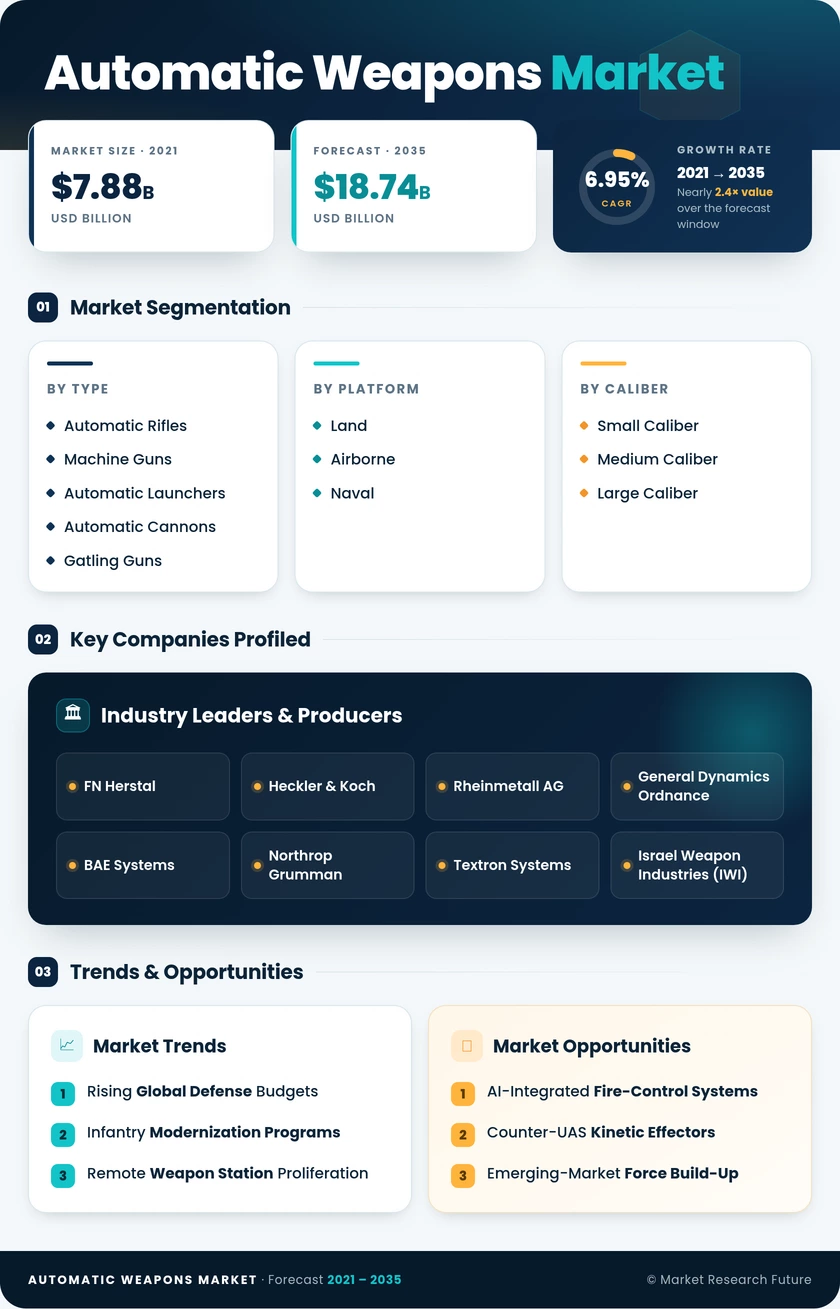
Automatic Weapons Market (2026 - 2035)

ID: MRFR/AD/6312-HCR
133 Pages
Abbas Raut
Last Updated: June 25, 2026
Automatic Weapons Market Size, Share, Industry Trend & Analysis Research Report Information By Type (Automatic Rifles, Machine Guns, Automatic Launchers, Automatic Cannons, Gatling Guns), By Platform (Land, Airborne, Naval), By Caliber (Small Caliber, Medium Caliber, Large Caliber), By End User (Defense, Law Enforcement), By Geography (North America, Europe, Asia-Pacific, South America, Middle East & Africa) – Forecast Till 2035.
Automatic Weapons Market
Market Size
Forecast Period2026-2035
CAGR (2026-2035)6.95%
2025 Market SizeUSD 9.58 billion
2035 Market SizeUSD 18.74 billion
Key Players
FN Herstal
Heckler & Koch
Rheinmetall AG
General Dynamics Ordnance
BAE Systems
Northrop Grumman
Opportunities
  • AI-Integrated Fire-Control Systems
  • Counter-UAS Kinetic Effectors
  • Emerging-Market Force Build-Up
  1. 1 Market Overview |
    1. 1.1 Study Assumptions & Market Definition |
    2. 1.2 Scope of the Study |
    3. 1.3 Research Methodology
  2. 2 Market Summary & Key Takeaways
  3. 3 Market Dynamics |
    1. 3.1 Market Drivers Analysis | |
      1. 3.1.1 Rising Global Defense Budgets | |
      2. 3.1.2 Infantry Modernization Programs | |
      3. 3.1.3 Remote Weapon Station Proliferation | |
      4. 3.1.4 Counter-Drone Mission Requirements | |
      5. 3.1.5 Indo-Pacific Naval Rearmament | |
      6. 3.1.6 Modular Caliber-Swap Platform Designs | |
      7. 3.1.7 AI-Enabled Fire-Control Integration |
    2. 3.2 Market Restraints Analysis | |
      1. 3.2.1 Supply-Chain Constraints on Specialty Steel and Propellants | |
      2. 3.2.2 Arms Export Control Tightening (ITAR / EU Dual-Use) | |
      3. 3.2.3 Budget Sequestration / Fiscal Austerity Risks | |
      4. 3.2.4 Ethical and Regulatory Opposition to Autonomous Fire | |
      5. 3.2.5 Skilled-Workforce Shortages in Ammunition Production |
    3. 3.3 Market Opportunity Analysis | |
      1. 3.3.1 AI-Integrated Fire-Control Systems | |
      2. 3.3.2 Counter-UAS Kinetic Effectors | |
      3. 3.3.3 Emerging-Market Force Build-Up | |
      4. 3.3.4 Modular Weapon-Platform Licensing | |
      5. 3.3.5 Ammunition-as-a-Service Sustainment Models |
    4. 3.4 Industry Value Chain Analysis |
    5. 3.5 Porter's Five Forces Analysis
  4. 4 Global Automatic Weapons Market Size & Forecast (2021–2035) |
    1. 4.1 Historical Market Size (2021–2025) |
    2. 4.2 Current & Forecast Market Size (2026–2035) |
    3. 4.3 Market Size by Revenue (USD billion) |
    4. 4.4 Year-over-Year Growth Analysis
  5. 5 Segmentation Analysis |
    1. 5.1 By Type | |
      1. 5.1.1 Automatic Rifles | |
      2. 5.1.2 Machine Guns | |
      3. 5.1.3 Automatic Launchers | |
      4. 5.1.4 Automatic Cannons | |
      5. 5.1.5 Gatling Guns |
    2. 5.2 By Platform | |
      1. 5.2.1 Land | |
      2. 5.2.2 Airborne | |
      3. 5.2.3 Naval |
    3. 5.3 By Caliber | |
      1. 5.3.1 Small Caliber (≤12.7 mm) | |
      2. 5.3.2 Medium Caliber (>12.7 mm – 40 mm) | |
      3. 5.3.3 Large Caliber (>40 mm) |
    4. 5.4 By End User | |
      1. 5.4.1 Defense | |
      2. 5.4.2 Law Enforcement
  6. 6 Regional Analysis |
    1. 6.1 North America | |
      1. 6.1.1 United States | |
      2. 6.1.2 Canada | |
      3. 6.1.3 Mexico |
    2. 6.2 Europe | |
      1. 6.2.1 Germany | |
      2. 6.2.2 United Kingdom | |
      3. 6.2.3 France | |
      4. 6.2.4 Italy | |
      5. 6.2.5 Spain | |
      6. 6.2.6 Nordic Countries | |
      7. 6.2.7 Russia | |
      8. 6.2.8 Rest of Europe |
    3. 6.3 Asia-Pacific | |
      1. 6.3.1 China | |
      2. 6.3.2 India | |
      3. 6.3.3 Japan | |
      4. 6.3.4 South Korea | |
      5. 6.3.5 ASEAN | |
      6. 6.3.6 Rest of Asia-Pacific |
    4. 6.4 South America | |
      1. 6.4.1 Brazil | |
      2. 6.4.2 Argentina | |
      3. 6.4.3 Rest of South America |
    5. 6.5 Middle East & Africa | |
      1. 6.5.1 Saudi Arabia | |
      2. 6.5.2 UAE | |
      3. 6.5.3 South Africa | |
      4. 6.5.4 Egypt | |
      5. 6.5.5 Rest of MEA
  7. 7 Competitive Landscape |
    1. 7.1 Market Share Analysis (2025) |
    2. 7.2 Competitive Benchmarking Matrix |
    3. 7.3 Company Profiles | |
      1. 7.3.1 FN Herstal | |
      2. 7.3.2 Heckler & Koch | |
      3. 7.3.3 Rheinmetall AG | |
      4. 7.3.4 General Dynamics Ordnance & Tactical Systems | |
      5. 7.3.5 BAE Systems | |
      6. 7.3.6 Northrop Grumman | |
      7. 7.3.7 Textron Systems | |
      8. 7.3.8 Israel Weapon Industries (IWI) | |
      9. 7.3.9 Kongsberg Defence & Aerospace | |
      10. 7.3.10 Dillon Aero
  8. 8 Future Outlook & Strategic Recommendations (2026–2035) |
    1. 8.1 AI-Autonomous Weapon Networking |
    2. 8.2 Caliber Convergence and Ammunition Innovation |
    3. 8.3 Directed-Energy Hybrid Platforms |
    4. 8.4 ESG and Responsible-Export Governance
  9. 9 Recent Developments & News
  10. 10 Frequently Asked Questions (FAQs)
  11. 11 Report Scope & Methodology |
    1. 11.1 Study Period & Base Year |
    2. 11.2 Data Sources & Citations |
    3. 11.3 Abbreviations
  12. 12 LIST OF TABLES |
  13. TABLE 1 Global Automatic Weapons Market Size & Forecast, by Revenue (USD billion), 2021–2035 |
  14. TABLE 2 Global Automatic Weapons Market — Year-over-Year Growth Analysis, 2021–2035 |
  15. TABLE 3 Market Driver Impact Analysis, 2026–2035 |
  16. TABLE 4 Market Restraint Impact Analysis, 2026–2035 |
  17. TABLE 5 Global Automatic Weapons Market Size, by Type, 2021–2035 (USD billion) |
  18. TABLE 6 Global Automatic Weapons Market Size, by Platform, 2021–2035 (USD billion) |
  19. TABLE 7 Global Automatic Weapons Market Size, by Caliber, 2021–2035 (USD billion) |
  20. TABLE 8 Global Automatic Weapons Market Size, by End User, 2021–2035 (USD billion) |
  21. TABLE 9 Global Automatic Weapons Market Size, by Region, 2021–2035 (USD billion) |
  22. TABLE 10 North America Automatic Weapons Market Size, by Country, 2021–2035 (USD billion) |
  23. TABLE 11 Europe Automatic Weapons Market Size, by Country, 2021–2035 (USD billion) |
  24. TABLE 12 Asia-Pacific Automatic Weapons Market Size, by Country, 2021–2035 (USD billion) |
  25. TABLE 13 South America Automatic Weapons Market Size, by Country, 2021–2035 (USD billion) |
  26. TABLE 14 Middle East & Africa Automatic Weapons Market Size, by Country, 2021–2035 (USD billion) |
  27. TABLE 15 Competitive Benchmarking Matrix — Global Automatic Weapons Market, 2025 |
  28. TABLE 16 Company Profiles — Key Players, Global Automatic Weapons Market |
  29. TABLE 17 Recent Developments & Strategic Announcements, 2023–2025 |
  30. TABLE 18 North America Automatic Weapons Market Size, by Type, 2021–2035 (USD billion) |
  31. TABLE 19 North America Automatic Weapons Market Size, by Platform, 2021–2035 (USD billion) |
  32. TABLE 20 North America Automatic Weapons Market Size, by Caliber, 2021–2035 (USD billion) |
  33. TABLE 21 North America Automatic Weapons Market Size, by End User, 2021–2035 (USD billion) |
  34. TABLE 22 Europe Automatic Weapons Market Size, by Type, 2021–2035 (USD billion) |
  35. TABLE 23 Europe Automatic Weapons Market Size, by Platform, 2021–2035 (USD billion) |
  36. TABLE 24 Europe Automatic Weapons Market Size, by Caliber, 2021–2035 (USD billion) |
  37. TABLE 25 Europe Automatic Weapons Market Size, by End User, 2021–2035 (USD billion) |
  38. TABLE 26 Asia-Pacific Automatic Weapons Market Size, by Type, 2021–2035 (USD billion) |
  39. TABLE 27 Asia-Pacific Automatic Weapons Market Size, by Platform, 2021–2035 (USD billion) |
  40. TABLE 28 Asia-Pacific Automatic Weapons Market Size, by Caliber, 2021–2035 (USD billion) |
  41. TABLE 29 Asia-Pacific Automatic Weapons Market Size, by End User, 2021–2035 (USD billion) |
  42. TABLE 30 South America Automatic Weapons Market Size, by Type, 2021–2035 (USD billion) |
  43. TABLE 31 South America Automatic Weapons Market Size, by Platform, 2021–2035 (USD billion) |
  44. TABLE 32 South America Automatic Weapons Market Size, by Caliber, 2021–2035 (USD billion) |
  45. TABLE 33 South America Automatic Weapons Market Size, by End User, 2021–2035 (USD billion) |
  46. TABLE 34 Middle East & Africa Automatic Weapons Market Size, by Type, 2021–2035 (USD billion) |
  47. TABLE 35 Middle East & Africa Automatic Weapons Market Size, by Platform, 2021–2035 (USD billion) |
  48. TABLE 36 Middle East & Africa Automatic Weapons Market Size, by Caliber, 2021–2035 (USD billion) |
  49. TABLE 37 Middle East & Africa Automatic Weapons Market Size, by End User, 2021–2035 (USD billion) |
  50. TABLE 38 Report Scope & Methodology Summary |
  51. TABLE 39 Detailed Sources and Citations
  52. 13 LIST OF FIGURES |
  53. FIGURE 1 Global Automatic Weapons Market Dynamics (Drivers, Restraints, Opportunities) |
  54. FIGURE 2 Industry Value Chain Analysis — Automatic Weapons Market |
  55. FIGURE 3 Porter's Five Forces Analysis — Automatic Weapons Market |
  56. FIGURE 4 Global Automatic Weapons Market Size Trend (USD billion), 2021–2035 |
  57. FIGURE 5 Automatic Weapons Market Share, by Type, 2025 (%) |
  58. FIGURE 6 Automatic Weapons Market Share, by Platform, 2025 (%) |
  59. FIGURE 7 Automatic Weapons Market Share, by Caliber, 2025 (%) |
  60. FIGURE 8 Automatic Weapons Market Share, by End User, 2025 (%) |
  61. FIGURE 9 Automatic Weapons Market Share, by Region, 2025 (%) |
  62. FIGURE 10 North America Automatic Weapons Market Size & Forecast, 2021–2035 (USD billion) |
  63. FIGURE 11 Europe Automatic Weapons Market Size & Forecast, 2021–2035 (USD billion) |
  64. FIGURE 12 Asia-Pacific Automatic Weapons Market Size & Forecast, 2021–2035 (USD billion) |
  65. FIGURE 13 South America Automatic Weapons Market Size & Forecast, 2021–2035 (USD billion) |
  66. FIGURE 14 Middle East & Africa Automatic Weapons Market Size & Forecast, 2021–2035 (USD billion) |
  67. FIGURE 15 Competitive Landscape — Market Share of Key Players, 2025

Segmentation Quick Reference

DimensionSub-SegmentsDominant SegmentFastest Growing Segment
By TypeAutomatic Rifles, Machine Guns, Automatic Launchers, Automatic Cannons, Gatling GunsAutomatic Rifles (38.40% share, 2025)Automatic Cannons (8.98% CAGR)
By PlatformLand, Airborne, NavalLand (62.30% share, 2025)Naval (9.70% CAGR)
By CaliberSmall Caliber, Medium Caliber, Large CaliberSmall Caliber (43.90% share, 2025)Large Caliber (8.72% CAGR)
By End UserDefense, Law EnforcementDefense (72.90% share, 2025)Law Enforcement (higher growth off a smaller base)
By GeographyNorth America, Europe, Asia-Pacific, South America, Middle East & AfricaNorth America (35.40% share, 2025)Asia-Pacific (9.40% CAGR)


Market Segmentation Overview

By Type

Sub-SegmentKey Trend
Automatic RiflesGenerational replacement cycles (NGSW, HK416 family adoption) are driving sustained volume.
Machine GunsContinued demand for 7.62 mm and 12.7 mm belt-fed systems in mounted and dismounted roles
Automatic LaunchersIntegration of 40 mm automatic grenade launchers into IFV and naval turret architectures
Automatic CannonsCounter-UAS mission requirements and remote weapon station proliferation are accelerating adoption.
Gatling GunsNiche high-rate-of-fire applications on helicopters, close-in weapon systems, and special-operations platforms


The type segmentation of the Automatic Weapons Market reflects a clear distinction between high-volume infantry platforms (automatic rifles and machine guns) and high-value vehicle-mounted or naval systems (automatic cannons and Gatling guns). Growth momentum is shifting toward the latter category as platform-integrated, digitally networked weapon systems capture an increasing share of defense budgets.

By Platform

Sub-SegmentKey Trend
LandArmored-vehicle modernization programs and dismounted infantry re-equipping globally
AirborneHelicopter gunship and tiltrotor door-gun replacement cycles
NavalCorvette, frigate, and OPV fleet expansions across Indo-Pacific and Gulf navies


Land platforms dominate the Automatic Weapons Market by platform. Still, the naval segment is growing fastest as maritime-security priorities intensify across the Indo-Pacific, the Arabian Gulf, and the Baltic Sea. New-build warships increasingly specify automatic-cannon turrets with programmable ammunition capability for multi-role engagements.

By Caliber

Sub-SegmentKey Trend
Small Caliber (≤12.7 mm)Volume-driven by infantry rifles and light machine guns; caliber transition from 5.56 mm to 6.8 mm underway
Medium Caliber (>12.7 mm – 40 mm)Core IFV and RWS caliber range: 30 mm and 40 mm families gaining share
Large Caliber (>40 mm)Naval CIWS and ground-based air-defense cannon are driving the fastest growth rate.


Caliber segmentation within the Automatic Weapons Market tracks closely with platform trends: small caliber aligns with infantry, medium caliber with armored vehicles, and large caliber with naval and air-defense applications. The ongoing debate around optimal intermediate calibers — exemplified by the 6.8 mm transition — will reshape supply chains through the 2030s.

By End User

Sub-SegmentKey Trend
DefenseNational armed forces account for the overwhelming majority of procurement spend.
Law EnforcementGrowing paramilitary and border-security demand in Latin America, Asia, and Africa


Defense remains the primary end-user segment of the Automatic Weapons Market, reflecting the capital-intensive nature of military procurement cycles and the volume requirements of national armed forces. Law enforcement demand is rising as governments expand paramilitary border-security and counter-narcotics capabilities, though it remains a fraction of military spending.

By Geography

Sub-SegmentKey Trend
North AmericaLargest regional market; NGSW rollout and C-UAS investment sustain dominance
EuropePost-2022 rearmament wave driving accelerated procurement across NATO Europe.
Asia-PacificFastest-growing region: India, Japan, South Korea, modernization cycles
South AmericaCounter-narcotics and border-security funding underpin steady but modest growth.
Middle East & AfricaGulf-state defense localization and conflict-driven procurement in Sub-Saharan Africa


North America leads the Automatic Weapons Market by regional share, backed by the world's largest single-country defense budget and a mature domestic industrial base. Asia-Pacific is the fastest-growing region, powered by multi-decade rearmament programs in India, Japan, and South Korea that are creating new production ecosystems and export competitors within the global Automatic Weapons Market.


 

Download PDF ×

We do not share your information with anyone. However, we may send you emails based on your report interest from time to time. You may contact us at any time to opt-out.