Automation as a Service Market
Automation as a Service Market Summary
As per Market Research Future analysis, the Automation as a Service Market Size was estimated at 2.071 USD Billion in 2024. The Automation as a Service industry is projected to grow from USD 2.5 Billion in 2025 to USD 16.47 Billion by 2035, exhibiting a compound annual growth rate (CAGR) of 20.74% during the forecast period 2025 - 2035
Key Market Trends & Highlights
The Automation as a Service Market is experiencing robust growth driven by technological advancements and evolving business needs.
- North America remains the largest market for Automation as a Service Market, reflecting a strong demand for cloud-based solutions.
- The Asia-Pacific region is emerging as the fastest-growing area, fueled by increasing digital transformation initiatives.
- Services continue to dominate the market, while tailored solutions for SMEs are rapidly gaining traction as the fastest-growing segment.
- Rising demand for operational efficiency and the integration of advanced technologies are key drivers propelling market expansion.
Market Size & Forecast
| 2024 Market Size | 2.071 (USD Billion) |
| 2035 Market Size | 16.47 (USD Billion) |
| CAGR (2025 - 2035) | 20.74% |
Major Players
UiPath (US), Automation Anywhere (US), Blue Prism (GB), Pega Systems (US), Kofax (US), WorkFusion (US), NICE (IL), IBM (US), Microsoft (US)
Automation as a Service Market Trends
The Automation as a Service Market is currently experiencing a transformative phase, characterized by a growing inclination towards cloud-based solutions that streamline operational processes. Organizations are increasingly recognizing the potential of automation to enhance efficiency, reduce costs, and improve service delivery. This shift is driven by advancements in artificial intelligence and machine learning, which enable more sophisticated automation capabilities. As businesses seek to remain competitive, the demand for flexible and scalable automation solutions continues to rise, suggesting a robust future for this market. Furthermore, the integration of automation tools with existing enterprise systems appears to facilitate smoother transitions and greater adoption rates, indicating a positive trajectory for service providers in this sector. In addition, the Automation as a Service Market is witnessing a surge in interest from small and medium-sized enterprises, which are beginning to leverage these technologies to optimize their operations. This trend may lead to a more democratized access to automation tools, allowing smaller players to compete effectively with larger corporations. As the market evolves, it is likely that new service models will emerge, catering to diverse industry needs and fostering innovation. Overall, the Automation as a Service Market seems poised for significant growth, driven by technological advancements and a shift in organizational priorities towards automation solutions. The increasing focus on automation of services is helping organizations streamline workflows, reduce manual intervention, and improve service delivery efficiency.
Increased Adoption of Cloud Solutions
Organizations are increasingly migrating to cloud-based automation services, which offer flexibility and scalability. This trend reflects a broader shift towards digital transformation, as businesses seek to enhance operational efficiency and reduce overhead costs.
Focus on AI and Machine Learning Integration
The integration of artificial intelligence and machine learning into automation services is becoming more prevalent. This development allows for more intelligent decision-making processes and improved automation capabilities, enhancing overall service delivery.
Emergence of Tailored Solutions for SMEs
Small and medium-sized enterprises are beginning to adopt automation solutions tailored to their specific needs. This trend indicates a growing recognition of the benefits of automation across various business sizes, potentially leveling the competitive landscape.
Automation as a Service Market Drivers
Increased Focus on Data Security
In the Automation as a Service Market, there is an increasing focus on data security and compliance. As organizations automate processes, they become more reliant on data, making security a paramount concern. Recent surveys indicate that over 70% of businesses prioritize data protection when selecting automation solutions. This heightened awareness drives demand for services that not only automate tasks but also ensure robust security measures are in place. Consequently, service providers in the Automation as a Service Market are investing in advanced security protocols to meet these demands, thereby enhancing their competitive edge.
Growing Need for Real-Time Analytics
The Automation as a Service Market is significantly shaped by the growing need for real-time analytics. Organizations are increasingly recognizing the value of immediate insights derived from automated processes. This demand is reflected in the projected growth of the analytics market, which is expected to reach USD 274 billion by 2025. Real-time analytics enable businesses to make informed decisions swiftly, enhancing their responsiveness to market changes. As companies seek to leverage data for strategic advantage, the Automation as a Service Market is likely to see a rise in solutions that incorporate real-time analytics capabilities, further driving market growth.
Integration of Advanced Technologies
The Automation as a Service Market is significantly influenced by the integration of advanced technologies such as artificial intelligence and machine learning. These technologies enable organizations to automate complex tasks and make data-driven decisions. Recent statistics indicate that the AI market is projected to reach USD 190 billion by 2025, which directly correlates with the growth of automation services. Companies are increasingly leveraging these technologies to enhance their operational capabilities, leading to a more agile and responsive business environment. This integration not only improves efficiency but also fosters innovation within the Automation as a Service Market, as firms seek to harness the full potential of these advancements.
Shift Towards Subscription-Based Models
The Automation as a Service Market is witnessing a shift towards subscription-based models, which offer flexibility and scalability to businesses. This model allows organizations to access automation tools without the burden of significant upfront investments. Recent data suggests that subscription-based services are expected to account for over 60% of the market by 2026. This trend is particularly appealing to small and medium-sized enterprises, which may lack the resources for large-scale automation projects. As more companies adopt this model, the Automation as a Service Market is likely to expand, providing a wider array of services tailored to diverse business needs.
Rising Demand for Operational Efficiency
The Automation as a Service Market experiences a notable surge in demand for operational efficiency across various sectors. Organizations are increasingly seeking solutions that streamline processes, reduce manual intervention, and enhance productivity. According to recent data, companies that implement automation can achieve up to a 30% increase in efficiency. This trend is particularly evident in manufacturing and logistics, where automation technologies are deployed to optimize supply chains and reduce costs. As businesses strive to remain competitive, the Automation as a Service Market is poised to benefit from this growing emphasis on efficiency, driving innovation and investment in automated solutions.
Market Segment Insights
By Solutions: Services (Largest) vs. Solutions (Fastest-Growing)
In the Automation as a Service Market, Services represent the largest share, establishing themselves as a fundamental component of business operations. They encompass a wide range of offerings from consulting to ongoing support, catering to different automation needs across industries. Services facilitate the seamless integration of automated solutions into existing workflows, showcasing their critical role in driving efficiency and productivity. On the other hand, the Solutions segment is marked as the fastest-growing, driven by the increasing demand for comprehensive automation frameworks tailored to specific business challenges. Organizations are seeking more targeted solutions that not only enhance operational efficiency but also leverage advanced technologies. This trend highlights a significant shift towards customized automation strategies that meet the unique demands of diverse industries.
Services (Dominant) vs. Solutions (Emerging)
The Services segment is currently the dominant force within the Automation as a Service Market, providing essential support systems and resources that help businesses implement automation successfully. These services range from initial consultation that assesses the automation needs to ongoing support and upgrades, ensuring systems remain efficient and effective. The adaptability and flexibility of services allow businesses to continuously evolve and stay competitive. In contrast, the Solutions segment is emerging rapidly, characterized by a focus on tailored automation packages that address specific organizational challenges. As companies prioritize efficiency, scalability, and innovation, Solutions that integrate advanced technologies such as AI and IoT are gaining traction, making them vital in shaping the future landscape of automation.
By Service: Managed Services (Largest) vs. Support and Training (Fastest-Growing)
In the Automation as a Service Market, the 'Service' segment showcases a diversified portfolio with Managed Services holding the largest share. Managed Services address critical operational needs for organizations, enabling them to leverage automation solutions with minimal disruption. Meanwhile, Support and Training are rapidly gaining traction as businesses seek to enhance their workforce's capabilities in using automated systems effectively. This shift reflects an increased investment in employee development alongside automated tool adoption. The growth trends in this segment highlight an overall expansion in demand for professional services, driven by the increasing complexity of technology integrations and the need for continuous support. Companies are recognizing the importance of strategic partnerships with service providers to navigate these integrations smoothly, thus emphasizing the significance of professional services and training initiatives as core components of their automation strategies.
Managed Services (Dominant) vs. Professional Services (Emerging)
Managed Services are characterized by their comprehensive approach to automating business processes while ensuring uninterrupted system performance. As a dominant force in the segment, Managed Services encompass ongoing management, monitoring, and maintenance of automation tools, allowing clients to focus on core activities. In contrast, Professional Services represent the emerging trend, providing tailored consulting and implementation assistance. This segment thrives on organizations needing specialized knowledge and expertise to facilitate seamless automation integrations. Both segments contribute significantly to client satisfaction; however, Managed Services are often perceived as a more stable, reliable choice, whereas Professional Services cater to those looking for customizable and project-based solutions.
By Type: Automation (Largest) vs. Knowledge-based Automation (Fastest-Growing)
In the Automation as a Service Market, the segment distribution showcases Automation as the largest component, holding a significant share of the total market landscape. This dominance is attributed to the extensive integration of automation tools in various industries, ranging from manufacturing to customer service. Meanwhile, Knowledge-based Automation is gaining traction, driven by its ability to leverage artificial intelligence to enhance decision-making processes.

Automation: Traditional (Dominant) vs. Knowledge-based Automation (Emerging)
Traditional Automation remains the dominant player in the Automation as a Service Market, characterized by its well-established processes that streamline repetitive tasks effectively. This segment is widely adopted across industries, leading to increased efficiency and cost savings. In contrast, Knowledge-based Automation is an emerging segment that utilizes advanced algorithms and machine learning to process information and provide insights in real time. Its growth is propelled by the demand for smarter solutions that not only automate tasks but also adapt and learn from data. As businesses face complex challenges, this hybrid approach allows organizations to gain competitive advantages through enhanced agility and innovation.
By Organization size: Large Scale (Largest) vs. Small Scale (Fastest-Growing)
In the Automation as a Service Market, the distribution of market share between large and small organizations presents a fascinating landscape. Large scale organizations dominate this segment due to their substantial resources, enabling significant investments in automation technologies. Their ability to adopt comprehensive automation solutions helps them gain a competitive edge, and as a result, they hold a substantial portion of the market. In contrast, small scale organizations are experiencing the fastest growth within this market segment. This trend can be attributed to the increasing accessibility of affordable automation solutions tailored for smaller businesses. As these organizations seek to enhance efficiency and reduce operational costs, their adoption of Automation as a Service Market offerings is rapidly rising, indicating a shift in market dynamics.
Large Scale (Dominant) vs. Small Scale (Emerging)
Large scale organizations in the Automation as a Service Market are typically characterized by their extensive infrastructure and resources, allowing them to leverage complex automation solutions effectively. Their dominance arises from a well-established presence in the industry, investment capacity, and the ability to integrate sophisticated technologies into their operations. Such organizations benefit from economies of scale, which drive down costs and improve their competitiveness. On the other hand, small scale organizations are emerging as increasingly relevant players in the market. With a focus on agility and adaptability, these businesses are capitalizing on tailored automation solutions that cater to their unique needs. This segment is typically characterized by a diverse range of industries, including startups and SMEs. Their growing interest in Automation as a Service Market arises from the necessity to streamline operations and enhance productivity, often at a lower investment threshold than their larger counterparts.
Regional Insights
North America : Innovation and Leadership Hub
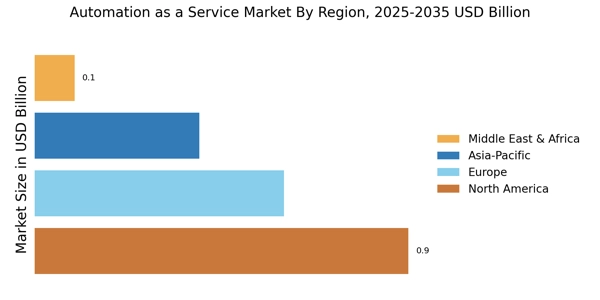
North America is the largest market for Automation as a Service Market, holding approximately 45% of the global market share. The region's growth is driven by rapid technological advancements, increased demand for operational efficiency, and supportive regulatory frameworks. The presence of major tech companies and a strong investment climate further catalyze market expansion, making it a focal point for innovation in automation. The United States leads the market, with significant contributions from Canada. Key players such as UiPath, Automation Anywhere, and IBM dominate the landscape, fostering a competitive environment. The focus on AI and machine learning integration into automation solutions is reshaping business processes across various sectors, enhancing productivity and reducing costs.
Europe : Emerging Automation Powerhouse
Europe is witnessing a significant rise in the Automation as a Service Market, accounting for approximately 30% of the global share. The region's growth is propelled by stringent regulations aimed at enhancing operational efficiency and compliance. Initiatives like the European Digital Strategy are fostering innovation and encouraging businesses to adopt automation technologies, thereby driving demand across various sectors. Leading countries such as Germany, the UK, and France are at the forefront of this transformation, with a robust presence of key players like Blue Prism and Pega Systems. The competitive landscape is characterized by a mix of established firms and emerging startups, all vying to capture market share. The focus on sustainability and digital transformation is further enhancing the region's appeal in the automation sector.
Asia-Pacific : Rapid Growth and Adoption
Asia-Pacific is rapidly emerging as a significant player in the Automation as a Service Market, holding around 20% of the global market share. The region's growth is driven by increasing digitalization, a burgeoning middle class, and government initiatives promoting technology adoption. Countries like China and India are leading this transformation, with substantial investments in automation technologies to enhance productivity and efficiency. China is the largest market in the region, followed closely by India and Japan. The competitive landscape is marked by both local and international players, including Kofax and WorkFusion. The region's focus on smart manufacturing and Industry 4.0 initiatives is further propelling the demand for automation solutions, making it a key area for future growth.
Middle East and Africa : Emerging Market Potential
The Middle East and Africa region is gradually emerging in the Automation as a Service Market, accounting for about 5% of the global share. The growth is primarily driven by increasing investments in technology and a growing recognition of the benefits of automation across various sectors. Governments are actively promoting digital transformation initiatives, which are catalyzing market growth and adoption of automation solutions. Countries like the UAE and South Africa are leading the charge, with a focus on enhancing operational efficiency in sectors such as finance and healthcare. The competitive landscape is still developing, with a mix of local startups and international players beginning to establish a foothold. The region's potential for growth in automation services is significant, as businesses seek to modernize and improve their operations.
Key Players and Competitive Insights
Key Companies in the Automation as a Service Market include
Industry Developments
May 2020:UiPath updated its Business Partner Program, allowing large organisations to take advantage of the company's hyper-automation capabilities. The organisation is now providing new training, credentialing, and marketing initiatives for business associates through the launch of its UiPath Services Network.
In March 2020:Microsoft Corporation has launched a public review of Power Automate Desktop, its new desktop-based Robotic Process Automation (RA) solution. This solution expands organisations' low-code automation capabilities by allowing coders and non-coders alike to automate processes and tasks across web applications and desktop.
In August 2020:IBM announced the acquisition of WDG Automation, a Brazilian robotic process automation software provider (RPA). This acquisition aims to advance enterprise Al-infused automation capabilities.
Future Outlook
Automation as a Service Market Future Outlook
The Automation as a Service Market is projected to grow at a 20.74% CAGR from 2025 to 2035, driven by technological advancements, increased demand for efficiency, and cost reduction strategies.
New opportunities lie in:
- Integration of AI-driven analytics for predictive maintenance solutions. Development of customizable automation platforms for diverse industries. Expansion of subscription-based pricing models for scalable automation services.
By 2035, the Automation as a Service Market is expected to be a pivotal component of global business operations.
Market Segmentation
Automation as a Service Market Type Outlook
- Automation
- Knowledge-based automation
Automation as a Service Market Service Outlook
- Managed services
- Professional service
- Deployment and integration
- Support and training
Automation as a Service Market Solutions Outlook
- Services
- Solutions
Automation as a Service Market Organization size Outlook
- Large scale
- Small scale
Report Scope
| MARKET SIZE 2024 | 2.071(USD Billion) |
| MARKET SIZE 2025 | 2.5(USD Billion) |
| MARKET SIZE 2035 | 16.47(USD Billion) |
| COMPOUND ANNUAL GROWTH RATE (CAGR) | 20.74% (2025 - 2035) |
| REPORT COVERAGE | Revenue Forecast, Competitive Landscape, Growth Factors, and Trends |
| BASE YEAR | 2024 |
| Market Forecast Period | 2025 - 2035 |
| Historical Data | 2019 - 2024 |
| Market Forecast Units | USD Billion |
| Key Companies Profiled | UiPath (US), Automation Anywhere (US), Blue Prism (GB), Pega Systems (US), Kofax (US), WorkFusion (US), NICE (IL), IBM (US), Microsoft (US) |
| Segments Covered | Solutions, Service, Type, Organization Size, Region |
| Key Market Opportunities | Integration of artificial intelligence enhances efficiency in the Automation as a Service Market. |
| Key Market Dynamics | Rising demand for operational efficiency drives competitive innovation in the Automation as a Service Market. |
| Countries Covered | North America, Europe, APAC, South America, MEA |
Market Highlights
FAQs
What is the projected market valuation of the Automation as a Service Market by 2035?
The projected market valuation for the Automation as a Service Market by 2035 is 16.47 USD Billion.
What was the market valuation of the Automation as a Service Market in 2024?
The overall market valuation of the Automation as a Service Market in 2024 was 2.071 USD Billion.
What is the expected CAGR for the Automation as a Service Market during the forecast period 2025 - 2035?
The expected CAGR for the Automation as a Service Market during the forecast period 2025 - 2035 is 20.74%.
Which companies are considered key players in the Automation as a Service Market?
Key players in the Automation as a Service Market include UiPath, Automation Anywhere, Blue Prism, Pega Systems, Kofax, WorkFusion, NICE, IBM, and Microsoft.
What are the projected revenues for Automation solutions in 2035?
The projected revenues for Automation solutions in 2035 are expected to reach 10.23 USD Billion.
How much did managed services contribute to the Automation as a Service Market in 2024?
Managed services contributed 0.831 USD Billion to the Automation as a Service Market in 2024.
What is the expected revenue for knowledge-based automation by 2035?
What segment of the Automation as a Service Market is anticipated to grow the most by 2035?
What was the revenue for professional services in the Automation as a Service Market in 2024?
How does the organization size impact the Automation as a Service Market?
Research Approach
Secondary Research
The secondary research process involved comprehensive analysis of government technology databases, peer-reviewed IT journals, industry publications, and authoritative technology organizations. Key sources included the US National Institute of Standards and Technology (NIST), European Commission Digital Strategy & Single Market Observatory, International Organization for Standardization (ISO), IEEE Computer Society, Association for Computing Machinery (ACM Digital Library), International Data Corporation (IDC), Gartner Research, US Bureau of Labor Statistics (BLS Occupational Outlook), Organisation for Economic Co-operation and Development (OECD) Digital Economy Outlook, Eurostat ICT Statistics, US General Services Administration (GSA IT Schedule), UK Office for National Statistics (ONS) Business ICT Data), Japan Ministry of Economy, Trade and Industry (METI) Reports, Singapore Infocomm Media Development Authority (IMDA), and national digital transformation reports from key markets. These sources were used to collect technology adoption statistics, cloud infrastructure data, automation penetration rates, digital economy trends, and market landscape analysis for cloud-based automation solutions, managed services, professional services, deployment & integration, and knowledge-based automation technologies.
Primary Research
To gather both qualitative and quantitative insights, supply-side and demand-side stakeholders were interviewed during the primary research phase. CEOs, CTOs, VPs of Cloud Solutions, RPA/AI platform product leaders, and enterprise sales directors from cloud vendors, automation service providers, and system integrators were examples of supply-side sources. CIOs, Chief Digital Officers, IT directors, process improvement managers, and procurement leads from manufacturing, retail, financial services, healthcare, and government organizations implementing automation-as-a-service solutions were among the demand-side sources. Primary research verified cloud platform roadmap dates, validated market segmentation across service types and organization sizes, and collected information on cybersecurity compliance needs, enterprise adoption trends, and subscription pricing models.
Primary Respondent Breakdown:
By Designation: C-level Primaries (40%), Director Level (30%), Others (30%)
By Region: North America (38%), Europe (25%), Asia-Pacific (28%), Rest of World (9%)
Market Size Estimation
Global market valuation was derived through revenue mapping and cloud service adoption analysis. The methodology included:
Identification of 50+ key service providers and technology vendors across North America, Europe, Asia-Pacific, Middle East, Africa, and Latin America
Service mapping across managed services, professional services, deployment & integration, and support & training categories
Solution mapping across automation platforms and knowledge-based automation (AI/ML-enabled)
Analysis of reported and modeled annual revenues specific to automation-as-a-service portfolios
Coverage of providers representing 65-70% of global market share in 2024
Extrapolation using bottom-up (enterprise adoption × subscription pricing by country) and top-down (vendor revenue validation) approaches to derive segment-specific valuations across organization sizes (large-scale and small-scale enterprises)
Kindly complete the form below to receive a free sample of this Report
Customer Stories
“This is really good guys. Excellent work on a tight deadline. I will continue to use you going forward and recommend you to others. Nice job”
“Thanks. It’s been a pleasure working with you, please use me as reference with any other Intel employees.”
“Thanks for sending the report it gives us a good global view of the Betaïne market.”
“Thank you, this will be very helpful for OQS.”
“We found the report very insightful! we found your research firm very helpful. I'm sending this email to secure our future business.”
“I am very pleased with how market segments have been defined in a relevant way for my purposes (such as "Portable Freezers & refrigerators" and "last-mile"). In general the report is well structured. Thanks very much for your efforts.”
“I have been reading the first document or the study, ,the Global HVAC and FP market report 2021 till 2026. Must say, good info! I have not gone in depth at all parts, but got a good indication of the data inside!”
“We got the report in time, we really thank you for your support in this process. I also thank to all of your team as they did a great job.”