Automotive Acoustic Engineering Services Market Summary
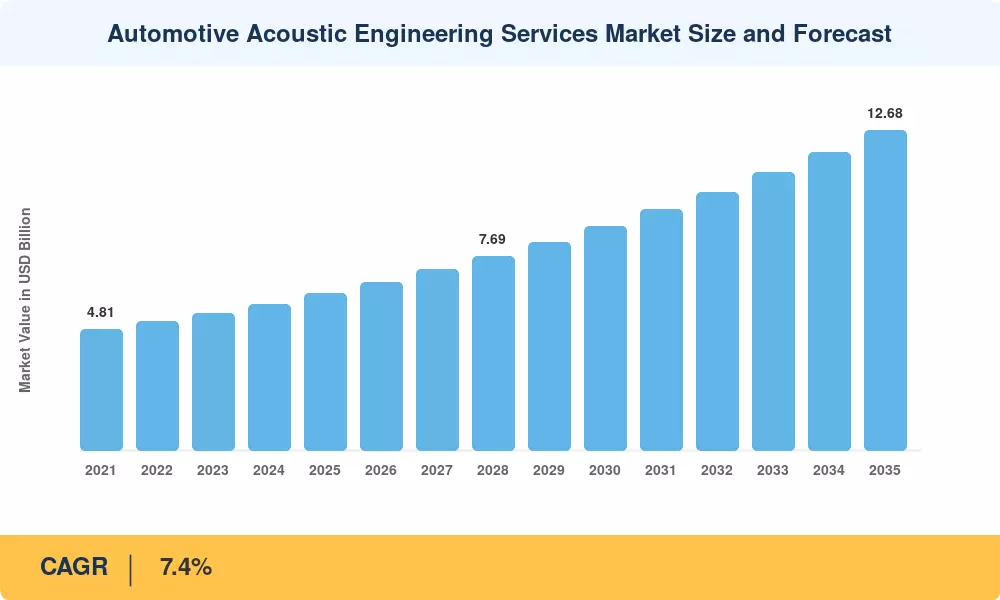
The Automotive Acoustic Engineering Services Market was valued at USD 6.21 billion in 2025 and is projected to grow from USD 6.67 billion in 2026 to USD 12.68 billion by 2035, registering a CAGR of 7.4% during the forecast period (2026–2035). Two catalysts are accelerating this trajectory: tightening EU and Chinese exterior noise regulations (UN ECE R51.03 Phase 3 mandates a 68 dB limit by 2026) and OEM commitments exceeding USD 500 billion globally toward electric vehicle platforms that demand entirely redesigned acoustic architectures[2].
A fundamental technology shift is reshaping how vehicles are engineered for sound. Traditional combustion-engine noise masking approaches — heavy bitumen pads, mass-loaded barriers, and reactive muffler tuning — are giving way to lightweight composite dampers, active noise cancellation systems, and digital-twin-based acoustic modeling. Honda's USD 124 million wind tunnel facility, commissioned in 2022 with dedicated aeroacoustics capability, illustrates the scale of investment OEMs are directing toward next-generation acoustic development [3]. ThyssenKrupp's structure-borne damping composites and Autoneum's Flexi-Loft lightweight insulation technology represent the material science breakthroughs complementing this digital transformation.
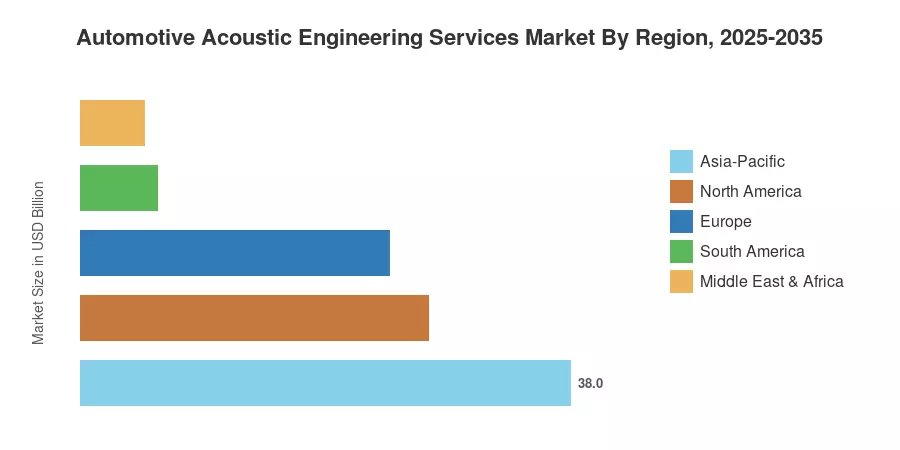
Asia-Pacific commands the largest share of the Automotive Acoustic Engineering Services Market at roughly 38%, driven by China's and India's combined vehicle production exceeding 35 million units annually. The region also registers the fastest growth, with a projected CAGR of 8.9% through 2035. North America holds the second-largest position at approximately 27% share, propelled by stringent EPA and NHTSA acoustic compliance requirements and a robust EV transition pipeline. Europe follows at 24% share, where German premium OEMs continue to set the global benchmark for cabin quietness [4][5]. The next decade will see acoustic engineering evolve from a compliance function into a core brand differentiator.
Key Report Takeaways
• By Process
- Testing commands the largest revenue share in the Automotive Acoustic Engineering Services Market, accounting for approximately 41% of total spending in 2025 — reflecting mandatory regulatory certification cycles across all major markets
- Development services are projected to register the highest CAGR through 2035, fueled by growing EV platform programs requiring ground-up acoustic architecture
• By Vehicle Type
- Passenger cars represent over 72% of the Automotive Acoustic Engineering Services Market, as consumer expectations for cabin refinement intensify across all price segments
- Commercial vehicles are emerging as a high-growth pocket, with fleet electrification programs in Europe and North America creating new acoustic compliance requirements
• By Region
- Asia-Pacific leads both in size and growth trajectory within the Automotive Acoustic Engineering Services Market, anchored by China, Japan, and South Korea's massive OEM ecosystems
- North America generates approximately USD 1.68 billion in acoustic engineering service revenue, driven by Detroit's testing infrastructure and Silicon Valley's EV startups
Market Size and Forecast (2021–2035)
Market Research Future's estimates draw on a triangulated methodology combining bottom-up OEM procurement data, top-down industry surveys across 22 countries, and cross-validation against Tier-1 supplier financial disclosures. Historical figures reflect actual contract values; forecast projections apply the calibrated CAGR with adjustments for anticipated regulatory phase-ins and EV adoption curves[6].