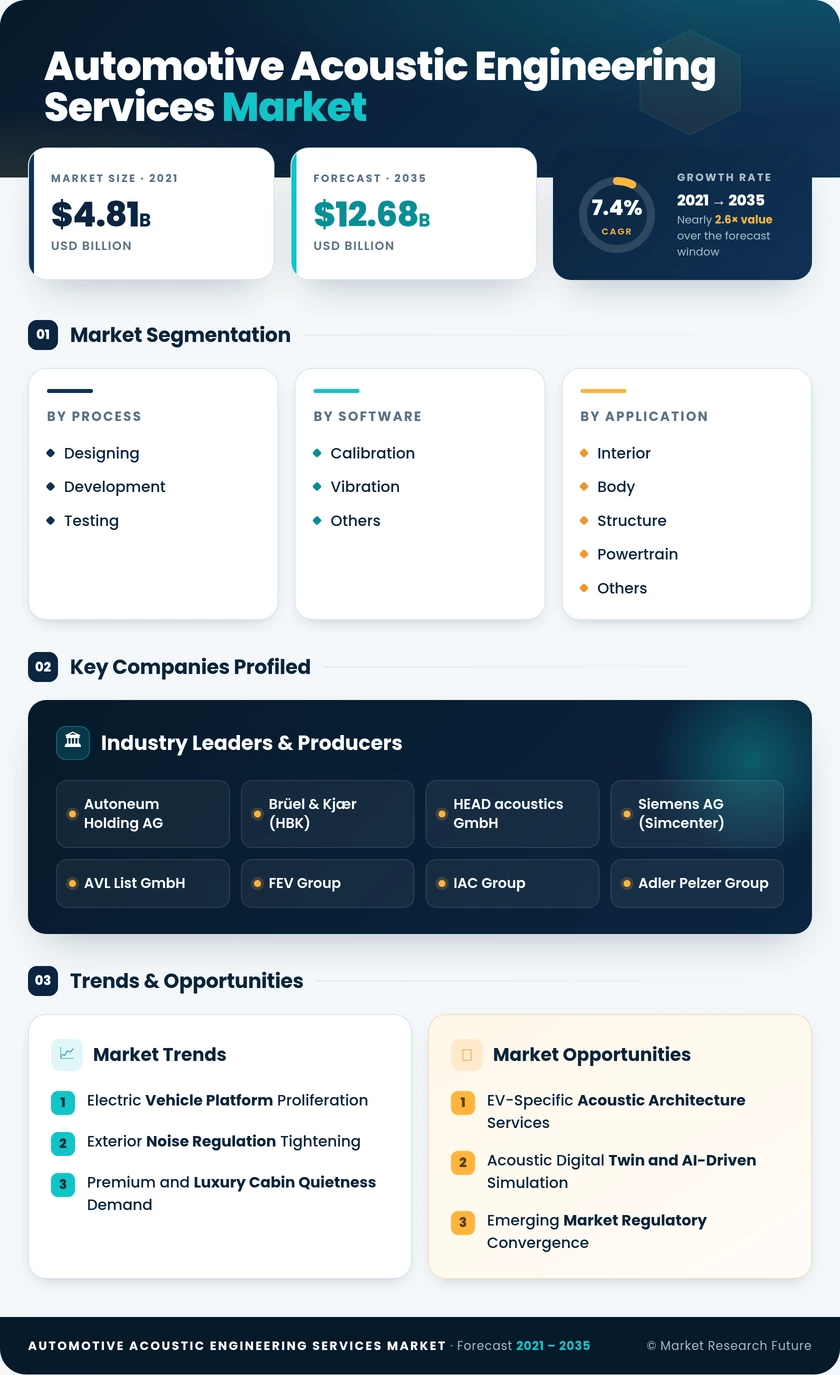
Segmentation Quick Reference
| Dimension | Sub-Segments | Dominant Segment | Fastest Growing Segment |
| By Process | Designing, Development, Testing | Testing | Development |
| By Software | Calibration, Vibration, Others | Calibration | Calibration |
| By Application | Interior, Body and Structure, Powertrain, Others | Interior | Powertrain |
| By Vehicle Type | Passenger Cars, Commercial Vehicles | Passenger Cars | Commercial Vehicles |
| By Propulsion Type | Internal Combustion Engine, Electric and Plug-In Hybrid | Internal Combustion Engine | Electric and Plug-In Hybrid |
Market Segmentation Overview
By Process
| Sub-Segment | Key Trend |
| Designing | Shift toward simulation-first approaches reduces physical prototype dependency |
| Development | EV platform programs expand scope and duration of acoustic development contracts |
| Testing | Regulatory certification cycles drive recurring, non-discretionary demand |
The process segmentation reflects the lifecycle stages of vehicle acoustic engineering. Testing captures the largest share due to mandatory compliance requirements, while development services are growing fastest as electrification programs require full acoustic architecture redesign from concept stage.
By Software
| Sub-Segment | Key Trend |
| Calibration | Active noise cancellation tuning creates iterative, recurring calibration demand |
| Vibration | Lightweight material adoption increases structural vibration complexity |
| Others | AI-based predictive acoustic tools and fleet analytics platforms emerging |
Software tools are increasingly central to service delivery, with calibration platforms commanding premium pricing as active acoustic systems proliferate across vehicle segments.
By Application
| Sub-Segment | Key Trend |
| Interior | Consumer satisfaction surveys drive OEM investment in cabin quietness |
| Body and Structure | Lightweight composites require new structural damping approaches |
| Powertrain | Electric motor and inverter noise sources demand novel engineering solutions |
| Others | ADAS sensor integration and HVAC noise management gaining attention |
Interior applications lead by revenue, reflecting the direct link between cabin noise levels and consumer brand perception. Powertrain applications are growing fastest due to the distinct acoustic signatures of electric drivetrains.
By Vehicle Type
| Sub-Segment | Key Trend |
| Passenger Cars | Volume production and consumer comfort expectations sustain dominant share |
| Commercial Vehicles | Fleet electrification and driver comfort regulations expand service demand |
Passenger cars account for the majority of acoustic engineering spending, though commercial vehicles represent a growing opportunity as electric truck and bus programs enter development.
By Propulsion Type
| Sub-Segment | Key Trend |
| Internal Combustion Engine | Legacy fleet compliance and model-year updates sustain baseline demand |
| Electric and Plug-In Hybrid | Novel noise sources and absence of engine masking drive rapid growth |
The propulsion-type segmentation captures the most significant structural shift in the market, as electric and hybrid platforms require fundamentally different acoustic engineering approaches compared to traditional combustion vehicles.