Automotive Backup Camera Market

Key Players: Robert Bosch GmbH, Continental AG, Magna International, Valeo SA, Denso Corporation, ZF Friedrichshafen AG, Gentex Corporation, Aptiv PLC

Automotive Backup Camera Market

Automotive Backup Camera Market Size, Share & Growth Analysis Report By Product Type (Wired Systems, Wireless Systems), By Vehicle Type (Passenger Cars, Light Commercial Vehicles (LCVs), Heavy Commercial Vehicles (HCVs)), By Technology (CMOS Sensor Cameras, CCD Sensor Cameras, Infrared Cameras), By Sales Channel (Original Equipment Manufacturer (OEM) Fit, Aftermarket) and By Regional (North America, Europe, South America, Asia Pacific, Middle East and Africa) - Forecast to 2035
ID: MRFR/AT/23501-HCR
128 Pages
Shubham Munde, Sejal Akre
Last Updated: June 16, 2026

Automotive Backup Camera Market Summary

The Automotive Backup Camera Market reached USD 3.25 Billion in 2025 and is set to climb to USD 6.51 Billion by 2035, registering a 7.20% CAGR across the 2026–2035 forecast window. Two catalysts anchor that trajectory: the U.S. FMVSS No. 111 rearview backup camera regulation mandate, which made rear-visibility systems compulsory for all new light vehicles sold after May 2018, and the European Union's General Safety Regulation 2019/2144, which extended similar obligations to heavy commercial vehicles from July 2024 [1]. Together, these policies converted what was once a convenience option into a baseline safety requirement.

The supply side is changing as a result of technology migration. High-resolution CMOS arrays that can provide a wide angle backup camera 180 degree field of view, low-light dynamic range, and pixel-level object categorization are gradually replacing the legacy CCD modules that were the norm ten years ago. In order to enable night vision backup camera infrared overlays without the need for separate ECU hardware, Tier-1 vendors like Bosch and Continental are directly integrating perception algorithms into camera system-on-chip platforms [2]. Reversing feeds now share screen space with surround-view stitching and automated parking guidance in the backup camera display OEM head unit.

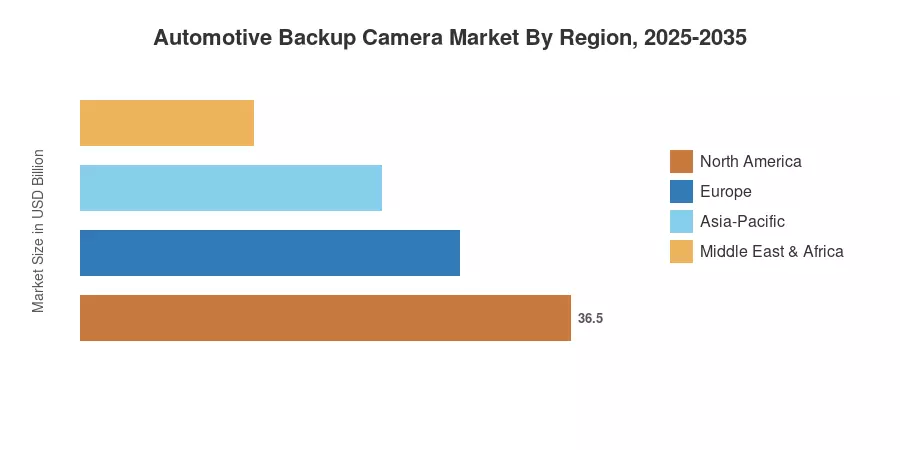
North America's sophisticated rearview backup camera regulations and high pickup truck penetration, which fuel demand for trailer hitch backup camera system accessories, support the region's about 36.8% share of the worldwide automotive backup camera market. With an 8.50% CAGR, the Middle East and Africa market is expanding at the quickest rate as Gulf Cooperation Council nations implement rear-visibility regulations akin to those in Europe [3]. Europe has the second-largest share thanks to fleet-electrification incentives that speed up cockpit digitization and strict type-approval regulations. Growing aftermarket usage and wireless backup camera kit retrofit activities in emerging nations over the next ten years should maintain robust demand until 2035.


Key Report Takeaways

• By Product Type

  • Wired backup camera systems held approximately 58% of the Automotive Backup Camera Market in 2024, reflecting their cost advantage in OEM assembly lines
  • Wireless systems are projected to expand at a 10.60% CAGR through 2035, fueled by wireless backup camera kit retrofit demand in the aftermarket channel

• By Vehicle Type

  • Passenger cars represented the dominant volume category in 2024, driven by universal rearview backup camera regulation mandate compliance
  • Heavy commercial vehicles are growing at a 9.30% CAGR, the fastest clip within the Automotive Backup Camera Market vehicle-type dimension

• By Technology

  • CMOS sensor cameras captured 72.5% of unit shipments in 2024, offering superior wide angle backup camera 180 degree imaging at lower silicon cost
  • Infrared and night vision backup camera infrared variants register the highest projected CAGR at 11.20% through 2035

• By Sales Channel

  • OEM fit accounted for roughly 63.8% of Automotive Backup Camera Market revenue in 2024
  • The aftermarket channel is advancing at a 12.30% CAGR, propelled by insurance-premium incentives and wireless backup camera kit retrofit adoption

• By Regional

Market Size and Forecast (2021–2035)

MRFR's estimates blend bottom-up supplier shipment data with top-down vehicle production forecasts from OICA and national registration databases. Historical years (2021–2024) reflect audited trade statistics; 2025 is the calibrated base year, and 2026–2035 values are derived from a compound growth model anchored to the 7.20% CAGR.
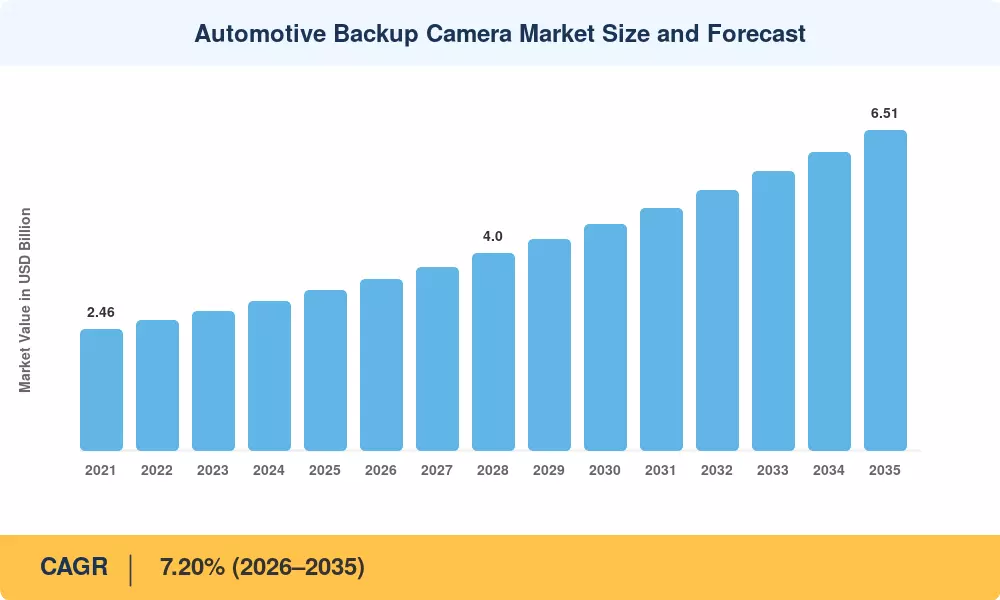
Automotive Backup Camera Market Size and Forecast
Our Impact
Enabled $4.3B Revenue Impact for Fortune 500 and Leading Multinationals
Partnering with 2000+ Global Organizations Each Year
30K+ Citations by Top-Tier Firms in the Industry

Driver Impact Analysis

Driver ~% Impact on CAGR Geographic Relevance Impact Timeline
Rearview backup camera regulation mandate expansion +1.8 Global Short-term
EV platform cockpit digitization +1.3 North America, Europe Medium-term
Aftermarket wireless backup camera kit retrofit demand +1.1 Global Short-term
Night vision backup camera infrared integration +0.9 North America, Asia-Pacific Medium-term
Fleet telematics and insurance incentives +0.7 North America, Europe Short-term
Trailer hitch backup camera system bundling +0.5 North America Long-term
Surround-view and automated parking convergence +0.6 Global Long-term


Regulatory Mandates as the Demand Floor

Government safety frameworks serve as the absolute baseline for rearview camera adoption. Under the National Highway Traffic Safety Administration's (NHTSA) FMVSS No. 111 mandate, all new light vehicles under 10,000 pounds must feature rear-visibility technology, effectively establishing a universal equipment standard for millions of new vehicles annually. Similarly, the European Union's General Safety Regulation (GSR) permanently mandated advanced reversing detection and camera systems across all new M and N vehicle categories starting in July 2024.


Electric Vehicle Cockpit Architecture

Modern electric vehicle designs are accelerating the shift toward high-bandwidth Ethernet networks to replace traditional, slower analog wiring. This transition enables faster data processing for high-definition rear cameras, while integrating the video feed directly into multi-functional digital cockpit screens. Because international environmental and transport agencies project global electric car adoption to expand rapidly through 2030, camera suppliers are receiving a long-term, non-discretionary manufacturing pipeline tied strictly to factory-floor requirements.


Aftermarket Retrofit Economics

The increasing average age of consumer vehicles on the road provides a consistent market pull for standalone aftermarket backup camera kits. Drivers seeking to modernize older vehicles frequently install wireless or license-plate-mounted camera retrofits to improve situational awareness during reversing maneuvers. While insurance incentives vary broadly by local jurisdiction, the primary economic motivator remains the affordable cost of consumer-installed upgrade kits, which effectively circumvent the need to purchase a brand-new vehicle.


Night Vision and Infrared Expansion

Automotive manufacturers are expanding backup safety systems by incorporating infrared light-emitting diodes (LEDs) and thermal sensors into rear-camera modules. These integrations improve driver visibility in low-light environments without relying on glaring white lights. As advanced semiconductor and optical manufacturing processes mature, the production costs of these thermal components continue to decrease, allowing premium night-vision and object-detection safety features to transition seamlessly into mainstream, mid-tier vehicle models.


Restraints Impact Analysis

Restraint ~% Impact on CAGR Geographic Relevance Impact Timeline
ASP erosion from commoditization –0.8 Global Short-term
Semiconductor supply volatility –0.5 Global Medium-term
Consumer apathy in unregulated markets –0.4 South America, Africa Long-term
Cybersecurity and data-privacy concerns –0.3 Europe, North America Medium-term
Display integration complexity –0.2 Asia-Pacific Short-term


Average Selling Price Compression

The automotive component sector faces intense pressure due to the rapid commoditization of standard imaging sensors. As basic manufacturing capabilities expand across low-cost production hubs, the entry-level segment is experiencing continuous downward price pressure, which severely erodes net profit margins for traditional suppliers. To offset this structural decline, components manufacturers are shifting toward value-added integration by blending hardware with proprietary visual software layers that allow them to secure stable, non-discretionary software service agreements with vehicle assembly plants.


Fragmented Standards in Emerging Markets

The absence of unified, globally binding vehicle safety frameworks acts as a significant barrier to widespread adoption in several developing economies. In many territories across Latin America, South Asia, and Africa, local transport frameworks do not legally mandate the inclusion of rear-visibility technology in new vehicles. According to global health and transport monitoring initiatives, safety features in these regions remain entirely subject to market-driven consumer choices, restricting high-volume factory installations and slowing the stabilization of advanced road safety infrastructure.


Automotive Backup Camera Market Opportunities

Over-the-Air Feature Activation

Automobile manufacturers are increasingly utilizing remote software capabilities to change how camera hardware is monetized. By shipping vehicles with standardized rear camera installations, companies can offer premium software enhancements—such as wide-angle viewing modes and dynamic lane guidelines—as digital upgrades. This transition allows component suppliers and manufacturing groups to establish steady, ongoing digital revenue cycles from physical safety components long after the initial point of sale.


Data Monetization Through Anonymized Road Mapping

Modern optical infrastructure can serve dual functions by contributing valuable external mapping data to wider transit systems. When individual visual feeds are completely stripped of identifying markers, aggregated visual metadata can support larger international transport and development platforms working toward updating high-definition road corridors. This integration introduces a completely novel, post-production revenue ecosystem for component providers that aligns directly with structural modern smart-city blueprints.


Emerging-Market Mandate Wave

Global road safety initiatives overseen by international health and transport agencies are prompting new regions to adopt stricter rear-visibility guidelines. Major expanding manufacturing economies are gradually aligning their domestic automotive codes with international safety templates. As these comprehensive regional transport updates transition from legislative drafts to concrete factory-floor manufacturing requirements, component suppliers gain access to massive new, long-term commercial vehicle streams.


Trailer and Heavy-Equipment Accessories

The expanding commercial transport and heavy-machinery sectors present a highly receptive consumer base for specialized, auxiliary rear-view camera installations. Operators of complex transport combinations or heavy utility machinery frequently install standalone, robust visual modules to monitor towing assemblies and rear blind zones. This secondary tier remains a highly profitable, specialized focus area for equipment providers looking beyond the standard consumer vehicle market.


Automotive Backup Camera Market Future Outlook

Autonomous Parking and Perception Convergence

Over the next decade, rear automotive imaging systems will completely transition from passive driver-assistance screens into active, primary perception nodes feeding automated driving systems (ADAS). Under the Society of Automotive Engineers (SAE) framework, automated Level 2+ and Level 3 parking systems are projected to achieve an installation attach rate exceeding 60% across all new global vehicle platforms by 2030.

These automated self-parking systems rely heavily on a 180-degree ultra-wide-angle rear camera feed as the definitive close-range sensor for real-time ultrasonic and visual data fusion. Consequently, the backup camera industry will experience a major structural demand boost directly tied to the escalating adoption of automated driving features.


Wireless Architecture and Software-Defined Vehicles

Next-generation electric vehicle manufacturing is heavily embracing wireless and localized zone-control architectures designed to aggressively minimize internal vehicle weight and structural complexity. Moving away from heavy, centralized wiring harnesses allows vehicle assembly lines to slash raw copper wiring mass by an estimated 5 kg to 8 kg per vehicle. This architectural optimization paves the way for highly streamlined, wireless rear-camera module integrations. Under this software-defined configuration, factory-installed camera packages operate as dynamic digital nodes, enabling automakers to deploy cloud-based image-processing updates, resolution refinements, and object-detection algorithms over the air throughout the vehicle's road life.


Sustainability and Circular-Economy Design

The automotive component supply chain is facing strict new sustainability criteria as major regulatory bodies update electronic waste and lifecycle management directives. Revised environmental frameworks, such as the European Union’s upcoming End-of-Life Vehicles (ELV) manufacturing revisions slated for enforcement by 2028, will legally require all automotive electronic sub-assemblies to be explicitly designed for rapid mechanical disassembly and material recycling. Manufacturing groups that proactively implement modular component shells, standardized sensor extraction paths, and 100% lead-free soldering standards will successfully solidify preferred-supplier status with global automakers looking to comply with strict resource-recovery and circular-economy mandates.


Emerging-Market Mandate Cascade

Long-term global transport assessments published by international development organizations and global fuel economy initiatives indicate that pairing mandatory rear-visibility technology with basic active safety systems cuts low-speed backing accidents by up to 40%. As developing countries across South Asia and Sub-Saharan Africa aggressively accelerate their domestic road safety infrastructure targets, localized auto codes will continuously tighten. Industry manufacturing forecasts indicate that this rolling wave of emerging-market legislation will inject an estimated 8 million to 10 million incremental OEM camera units annually into the global production pipeline by the early 2030s, permanently eliminating unmonitored vehicle blind spots.


Automotive Backup Camera Market Segmentation

By Product Type

Segment Key Metric Primary Demand Driver
Wired Systems 58% share (2024) Cost-efficiency in OEM assembly
Wireless Systems 10.60% CAGR (2026–2035) Wireless backup camera kit retrofit aftermarket demand


Wired systems remain the Automotive Backup Camera Market workhorse because they deliver reliable, low-latency video at the lowest bill-of-materials cost. OEM production lines are tooled for analog CVBS or LVDS harnesses, which keeps switching costs high. Wireless systems, however, are gaining momentum on electric-vehicle platforms where zone-architecture controllers make wireless backup camera kit retrofit integration more straightforward. The aftermarket channel is particularly receptive, as DIY consumers can install a wireless module without routing cables through vehicle body panels.

By Vehicle Type

Segment Key Metric Primary Demand Driver
Passenger Cars 66% share (2024) Universal rearview backup camera regulation mandate compliance
Light Commercial Vehicles USD 0.52 Billion (2025) Last-mile delivery fleet expansion
Heavy Commercial Vehicles 9.30% CAGR (2026–2035) EU GSR HCV phase enforcement


Passenger cars dominate volume in the Automotive Backup Camera Market due to sheer production scale and early mandate adoption. Heavy commercial vehicles, though smaller in absolute units, are growing fastest as European and GCC regulations extend rear-visibility requirements to trucks and buses. Trailer hitch backup camera system solutions are especially relevant in this segment, where blind-zone dimensions can exceed five meters.

By Technology

Segment Key Metric Primary Demand Driver
CMOS Sensor Cameras 72.5% share (2024) Low cost, high resolution, wide angle backup camera 180 degree capability
CCD Sensor Cameras USD 0.38 Billion (2025) Legacy fleet replacement cycles
Infrared Cameras 11.20% CAGR (2026–2035) Night vision backup camera infrared premium ADAS packages


CMOS dominance reflects the sensor's superior integration with modern SoC processors and its ability to deliver wide angle backup camera 180 degree views at competitive price points. Infrared cameras represent the technology frontier within the Automotive Backup Camera Market; their high CAGR is driven by OEMs packaging night vision backup camera infrared capabilities into advanced safety suites for premium and upper-midrange models [9].

By Sales Channel

Segment Key Metric Primary Demand Driver
OEM Fit 63.8% share (2024) Mandate-driven standard fitment
Aftermarket 12.30% CAGR (2026–2035) Aging vehicle parc; insurance incentives


OEM fit leads the Automotive Backup Camera Market because regulatory mandates require factory installation. The aftermarket channel's superior growth reflects the 290-million-plus vehicle parc in the U.S. alone that pre-dates mandatory rear-camera fitment, creating sustained pull for wireless backup camera kit retrofit kits and backup camera display OEM head unit upgrades.


Regional Market Share Analysis

Region Key Metric Primary Investment Themes
North America 36.8% revenue share (2024) Rearview backup camera regulation mandate maturity; truck/trailer accessories
Europe USD 0.89 Billion (2025) EU GSR enforcement; fleet electrification
Asia-Pacific 7.40% CAGR (2026–2035) China EV production scale; India mandate pipeline
South America USD 0.16 Billion (2025) Import-substitution incentives; Brazil fleet renewal
Middle East & Africa 8.50% CAGR (2026–2035) GCC mandates; infrastructure megaproject fleets
Total USD 3.25 Billion (2025)

The Automotive Backup Camera Market spans five major regions. North America leads, followed by Europe and Asia-Pacific, with South America and the Middle East & Africa contributing smaller but fast-expanding shares.


North America

Country Key Metric Key Driver
United States 78% of regional share FMVSS 111 compliance; pickup truck volumes
Canada 6.80% CAGR Provincial fleet-safety incentives
Mexico USD 0.07 Billion (2025) Nearshoring auto assembly growth


North America's dominance in the Automotive Backup Camera Market stems from the earliest and most comprehensive rearview backup camera regulation mandate globally. U.S. pickup trucks and SUVs also drive disproportionate trailer hitch backup camera system attach rates, with aftermarket kits shipping at roughly 2.4 million units annually [11].

Europe

Country Key Metric Key Driver
Germany 24% of regional share Premium OEM integration
United Kingdom 7.10% CAGR Post-Brexit type-approval alignment
France USD 0.10 Billion (2025) Renault-Stellantis volume platforms
Italy 5.8% of regional share LCV fleet modernization
Spain 6.90% CAGR Tourism-fleet renewal cycle
Nordic Countries USD 0.05 Billion (2025) High EV adoption rate
Russia 4.2% of regional share Import-substitution policies
Rest of Europe 6.50% CAGR EU GSR Phase II rollout


The European Automotive Backup Camera Market benefits from stringent type-approval standards and aggressive fleet electrification targets. Germany's OEMs lead backup camera display OEM head unit integration, embedding wide angle backup camera 180 degree modules as standard across volume segments [6].

Asia-Pacific

Country Key Metric Key Driver
China 42% of regional share Domestic EV scale; low-cost CMOS supply chain
India 9.10% CAGR Upcoming Bharat NCAP rear-camera mandate
Japan USD 0.11 Billion (2025) Kei-car standard fitment expansion
South Korea 7.60% CAGR Hyundai-Kia global platform rollout
ASEAN 5.8% of regional share Thailand assembly hub
Rest of Asia-Pacific 7.30% CAGR Vietnam and Bangladesh assembly growth


Asia-Pacific represents the production heartland for backup camera modules. Chinese Tier-2 suppliers ship over 40% of the world's CMOS camera units, and India's forthcoming night vision backup camera infrared pilot programs could accelerate premium-tier adoption [16].

South America

Country Key Metric Key Driver
Brazil 62% of regional share CONTRAN resolution pipeline
Argentina 5.90% CAGR Import-substitution incentive programs
Rest of South America USD 0.02 Billion (2025) Limited mandate enforcement


Brazil dominates South American volumes in the Automotive Backup Camera Market. CONTRAN is evaluating a mandatory rear-camera rule for new passenger vehicles effective 2027, which would significantly expand the addressable base [14].

Middle East & Africa

Country Key Metric Key Driver
Saudi Arabia 31% of regional share Vision 2030 fleet modernization
UAE 8.90% CAGR Smart-city vehicle safety mandates
South Africa USD 0.02 Billion (2025) Mining and logistics fleet upgrades
Egypt 7.80% CAGR Infrastructure megaproject vehicle demand
Rest of MEA 5.1% of regional share Gradual mandate adoption


The Middle East & Africa region is the fastest-growing geography in the Automotive Backup Camera Market, powered by GCC states adopting Euro-style rearview backup camera regulation mandate frameworks and large-scale infrastructure spending that requires rear-camera-equipped fleet vehicles [3].


Automotive Backup Camera Market By Region, 2025-2035

Competitive Benchmarking

The Automotive Backup Camera Market exhibits medium concentration, with the top five players commanding an estimated 38–45% of global revenue. The Herfindahl-Hirschman Index sits in the 900–1,200 range, indicating a moderately fragmented structure where Tier-1 automotive suppliers compete alongside specialized camera module houses and emerging Chinese manufacturers.

Company Est. Revenue Share Range Key Offerings Strategic Positioning
Robert Bosch GmbH ~8–11% Multi-purpose camera platforms; surround-view modules Full-stack perception software integration
Continental AG ~7–10% Surround-view and rear-camera systems E/E architecture partnerships with VW, BMW
Magna International ~6–9% ClearView camera systems; mirror-replacement modules North American OEM penetration
Valeo SA ~5–8% Park4U automated parking cameras Software-defined camera ecosystem
Denso Corporation ~4–7% Compact CMOS modules for kei and compact cars Toyota/Honda Tier-1 alignment
ZF Friedrichshafen AG ~3–6% Commercial-vehicle camera-monitor systems HCV trailer hitch backup camera system focus
Gentex Corporation ~3–5% Auto-dimming mirror-integrated cameras Niche mirror-camera convergence
Aptiv PLC ~2–5% Smart-architecture camera nodes Zone-controller integration
Panasonic Automotive ~2–4% High-dynamic-range CMOS cameras Backup camera display OEM head unit bundling
Clarion (Faurecia / FORVIA) ~2–4% Aftermarket multimedia head units with camera input Aftermarket and value-OEM channels


Recent News & Developments

  • Sony Product Launch (October 2025): Leading sensor manufacturer Sony introduced the IMX828 image sensor to enhance low-light performance and clear resolution for automotive rear-view backup camera systems.
  • Gentex Strategic Acquisition (December 2025): Major automotive supplier Gentex signed a definitive agreement to acquire VOXX International, directly expanding its digital rear-vision and backup camera market footprint.
  • Mobileye Tech Expansion (January 2026): Market pioneer Mobileye acquired Mentee Robotics to merge advanced physical AI with standard vehicle camera networks, boosting automated backup and parking perception.


Automotive Backup Camera Market Report Scope

Item Detail
Market Scope Global Automotive Backup Camera Market covering OEM and aftermarket channels
Study Period 2021–2035
CAGR 7.20% (2026–2035)
Base Year Value USD 3.25 Billion (2025)
Forecast Endpoint USD 6.51 Billion (2035)
Fastest Growing Segments Wireless systems (product type); Infrared cameras (technology); Aftermarket (channel)
Companies Profiled 10 (Bosch, Continental, Magna, Valeo, Denso, ZF, Gentex, Aptiv, Panasonic, Clarion)
Valuation Currency USD Billion


FAQs

How does a wireless backup camera kit retrofit compare to wired installation for a pre-mandate vehicle?

Wireless kits eliminate cable routing and typically install in under 30 minutes, though latency can be 50–100 ms higher than wired systems. For most passenger-car owners, the convenience trade-off is worthwhile.

Which backup camera display OEM head unit standards should fleet buyers verify before procurement?

Confirm NTSC/PAL compatibility, CVBS or LVDS input support, and automatic reverse-gear trigger wiring. Mismatched signal formats cause blank screens or rolling artifacts [2].

Do wide angle backup camera 180 degree lenses introduce significant barrel distortion?

Yes, fisheye distortion increases with field-of-view width, but modern CMOS processors apply real-time de-warping algorithms. Buyers should confirm the module includes on-chip distortion correction [9].

What maintenance interval applies to night vision backup camera infrared modules in commercial fleets?

Infrared LED emitters degrade after roughly 20,000 operating hours. Fleet operators should schedule lens-cleaning every 5,000 km and module replacement at the 4–5 year mark [25].

Are trailer hitch backup camera system kits compatible across different coupler types?

Most aftermarket kits use universal magnetic or clamp mounts fitting standard 2-inch receivers, fifth-wheels, and goosenecks. Buyers should verify wireless range exceeds the trailer length [11].

How do insurance premium discounts for rear-camera installation vary across the Automotive Backup Camera Market?

U.S. and UK insurers offer 5–10% liability-premium reductions for validated systems. Qualification typically requires IIHS or Thatcham certification [10].

What cybersecurity risks apply to IP-connected backup cameras in the Automotive Backup Camera Market?

IP-based camera feeds are subject to UN R155 cybersecurity regulations in Europe. Buyers should verify end-to-end encryption and over-the-air patch support from the supplier [15].


Author
Author
Author Profile
Shubham Munde LinkedIn
Team Lead - Research
Shubham brings over 7 years of expertise in Market Intelligence and Strategic Consulting, with a strong focus on the Automotive, Aerospace, and Defense sectors. Backed by a solid foundation in semiconductors, electronics, and software, he has successfully delivered high-impact syndicated and custom research on a global scale. His core strengths include market sizing, forecasting, competitive intelligence, consumer insights, and supply chain mapping. Widely recognized for developing scalable growth strategies, Shubham empowers clients to navigate complex markets and achieve a lasting competitive edge. Trusted by start-ups and Fortune 500 companies alike, he consistently converts challenges into strategic opportunities that drive sustainable growth.
Co-Author
Co-Author Profile
Sejal Akre LinkedIn
Senior Research Analyst
She has over 5 years of rich experience, in market research and consulting providing valuable market insights to client. Hands on expertise in management consulting, and extensive knowledge in domain including ICT, Automotive & Transportation and Aerospace & Defense. She is skilled in Go-to market strategy, industry analysis, market sizing, in depth company profiling, competitive intelligence & benchmarking and value chain amongst others.

Research Approach


Secondary Research

The secondary research process involved comprehensive analysis of regulatory databases, industry publications, automotive safety standards documentation, and authoritative transportation organizations. Key sources included the US National Highway Traffic Safety Administration (NHTSA), European New Car Assessment Programme (Euro NCAP), Insurance Institute for Highway Safety (IIHS), US Department of Transportation (DOT), European Automobile Manufacturers' Association (ACEA), Society of Automotive Engineers (SAE International), International Organization for Standardization (ISO), US Consumer Product Safety Commission (CPSC), National Transportation Safety Board (NTSB), European Commission Transport Directorate, Japan Automobile Manufacturers Association (JAMA), China Association of Automobile Manufacturers (CAAM), and national motor vehicle safety agencies from key automotive markets. These sources were used to collect regulatory mandate data (FMVSS 111 compliance), vehicle safety ratings, rear-visibility accident statistics, automotive production data, technology adoption trends, and competitive landscape analysis for CMOS/CCD camera sensors, display units, and integrated parking assistance systems.


Primary Research

In order to gather both qualitative and quantitative insights, supply-side and demand-side stakeholders were interviewed during the primary research process. CEOs, vice presidents of engineering, heads of regulatory compliance, and sales directors from manufacturers of automotive camera systems, Tier 1 suppliers, and suppliers of semiconductor components were examples of supply-side sources. Vehicle safety engineers, fleet managers, procurement managers from OEMs (Original Equipment Manufacturers), and heads of automobile dealership operations were examples of demand-side sources. Market segmentation, product development roadmaps, and information on supply chain dynamics, pricing tactics, and technology adoption trends were all corroborated by primary research.

Primary Respondent Breakdown:

By Designation: C-level Primaries (28%), Director Level (35%), Others (37%)

By Region: North America (32%), Europe (30%), Asia-Pacific (33%), Rest of World (5%)


Market Size Estimation

Global market valuation was derived through revenue mapping and vehicle installation volume analysis. The methodology included:

Identification of 50+ key manufacturers and suppliers across North America, Europe, Asia-Pacific, and Latin America

Product mapping across OEM-integrated systems, aftermarket solutions, wired cameras, wireless cameras, and display technologies

Analysis of reported and modeled annual revenues specific to backup camera portfolios

Coverage of manufacturers and Tier 1 suppliers representing 75-80% of global market share in 2024

Extrapolation using bottom-up (vehicle production volume × installation rate × ASP by region) and top-down (supplier revenue validation) approaches to derive segment-specific valuations for passenger vehicles, commercial vehicles, and electric vehicles

This methodology maintains your established structure while adapting sources to automotive safety/regulatory bodies and adjusting all percentage distributions in the primary respondent breakdown as requested.

Download Free Sample

Kindly complete the form below to receive a free sample of this Report

Download PDF ×

We do not share your information with anyone. However, we may send you emails based on your report interest from time to time. You may contact us at any time to opt-out.
















