×
Request Free Sample ×

Kindly complete the form below to receive a free sample of this Report

* Please use a valid business email

Leading companies partner with us for data-driven Insights

clients tt-cursor
Hero Background

Automotive Motor Market

ID: MRFR/AT/4146-CR
110 Pages
Sejal Akre
October 2022

Automotive Motor Market Research Report Information By Product Type (DC Brushed Motor, BLDC Motor, Stepper Motor), By Vehicle Type (Passenger, Light Commercial Vehicle, Heavy Commercial Vehicle), By Sales Channel (OEM, Aftermarket), By Application (Performance Motors, Comfort Motors, Safety Motors) And By Region (North America, Europe, Asia-Pacific, And Rest Of The World) –Market Forecast Till 2035

Share:
Download PDF ×

We do not share your information with anyone. However, we may send you emails based on your report interest from time to time. You may contact us at any time to opt-out.

Automotive Motor Market Infographic
Purchase Options

Automotive Motor Market Summary

As per MRFR analysis, the Automotive Motor Market Size was estimated at 42.18 USD Billion in 2024. The Automotive Motor industry is projected to grow from 44.04 USD Billion in 2025 to 67.87 USD Billion by 2035, exhibiting a compound annual growth rate (CAGR) of 4.42 during the forecast period 2025 - 2035.

Key Market Trends & Highlights

The Automotive Motor Market is experiencing a transformative shift towards electrification and smart technologies.

  • The rise of electric vehicles is reshaping the automotive landscape, particularly in North America.
  • Integration of smart technologies is enhancing vehicle performance and user experience across the Asia-Pacific region.
  • Passenger vehicles remain the largest segment, while commercial vehicles are witnessing the fastest growth in demand.
  • Increasing demand for fuel efficiency and government incentives for electric vehicles are driving market expansion.

Market Size & Forecast

2024 Market Size 42.18 (USD Billion)
2035 Market Size 67.87 (USD Billion)
CAGR (2025 - 2035) 4.42%

Major Players

Toyota Motor Corporation (JP), Volkswagen AG (DE), General Motors Company (US), Ford Motor Company (US), Honda Motor Co., Ltd. (JP), BMW AG (DE), Daimler AG (DE), Hyundai Motor Company (KR), Nissan Motor Co., Ltd. (JP)

Automotive Motor Market Trends

The Automotive Motor Market is currently experiencing a transformative phase, driven by advancements in technology and shifting consumer preferences. The increasing demand for electric vehicles is reshaping the landscape, as manufacturers focus on developing more efficient and powerful motors. This trend is further fueled by the global push for sustainability, prompting automakers to invest in innovative solutions that reduce emissions and enhance energy efficiency. Additionally, the integration of smart technologies into vehicles is becoming more prevalent, leading to the development of motors that can communicate with other systems, thereby improving overall vehicle performance. Moreover, the Automotive Motor Market is witnessing a rise in the adoption of automation and robotics in manufacturing processes. This shift not only enhances production efficiency but also allows for greater precision in motor design and assembly. As competition intensifies, companies are likely to prioritize research and development to stay ahead, exploring new materials and designs that could revolutionize motor capabilities. The convergence of these trends suggests a dynamic future for the Automotive Motor Market, where innovation and sustainability will play pivotal roles in shaping its trajectory.

Rise of Electric Vehicles

The shift towards electric vehicles is significantly influencing the Automotive Motor Market. As consumers increasingly prioritize eco-friendly options, manufacturers are compelled to enhance their electric motor offerings, focusing on efficiency and performance.

Integration of Smart Technologies

The incorporation of smart technologies into automotive systems is reshaping motor design. Motors are now being developed to interact with various vehicle components, improving functionality and user experience.

Automation in Manufacturing

The Automotive Motor Market is seeing a trend towards automation in production processes. This advancement not only boosts efficiency but also enhances the precision of motor manufacturing, leading to higher quality products.

Automotive Motor Market Drivers

Growing Demand for Electric Vehicles

The increasing global emphasis on sustainability and reducing carbon emissions drives the demand for electric vehicles, which rely heavily on advanced automotive motors. In 2024, the Global Automotive Motor Market Industry is valued at 42.2 USD Billion, reflecting a significant shift towards electric mobility. Governments worldwide are implementing stringent regulations to promote electric vehicle adoption, which further fuels the market. For instance, countries like Norway and Germany are leading in electric vehicle sales, indicating a robust market potential. This trend is expected to continue, with projections suggesting that by 2035, the market could reach 67.9 USD Billion, showcasing a compound annual growth rate of 4.42% from 2025 to 2035.

Market Segment Insights

By Application: Passenger Vehicle (Largest) vs. Commercial Vehicle (Fastest-Growing)

The automotive motor market is significantly driven by the passenger vehicle segment, which holds the largest market share due to the increasing consumer demand for personal transportation. As urbanization and disposable incomes rise globally, this segment continues to thrive, accounting for a substantial portion of total automotive sales. Meanwhile, the commercial vehicle segment is rapidly evolving, reflecting changes in logistics and transportation dynamics, making it the fastest-growing sector within this market. Growth trends within the automotive motor application segment are largely propelled by technological advancements and increasing fuel efficiency mandates. The rising popularity of electric and hybrid vehicles is further influencing demand within the passenger vehicle segment, compelling manufacturers to innovate continuously. Concurrently, the commercial vehicle segment is enjoying a surge due to booming e-commerce, which necessitates reliable and efficient transport solutions, thus driving investment and growth in this area.

Passenger Vehicle (Dominant) vs. Heavy-Duty Vehicle (Emerging)

The passenger vehicle segment is the dominant application in the automotive motor market, characterized by a vast consumer base and enduring demand for cars, SUVs, and crossovers. This segment benefits from significant advancements in technology, focusing on electric vehicle development and improved safety standards, appealing to environmentally conscious consumers. In contrast, the heavy-duty vehicle segment, while currently considered emerging, is gaining traction with increased focus on freight transport and logistics efficiency. Heavy-duty vehicles are investing in fuel-efficient motors and transitioning to electric models, meeting regulatory demands and aligning with future sustainability goals. This shift is gradually enhancing its market position, compelling manufacturers to adapt and innovate further.

By Motor Type: Internal Combustion Engine (Largest) vs. Electric Motor (Fastest-Growing)

The Automotive Motor Market displays a diverse segmentation, with Internal Combustion Engines (ICE) holding a commanding market share due to their long-established presence and consumer familiarity. Conversely, Electric Motors are rapidly gaining momentum, capitalizing on the growing consumer preference for sustainable and eco-friendly alternatives. As government regulations tighten around emissions, Electric Motors are positioned to capture an increasing share of the automotive landscape.

Motor Type: Internal Combustion Engine (Dominant) vs. Electric Motor (Emerging)

Internal Combustion Engines have been the backbone of the automotive industry for decades, known for their robustness and widespread availability. However, Electric Motors are emerging as a formidable competitor with advancements in battery technology and electric vehicle infrastructure. The shift towards electrification is propelled by increasing environmental concerns and government incentives, making Electric Motors not just a trend but a significant player in the market. As consumers demand more efficient and eco-friendly solutions, Internal Combustion Engines will likely face growing challenges to maintain their dominance.

By Power Output: Medium Power Output (Largest) vs. High Power Output (Fastest-Growing)

In the Automotive Motor Market, the distribution of power output segments shows a clear dominance of the Medium Power Output category. This segment not only occupies a significant share but also caters to a wide range of vehicle types, balancing efficiency and performance. Conversely, the High Power Output segment, while smaller in share, is witnessing rapid growth due to increasing demand for performance-oriented vehicles and advancements in motor technology. The growth trends in the Power Output segment are primarily driven by the automotive industry's shift towards electrification and the pursuit of higher efficiency. The ongoing development of electric and hybrid vehicles is propelling the High Power Output segment forward, as manufacturers seek to enhance performance. Additionally, the rise in consumer preference for powerful yet eco-friendly vehicles is further fueling this segment's expansion, indicating a thriving competitive landscape ahead.

Medium Power Output (Dominant) vs. High Power Output (Emerging)

The Medium Power Output segment serves as the cornerstone of the Automotive Motor Market, appealing to a wide array of vehicles, including sedans, compact cars, and some SUVs. Its balanced nature combines adequate power with fuel efficiency, making it a top choice among manufacturers and consumers alike. Meanwhile, the High Power Output segment is emerging as an innovative force, appealing to high-performance vehicles and luxury brands. With advancements in technology, the High Power Output segment is rapidly adapting to meet the demands for electrified powertrains and enhanced performance capabilities. As automotive manufacturers push boundaries in performance, this segment is expected to evolve, integrating cutting-edge technologies that redefine power efficiency and driving experience.

Get more detailed insights about Automotive Motor Market

Regional Insights

North America : Established Automotive Market

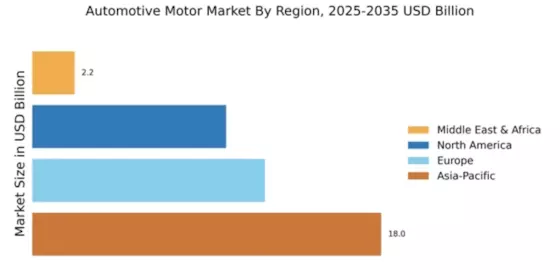
The North American automotive motor market is projected to reach $10.0 billion by December 2025, driven by increasing consumer demand for electric vehicles (EVs) and stringent emissions regulations. The region's automotive sector is focusing on innovation, with investments in advanced motor technologies and sustainable practices. Regulatory support for EV adoption is further catalyzing market growth, as manufacturers adapt to changing consumer preferences and environmental standards. Leading countries in this region include the US and Canada, where major automotive players like General Motors, Ford, and Toyota are heavily investing in R&D. The competitive landscape is characterized by a mix of established automakers and emerging startups focusing on electric and hybrid technologies. The presence of key players ensures a robust supply chain and innovation pipeline, positioning North America as a significant player in The Automotive Motor.

Europe : Innovative Automotive Hub

Europe's automotive motor market is expected to reach $12.0 billion by December 2025, fueled by a strong push towards electrification and sustainability. The European Union's stringent regulations on emissions and a commitment to reducing carbon footprints are driving manufacturers to innovate. The region is witnessing a surge in demand for high-efficiency motors, particularly in the EV segment, as consumers increasingly prioritize eco-friendly options. Germany, France, and the UK are leading countries in this market, with major players like Volkswagen, BMW, and Daimler at the forefront of technological advancements. The competitive landscape is marked by collaborations between traditional automakers and tech companies, enhancing the development of smart automotive solutions. This synergy is crucial for maintaining Europe's position as a leader in automotive innovation and sustainability.

Asia-Pacific : Emerging Powerhouse in Motors

The Asia-Pacific automotive motor market is projected to reach $18.0 billion by December 2025, making it the largest regional market. This growth is driven by rapid urbanization, increasing disposable incomes, and a rising demand for electric vehicles. Government initiatives promoting EV adoption and infrastructure development are significant catalysts for market expansion. The region's focus on technological advancements in automotive motors is reshaping the industry landscape. China, Japan, and South Korea are the leading countries in this market, with key players like Toyota, Honda, and Hyundai leading the charge. The competitive environment is characterized by aggressive investments in R&D and a strong emphasis on innovation. The presence of numerous manufacturers and suppliers enhances the region's capability to meet the growing demand for advanced automotive motors, solidifying its position as a global leader.

Middle East and Africa : Emerging Market Potential

The Middle East and Africa automotive motor market is expected to reach $2.18 billion by December 2025, driven by increasing vehicle ownership and infrastructure development. The region is witnessing a gradual shift towards electric mobility, supported by government initiatives aimed at reducing carbon emissions. This transition is expected to create new opportunities for automotive motor manufacturers, particularly in the EV segment, as consumer awareness grows. Countries like South Africa and the UAE are leading the market, with a growing presence of international automotive brands. The competitive landscape is evolving, with local manufacturers beginning to emerge alongside established global players. This dynamic environment is fostering innovation and investment in automotive technologies, positioning the region for future growth in the automotive motor market.

Key Players and Competitive Insights

The Automotive Motor Market is currently characterized by intense competition and rapid innovation, driven by a confluence of technological advancements and shifting consumer preferences. Major players such as Toyota Motor Corporation (JP), Volkswagen AG (DE), and General Motors Company (US) are at the forefront, each adopting distinct strategies to enhance their market positioning. Toyota (JP) emphasizes sustainability through its commitment to hybrid and hydrogen fuel cell technologies, while Volkswagen (DE) focuses on electric vehicle (EV) production, aiming to become a leader in the EV segment. General Motors (US) is also pivoting towards electrification, with a robust plan to launch multiple new electric models by 2026, thereby reshaping the competitive landscape.

In terms of business tactics, companies are increasingly localizing manufacturing to mitigate supply chain disruptions and enhance responsiveness to regional markets. The Automotive Motor Market appears moderately fragmented, with a mix of established players and emerging challengers. The collective influence of key players is significant, as they engage in strategic partnerships and collaborations to bolster their technological capabilities and market reach.

In November 2025, Ford Motor Company (US) announced a strategic partnership with a leading battery technology firm to enhance its EV production capabilities. This move is pivotal as it not only strengthens Ford's supply chain but also positions the company to meet the growing demand for electric vehicles, aligning with global sustainability goals. Furthermore, in October 2025, Hyundai Motor Company (KR) unveiled its ambitious plan to invest $10 billion in EV infrastructure over the next five years, indicating a strong commitment to electrification and innovation in the automotive sector.

Additionally, in September 2025, BMW AG (DE) launched a new line of electric vehicles that incorporate advanced AI technologies for enhanced driver assistance and safety features. This strategic initiative underscores BMW's focus on integrating cutting-edge technology into its product offerings, thereby appealing to tech-savvy consumers and reinforcing its competitive edge in the market.

As of December 2025, the Automotive Motor Market is witnessing a pronounced shift towards digitalization, sustainability, and AI integration. Strategic alliances are increasingly shaping the competitive landscape, as companies collaborate to leverage shared resources and expertise. The evolution of competitive differentiation is likely to transition from traditional price-based competition to a focus on innovation, technology, and supply chain reliability. This shift suggests that companies that prioritize R&D and sustainable practices will be better positioned to thrive in the future.

Key Companies in the Automotive Motor Market market include

Industry Developments

Feb 2022: In France, Renault Group, Valeo, and Valeo Siemens e-Automotive have come together to collaborate on the development and production of a next-generation electric motor for automobiles.

September 2021: Continental AG, a German multinational automotive parts manufacturer, has announced that it is preparing to start production for an 800 V electric traction motor technology in China. This motor is designed to fit the EMR4 platform, introduced at the 13th Transmission Symposium in China. The stator and rotor components are part of the Chinese OEM's electric vehicle powertrain platform, and this technology will be produced on a new line at Continental AG's Tianjin site. The development of the 8-layer hairpin stator was a global project, and the SOP for the 800 V motor technology is planned for 2023.

Future Outlook

Automotive Motor Market Future Outlook

The Automotive Motor Market is projected to grow at a 4.42% CAGR from 2024 to 2035, driven by technological advancements, increasing electric vehicle adoption, and rising consumer demand for efficiency.

New opportunities lie in:

  • Development of advanced electric motor technologies for enhanced performance.
  • Expansion into emerging markets with tailored automotive solutions.
  • Integration of AI-driven predictive maintenance systems for fleet management.

By 2035, the Automotive Motor Market is expected to achieve robust growth, reflecting evolving consumer preferences and technological innovations.

Market Segmentation

Automotive Motor Market Motor Type Outlook

  • Internal Combustion Engine
  • Electric Motor
  • Hybrid Motor
  • Fuel Cell Motor

Automotive Motor Market Application Outlook

  • Passenger Vehicle
  • Commercial Vehicle
  • Two-Wheeler
  • Heavy-Duty Vehicle

Automotive Motor Market Power Output Outlook

  • Low Power Output
  • Medium Power Output
  • High Power Output
  • Ultra High Power Output

Report Scope

MARKET SIZE 202442.18(USD Billion)
MARKET SIZE 202544.04(USD Billion)
MARKET SIZE 203567.87(USD Billion)
COMPOUND ANNUAL GROWTH RATE (CAGR)4.42% (2024 - 2035)
REPORT COVERAGERevenue Forecast, Competitive Landscape, Growth Factors, and Trends
BASE YEAR2024
Market Forecast Period2025 - 2035
Historical Data2019 - 2024
Market Forecast UnitsUSD Billion
Key Companies ProfiledToyota Motor Corporation (JP), Volkswagen AG (DE), General Motors Company (US), Ford Motor Company (US), Honda Motor Co., Ltd. (JP), BMW AG (DE), Daimler AG (DE), Hyundai Motor Company (KR), Nissan Motor Co., Ltd. (JP)
Segments CoveredApplication, Motor Type, Power Output
Key Market OpportunitiesIntegration of electric vehicle technologies and sustainable practices in the Automotive Motor Market.
Key Market DynamicsTechnological advancements in electric motors drive competition and reshape consumer preferences in the automotive sector.
Countries CoveredNorth America, Europe, APAC, South America, MEA

Market Highlights

Author
Sejal Akre
Senior Research Analyst

She has over 5 years of rich experience, in market research and consulting providing valuable market insights to client. Hands on expertise in management consulting, and extensive knowledge in domain including ICT, Automotive & Transportation and Aerospace & Defense. She is skilled in Go-to market strategy, industry analysis, market sizing, in depth company profiling, competitive intelligence & benchmarking and value chain amongst others.

Leave a Comment

FAQs

How much is the Automotive Motor market?

The Automotive Motor market size was valued at USD 38.5 Billion in 2022.

What is the growth rate of the Automotive Motor market?

The global market is projected to grow at a CAGR of 4.42% during the forecast period, 2025-2034.

Which Region held the largest market share in the Automotive Motor market?

North America had the largest share of the global market

Who are the key players in the Automotive Motor market?

The key players in the market areRobert Bosch (Germany), Johnson Electric Holdings Limited (Hong Kong), Continental (Germany), Nidec (Japan), Denso (Japan), Mitsubishi (Japan), Siemens (Germany), Magna (Canada), Valeo (France).

Which Product Type led the Automotive Motor market?

The DC Brushed MotorAutomotive Motor category dominated the market in 2022.

Which Sales Channelhad the largest market share in the Automotive Motor market?

The OEM had the largest share of the global market.

Download Free Sample

Kindly complete the form below to receive a free sample of this Report

Compare Licence

×
Features License Type
Single User Multiuser License Enterprise User
Price $4,950 $5,950 $7,250
Maximum User Access Limit 1 User Upto 10 Users Unrestricted Access Throughout the Organization
Free Customization
Direct Access to Analyst
Deliverable Format
Platform Access
Discount on Next Purchase 10% 15% 15%
Printable Versions