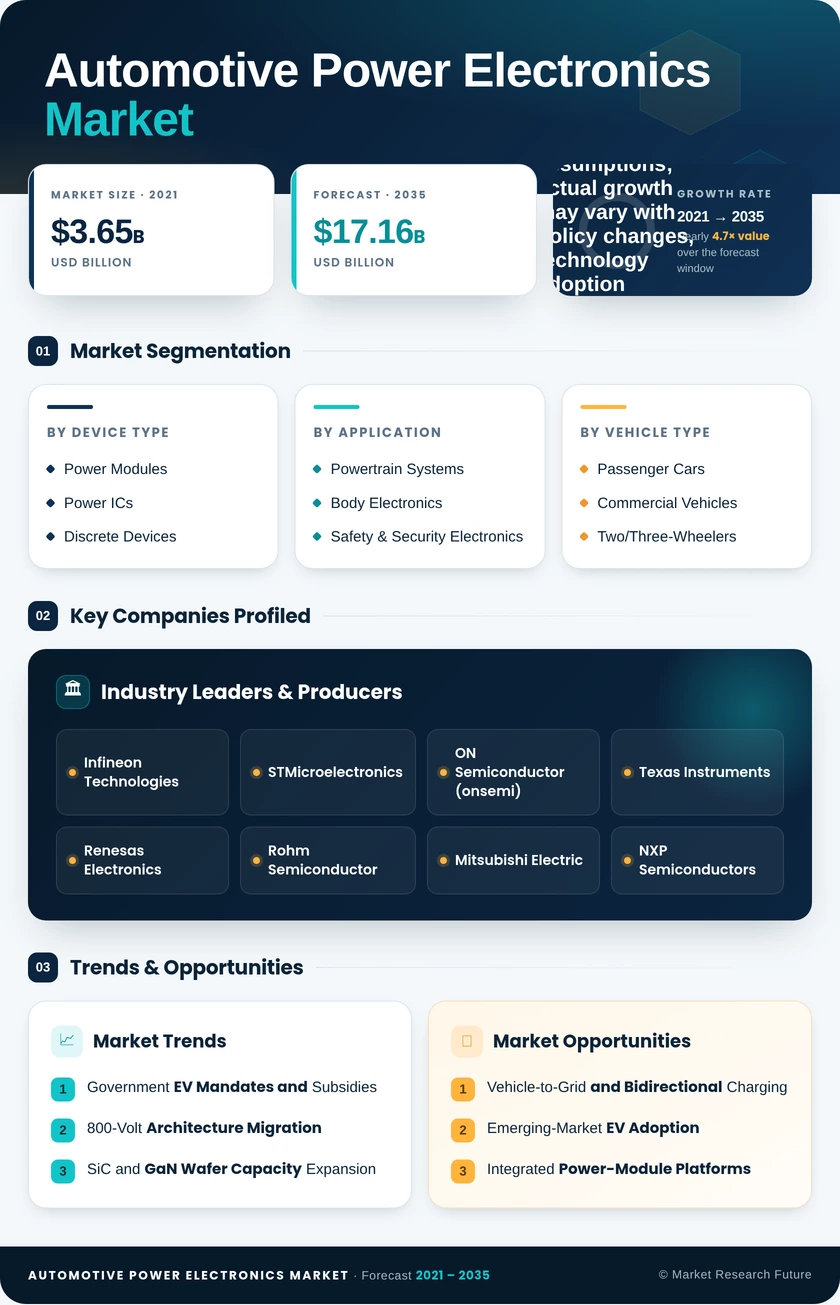
Automotive Power Electronics Market (2026 - 2035)

ID: MRFR/AT/3578-HCR
200 Pages
Triveni Bhoyar
Last Updated: August 05, 2026
Automotive Power Electronics Market Research Report By Device Type (Power Modules, Power ICs, Discrete Devices), By Application (Powertrain Systems, Body Electronics, Safety & Security Electronics), By Vehicle Type (Passenger Cars, Commercial Vehicles, Two/Three-Wheelers), By Drive Type (Battery Electric Vehicles, Plug-in Hybrid EVs, ICE Vehicles), By Component (Power Modules, On-Board Chargers, DC-DC Converters, Others) and By Regional (North America, Europe, South America, Asia Pacific, Middle East and Africa) - Forecast to 2035
Automotive Power Electronics Market
Market Size
Forecast Period2026-2035
CAGR (2026-2035)12.0%
2025 Market SizeUSD 5.53 Billion
2035 Market SizeUSD 17.16 Billion
Key Players
Infineon Technologies
STMicroelectronics
ON Semiconductor
Texas Instruments
Renesas Electronics
Rohm Semiconductor
Opportunities
  • Vehicle-to-Grid and Bidirectional Charging
  • Emerging-Market EV Adoption
  • Integrated Power-Module Platforms
  1. 1 Market Overview |
    1. 1.1 Study Assumptions & Market Definition |
    2. 1.2 Scope of the Study |
    3. 1.3 Research Methodology
  2. 2 Market Summary & Key Takeaways
  3. 3 Market Dynamics |
    1. 3.1 Market Drivers Analysis | |
      1. 3.1.1 Government EV Mandates and Subsidies | |
      2. 3.1.2 800-Volt Architecture Migration | |
      3. 3.1.3 SiC and GaN Wafer Capacity Expansion | |
      4. 3.1.4 Battery-Electric-Vehicle Production Growth | |
      5. 3.1.5 Bidirectional Charging and V2G Services | |
      6. 3.1.6 Autonomous Driving Power Requirements | |
      7. 3.1.7 Thermal Management Innovation |
    2. 3.2 Market Restraints Analysis | |
      1. 3.2.1 SiC Wafer Supply Shortages | |
      2. 3.2.2 High Cost of Wide-Bandgap Devices | |
      3. 3.2.3 EV Demand Softening in Key Markets | |
      4. 3.2.4 Geopolitical Trade Restrictions on Semiconductors | |
      5. 3.2.5 Thermal Reliability Concerns |
    3. 3.3 Market Opportunity Analysis | |
      1. 3.3.1 Vehicle-to-Grid and Bidirectional Charging | |
      2. 3.3.2 Emerging-Market EV Adoption | |
      3. 3.3.3 Integrated Power-Module Platforms | |
      4. 3.3.4 Data-Driven Predictive Maintenance | |
      5. 3.3.5 GaN Adoption in Auxiliary Power Electronics |
    4. 3.4 Industry Value Chain Analysis |
    5. 3.5 Porter's Five Forces Analysis
  4. 4 Global Automotive Power Electronics Market Size & Forecast (2021–2035) |
    1. 4.1 Historical Market Size (2021–2025) |
    2. 4.2 Current & Forecast Market Size (2026–2035) |
    3. 4.3 Market Size by Revenue (USD Billion) |
    4. 4.4 Year-over-Year Growth Analysis
  5. 5 Segmentation Analysis |
    1. 5.1 By Device Type | |
      1. 5.1.1 Power Modules | |
      2. 5.1.2 Power ICs | |
      3. 5.1.3 Discrete Devices |
    2. 5.2 By Application | |
      1. 5.2.1 Powertrain Systems | |
      2. 5.2.2 Body Electronics | |
      3. 5.2.3 Safety & Security Electronics |
    3. 5.3 By Vehicle Type | |
      1. 5.3.1 Passenger Cars | |
      2. 5.3.2 Commercial Vehicles | |
      3. 5.3.3 Two/Three-Wheelers |
    4. 5.4 By Drive Type | |
      1. 5.4.1 Battery Electric Vehicles | |
      2. 5.4.2 Plug-in Hybrid EVs | |
      3. 5.4.3 ICE Vehicles |
    5. 5.5 By Component | |
      1. 5.5.1 Power Modules | |
      2. 5.5.2 On-Board Chargers | |
      3. 5.5.3 DC-DC Converters | |
      4. 5.5.4 Others
  6. 6 Regional Analysis |
    1. 6.1 North America | |
      1. 6.1.1 United States | |
      2. 6.1.2 Canada | |
      3. 6.1.3 Mexico |
    2. 6.2 Europe | |
      1. 6.2.1 Germany | |
      2. 6.2.2 United Kingdom | |
      3. 6.2.3 France | |
      4. 6.2.4 Italy | |
      5. 6.2.5 Spain | |
      6. 6.2.6 Nordic Countries | |
      7. 6.2.7 Russia | |
      8. 6.2.8 Rest of Europe |
    3. 6.3 Asia-Pacific | |
      1. 6.3.1 China | |
      2. 6.3.2 Japan | |
      3. 6.3.3 India | |
      4. 6.3.4 South Korea | |
      5. 6.3.5 ASEAN | |
      6. 6.3.6 Rest of Asia-Pacific |
    4. 6.4 South America | |
      1. 6.4.1 Brazil | |
      2. 6.4.2 Argentina | |
      3. 6.4.3 Rest of South America |
    5. 6.5 Middle East & Africa | |
      1. 6.5.1 Saudi Arabia | |
      2. 6.5.2 UAE | |
      3. 6.5.3 South Africa | |
      4. 6.5.4 Egypt | |
      5. 6.5.5 Rest of MEA
  7. 7 Competitive Landscape |
    1. 7.1 Market Share Analysis (2025) |
    2. 7.2 Competitive Benchmarking Matrix |
    3. 7.3 Company Profiles | |
      1. 7.3.1 Infineon Technologies | |
      2. 7.3.2 STMicroelectronics | |
      3. 7.3.3 ON Semiconductor (onsemi) | |
      4. 7.3.4 Texas Instruments | |
      5. 7.3.5 Renesas Electronics | |
      6. 7.3.6 Rohm Semiconductor | |
      7. 7.3.7 Mitsubishi Electric | |
      8. 7.3.8 NXP Semiconductors | |
      9. 7.3.9 Fuji Electric | |
      10. 7.3.10 BorgWarner
  8. 8 Future Outlook & Strategic Recommendations (2026–2035) |
    1. 8.1 Electrification Supercycle |
    2. 8.2 Autonomous Driving and Compute-Power Demands |
    3. 8.3 Platform Economics and Modular Skateboard Chassis |
    4. 8.4 ESG Reporting and Circular-Economy Requirements
  9. 9 Recent Developments & News
  10. 10 Frequently Asked Questions (FAQs)
  11. 11 Report Scope & Methodology |
    1. 11.1 Study Period & Base Year |
    2. 11.2 Data Sources & Citations |
    3. 11.3 Abbreviations
  12. 12 LIST OF TABLES |
  13. TABLE 1 Global Automotive Power Electronics Market Size & Forecast, by Revenue (USD Billion), 2021–2035 |
  14. TABLE 2 Global Automotive Power Electronics Market — Year-over-Year Growth Analysis, 2021–2035 |
  15. TABLE 3 Driver Impact Analysis — Automotive Power Electronics Market |
  16. TABLE 4 Restraints Impact Analysis — Automotive Power Electronics Market |
  17. TABLE 5 Regional Market Share Summary — Automotive Power Electronics Market, 2025 |
  18. TABLE 6 North America Automotive Power Electronics Market Size, by Country, 2021–2035 (USD Billion) |
  19. TABLE 7 Europe Automotive Power Electronics Market Size, by Country, 2021–2035 (USD Billion) |
  20. TABLE 8 Asia-Pacific Automotive Power Electronics Market Size, by Country, 2021–2035 (USD Billion) |
  21. TABLE 9 South America Automotive Power Electronics Market Size, by Country, 2021–2035 (USD Billion) |
  22. TABLE 10 Middle East & Africa Automotive Power Electronics Market Size, by Country, 2021–2035 (USD Billion) |
  23. TABLE 11 Automotive Power Electronics Market Size, by Device Type, 2021–2035 (USD Billion) |
  24. TABLE 12 Automotive Power Electronics Market Size, by Application, 2021–2035 (USD Billion) |
  25. TABLE 13 Automotive Power Electronics Market Size, by Vehicle Type, 2021–2035 (USD Billion) |
  26. TABLE 14 Automotive Power Electronics Market Size, by Drive Type, 2021–2035 (USD Billion) |
  27. TABLE 15 Automotive Power Electronics Market Size, by Component, 2021–2035 (USD Billion) |
  28. TABLE 16 Competitive Benchmarking Matrix — Automotive Power Electronics Market, 2025 |
  29. TABLE 17 Company Profiles — Key Players, Automotive Power Electronics Market |
  30. TABLE 18 Recent Developments & Strategic Announcements, 2023–2025 |
  31. TABLE 19 Report Scope & Methodology — Automotive Power Electronics Market |
  32. TABLE 20 Detailed Sources and Citations
  33. 13 LIST OF FIGURES |
  34. FIGURE 1 Automotive Power Electronics Market Dynamics — Drivers, Restraints, and Opportunities |
  35. FIGURE 2 Value Chain Analysis — Automotive Power Electronics Market |
  36. FIGURE 3 Porter's Five Forces Analysis — Automotive Power Electronics Market |
  37. FIGURE 4 Automotive Power Electronics Market Size Trend, 2021–2035 (USD Billion) |
  38. FIGURE 5 Automotive Power Electronics Market Share, by Device Type, 2025 |
  39. FIGURE 6 Automotive Power Electronics Market Share, by Application, 2025 |
  40. FIGURE 7 Automotive Power Electronics Market Share, by Vehicle Type, 2025 |
  41. FIGURE 8 Automotive Power Electronics Market Share, by Drive Type, 2025 |
  42. FIGURE 9 Automotive Power Electronics Market Share, by Component, 2025 |
  43. FIGURE 10 Automotive Power Electronics Market Share, by Region, 2025 |
  44. FIGURE 11 North America Automotive Power Electronics Market — Country-Level Breakdown |
  45. FIGURE 12 Europe Automotive Power Electronics Market — Country-Level Breakdown |
  46. FIGURE 13 Asia-Pacific Automotive Power Electronics Market — Country-Level Breakdown |
  47. FIGURE 14 South America Automotive Power Electronics Market — Country-Level Breakdown |
  48. FIGURE 15 Middle East & Africa Automotive Power Electronics Market — Country-Level Breakdown |
  49. FIGURE 16 Competitive Landscape — Automotive Power Electronics Market, 2025

Segmentation Quick Reference

DimensionSub-SegmentsDominant SegmentFastest Growing Segment
Device TypePower Modules, Power ICs, Discrete DevicesPower Modules (50.5% share, 2025)Power ICs
ApplicationPowertrain Systems, Body Electronics, Safety & Security ElectronicsPowertrain Systems (67.1% share, 2025)Body Electronics
Vehicle TypePassenger Cars, Commercial Vehicles, Two/Three-WheelersPassenger Cars (58.1% share, 2025)Commercial Vehicles
Drive TypeBattery Electric Vehicles, Plug-in Hybrid EVs, ICE VehiclesBattery Electric Vehicles (51.7% share, 2025)Plug-in Hybrid EVs
ComponentPower Modules, On-Board Chargers, DC-DC Converters, OthersPower Modules (44.8% share, 2025)On-Board Chargers


Market Segmentation Overview

By Device Type

Sub-SegmentKey Trend
Power ModulesMigration from Si IGBT to SiC MOSFET modules for 800 V traction inverters
Power ICsRising gate-driver and power-management IC content driven by ADAS and zone architectures
Discrete DevicesCost-optimized Si and SiC diodes for auxiliary and two-wheeler applications


Power modules remain the value anchor of the market, accounting for over half of revenue. The ongoing transition to wide-bandgap materials is the defining trend, as SiC modules deliver lower switching losses and enable compact, lightweight inverter designs that improve vehicle range.

By Application

Sub-SegmentKey Trend
Powertrain Systems800 V inverter adoption and integrated charger-converter assemblies
Body ElectronicsElectrification of HVAC compressors, seat motors, and lighting
Safety & Security ElectronicsPower-supply redundancy for ADAS and airbag systems


Powertrain applications absorb the majority of power-semiconductor content per vehicle, and this dominance will intensify as bidirectional charging and multi-motor drivetrains increase component counts.

By Vehicle Type

Sub-SegmentKey Trend
Passenger CarsMass-market BEV platform launches across all price segments
Commercial VehiclesElectric bus mandates and Class 8 electric-truck production ramp
Two/Three-WheelersIndia and ASEAN electrification driving high-volume, low-voltage demand.


Passenger cars set the production-volume floor for the industry, but commercial vehicles are emerging as a high-growth category as cities enforce zero-emission transit fleet requirements.

By Drive Type

Sub-SegmentKey Trend
Battery Electric VehiclesZero-emission mandates driving BEV dominance in new-vehicle mix
Plug-in Hybrid EVsEuropean and Chinese OEMs extending PHEV as a transitional architecture.
ICE Vehicles48 V mild-hybrid and start-stop systems sustaining silicon power-device demand


BEVs lead the drive-type mix, but PHEVs remain a meaningful growth contributor as OEMs use plug-in hybrids to meet fleet-average emission targets while battery costs continue declining.

By Component

Sub-SegmentKey Trend
Power ModulesCore switching element for traction inverters and motor controllers
On-Board ChargersRapid power-rating escalation from 7.4 kW to 22+ kW bidirectional units
DC-DC ConvertersVoltage-level translation between 800 V bus and 12 V / 48 V auxiliary systems
OthersGate drivers, busbars, DC-link capacitors, and thermal-interface materials


On-board chargers represent the fastest-growing component line as charger power ratings scale up and bidirectional capability becomes a market differentiator for premium BEV platforms.




Download PDF ×

We do not share your information with anyone. However, we may send you emails based on your report interest from time to time. You may contact us at any time to opt-out.