SEGMENTATION QUICK REFERENCE
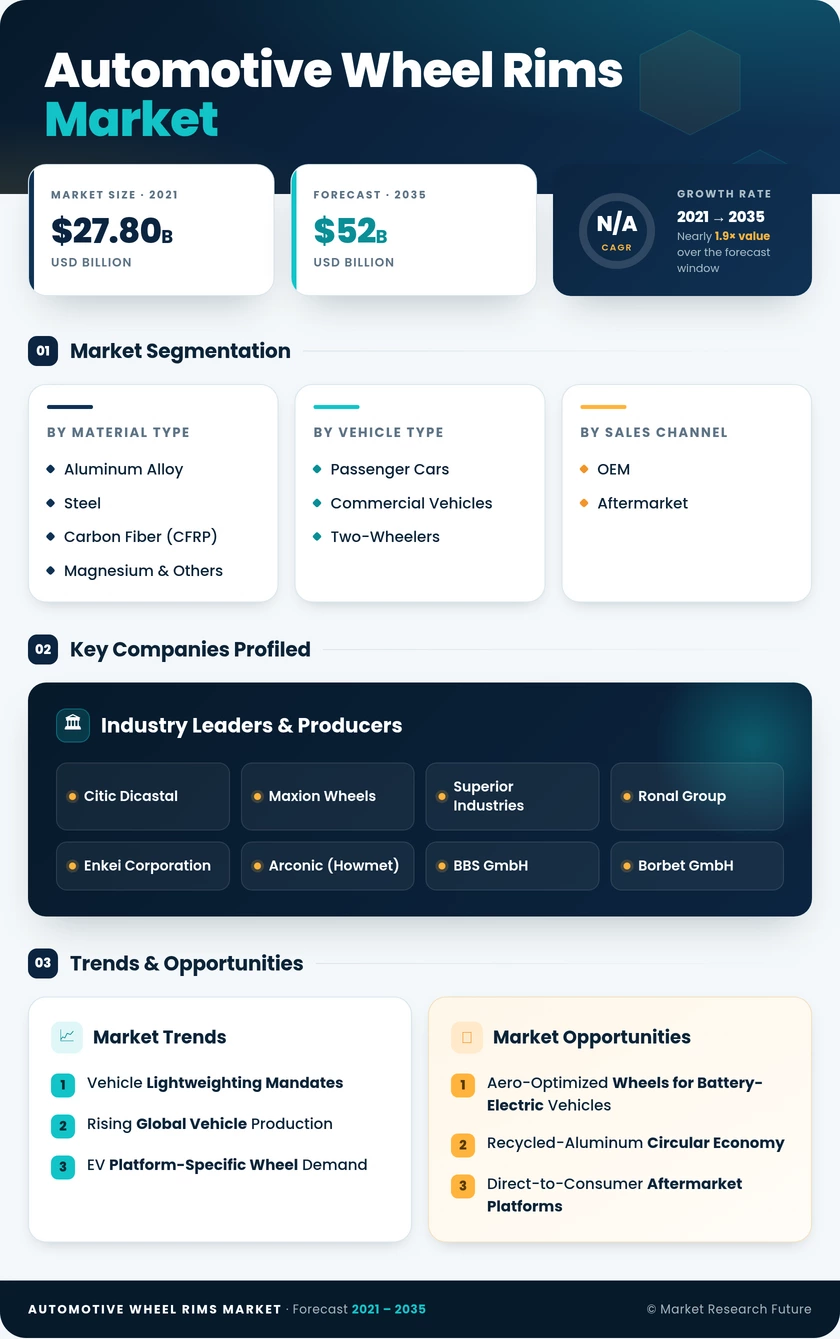
| Dimension | Sub-Segments | Dominant Segment | Fastest Growing Segment |
| By Material Type | Aluminum Alloy, Steel, Carbon Fiber (CFRP), Magnesium & Others | Aluminum Alloy | Carbon Fiber (CFRP) |
| By Vehicle Type | Passenger Cars, Commercial Vehicles, Two-Wheelers | Passenger Cars | Two-Wheelers |
| By Sales Channel | OEM, Aftermarket | OEM | Aftermarket |
| By Rim Size | 13–15 Inch, 16–18 Inch, 19–21 Inch, Above 21 Inch | 16–18 Inch | 19–21 Inch |
MARKET SEGMENTATION OVERVIEW
By Material Type
| Sub-Segment | Key Trend |
| Aluminum Alloy | Dominant material; OEM lightweighting spec and flow-forming adoption driving volume |
| Steel | Declining share but stable absolute revenue in commercial vehicles and economy cars |
| Carbon Fiber (CFRP) | Highest growth; transitioning from motorsport to factory options on luxury EVs |
| Magnesium & Others | Niche ultra-premium; corrosion challenges limit mainstream scalability |
Aluminum alloy continues to be the default specification for passenger-vehicle OEMs globally, driven by a favorable balance of weight savings, design freedom, and unit economics. Carbon fiber represents the frontier material, with cost reductions in aerospace-grade precursor fibers gradually making CFRP wheels accessible beyond the supercar segment.
By Vehicle Type
| Sub-Segment | Key Trend |
| Passenger Cars | Volume anchor; SUV/crossover mix shift inflating per-vehicle rim revenue |
| Commercial Vehicles | Durability-driven; slow material migration from steel to forged aluminum |
| Two-Wheelers | Fast-growing in ASEAN and India; alloy cast wheels replacing wire-spoke designs |
Passenger cars consume the largest share of wheel-rim output, but the SUV and crossover categories within this segment are growing disproportionately, pushing average rim diameters and per-set pricing upward. Two-wheelers represent the highest unit-volume opportunity in Asia-Pacific, where motorcycles are transitioning from stamped-steel to cast-alloy rims for improved braking performance and aesthetics.
By Sales Channel
| Sub-Segment | Key Trend |
| OEM | Multi-tier configurator strategies turning wheels into high-margin accessory lines |
| Aftermarket | E-commerce and AR fitment tools accelerating digital-channel penetration |
OEM channels dominate revenue because every vehicle produced requires a factory-fitted set of rims, and automakers increasingly monetize wheel choice through tiered pricing at the online configurator stage. The aftermarket channel, though smaller, is growing faster as digital-native platforms reduce the complexity of selecting compatible wheel-and-tire packages.
By Rim Size
| Sub-Segment | Key Trend |
| 13–15 Inch | Declining; concentrated in economy sedans and emerging-market entry vehicles |
| 16–18 Inch | Largest segment by volume; standard on B/C-segment cars and compact SUVs |
| 19–21 Inch | Fastest growing; standard on mid- to full-size SUVs and luxury sedans |
| Above 21 Inch | Niche but high ASP; driven by full-size luxury SUVs and pickup trucks |
The 16–18-inch range remains the industry workhorse, but the center of gravity is shifting upward as the global vehicle mix tilts toward larger SUV and crossover platforms. Rims above 19 inches carry significantly higher average selling prices, making them a revenue-growth lever even without proportional unit-volume gains.