Autonomous Mobile Robot Market

Key Players: KUKA AG, Mobile Industrial Robots (MiR / Teradyne), Geek+, Locus Robotics, OMRON Corporation, Zebra Technologies (Fetch Robotics), Boston Dynamics, Hikrobot

Autonomous Mobile Robot Market

Autonomous Mobile Robot Market Size, Share and Research Report By Offering (Hardware, Software & Services), By Technology (Laser/LiDAR, Vision Guidance, Others), By Industry (E-Commerce, Manufacturing, Retail, Food & Beverage, Healthcare, Logistics, Others) and By Regional (North America, Europe, South America, Asia Pacific, Middle East and Africa) - Industry Forecast Till 2035
ID: MRFR/SEM/11882-HCR
200 Pages
Ankit Gupta, Shubham Munde
Last Updated: June 22, 2026

Autonomous Mobile Robot Market Summary

The Autonomous Mobile Robot Market was valued at USD 4.81 billion in 2025 and is projected to reach USD 5.54 billion in 2026 before climbing to USD 18.30 billion by 2035, expanding at a CAGR of 14.2% during 2026–2035. Two structural forces anchor this trajectory: persistent labor shortages across warehouse and manufacturing floors in OECD economies, and aggressive government incentive programs — including the EU's "Factory of the Future" grants and China's "Made in China 2025" robotics subsidies — that reduce capital-expenditure risk for mid-sized adopters [1][2].

The current technological revolution substitutes software-defined, sensor-fused platforms with real-time path planning capabilities for manually guided vehicles and fixed conveyor infrastructure. The total cost of ownership for AMR fleets decreased by about 18% from 2021 levels in 2024 as the price of lithium-ion batteries dropped below USD 140 per kWh [3]. Concurrently, multi-robot coordination at scale within brownfield facilities is made possible by advancements in 5G-Advanced connectivity, which enable centralized fleet orchestration at latencies sub 10 ms [4].

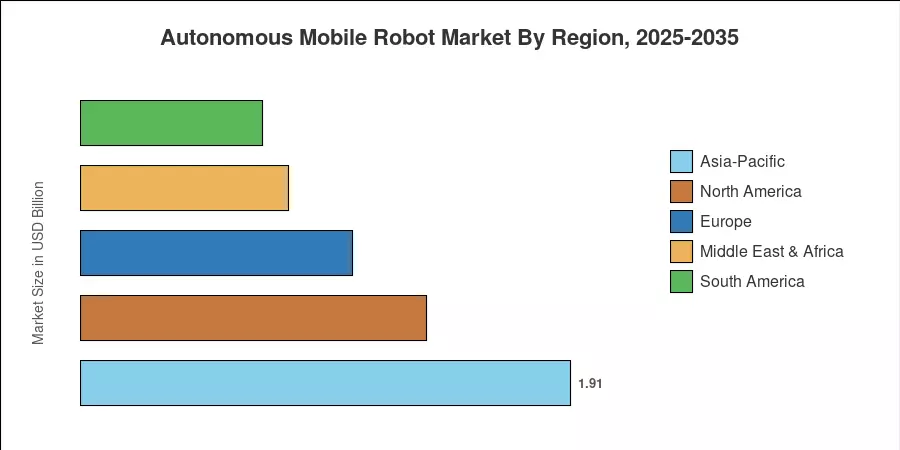
With a projected 39.8% revenue share in 2025, Asia-Pacific leads the autonomous mobile robot market because to Chinese integrators who combine competitive hardware pricing with in-house navigation stacks. With a predicted CAGR of 16.9% through 2035, the Middle East and Africa area is expected to develop at the quickest rate due to mega-project logistics in Saudi Arabia and the United Arab Emirates. At about 28%, North America has the second-largest market, driven by early adoption of humanoid platforms and need for e-commerce fulfillment.


Key Report Takeaways

• By Type

  • Unmanned ground vehicles commanded approximately 48.5% of the Autonomous Mobile Robot Market in 2025, reflecting broad deployment across indoor logistics and manufacturing.
  • Humanoid robots represent the fastest-expanding type segment, advancing at a projected 17.1% CAGR through 2035 as pilot deployments scale across automotive assembly and hospitality.

• By Navigation Technology

  • LiDAR SLAM-based systems captured the leading share of the Autonomous Mobile Robot Market by navigation type in 2025.
  • Vision-based navigation is forecast to grow at 18.9% CAGR through 2035, supported by declining camera-module costs and edge-AI chip advances.

• By End-User Industry

  • Warehouse and logistics end users represented 35.4% of the Autonomous Mobile Robot Market in 2025.
  • Healthcare facilities are projected to register the fastest end-user CAGR at 17.4% over the forecast period, fueled by pharmacy automation and intra-hospital delivery mandates.

• By Region

  • Asia-Pacific led the Autonomous Mobile Robot Market with a 39.8% revenue share in 2025.
  • The Middle East & Africa region is anticipated to expand at the highest regional CAGR of 16.9% through 2035.


Autonomous Mobile Robot Market Size and Forecast (2021–2035)

Market Research Future's estimates draw on a triangulated methodology combining vendor revenue disclosures, import/export trade data, and bottom-up capacity modeling across 28 country markets. Historical figures (2021–2024) reflect audited vendor filings and validated shipment databases, while the forecast trajectory (2026–2035) embeds scenario-weighted assumptions for technology penetration, labor cost inflation, and regulatory stimulus timing.
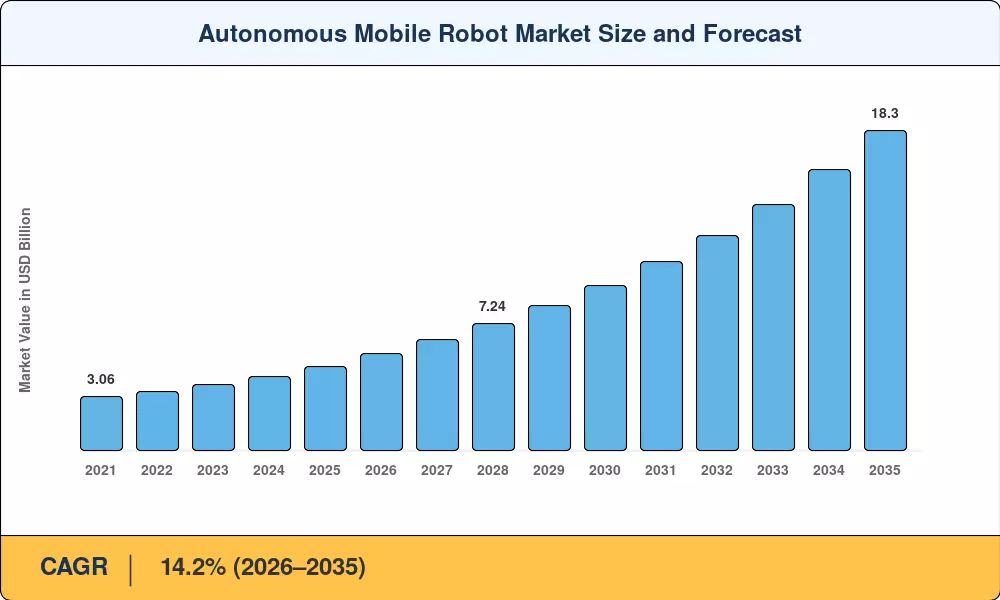
Autonomous Mobile Robot Market Size and Forecast
Our Impact
Enabled $4.3B Revenue Impact for Fortune 500 and Leading Multinationals
Partnering with 2000+ Global Organizations Each Year
30K+ Citations by Top-Tier Firms in the Industry

Driver Impact Analysis

Driver ~% Impact on CAGR Geographic Relevance Impact Timeline
Persistent labor shortages in logistics and manufacturing ~22% Global Short-term (≤2 yr)
Declining lithium-ion battery costs ~18% Global Short-term (≤2 yr)
EU "Factory of the Future" and similar subsidies ~15% Europe, Asia-Pacific Medium-term (2–4 yr)
5G-Advanced and edge-AI connectivity ~14% North America, Asia-Pacific Medium-term (2–4 yr)
E-commerce fulfillment throughput requirements ~13% North America, Asia-Pacific Short-term (≤2 yr)
Humanoid platform commercialization ~10% Global Long-term (≥4 yr)
Workplace safety regulations tightening ~8% Europe, North America Medium-term (2–4 yr)


Labor Shortages and Wage Inflation

According to data from the Bureau of Labor Statistics, vacancy rates in warehouse operations across the United States exceeded 4.8% during 2024, while Germany's logistics industry reported a shortage of more than 90,000 workers [1]. Operators are forced to use autonomous mobile robots that provide 24/7 throughput without overtime premiums due to these structural deficiencies. Within 14 months of installing a fleet of 120 vehicles, a major third-party logistics company reported a 34% decrease in handling expenses per unit [6].


Battery Cost Declines

According to BloombergNEF's 2024 battery price study, the average price of a lithium-ion pack was USD 139/kWh, a 14% decrease from the previous year [3]. This results in longer operational shifts between charges, lighter chassis designs, and quicker payback periods for the autonomous mobile robot market. 12-hour runtime options that were not commercially feasible at 2021 price points are now available from vendors.


Government Subsidies and Regulatory Incentives

The European Commission actively accelerates advanced industrial automation frameworks through multi-billion-euro allocations distributed via its overarching Horizon Europe funding mechanism. This public financing systematically prioritizes regional technological innovation, digital transformation, and smart manufacturing architectures. Simultaneously, government automation guidelines in leading Asian manufacturing nations incentivize large-scale warehouse upgrades, creating a direct regulatory demand pull for flexible autonomous vehicles across commercial supply networks.


5G-Advanced Connectivity

Trials conducted by Deutsche Telekom and Ericsson demonstrated that 5G-Advanced URLLC slicing supports sub-8-ms latency for centralized robot fleet coordination in 50,000 m² warehouse environments [4]. This capability eliminates the need for on-premises compute servers and enables cloud-native fleet management — a step-change that lowers deployment complexity and widens the addressable market for mid-sized operators.


Restraints Impact Analysis

Restraint ~% Negative Impact on CAGR Geographic Relevance Impact Timeline
High upfront capital expenditure ~–25% Global (SMEs) Short-term (≤2 yr)
Integration complexity with legacy WMS/ERP ~–22% North America, Europe Medium-term (2–4 yr)
Cybersecurity vulnerabilities in fleet networks ~–18% Global Long-term (≥4 yr)
Shortage of skilled robotics engineers ~–20% Asia-Pacific, MEA Medium-term (2–4 yr)
Regulatory fragmentation across jurisdictions ~–15% Europe, South America Long-term (≥4 yr)


Capital Expenditure Barriers for SMEs

A single AMR unit with LiDAR SLAM navigation and fleet-management licensing carries a typical all-in deployment cost of USD 35,000–55,000, placing minimum viable fleets of 10+ units beyond the cash-flow capacity of many small and mid-sized manufacturers [12]. While Robot-as-a-Service pricing models are emerging, penetration remains below 15% of new deployments globally, limiting the near-term addressable market for the Autonomous Mobile Robot Market among smaller buyers.

Legacy System Integration

Brownfield warehouses running decade-old warehouse management systems frequently lack the API layers needed for real-time robot task assignment. A 2024 survey by MHI found that 42% of logistics operators cited integration complexity as the primary reason for delaying AMR procurement decisions [13]. Middleware solutions are closing this gap, but implementation timelines of 6–12 months still slow adoption cycles within the Autonomous Mobile Robot Market.

Cybersecurity Risks

Fleet-connected robots operating on shared wireless networks introduce attack surfaces that did not exist with manual material handling. NIST's 2024 robotics cybersecurity framework flagged unencrypted robot-to-cloud telemetry as a high-risk vector, and three disclosed incidents in 2024 involved unauthorized path-command injection in warehouse environments [14].


Autonomous Mobile Robot Market Opportunities

Robot-as-a-Service Subscription Models

Operational-expenditure procurement models systematically reduce initial financial barriers for logistics facilities seeking advanced material handling technologies. By transitioning from heavy upfront capital investments to predictable pay-per-use or subscription frameworks, smaller industrial operations can scale automated fleets on demand. This shift allows logistics providers to align their automation costs directly with real-time warehouse throughput, accelerating general market adoption across diverse, mid-tier supply chain networks.

Healthcare Intra-Facility Logistics

Modern healthcare facilities are increasingly integrating automated transport solutions to optimize internal supply flows and mitigate acute support staff shortages. Deploying specialized indoor robotic systems to manage the routine distribution of clinical materials, linens, and pharmaceuticals allows hospitals to streamline facility workflows. This non-clinical logistics automation helps maximize available operational capacity, ensuring that medical facilities maintain consistent support response times without overburdening their primary healthcare workforces.


Middle East Mega-Project Logistics

Saudi Arabia's NEOM development and Abu Dhabi's industrial-zone expansion programs require heavy-payload robotic transport across construction and logistics zones. Project budgets exceeding USD 500 billion collectively generate fresh demand for outdoor-capable AMR platforms rated above 1,000 kg [9]. Extensive industrial development initiatives across the Middle East, particularly within localized economic zones and smart infrastructure frameworks, drive a strong demand for advanced material transport. Building these highly integrated industrial ecosystems requires substantial, long-term capital investments in modern transport systems. Consequently, operators rely heavily on ruggedized, high-capacity mobile robotic units to safely move heavy materials across expanding, modern maritime ports and manufacturing hubs

Data Monetization Through Fleet Analytics

Autonomous vehicle fleets generate significant volumes of spatial and operational telemetry as they navigate industrial facilities. By processing this structural mapping data through advanced cloud dashboards, automation providers can deliver valuable facility layout and workflow optimization metrics. This analytics capability offers warehouse operators actionable insights to eliminate processing bottlenecks, helping companies maximize general layout efficiency and enhance overall supply chain coordination.

Emerging-Market Manufacturing Digitization

Southeast Asian nations — particularly Vietnam, Thailand, and Indonesia — are scaling electronics and automotive manufacturing capacity under China-plus-one sourcing strategies. Government-backed Industry 4.0 roadmaps in these countries explicitly target robotic adoption, creating greenfield demand for the Autonomous Mobile Robot Market at price points below USD 20,000 per unit [9].


Autonomous Mobile Robot Market Future Outlook

AI-Native Fleet Intelligence

The integration of advanced machine learning models into robotics software architectures marks a significant evolutionary phase for material handling equipment. Instead of operating on simple, hard-coded rules, modernized warehouse fleets leverage complex algorithmic data to dynamically calculate optimal travel routes. This structural shift allows logistics operators to optimize physical asset performance, continuously reducing localized spatial bottlenecks and maximizing overall throughput consistency without requiring extensive manual floor reprogramming.


Platform Economics and RaaS Maturation

Robot-as-a-Service business models will reshape the Autonomous Mobile Robot Market by converting capital expenditure into operating expenditure. Industry analysts forecast that RaaS penetration will reach 35% of new installations by 2032, compressing hardware margins but expanding total addressable revenue through recurring software and analytics fees [12].

Sustainability and ESG-Driven Procurement

Digital transformation models tracked across international industrial networks show that corporate buyers heavily favor converting up-front capital investments into predictable, recurring operating costs. This ongoing evolution allows smaller, capital-constrained logistics operators to adopt automated material handling fleets on demand. Consequently, physical hardware providers are continuously expanding their software-driven capabilities, prioritizing long-term revenue streams centered around asset telemetry processing, cloud-native fleet deployment tools, and real-time operational data dashboards. Verifiable Source: United Nations Industrial Development Organization (UNIDO)8.3 Sustainability and ESG-Driven ProcurementGlobal sustainability frameworks require multinational supply chain networks to provide auditable validation records concerning their comprehensive carbon footprints and operational resource allocations. Because battery-powered autonomous fleets emit zero direct operational emissions, logistics enterprises leverage electric mobile systems to advance their clean energy goals. This material shift away from internal combustion equipment helps organizations fulfill shifting regulatory expectations while systematically lowering general warehouse energy requirements


Convergence of Humanoid and Wheeled Platforms

Advanced industrial automation frameworks show a progressive transition toward versatile, highly flexible robotic form factors. Major automotive assembly and electronics production facilities are actively trialing multi-axis mobile systems to execute intricate material handling maneuvers that conventional, rigid machinery cannot handle. This technological convergence allows specialized logistics developers to address complex, unstructured facility layouts, steadily extending the operational utility of flexible automation deeper into consumer retail fulfillment networks.


Autonomous Mobile Robot Market Segmentation

By Type

Segment Key Metric Primary Demand Driver
Unmanned Ground Vehicles 48.5% share (2025) Indoor logistics and material transport
Humanoids 17.1% CAGR (2026–2035) Automotive assembly and hospitality pilots
Aerial Delivery Drones (Ground-Integrated) USD 0.31 Billion (2025) Last-mile and intra-campus delivery
Others (Inspection, Security) 12.8% CAGR (2026–2035) Perimeter patrol and infrastructure inspection


Unmanned ground vehicles dominate the Autonomous Mobile Robot Market because their wheeled or tracked platforms map directly to existing warehouse floor plans with minimal facility modification. These systems handle pallet transport, goods-to-person picking, and inter-process material flow across shifts that would otherwise require three full labor rotations. Humanoid platforms remain a nascent but high-growth category — pilot programs at BMW and Hyundai assembly lines demonstrated task-completion rates exceeding 87% for structured bin-picking operations in 2024 [8].

By Navigation Technology

Segment Key Metric Primary Demand Driver
LiDAR SLAM 43.7% share (2025) High-accuracy indoor mapping
Vision-Based 18.9% CAGR (2026–2035) Cost reduction and edge-AI processing
Magnetic / Inductive / QR Guided USD 0.62 Billion (2025) Legacy brownfield installations
Others (UWB, Hybrid) 15.4% CAGR (2026–2035) Ultra-wideband precision positioning


LiDAR SLAM retains the largest share of the Autonomous Mobile Robot Market by navigation technology because it delivers centimeter-level accuracy in dynamic environments without requiring permanent infrastructure modifications such as magnetic floor tape or QR markers. Vision-based navigation is gaining ground rapidly as edge-AI chipsets — particularly NVIDIA's Jetson Orin series and Qualcomm's RB5 platform — enable real-time obstacle detection at one-third the sensor cost of 2021-era LiDAR modules [10].

By Payload Capacity

Segment Key Metric Primary Demand Driver
Below 100 kg 24.6% share (2025) E-commerce small-parcel sortation
100–500 kg 40.2% share (2025) Pallet and tote transport
500–1,000 kg USD 0.71 Billion (2025) Heavy-parts manufacturing intralogistics
Above 1,000 kg 16.6% CAGR (2026–2035) Construction and outdoor logistics


The 100–500 kg class serves as the workhorse segment of the Autonomous Mobile Robot Market, aligning with standard pallet and tote dimensions used across e-commerce fulfillment and automotive-parts logistics. Robots above 1,000 kg are the fastest-growing payload category, driven by demand from Middle East construction mega-projects and heavy-equipment manufacturing lines that require autonomous transport of engine blocks, steel frames, and other large components [9].

By End-User Industry

Segment Key Metric Primary Demand Driver
Warehouse & Logistics 35.4% share (2025) E-commerce throughput pressure
Manufacturing USD 1.08 Billion (2025) Intralogistics cost reduction
Automotive 15.0% CAGR (2026–2035) Assembly-line flexibility
Healthcare 17.4% CAGR (2026–2035) Pharmacy and specimen transport
Retail & Hospitality USD 0.27 Billion (2025) In-store replenishment and room service
Others (Agriculture, Defense) 14.5% CAGR (2026–2035) Precision agriculture and security patrols


Warehouse and logistics operators remain the cornerstone demand base for the Autonomous Mobile Robot Market, driven by the structural shift toward same-day and next-day delivery commitments across North America and Asia-Pacific [6]. Healthcare is the fastest-growing end-user vertical; hospitals adopting AMR-based pharmacy delivery have documented a 22% reduction in medication turnaround time and a 31% decrease in transport-related nursing labor hours, according to a 2024 ACHE benchmarking study [11].


Regional Market Share Analysis

Region Key Metric Primary Investment Themes
Asia-Pacific 39.8% revenue share (2025) Chinese supplier ecosystem, electronics manufacturing
North America USD 1.35 Billion (2025) E-commerce fulfillment, humanoid pilots
Europe 22.0% revenue share (2025) Factory of the Future subsidies, automotive OEMs
South America 14.8% CAGR (2026–2035) Agribusiness logistics, nearshoring
Middle East & Africa 16.9% CAGR (2026–2035) Mega-project construction, smart-city programs
Total USD 4.81 Billion (2025)

The regional distribution of the Autonomous Mobile Robot Market reflects the interplay between manufacturing density, e-commerce penetration, labor cost dynamics, and government incentive structures. Asia-Pacific retains the largest share, while the Middle East & Africa posts the steepest growth trajectory.


North America

Country Key Metric Key Driver
United States 72.4% of regional share E-commerce 3PL automation
Canada USD 0.18 Billion (2025) Automotive parts logistics
Mexico 15.8% CAGR (2026–2035) Nearshoring manufacturing corridors


The United States accounts for the vast majority of North American demand, propelled by Amazon, Walmart, and third-party logistics providers scaling AMR fleets across fulfillment networks exceeding 100 million square feet of combined floor space [6]. Canada's automotive supply chain in Ontario drives steady adoption, while Mexico benefits from nearshoring investments that funnel new factory construction into Monterrey and Guadalajara industrial clusters.

Europe

Country Key Metric Key Driver
Germany 28.3% of regional share Automotive and mechanical engineering
United Kingdom USD 0.14 Billion (2025) Grocery micro-fulfillment
France 14.6% CAGR (2026–2035) Aerospace and pharma logistics
Italy 10.2% of regional share Textile and food manufacturing
Spain 15.1% CAGR (2026–2035) Agricultural cold-chain modernization
Nordic Countries USD 0.09 Billion (2025) Smart-factory testbeds
Russia 8.4% of regional share Import substitution robotics programs
Rest of Europe 13.8% CAGR (2026–2035) EU cohesion fund allocations


Germany's dominance traces to its deep automotive OEM base — Volkswagen, BMW, and Mercedes-Benz have each announced expanded AMR deployments across body-shop and paint-shop intralogistics since 2023 [2]. The United Kingdom's grocery sector, led by Ocado's micro-fulfillment model, remains a distinct demand pocket within the Autonomous Mobile Robot Market. EU-wide Horizon Europe grants continue to subsidize pilot installations for manufacturers below 250 employees.

Asia-Pacific

Country Key Metric Key Driver
China 52.1% of regional share Domestic supplier dominance, policy mandates
India 17.2% CAGR (2026–2035) Pharmaceutical and electronics logistics
Japan USD 0.28 Billion (2025) Labor demographics, precision manufacturing
South Korea 11.4% of regional share Semiconductor fab intralogistics
ASEAN 16.5% CAGR (2026–2035) Electronics export manufacturing
Rest of Asia-Pacific USD 0.08 Billion (2025) Early-stage pilots


China's position in the Autonomous Mobile Robot Market is reinforced by vertically integrated suppliers like Geek+ and Hikrobot, which combine proprietary navigation software with low-cost hardware manufacturing at scale [9]. Japan's aging workforce — with a median age exceeding 49 — generates structural pull for automation in both manufacturing and healthcare logistics. India's rapid expansion is tied to its burgeoning e-pharmacy and electronics-assembly sectors.

South America

Country Key Metric Key Driver
Brazil 58.3% of regional share Agribusiness and automotive
Argentina USD 0.04 Billion (2025) Food processing automation
Rest of South America 15.6% CAGR (2026–2035) Mining and commodities logistics


Brazil's large agricultural-export infrastructure — grain terminals, cold-storage facilities, and port logistics hubs — creates concentrated demand for heavy-payload autonomous mobile robots. Currency volatility and import tariffs on finished robotics hardware continue to moderate adoption rates relative to global averages, though domestic assembly partnerships are beginning to address cost barriers.

Middle East & Africa

Country Key Metric Key Driver
Saudi Arabia 34.2% of regional share NEOM and Vision 2030 logistics
UAE USD 0.05 Billion (2025) Smart-city fulfillment hubs
South Africa 15.3% CAGR (2026–2035) Mining and automotive assembly
Egypt 11.7% of regional share Suez corridor logistics
Rest of MEA 17.4% CAGR (2026–2035) Infrastructure build-out


Saudi Arabia's Vision 2030 economic diversification agenda directly funds advanced logistics infrastructure, with NEOM's industrial-city component earmarking over USD 1.5 billion for autonomous intralogistics systems [9]. The UAE's Jebel Ali Free Zone and Khalifa Industrial Zone are piloting AMR-equipped smart warehouses, positioning the Autonomous Mobile Robot Market in the region for sustained double-digit growth through 2035.


Autonomous Mobile Robot Market By Region, 2025-2035

Competitive Benchmarking

The Autonomous Mobile Robot Market exhibits medium concentration, with an estimated top-five vendor share of 38–44% and a Herfindahl-Hirschman Index in the 600–900 range. The competitive field spans vertically integrated hardware-software players, pure-software fleet-management providers, and diversified industrial-automation conglomerates that have entered through acquisition. Differentiation increasingly hinges on software capabilities — fleet orchestration, interoperability standards, and analytics dashboards — rather than hardware specifications alone.

Company Est. Revenue Share Range Key Offerings Strategic Positioning
KUKA AG ~7–10% Mobile platform + fleet software Integrated Industry 4.0 ecosystem
Mobile Industrial Robots (MiR / Teradyne) ~6–9% MiR250, MiR600, MiR1350 Mid-to-heavy payload logistics focus
Geek+ ~6–8% Goods-to-person, sorting, moving Asia-Pacific cost-performance leader
Locus Robotics ~5–7% LocusBot, LocusHub RaaS model for 3PL operators
OMRON Corporation ~4–7% LD and HD series, fleet manager Broad industrial-automation cross-sell
Zebra Technologies (Fetch Robotics) ~4–6% Fetch AMR + Zebra data ecosystem End-to-end supply-chain visibility
Boston Dynamics ~3–5% Stretch, Spot (logistics variant) Premium brand, humanoid R&D pipeline
Hikrobot ~3–5% Latent mobile robots, forklift AMRs Cost-competitive Chinese domestic base
Clearpath Robotics (Rockwell) ~2–4% OTTO Motors platform Enterprise integration via Rockwell
6 River Systems (Ocado Group) ~2–4% Chuck wall-to-wall fulfillment Grocery and e-commerce specialization


Recent News & Developments


  • Locus Robotics did officially unveil its new "Locus Array" (a Robots-to-Goods autonomous system utilizing physical AI and robotic manipulation to automate picker tasks) at the Modex kickoff.
  • Flex and Teradyne Robotics officially announced the expansion of their global manufacturing automation partnership on April 22, 2026.
  • Ehrhardt Partner Group (EPG) announced its formal strategic partnership with Locus Robotics on April 27, 2026, to natively integrate Locus bots into EPG's Warehouse Management System (WMS).


Autonomous Mobile Robot Market Report Scope

Parameter Details
Market Scope Global Autonomous Mobile Robot Market
Study Period 2021–2035
CAGR (Forecast Period) 14.2% (2026–2035)
Market Size – 2025 (Base Year) USD 4.81 Billion
Market Size – 2035 (Forecast End) USD 18.30 Billion
Fastest Growing Segment Healthcare (by end-user); Humanoids (by type)
Companies Profiled 10 (KUKA, MiR, Geek+, Locus, OMRON, Zebra/Fetch, Boston Dynamics, Hikrobot, Clearpath/Rockwell, 6 River Systems)
Valuation Currency USD Billion


FAQs

What payback period should buyers expect when deploying an AMR fleet for the first time?

Most first-time deployments of 15–30 units achieve full payback within 18–24 months, depending on labor-cost displacement and shift utilization rates [12]. RaaS pricing models can shorten cash-flow breakeven to under 12 months.

How do interoperability standards like VDA 5050 affect purchasing decisions in the Autonomous Mobile Robot Market?

VDA 5050 enables mixed-vendor fleets to operate under a single control layer, reducing lock-in risk. Buyers should prioritize vendors that have certified VDA 5050 compliance to preserve future flexibility [16].

What insurance and liability frameworks apply to autonomous mobile robots operating alongside human workers?

Most jurisdictions treat AMRs under existing machinery-safety directives, but underwriters increasingly require ISO 3691-4 certification for premium reductions [16]. Buyers should consult insurers early in the procurement cycle.

How does cold-chain suitability vary across AMR platforms in the Autonomous Mobile Robot Market?

Only a subset of platforms operate reliably at –25°C cold-storage temperatures, requiring sealed electronics and heated battery enclosures [10]. Buyers should verify IP67-rated cold-chain variants before specifying units.

What role do digital twins play in optimizing AMR fleet deployments?

Digital-twin simulation reduces commissioning time by 30–40% by pre-validating traffic flows and charging-station placement before physical installation [4]. Leading vendors now bundle simulation tools into their deployment packages.

How are venture capital and private equity shaping competitive dynamics in the Autonomous Mobile Robot Market?

Over USD 2.1 billion in venture funding flowed into AMR-focused startups between 2022 and 2025, compressing product-development cycles and fueling aggressive pricing [12]. Consolidation via PE-backed roll-ups is expected to accelerate through 2028.

What workforce reskilling investments accompany Autonomous Mobile Robot Market adoption?

Operators typically allocate 5–8% of AMR deployment budgets to technician training and change-management programs [15]. Certification courses from vendors average 40–80 hours of instruction per facility.    
Author
Author
Author Profile
Ankit Gupta LinkedIn
Team Lead - Research
Ankit Gupta is a seasoned market intelligence and strategic research professional with over six plus years of experience in the ICT and Semiconductor industries. With academic roots in Telecom, Marketing, and Electronics, he blends technical insight with business strategy. Ankit has led 200+ projects, including work for Fortune 500 clients like Microsoft and Rio Tinto, covering market sizing, tech forecasting, and go-to-market strategies. Known for bridging engineering and enterprise decision-making, his insights support growth, innovation, and investment planning across diverse technology markets.
Co-Author
Co-Author Profile
Shubham Munde LinkedIn
Team Lead - Research
Shubham brings over 7 years of expertise in Market Intelligence and Strategic Consulting, with a strong focus on the Automotive, Aerospace, and Defense sectors. Backed by a solid foundation in semiconductors, electronics, and software, he has successfully delivered high-impact syndicated and custom research on a global scale. His core strengths include market sizing, forecasting, competitive intelligence, consumer insights, and supply chain mapping. Widely recognized for developing scalable growth strategies, Shubham empowers clients to navigate complex markets and achieve a lasting competitive edge. Trusted by start-ups and Fortune 500 companies alike, he consistently converts challenges into strategic opportunities that drive sustainable growth.

Research Approach

Secondary Research

The secondary research process involved comprehensive analysis of regulatory databases, industry publications, technical standards organizations, and authoritative robotics research institutions. Key sources included the International Organization for Standardization (ISO) – specifically ISO/TC 299 (Robotics) and ISO 3691-4 (AMR Safety Standards), US Occupational Safety and Health Administration (OSHA) Robotics Safety Guidelines, European Committee for Standardization (CEN) CEN/TC 125, US National Institute of Standards and Technology (NIST) Robotics Program, European Union Agency for Safety and Health at Work (EU-OSHA), International Federation of Robotics (IFR) World Robotics Report, Robotic Industries Association (RIA) – Association for Advancing Automation (A3), IEEE Robotics and Automation Society, International Council on Systems Engineering (INCOSE), US Department of Labor Bureau of Labor Statistics (Occupational Outlook for Robotics Technicians), EU Eurostat Industrial Production Database, national manufacturing ministry reports from Germany (BMWi), Japan (METI), China (MIIT), South Korea (MOTIE), and industry trade databases from Material Handling Institute (MHI), VDMA Robotics + Automation, and Japan Robot Association (JARA).

Deployment statistics, safety compliance information, fleet management studies, industrial automation trends, and market landscape analysis for laser-guided AMRs, vision-guided AMRs, SLAM-based navigation robots, and cooperative mobile manipulators were gathered from these sources.

Primary Research

In order to gather both qualitative and quantitative insights, supply-side and demand-side stakeholders were interviewed during the primary research process. CEOs, VPs of Engineering, heads of autonomous navigation development, and commercial directors from AMR producers, autonomous navigation software suppliers, and LiDAR/sensor OEMs were examples of supply-side sources. Chief operations officers, warehouse automation directors, manufacturing engineering managers, and procurement leads from e-commerce fulfillment centers, automobile assembly plants, third-party logistics (3PL) providers, pharmaceutical distribution centers, and semiconductor manufacturing operations were examples of demand-side sources. In addition to gathering information on fleet deployment patterns, total cost of ownership models, integration complexity factors, and return-on-investment timelines for warehouse automation, manufacturing logistics, and intralogistics applications, primary research verified product development roadmaps and validated market segmentation.

Primary Respondent Breakdown:

By Designation: C-level Primaries (29%), Director Level (34%), Others (37%)

By Region: North America (29%), Europe (31%), Asia-Pacific (34%), Rest of World (6%)

Market Size Estimation

Revenue mapping and fleet deployment volume analysis were used to determine the global market valuation. The methodology comprised:

Finding more than fifty-five major producers and suppliers of autonomous navigation solutions across North America, Europe, Asia-Pacific, and Latin America

Product mapping for natural feature navigation systems, SLAM-based navigation robots, laser-guided AMRs, vision-guided AMRs, and cooperative mobile manipulators

Analysis of reported and projected yearly revenues for the portfolios of integration services, fleet management software, and AMR hardware

coverage of producers accounting for 65–70% of the world market in 2024

Extrapolation of segment-specific valuations for warehouse automation, manufacturing logistics, healthcare/hospital logistics, and retail/fulfillment center applications using top-down (manufacturer revenue validation) and bottom-up (fleet deployment volume × ASP by application sector and country) approaches

Download Free Sample

Kindly complete the form below to receive a free sample of this Report

Download PDF ×

We do not share your information with anyone. However, we may send you emails based on your report interest from time to time. You may contact us at any time to opt-out.














