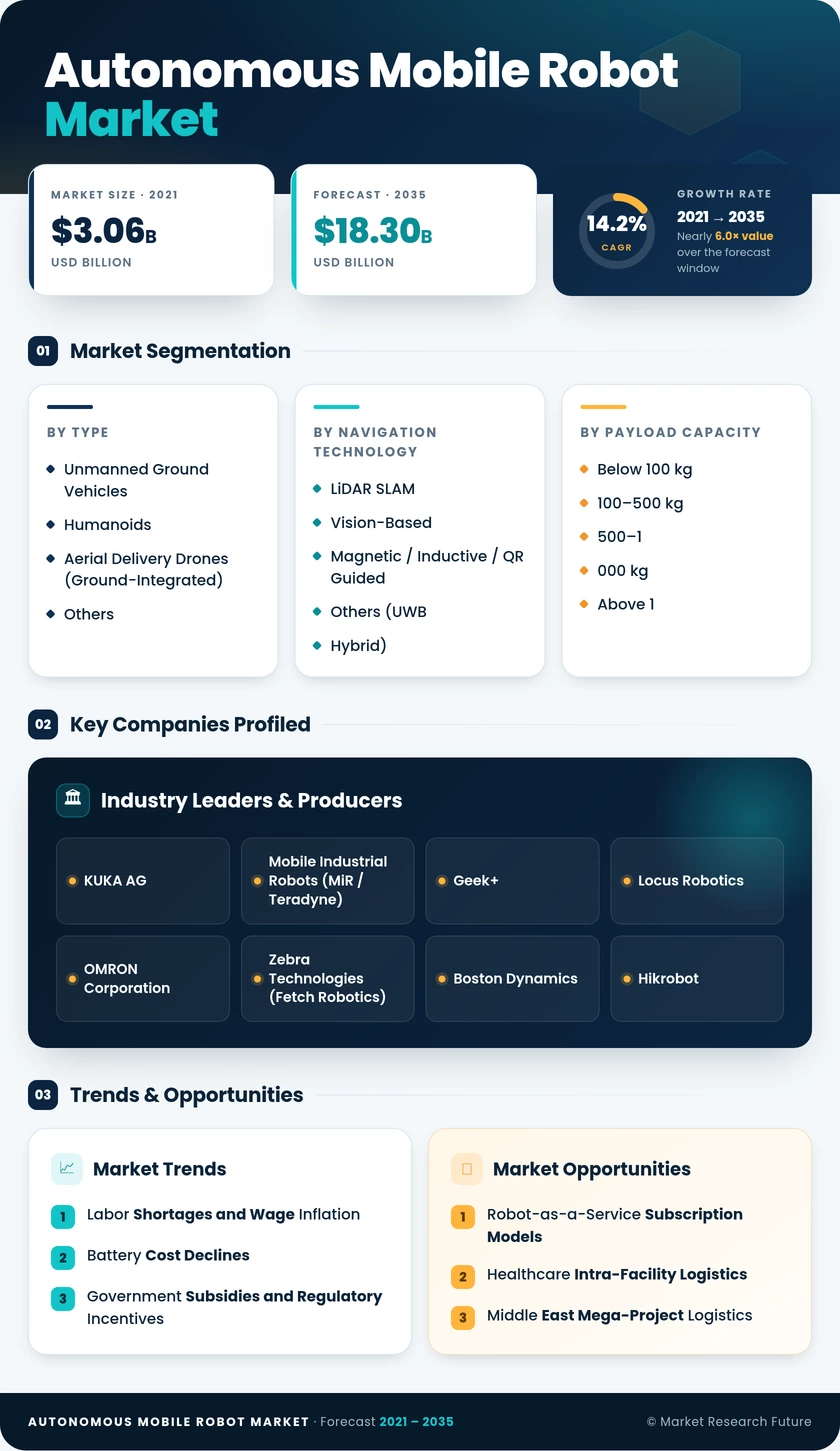
Autonomous Mobile Robot Market

ID: MRFR/SEM/11882-HCR
200 Pages
Ankit Gupta
Last Updated: June 22, 2026
Autonomous Mobile Robot Market Size, Share and Research Report By Offering (Hardware, Software & Services), By Technology (Laser/LiDAR, Vision Guidance, Others), By Industry (E-Commerce, Manufacturing, Retail, Food & Beverage, Healthcare, Logistics, Others) and By Regional (North America, Europe, South America, Asia Pacific, Middle East and Africa) - Industry Forecast Till 2035
Download PDF ×

We do not share your information with anyone. However, we may send you emails based on your report interest from time to time. You may contact us at any time to opt-out.

  1. 1 Market Overview |
    1. 1.1 Study Assumptions & Market Definition |
    2. 1.2 Scope of the Study |
    3. 1.3 Research Methodology
  2. 2 Market Summary & Key Takeaways
  3. 3 Market Dynamics |
    1. 3.1 Market Drivers Analysis | |
      1. 3.1.1 Persistent Labor Shortages in Logistics and Manufacturing | |
      2. 3.1.2 Declining Lithium-Ion Battery Costs | |
      3. 3.1.3 Government Subsidies and Regulatory Incentives | |
      4. 3.1.4 5G-Advanced and Edge-AI Connectivity | |
      5. 3.1.5 E-Commerce Fulfillment Throughput Requirements | |
      6. 3.1.6 Humanoid Platform Commercialization | |
      7. 3.1.7 Workplace Safety Regulations Tightening |
    2. 3.2 Market Restraints Analysis | |
      1. 3.2.1 High Upfront Capital Expenditure | |
      2. 3.2.2 Integration Complexity with Legacy WMS/ERP | |
      3. 3.2.3 Cybersecurity Vulnerabilities in Fleet Networks | |
      4. 3.2.4 Shortage of Skilled Robotics Engineers | |
      5. 3.2.5 Regulatory Fragmentation Across Jurisdictions |
    3. 3.3 Market Opportunity Analysis | |
      1. 3.3.1 Robot-as-a-Service Subscription Models | |
      2. 3.3.2 Healthcare Intra-Facility Logistics | |
      3. 3.3.3 Middle East Mega-Project Logistics | |
      4. 3.3.4 Data Monetization Through Fleet Analytics | |
      5. 3.3.5 Emerging-Market Manufacturing Digitization |
    4. 3.4 Industry Value Chain Analysis |
    5. 3.5 Porter's Five Forces Analysis
  4. 4 Global Autonomous Mobile Robot Market Size & Forecast (2021–2035) |
    1. 4.1 Historical Market Size (2021–2025) |
    2. 4.2 Current & Forecast Market Size (2026–2035) |
    3. 4.3 Market Size by Revenue (USD Billion) |
    4. 4.4 Year-over-Year Growth Analysis
  5. 5 Segmentation Analysis |
    1. 5.1 By Type | |
      1. 5.1.1 Unmanned Ground Vehicles | |
      2. 5.1.2 Humanoids | |
      3. 5.1.3 Aerial Delivery Drones (Ground-Integrated) | |
      4. 5.1.4 Others (Inspection, Security) |
    2. 5.2 By Navigation Technology | |
      1. 5.2.1 LiDAR SLAM | |
      2. 5.2.2 Vision-Based | |
      3. 5.2.3 Magnetic / Inductive / QR Guided | |
      4. 5.2.4 Others (UWB, Hybrid) |
    3. 5.3 By Payload Capacity | |
      1. 5.3.1 Below 100 kg | |
      2. 5.3.2 100–500 kg | |
      3. 5.3.3 500–1,000 kg | |
      4. 5.3.4 Above 1,000 kg |
    4. 5.4 By End-User Industry | |
      1. 5.4.1 Warehouse & Logistics | |
      2. 5.4.2 Manufacturing | |
      3. 5.4.3 Automotive | |
      4. 5.4.4 Healthcare | |
      5. 5.4.5 Retail & Hospitality | |
      6. 5.4.6 Others (Agriculture, Defense)
  6. 6 Regional Analysis |
    1. 6.1 North America | |
      1. 6.1.1 United States | |
      2. 6.1.2 Canada | |
      3. 6.1.3 Mexico |
    2. 6.2 Europe | |
      1. 6.2.1 Germany | |
      2. 6.2.2 United Kingdom | |
      3. 6.2.3 France | |
      4. 6.2.4 Italy | |
      5. 6.2.5 Spain | |
      6. 6.2.6 Nordic Countries | |
      7. 6.2.7 Russia | |
      8. 6.2.8 Rest of Europe |
    3. 6.3 Asia-Pacific | |
      1. 6.3.1 China | |
      2. 6.3.2 India | |
      3. 6.3.3 Japan | |
      4. 6.3.4 South Korea | |
      5. 6.3.5 ASEAN | |
      6. 6.3.6 Rest of Asia-Pacific |
    4. 6.4 South America | |
      1. 6.4.1 Brazil | |
      2. 6.4.2 Argentina | |
      3. 6.4.3 Rest of South America |
    5. 6.5 Middle East & Africa | |
      1. 6.5.1 Saudi Arabia | |
      2. 6.5.2 UAE | |
      3. 6.5.3 South Africa | |
      4. 6.5.4 Egypt | |
      5. 6.5.5 Rest of MEA
  7. 7 Competitive Landscape |
    1. 7.1 Market Share Analysis (2025) |
    2. 7.2 Competitive Benchmarking Matrix |
    3. 7.3 Company Profiles | |
      1. 7.3.1 KUKA AG | |
      2. 7.3.2 Mobile Industrial Robots (MiR / Teradyne) | |
      3. 7.3.3 Geek+ | |
      4. 7.3.4 Locus Robotics | |
      5. 7.3.5 OMRON Corporation | |
      6. 7.3.6 Zebra Technologies (Fetch Robotics) | |
      7. 7.3.7 Boston Dynamics | |
      8. 7.3.8 Hikrobot | |
      9. 7.3.9 Clearpath Robotics (Rockwell) | |
      10. 7.3.10 6 River Systems (Ocado Group)
  8. 8 Future Outlook & Strategic Recommendations (2026–2035) |
    1. 8.1 AI-Native Fleet Intelligence |
    2. 8.2 Platform Economics and RaaS Maturation |
    3. 8.3 Sustainability and ESG-Driven Procurement |
    4. 8.4 Convergence of Humanoid and Wheeled Platforms
  9. 9 Recent Developments & News
  10. 10 Frequently Asked Questions (FAQs)
  11. 11 Report Scope & Methodology |
    1. 11.1 Study Period & Base Year |
    2. 11.2 Data Sources & Citations |
    3. 11.3 Abbreviations
  12. 12 LIST OF TABLES |
  13. TABLE 1 Global Autonomous Mobile Robot Market Size & Forecast, by Revenue (USD Billion), 2021–2035 |
  14. TABLE 2 Global Autonomous Mobile Robot Market – Year-over-Year Growth Analysis, 2021–2035 |
  15. TABLE 3 Global Autonomous Mobile Robot Market – Driver Impact Analysis |
  16. TABLE 4 Global Autonomous Mobile Robot Market – Restraint Impact Analysis |
  17. TABLE 5 Global Autonomous Mobile Robot Market Size, by Type, 2021–2035 (USD Billion) |
  18. TABLE 6 Global Autonomous Mobile Robot Market Size, by Navigation Technology, 2021–2035 (USD Billion) |
  19. TABLE 7 Global Autonomous Mobile Robot Market Size, by Payload Capacity, 2021–2035 (USD Billion) |
  20. TABLE 8 Global Autonomous Mobile Robot Market Size, by End-User Industry, 2021–2035 (USD Billion) |
  21. TABLE 9 Global Autonomous Mobile Robot Market Size, by Region, 2021–2035 (USD Billion) |
  22. TABLE 10 North America Autonomous Mobile Robot Market Size, by Country, 2021–2035 (USD Billion) |
  23. TABLE 11 Europe Autonomous Mobile Robot Market Size, by Country, 2021–2035 (USD Billion) |
  24. TABLE 12 Asia-Pacific Autonomous Mobile Robot Market Size, by Country, 2021–2035 (USD Billion) |
  25. TABLE 13 South America Autonomous Mobile Robot Market Size, by Country, 2021–2035 (USD Billion) |
  26. TABLE 14 Middle East & Africa Autonomous Mobile Robot Market Size, by Country, 2021–2035 (USD Billion) |
  27. TABLE 15 Competitive Benchmarking Matrix – Global Autonomous Mobile Robot Market, 2025 |
  28. TABLE 16 Company Profiles – Key Players, Global Autonomous Mobile Robot Market |
  29. TABLE 17 Recent Developments & Strategic Announcements, 2023–2025 |
  30. TABLE 18 Report Scope & Methodology Summary |
  31. TABLE 19 Detailed Sources and Citations
  32. 13 LIST OF FIGURES |
  33. FIGURE 1 Autonomous Mobile Robot Market Dynamics — Drivers, Restraints, and Opportunities |
  34. FIGURE 2 Industry Value Chain Analysis — Autonomous Mobile Robot Market |
  35. FIGURE 3 Porter's Five Forces Analysis — Autonomous Mobile Robot Market |
  36. FIGURE 4 Global Autonomous Mobile Robot Market Size Trend (USD Billion), 2021–2035 |
  37. FIGURE 5 Autonomous Mobile Robot Market Share, by Type (%), 2025 |
  38. FIGURE 6 Autonomous Mobile Robot Market Share, by Navigation Technology (%), 2025 |
  39. FIGURE 7 Autonomous Mobile Robot Market Share, by Payload Capacity (%), 2025 |
  40. FIGURE 8 Autonomous Mobile Robot Market Share, by End-User Industry (%), 2025 |
  41. FIGURE 9 Autonomous Mobile Robot Market Share, by Region (%), 2025 |
  42. FIGURE 10 North America Autonomous Mobile Robot Market Size (USD Billion), 2021–2035 |
  43. FIGURE 11 Europe Autonomous Mobile Robot Market Size (USD Billion), 2021–2035 |
  44. FIGURE 12 Asia-Pacific Autonomous Mobile Robot Market Size (USD Billion), 2021–2035 |
  45. FIGURE 13 South America Autonomous Mobile Robot Market Size (USD Billion), 2021–2035 |
  46. FIGURE 14 Middle East & Africa Autonomous Mobile Robot Market Size (USD Billion), 2021–2035 |
  47. FIGURE 15 Competitive Landscape — Market Share Analysis, 2025

Segmentation Quick Reference

DimensionSub-SegmentsDominant SegmentFastest Growing Segment
By TypeUnmanned Ground Vehicles; Humanoids; Aerial Delivery Drones (Ground-Integrated); OthersUnmanned Ground VehiclesHumanoids
By Navigation TechnologyLiDAR SLAM; Vision-Based; Magnetic / Inductive / QR Guided; Others (UWB, Hybrid)LiDAR SLAMVision-Based
By Payload CapacityBelow 100 kg; 100–500 kg; 500–1,000 kg; Above 1,000 kg100–500 kgAbove 1,000 kg
By End-User IndustryWarehouse & Logistics; Manufacturing; Automotive; Healthcare; Retail & Hospitality; OthersWarehouse & LogisticsHealthcare


Market Segmentation Overview

By Type

Sub-SegmentKey Trend
Unmanned Ground VehiclesContinued dominance driven by goods-to-person picking and pallet transport standardization
HumanoidsCommercial pilot programs expanding from automotive assembly into hospitality and retail
Aerial Delivery Drones (Ground-Integrated)Integration with ground-based AMR fleets for seamless campus and intra-facility delivery
Others (Inspection, Security)Growing adoption in perimeter surveillance and infrastructure-inspection applications


Unmanned ground vehicles remain the backbone of deployments, while humanoid platforms are transitioning from laboratory demonstrations to revenue-generating commercial pilots, particularly in automotive and logistics environments where dexterous manipulation complements wheeled transport.

By Navigation Technology

Sub-SegmentKey Trend
LiDAR SLAMSensor costs declining 15–20% annually, broadening accessibility for mid-market buyers
Vision-BasedEdge-AI chipsets enabling real-time stereo-vision navigation at lower hardware cost
Magnetic / Inductive / QR GuidedLegacy installed base in brownfield facilities sustaining steady replacement demand
Others (UWB, Hybrid)Ultra-wideband positioning gaining traction in high-precision manufacturing environments


LiDAR SLAM continues to lead on accuracy, but vision-based systems are closing the performance gap as neural-network inference accelerates on next-generation embedded processors.

By Payload Capacity

Sub-SegmentKey Trend
Below 100 kgSmall-parcel sortation and e-commerce micro-fulfillment hubs
100–500 kgStandard pallet and tote transport across warehouse and manufacturing floors
500–1,000 kgHeavy-parts intralogistics in automotive and aerospace production
Above 1,000 kgOutdoor construction logistics and mega-project material handling


The 100–500 kg class aligns with the most common unit-load dimensions in global logistics, while heavy-payload segments above 1,000 kg are expanding rapidly to serve construction and outdoor industrial applications.

By End-User Industry

Sub-SegmentKey Trend
Warehouse & LogisticsSame-day delivery mandates driving fleet-scale AMR deployments across 3PL networks
ManufacturingIntralogistics automation replacing manual tugger-train and forklift operations
AutomotiveFlexible assembly-line material supply and just-in-sequence delivery
HealthcarePharmacy dispensing, specimen transport, and linen-management automation
Retail & HospitalityIn-store inventory scanning and hotel room-service delivery pilots
Others (Agriculture, Defense)Precision agriculture scouting and perimeter-security patrol applications


Warehouse and logistics remains the largest vertical, but healthcare is emerging as the fastest-growing end-user segment as hospitals seek measurable reductions in non-clinical labor time.