×
Request Free Sample ×

Kindly complete the form below to receive a free sample of this Report

* Please use a valid business email

Leading companies partner with us for data-driven Insights

clients tt-cursor
Hero Background

Bidets Market

ID: MRFR/CG/8687-CR
128 Pages
Snehal Singh
March 2023

Bidets Market Research Report Information By Type (Ceramic Bidets, Over the Rim Bidets, Toilet Seat Bidets, Handheld Bidets, Portable Bidets, and Others), By Category (Electronic and Manual), By End Use (Residential and Commercial), and By Region (North America, Europe, Asia-Pacific, and Rest Of The World) – Market Forecast Till 2035

Share:
Download PDF ×

We do not share your information with anyone. However, we may send you emails based on your report interest from time to time. You may contact us at any time to opt-out.

Bidets Market Infographic
Purchase Options

Bidets Market Summary

As per MRFR analysis, the Bidets Market Size was estimated at 33.67 USD Billion in 2024. The Bidets industry is projected to grow from 35.68 USD Billion in 2025 to 63.54 USD Billion by 2035, exhibiting a compound annual growth rate (CAGR) of 5.94 during the forecast period 2025 - 2035.

Key Market Trends & Highlights

The Bidets Market is experiencing a transformative shift towards sustainability and technological integration.

  • North America remains the largest market for bidets, driven by increasing consumer awareness and demand for hygiene solutions.
  • Asia-Pacific is recognized as the fastest-growing region, reflecting a rising trend in health and hygiene consciousness among consumers.
  • Electric bidets dominate the market, while non-electric bidets are emerging as the fastest-growing segment due to their affordability and ease of use.
  • Key market drivers include the rising demand for eco-friendly solutions and government initiatives promoting hygiene standards.

Market Size & Forecast

2024 Market Size 33.67 (USD Billion)
2035 Market Size 63.54 (USD Billion)
CAGR (2025 - 2035) 5.94%

Major Players

TOTO (JP), Kohler (US), American Standard (US), LIXIL Group (JP), Roca (ES), Duravit (DE), Villeroy & Boch (DE), Brondell (US), Bio Bidet (US)
Bidets Market Trends

The Bidets Market is currently experiencing a notable transformation, driven by evolving consumer preferences and increasing awareness regarding hygiene and sustainability. As individuals become more conscious of their environmental impact, the demand for bidets, which utilize less water compared to traditional toilet paper, appears to be on the rise. This shift is further supported by a growing recognition of the health benefits associated with bidet usage, such as improved cleanliness and comfort. Consequently, manufacturers are innovating to meet these changing needs, introducing advanced features and designs that appeal to a broader audience. In addition to hygiene and sustainability, the Bidets Market is witnessing a surge in technological advancements. Smart bidets equipped with features like heated seats, adjustable water pressure, and self-cleaning capabilities are gaining traction among consumers. This trend indicates a shift towards more luxurious and user-friendly bathroom experiences. Furthermore, the increasing availability of bidets in various retail channels, including online platforms, suggests a potential for greater market penetration. As awareness continues to grow, the Bidets Market is poised for further expansion, reflecting a broader acceptance of this bathroom fixture across diverse demographics and regions.

Sustainability Focus

The Bidets Market is increasingly influenced by a growing emphasis on sustainability. Consumers are becoming more aware of their ecological footprint, leading to a preference for products that minimize waste and conserve resources. Bidets, which typically use less water than traditional toilet paper, align well with these values, making them an attractive option for environmentally conscious buyers.

Technological Integration

The integration of technology into bidet designs is a prominent trend within the Bidets Market. Modern bidets now feature advanced functionalities such as heated seats, customizable water pressure, and even remote controls. This technological evolution enhances user experience, appealing to consumers seeking convenience and luxury in their bathroom routines.

Health and Hygiene Awareness

There is a notable increase in health and hygiene awareness among consumers, which is positively impacting the Bidets Market. Bidets are recognized for their ability to provide superior cleanliness compared to traditional methods. This heightened focus on personal hygiene is likely to drive demand, as more individuals seek products that promote better health outcomes.

Bidets Market Drivers

Market Growth Projections

The Global Bidets Industry is poised for substantial growth, with projections indicating a market size of 33.7 USD Billion in 2024 and an anticipated increase to 63.5 USD Billion by 2035. This growth reflects a compound annual growth rate (CAGR) of 5.94% from 2025 to 2035. The increasing adoption of bidets across various regions, driven by factors such as hygiene awareness, sustainability, and technological advancements, is expected to contribute to this upward trend. As consumer preferences continue to evolve, the market is likely to expand, presenting opportunities for manufacturers and retailers alike.

Technological Advancements

Technological innovations in bidet design and functionality are propelling the Global Bidets Industry forward. Modern bidets now feature advanced options such as heated seats, adjustable water pressure, and air drying capabilities, enhancing user comfort and convenience. These advancements cater to a broader audience, including those who may have previously been hesitant to adopt bidets. The integration of smart technology, such as remote controls and app connectivity, further appeals to tech-savvy consumers. As these innovations continue to evolve, they are likely to attract new customers, contributing to the market's projected CAGR of 5.94% from 2025 to 2035.

Rising Awareness of Hygiene

The increasing awareness of personal hygiene and sanitation is a pivotal driver for the Global Bidets Industry. Consumers are becoming more conscious of the health benefits associated with bidet usage, such as reduced risk of urinary tract infections and improved overall cleanliness. This trend is particularly evident in regions where bidets are traditionally used, such as Europe and Asia. As a result, the market is projected to reach 33.7 USD Billion in 2024, reflecting a growing acceptance of bidets as a hygienic alternative to toilet paper. The emphasis on hygiene is likely to continue influencing consumer preferences in the coming years.

Changing Consumer Preferences

Shifts in consumer preferences towards comfort and luxury are influencing the Global Bidets Industry. As more individuals prioritize their bathroom experience, bidets are increasingly viewed as a premium product that enhances personal comfort. This trend is particularly pronounced in North America, where traditional bathroom fixtures are being replaced with more luxurious options. The growing middle class in emerging markets is also contributing to this shift, as consumers seek to invest in higher-quality bathroom products. This evolving mindset is expected to drive the market's growth, with projections indicating a significant increase in demand for bidets in the coming years.

Government Initiatives and Regulations

Government initiatives aimed at promoting sanitation and hygiene are playing a crucial role in the Global Bidets Industry. Various countries are implementing regulations that encourage the adoption of bidets as part of public health strategies. These initiatives often focus on improving sanitation standards in both urban and rural areas, thereby increasing the accessibility of bidets. As governments recognize the health benefits associated with improved hygiene practices, the market is likely to see a boost in demand. This supportive regulatory environment may further facilitate the market's growth trajectory, aligning with the overall trend towards enhanced public health.

Sustainability and Environmental Concerns

Sustainability is increasingly becoming a priority for consumers, driving the Global Bidets Industry. Bidets Market are perceived as an eco-friendly alternative to toilet paper, which contributes to deforestation and waste. The reduction in toilet paper usage aligns with global efforts to promote sustainable living. As consumers seek to minimize their environmental footprint, the demand for bidets is expected to rise. This shift is supported by the market's anticipated growth to 63.5 USD Billion by 2035, indicating a long-term trend towards more sustainable bathroom solutions. The environmental benefits of bidets are likely to resonate with eco-conscious consumers.

Market Segment Insights

By Product Type: Electric Bidets (Largest) vs. Non-Electric Bidets (Fastest-Growing)

The bidets market is segmented into four primary product types: Electric Bidets, Non-Electric Bidets, Bidet Attachments, and Integrated Bidet Toilets. Within this landscape, Electric Bidets hold the largest market share, driven by their advanced features and increasing consumer preference for convenience and hygiene. Conversely, Non-Electric Bidets are witnessing rapid adoption, appealing to cost-conscious consumers and those looking for eco-friendly alternatives. Bidet Attachments and Integrated Bidet Toilets follow in market share but are also gaining traction as they become more widely recognized for their benefits.

Electric Bidets (Dominant) vs. Non-Electric Bidets (Emerging)

Electric Bidets are characterized by their offering of advanced functionalities such as temperature control, adjustable water pressure, and integrated drying features, positioning them as a dominant player in the market. They cater to a niche segment eager for high-tech sanitary solutions, often preferred in modern bathrooms. In contrast, Non-Electric Bidets are emerging as a popular choice due to their affordability and simplicity, appealing to those seeking sustainable and budget-friendly options. Their rise is attributed to the increasing awareness of personal hygiene and water conservation, as many consumers gravitate towards non-electric models that provide essential bidet functions without the complexity of electronic controls.

By End User: Residential (Largest) vs. Commercial (Fastest-Growing)

In the Bidets Market, the distribution among end users shows a significant prominence of the residential segment, capturing the largest market share. As consumers become increasingly aware of hygiene and comfort, residential installations are on the rise. In contrast, the commercial segment, which includes offices and public restrooms, is emerging rapidly due to an increased focus on sanitary amenities in public spaces, thus fueling its growth within the market.

Residential (Dominant) vs. Healthcare (Emerging)

The residential segment of the Bidets Market stands out as the dominant player, driven by growing consumer health consciousness and the desire for enhanced bathroom experiences. Homeowners are increasingly opting for bidets as a solution for better hygiene and comfort compared to traditional toilets. Conversely, the healthcare sector is emerging as a significant segment, propelled by the demand for sanitary solutions in hospitals and clinics. Healthcare facilities prioritize patient hygiene and comfort, leading to increased adoption of bidet systems. As a result, the healthcare segment is gaining traction and is positioning itself as a considerable contender in the market.

By Distribution Channel: Online Retail (Largest) vs. Offline Retail (Fastest-Growing)

In the Bidets Market, the distribution channels exhibit distinct market share dynamics. Online Retail emerges as the dominant channel, appealing to consumers seeking convenience and variety. It leverages e-commerce platforms and digital marketing strategies, facilitating easy accessibility to a diverse range of bidet products. Conversely, Offline Retail, including brick-and-mortar stores, caters to consumers who prefer a hands-on approach to purchasing and is growing rapidly as more stores focus on enhancing the in-store customer experience.

Online Retail (Dominant) vs. Offline Retail (Emerging)

The Online Retail segment stands out as the dominant force in the Bidets Market, characterized by its expansive reach and robust sales strategies. Major e-commerce platforms offer a vast selection of bidets, enabling consumers to compare features, prices, and customer reviews conveniently. In contrast, Offline Retail is becoming increasingly significant as more customers return to physical stores, driven by the opportunity to experience products firsthand. This segment is characterized by personalized service, with retailers providing expert guidance and support to consumers, fostering trust and customer loyalty in the purchasing process.

By Material Type: Plastic (Largest) vs. Ceramic (Fastest-Growing)

The Bidets Market has seen a diverse distribution of market share among various material types, notably with plastic leading as the largest segment. This is attributed to its affordability, ease of maintenance, and wide availability. Plastic bidets appeal to a broad range of consumers, particularly those seeking cost-effective hygiene solutions. Ceramic follows closely, often favored for its traditional aesthetics and durability, while materials like stainless steel and wood occupy smaller niches due to specific consumer preferences and price points. As consumer preferences evolve, growth trends indicate a significant uptick in demand for ceramic bidets, making it the fastest-growing segment. This trend is driven by increasing consumer awareness of hygiene, coupled with the desire for stylish and durable home fixtures. The increasing availability of ceramic options in modern designs further fuels its growth, as it blends well with contemporary bathroom aesthetics, appealing to both traditionalists and modern consumers.

Plastic (Dominant) vs. Wood (Emerging)

Plastic bidets dominate the Bidets Market, primarily due to their extensive market penetration and unbeatable price point. This material offers excellent value for money and is widely favored by mass-market consumers. On the other hand, wood bidets are emerging as a niche yet appealing option, attracting environmentally conscious customers who prefer sustainable materials. Although wood bidets are less prevalent, their unique aesthetic and eco-friendly appeal make them attractive to upscale segments looking for distinctive bathroom features. The craftsmanship involved in wood bidets positions them as luxury items, further differentiating them from the widely produced plastic alternatives.

By Functionality: Heated Seat (Largest) vs. Water Temperature Control (Fastest-Growing)

In the Bidets Market, the functionality segment is dominated by heated seats, which are highly favored by consumers for their comfort and usability. Heated seats are a standard feature in many premium bidets, accounting for a significant portion of market share due to their appeal in enhancing user experience, especially in colder climates. On the other hand, water temperature control is rapidly gaining traction as more consumers are seeking customizable options that cater to individual preferences, positioning it as a growing segment in the market.

Water Pressure Control (Dominant) vs. Self-Cleaning (Emerging)

Water pressure control remains a dominant feature in the Bidets Market, as it significantly influences the overall user experience by allowing users to adjust the water flow to their comfort level. This functionality is often combined with other advanced features, enhancing the allure of bidets for users who value customizable hygiene solutions. Conversely, self-cleaning bidets are emerging due to increased consumer interest in ease of maintenance and sanitation. This feature resonates well in a health-conscious market, appealing to consumers looking for practical and hygienic bathroom solutions, thereby gaining popularity and driving growth in the segment.

Get more detailed insights about Bidets Market

Regional Insights

North America : Market Leader in Bidets

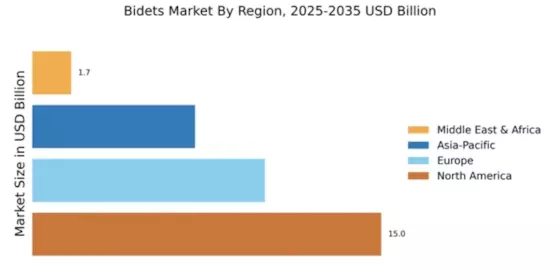
North America is poised to maintain its leadership in the bidet market, holding a significant market share of 15.0 in 2024. The growth is driven by increasing consumer awareness regarding hygiene and comfort, alongside a shift towards eco-friendly bathroom solutions. Regulatory support for water conservation and health standards further catalyzes demand, making bidets a preferred choice among consumers. The competitive landscape is characterized by key players such as Kohler, American Standard, and Brondell, who are innovating to meet consumer preferences. The U.S. leads the market, with Canada also showing growing interest. The presence of established brands and their commitment to quality and technology enhances market dynamics, ensuring a robust growth trajectory for the region.

Europe : Emerging Market for Bidets

Europe is witnessing a burgeoning interest in bidets, with a market size of 10.0 projected for 2025. This growth is fueled by rising health consciousness and a cultural shift towards sustainable bathroom solutions. Regulatory initiatives promoting water-saving technologies and hygiene standards are pivotal in driving demand, making bidets increasingly popular across various demographics. Leading countries such as Germany, France, and Italy are at the forefront of this trend, with brands like Duravit and Villeroy & Boch leading the charge. The competitive landscape is vibrant, with both established and emerging players vying for market share. The increasing availability of innovative designs and features is expected to further enhance consumer adoption in the region.

Asia-Pacific : Rapid Growth in Asia-Pacific

The Asia-Pacific region is experiencing rapid growth in the bidet market, with a market size of 7.0 anticipated by 2025. This surge is driven by urbanization, rising disposable incomes, and a growing awareness of hygiene practices. Countries like Japan and South Korea are leading the charge, with cultural acceptance of bidets contributing to their popularity. Regulatory frameworks supporting health and sanitation are also enhancing market prospects. Japan, home to key players like TOTO and LIXIL Group, showcases advanced technology in bidet designs, setting trends for the region. The competitive landscape is evolving, with local and international brands expanding their presence. As consumer preferences shift towards modern bathroom solutions, the bidet market is expected to flourish in this dynamic region.

Middle East and Africa : Emerging Market Potential

The Middle East and Africa (MEA) region presents significant growth opportunities in the bidet market, with a projected size of 1.67 by 2025. The increasing focus on hygiene and sanitation, coupled with rising urbanization, is driving demand for bidets. Regulatory initiatives aimed at improving public health standards are also contributing to market growth, making bidets an attractive option for consumers. Countries like South Africa and the UAE are emerging as key markets, with a growing number of local and international brands entering the space. The competitive landscape is still developing, but the presence of established players is expected to enhance market dynamics. As awareness of the benefits of bidets increases, the MEA region is likely to see a steady rise in adoption rates.

Key Players and Competitive Insights

The Bidets Market is currently characterized by a dynamic competitive landscape, driven by increasing consumer awareness regarding hygiene and sustainability. Major players such as TOTO (Japan), Kohler (US), and LIXIL Group (Japan) are at the forefront, each adopting distinct strategies to enhance their market presence. TOTO (Japan) emphasizes innovation, particularly in smart bidet technology, which aligns with the growing trend towards digital home solutions. Kohler (US) focuses on expanding its product line to include eco-friendly options, thereby appealing to environmentally conscious consumers. LIXIL Group (Japan) is actively pursuing regional expansion, particularly in emerging markets, which suggests a strategic intent to capture a broader customer base. Collectively, these strategies indicate a competitive environment that is increasingly shaped by technological advancements and consumer preferences.

Key business tactics within the Bidets Market include localizing manufacturing and optimizing supply chains to enhance efficiency and reduce costs. The market structure appears moderately fragmented, with several key players exerting influence while also allowing for smaller entrants to carve out niches. This fragmentation may lead to increased competition, as companies strive to differentiate themselves through unique product offerings and customer engagement strategies.

In November 2025, TOTO (Japan) launched a new line of bidets featuring advanced AI technology that personalizes user experience based on individual preferences. This strategic move not only reinforces TOTO's commitment to innovation but also positions the company as a leader in the smart home segment, potentially attracting tech-savvy consumers looking for enhanced functionality in their bathroom fixtures. The integration of AI into bidet technology could redefine user interaction, setting a new standard in the market.

In October 2025, Kohler (US) announced a partnership with a leading sustainability organization to develop a range of water-efficient bidets. This collaboration underscores Kohler's focus on sustainability and aligns with the increasing consumer demand for eco-friendly products. By leveraging this partnership, Kohler may enhance its brand reputation and appeal to a demographic that prioritizes environmental responsibility, thereby strengthening its competitive position.

In September 2025, LIXIL Group (Japan) acquired a regional manufacturer to bolster its production capabilities in Southeast Asia. This acquisition is indicative of LIXIL's strategy to enhance its supply chain efficiency and respond to the growing demand in emerging markets. By localizing production, LIXIL could potentially reduce lead times and costs, allowing for more competitive pricing and improved market responsiveness.

As of December 2025, the Bidets Market is witnessing trends such as digitalization, sustainability, and the integration of AI technologies. These trends are reshaping competitive dynamics, with strategic alliances becoming increasingly prevalent as companies seek to leverage complementary strengths. The competitive differentiation is likely to evolve from traditional price-based competition towards a focus on innovation, technology, and supply chain reliability. This shift suggests that companies that prioritize these aspects may gain a competitive edge in an increasingly sophisticated market.

Key Companies in the Bidets Market market include

Industry Developments

For Instance, April 2022 In Al Quoz 3, Dubai, the Al Qama Group inaugurated its main RAK Ceramics showroom. The showroom, which is 5000 square feet in size, features sanitary ware and tiles made by RAK Ceramics.


Future Outlook

Bidets Market Future Outlook

The Bidets Market is projected to grow at a 5.94% CAGR from 2024 to 2035, driven by increasing hygiene awareness, technological advancements, and sustainability trends.

New opportunities lie in:

  • Expansion into smart bidet technology for enhanced user experience.
  • Development of eco-friendly bidet models to attract environmentally conscious consumers.
  • Partnerships with home improvement retailers for increased market penetration.

By 2035, the Bidets Market is expected to achieve substantial growth, reflecting evolving consumer preferences and technological innovations.

Market Segmentation

Bidets Market End User Outlook

  • Residential
  • Commercial
  • Healthcare
  • Hospitality

Bidets Market Product Type Outlook

  • Electric Bidets
  • Non-Electric Bidets
  • Bidet Attachments
  • Integrated Bidet Toilets

Bidets Market Functionality Outlook

  • Heated Seat
  • Water Temperature Control
  • Water Pressure Control
  • Self-Cleaning

Bidets Market Material Type Outlook

  • Plastic
  • Ceramic
  • Stainless Steel
  • Wood

Bidets Market Distribution Channel Outlook

  • Online Retail
  • Offline Retail
  • Direct Sales
  • Wholesale

Report Scope

MARKET SIZE 202433.67(USD Billion)
MARKET SIZE 202535.68(USD Billion)
MARKET SIZE 203563.54(USD Billion)
COMPOUND ANNUAL GROWTH RATE (CAGR)5.94% (2024 - 2035)
REPORT COVERAGERevenue Forecast, Competitive Landscape, Growth Factors, and Trends
BASE YEAR2024
Market Forecast Period2025 - 2035
Historical Data2019 - 2024
Market Forecast UnitsUSD Billion
Key Companies ProfiledTOTO (JP), Kohler (US), American Standard (US), LIXIL Group (JP), Roca (ES), Duravit (DE), Villeroy & Boch (DE), Brondell (US), Bio Bidet (US)
Segments CoveredProduct Type, End User, Distribution Channel, Material Type, Functionality
Key Market OpportunitiesGrowing consumer preference for hygiene and sustainability drives innovation in the Bidets Market.
Key Market DynamicsRising consumer awareness of hygiene drives demand for bidets, influencing market growth and competitive dynamics.
Countries CoveredNorth America, Europe, APAC, South America, MEA

Market Highlights

Author
Snehal Singh
Assistant Manager - Research

High acumen in analyzing complex macro & micro markets with more than 6 years of work experience in the field of market research. By implementing her analytical skills in forecasting and estimation into market research reports, she has expertise in Packaging, Construction, and Equipment domains. She handles a team size of 20-25 resources and ensures smooth running of the projects, associated marketing activities, and client servicing.

Leave a Comment

FAQs

How much is the Bidets market?

The Bidets market size was valued at USD 31.79 Billion in 2023.

What is the growth rate of the Bidets market?

The market is projected to grow at a CAGR of 5.9% during the forecast period, 2025-2034.

Which region held the largest market share in the Bidets market?

North America had the largest share in the market

Who are the key players in the Bidets market?

The key players in the market are Lixil Corporation, Duravit AG, Toto Ltd., Kohler Co., Roca Sanitario, S.A., Bidet Toilets Store, Drummond Bathroom Ltd., 2Go Products, LLC, Laufen Bathrooms AG, and Brondell

Which Type led the Bidets market?

The Ceramic Bidets Type dominated the market in 2023.

Which Category had the largest market share in the Bidets market?

The Electronic Category had the largest share in the market.

Download Free Sample

Kindly complete the form below to receive a free sample of this Report

Compare Licence

×
Features License Type
Single User Multiuser License Enterprise User
Price $4,950 $5,950 $7,250
Maximum User Access Limit 1 User Upto 10 Users Unrestricted Access Throughout the Organization
Free Customization
Direct Access to Analyst
Deliverable Format
Platform Access
Discount on Next Purchase 10% 15% 15%
Printable Versions