×
Request Free Sample ×

Kindly complete the form below to receive a free sample of this Report

* Please use a valid business email

Leading companies partner with us for data-driven Insights

clients tt-cursor
Hero Background

Biofuels Market

ID: MRFR/EnP/2157-CR
128 Pages
Anshula Mandaokar
September 2024

Biofuels Market Research Report By Type (Bioethanol, Biodiesel, Biogas, Advanced Biofuels), By Feedstock (Food Crops, Non-Food Crops, Waste Materials, Algae), By Application (Transportation, Power Generation, Heating, Industrial), By End Use (Automotive, Aviation, Marine, Residential) and By Regional (North America, Europe, South America, Asia Pacific, Middle East and Africa) - Forecast to 2035

Share:
Download PDF ×

We do not share your information with anyone. However, we may send you emails based on your report interest from time to time. You may contact us at any time to opt-out.

Bio Fuels Market Infographic
Purchase Options

Bio Fuels Market Summary

As per MRFR analysis, the Bio Fuels Market size was estimated at 68802.15 USD Billion in 2024. The Bio Fuels industry is projected to grow from 73838.63 USD Billion in 2025 to 149658.05 USD Billion by 2035, exhibiting a compound annual growth rate (CAGR) of 7.32 during the forecast period 2025 - 2035.

Key Market Trends & Highlights

The Bio Fuels Market is experiencing robust growth driven by sustainability initiatives and technological advancements.

  • North America remains the largest market for biofuels, primarily driven by increasing consumer demand for green energy.
  • The Asia-Pacific region is emerging as the fastest-growing market, fueled by rising investments in renewable energy infrastructure.
  • The transportation segment continues to dominate the market, while the power generation segment is witnessing rapid growth.
  • Regulatory support for renewable energy and rising oil prices are key drivers propelling the biofuels market forward.

Market Size & Forecast

2024 Market Size 68802.15 (USD Billion)
2035 Market Size 149658.05 (USD Billion)
CAGR (2025 - 2035) 7.32%

Major Players

POET LLC (US), Archer Daniels Midland Company (US), Green Plains Inc. (US), Valero Energy Corporation (US), Renewable Energy Group Inc. (US), Neste Corporation (FI), Bunge Limited (US), Cargill, Incorporated (US), BP p.l.c. (GB), Shell Global (GB)

Bio Fuels Market Trends

The Bio Fuels Market is currently experiencing a transformative phase, driven by a confluence of environmental concerns and technological advancements. As nations strive to reduce greenhouse gas emissions and enhance energy security, biofuels are emerging as a viable alternative to fossil fuels. This shift is not merely a trend but appears to be a fundamental change in how energy is produced and consumed globally. The increasing adoption of renewable energy policies and incentives is likely to further bolster the market, encouraging investments in research and development. Moreover, the integration of biofuels into existing energy infrastructures suggests a growing recognition of their potential to contribute to a sustainable energy future. In addition to regulatory support, consumer awareness regarding the environmental impact of traditional fuels is rising. This heightened consciousness may lead to a greater demand for biofuels, as individuals and businesses alike seek greener options. Furthermore, advancements in production technologies, such as second and third-generation biofuels, indicate a promising trajectory for the market. These innovations could enhance efficiency and reduce costs, making biofuels more competitive with conventional energy sources. Overall, the Bio Fuels Market appears poised for growth, driven by a combination of policy support, consumer demand, and technological progress.

Sustainability Initiatives

The Bio Fuels Market is increasingly influenced by global sustainability initiatives. Governments and organizations are prioritizing renewable energy sources to combat climate change, leading to a surge in biofuel production. This trend reflects a broader commitment to reducing carbon footprints and promoting environmentally friendly practices.

Technological Advancements

Innovations in biofuel production technologies are reshaping the market landscape. Enhanced methods for converting biomass into fuel are emerging, potentially increasing efficiency and lowering costs. These advancements may facilitate the transition to more sustainable energy solutions.

Consumer Demand for Green Energy

There is a noticeable shift in consumer preferences towards greener energy options. As awareness of environmental issues grows, individuals and businesses are more inclined to choose biofuels over traditional fossil fuels. This trend suggests a significant opportunity for market expansion.

Bio Fuels Market Drivers

Market Growth Projections

The Biofuels Market is projected to experience substantial growth over the coming years, with estimates indicating a market size of 144.0 USD Billion in 2024. This growth trajectory is expected to continue, with projections suggesting a rise to 250 USD Billion by 2035. The anticipated compound annual growth rate of 5.14% from 2025 to 2035 reflects the increasing adoption of biofuels across various sectors, including transportation and energy generation. This upward trend underscores the industry's potential to play a significant role in the global transition towards renewable energy sources, driven by both consumer demand and regulatory support.

Diverse Feedstock Availability

The availability of diverse feedstocks is a crucial driver for the Biofuels Market. Various agricultural residues, waste materials, and dedicated energy crops can be utilized to produce biofuels, providing flexibility and resilience to the supply chain. For instance, the use of waste cooking oil and agricultural by-products not only reduces waste but also enhances the sustainability of biofuel production. This diversity in feedstock options is likely to support the industry's growth, as it allows for localized production and reduces dependency on specific crops. Consequently, the market is expected to expand, aligning with the increasing global focus on sustainable energy solutions.

Government Policies and Incentives

Government policies and incentives play a pivotal role in shaping the Biofuels Market. Many nations are implementing tax credits, subsidies, and mandates to encourage the production and consumption of biofuels. For example, the Renewable Fuel Standard in the United States mandates a certain volume of biofuels to be blended into transportation fuels. Such regulatory frameworks not only stimulate market growth but also attract investments in biofuel production facilities. As a result, the industry is anticipated to grow significantly, with projections indicating a market size of 250 USD Billion by 2035, reflecting the positive impact of supportive government measures.

Rising Demand for Renewable Energy

The Biofuels Market experiences a robust increase in demand for renewable energy sources, driven by global initiatives aimed at reducing greenhouse gas emissions. Countries are increasingly adopting policies that promote biofuels as a sustainable alternative to fossil fuels. For instance, the European Union has set ambitious targets for renewable energy usage, which includes biofuels. This shift is projected to contribute to the market's growth, with the industry expected to reach a valuation of 144.0 USD Billion by 2024. The transition towards cleaner energy sources is likely to bolster investments in biofuel technologies, enhancing production capacities and market reach.

Technological Advancements in Biofuel Production

Technological advancements are transforming the Biofuels Industry by enhancing the efficiency and sustainability of biofuel production processes. Innovations such as advanced fermentation techniques and genetic engineering of feedstocks are enabling higher yields and lower production costs. For instance, the development of second-generation biofuels from non-food feedstocks is gaining traction, reducing competition with food supply. These advancements are likely to drive market growth, as they make biofuels more economically viable. The industry is projected to witness a compound annual growth rate of 5.14% from 2025 to 2035, underscoring the potential of technology to reshape the biofuels landscape.

Increasing Awareness of Environmental Sustainability

The Biofuels Market is significantly influenced by the growing awareness of environmental sustainability among consumers and businesses. As climate change concerns escalate, there is a noticeable shift towards eco-friendly fuel alternatives. This trend is evident in the rising consumer preference for biofuels, which are perceived as cleaner options compared to traditional fossil fuels. Companies are also adopting sustainable practices, further driving the demand for biofuels. This heightened awareness is expected to propel the market forward, contributing to its anticipated growth to 250 USD Billion by 2035, as stakeholders increasingly prioritize sustainability in their operations.

Market Segment Insights

By Application: Transportation (Largest) vs. Power Generation (Fastest-Growing)

In the Bio Fuels Market, the application segment is prominently dominated by transportation, which holds the largest market share. This segment encompasses a wide range of biofuel implementations, encompassing road transport, aviation, and maritime, influenced by an increased awareness of sustainability and the need to reduce carbon emissions. Meanwhile, the power generation portion of the biofuels application, while smaller in share, is rapidly gaining traction as countries shift their energy production models towards renewable sources. This shift is further augmented by supportive government policies and technological advancements in bioenergy.

Transportation: Dominant vs. Power Generation: Emerging

The transportation application of biofuels remains a dominant player in the sector, driven by the rapid adoption of biodiesel and ethanol as viable, eco-friendly alternatives to traditional fuels. This segment is characterized by its critical role in meeting emission standards and consumer demand for cleaner energy. Conversely, the power generation sector is emerging as a significant player in the biofuels arena, thanks to innovations in biomass energy conversion technologies. This sector showcases a strong potential for growth, fueled by increasing investments in renewable energy projects, thus aligning with global climate goals and enhancing energy security.

By Feedstock Type: Vegetable Oils (Largest) vs. Waste Oils (Fastest-Growing)

In the Bio Fuels Market, Vegetable Oils hold the largest market share among feedstock types due to their high yield and favorable conversion rates into biodiesel. They are widely adopted for their quality, stability, and availability, consistently dominating the market compared to other feedstocks. In contrast, Waste Oils are positioned as a rapidly growing segment as industries and consumers shift towards sustainable practices and waste recovery, highlighting a move away from conventional sources to more innovative and eco-friendly alternatives. Growth trends in the Bio Fuels Market show a significant increase in the use of Waste Oils, driven by rising environmental regulations and the quest for energy independence. This shift is bolstered by advancements in processing technologies that enhance the efficiency of converting such feedstocks into biofuels. Furthermore, the increasing awareness regarding carbon footprints and waste management has propelled the demand for Waste Oils, establishing them as a key player in the future landscape of bioenergy production.

Vegetable Oils (Dominant) vs. Starch (Emerging)

Vegetable Oils emerge as the dominant choice for biofuel production owing to their higher oil content and better feedstock quality, making them more efficient for conversion processes. Their established supply chain, coupled with widespread agricultural practices, ensures a steady availability that is crucial for biodiesel production. Conversely, Starch-based feedstocks are seen as emerging contenders in the market, characterized by their abundant availability in agriculture, particularly from crops like corn and potatoes. While they may pose some challenges regarding conversion efficiency, they present significant potential for innovation in biofuel production. As technologies evolve, particularly in enzymatic treatments, Starch could play a pivotal role in diversifying the feedstock portfolio in the biofuels landscape.

By Production Technology: Fermentation (Largest) vs. Transesterification (Fastest-Growing)

The production technology segment of the biofuels market showcases a diverse landscape comprising fermentation, transesterification, gasification, and hydrothermal liquefaction. Among these, fermentation holds the largest share, attributed to its extensive application in the production of bioethanol from organic materials such as corn and sugarcane. Meanwhile, transesterification emerges as the fastest-growing technology as it transforms feedstocks like vegetable oils and animal fats into biodiesel, gaining traction due to rising diesel fuel demand and sustainability options.

Production Technology: Fermentation (Dominant) vs. Transesterification (Emerging)

Fermentation technology remains the dominant player within the biofuels market due to its established processes and broad acceptance in bioethanol production. It capitalizes on renewable resources, producing fuels with lower greenhouse gas emissions. On the other hand, transesterification is recognized as an emerging technology being adopted rapidly in various regions due to its efficiency in converting numerous feedstocks to biodiesel. The growing emphasis on sustainable transport fuels and government policies promoting biofuels further amplify transesterification's market momentum, indicating a shift towards cleaner fuel alternatives.

By End Use: Automotive (Largest) vs. Aviation (Fastest-Growing)

In the Bio Fuels Market, the end use distribution is predominantly led by the automotive sector, which constitutes the largest segment. This sector continues to capture a substantial share of biofuels due to the increasing reliance on renewable energy sources for transportation. The aviation industry, meanwhile, is the fastest-growing segment as it fosters advancements in sustainable aviation fuels, which are expected to revolutionize air travel in the coming years. As regulations tighten and environmental concerns mount, both sectors show a promising direction in biofuel adoption. The growth trends across these segments are indicative of a shifting landscape toward sustainable energy solutions. The automotive sector benefits from a growing consumer base that prioritizes eco-friendly transportation options, thereby propelling its expansion. Conversely, the aviation industry is witnessing significant investments aimed at developing biofuel technologies that minimize carbon emissions and enhance fuel efficiency. As the demand for greener solutions escalates, both sectors are likely to play crucial roles in shaping the future of biofuels.

Automotive (Dominant) vs. Aviation (Emerging)

In the Bio Fuels Market, the automotive segment stands out as the dominant player, benefiting from a widespread acceptance of biofuels such as bioethanol and biodiesel. This dominance is partly driven by government incentives and a growing consumer preference for environmentally friendly alternatives to fossil fuels. Automakers are increasingly integrating biofuel-compatible engines in response to regulations aimed at reducing greenhouse gas emissions. On the other hand, the aviation sector represents an emerging area of significant growth within biofuels. Sustainable aviation fuels (SAFs) are gaining traction as airlines look to mitigate their carbon footprints. While aviation remains a smaller segment compared to automotive, the rapid advancements in biofuel technologies and regulatory support position it as a crucial area for future advancements.

By Blend Type: Biodiesel (Largest) vs. Bioethanol (Fastest-Growing)

The Bio Fuels Market exhibits a diverse distribution of share among its blend types, with Biodiesel leading the segment significantly due to its mature supply chains and established applications in the transportation sector. In contrast, Bioethanol, while currently capturing a smaller share, is rapidly gaining traction owing to its versatility in various fuel mixtures and robust government support geared towards renewable energy solutions.

Bioethanol (Dominant) vs. Biogas (Emerging)

Bioethanol stands out as a dominant force in the Bio Fuels Market, known for its broad usage in the automotive industry and compatibility with existing infrastructure. Conversely, Biogas represents an emerging segment, leveraging organic waste materials for energy production and attracting interest for its sustainability benefits. As regulatory policies increasingly favor renewable energy sources, both segments are poised for evolution, with Bioethanol enjoying a historical advantage while Biogas is anticipated to rise due to its environmental credentials and potential for local production.

Get more detailed insights about Bio Fuels Market

Regional Insights

North America : Leading Biofuels Innovator

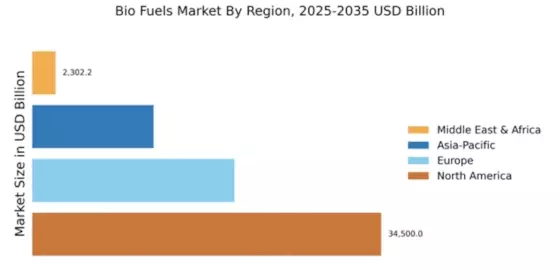
North America continues to lead the biofuels market, holding a significant share of 34500.0 in 2024. The region's growth is driven by increasing demand for renewable energy sources, stringent environmental regulations, and government incentives promoting biofuel production. The push for sustainable energy solutions is further supported by advancements in technology and infrastructure, making biofuels a viable alternative to fossil fuels. The United States is the primary player in this market, with key companies like POET LLC, Archer Daniels Midland Company, and Valero Energy Corporation leading the charge. The competitive landscape is characterized by innovation and investment in biofuel technologies, ensuring a robust supply chain. As the market evolves, these companies are expected to expand their production capabilities, further solidifying North America's position as a biofuels powerhouse.

Europe : Sustainable Energy Transition

Europe is witnessing a significant shift towards biofuels, with a market size of 20000.0 in 2024. This growth is fueled by the European Union's commitment to reducing greenhouse gas emissions and increasing the share of renewable energy in its energy mix. Regulatory frameworks, such as the Renewable Energy Directive, are pivotal in driving biofuel adoption, encouraging investments in sustainable technologies and infrastructure. Leading countries in this region include Germany, France, and the Netherlands, where biofuels are increasingly integrated into transportation and heating sectors. Major players like Neste Corporation and BP p.l.c. are actively involved in expanding their biofuel offerings. The competitive landscape is marked by collaborations and partnerships aimed at enhancing production efficiency and sustainability, positioning Europe as a leader in The Bio Fuels.

Asia-Pacific : Emerging Biofuels Market

The Asia-Pacific region is emerging as a significant player in the biofuels market, with a market size of 12000.0 in 2024. The growth is driven by increasing energy demands, government initiatives promoting renewable energy, and rising awareness of environmental issues. Countries are implementing policies to support biofuel production, aiming to reduce reliance on fossil fuels and enhance energy security. Key players in this region include companies like Green Plains Inc. and Cargill, Incorporated, which are focusing on expanding their operations. Countries such as China and India are leading the charge, with substantial investments in biofuel technologies. The competitive landscape is evolving, with new entrants and innovations contributing to market dynamics, making Asia-Pacific a region to watch in the biofuels sector.

Middle East and Africa : Developing Biofuels Sector

The Middle East and Africa region is in the early stages of developing its biofuels market, with a size of 2302.15 in 2024. The growth potential is significant, driven by increasing energy needs and a shift towards sustainable energy solutions. However, challenges such as limited infrastructure and investment in biofuel technologies hinder rapid growth. Governments are beginning to recognize the importance of biofuels in achieving energy diversification and sustainability goals. Countries like South Africa and Kenya are exploring biofuel production, with initiatives aimed at enhancing local energy security. The competitive landscape is characterized by a mix of established players and new entrants, focusing on innovative solutions to overcome existing barriers. As the market matures, opportunities for growth and investment are expected to increase, positioning the region for future developments in biofuels.

Key Players and Competitive Insights

The Bio Fuels Market is currently characterized by a dynamic competitive landscape, driven by increasing demand for renewable energy sources and stringent regulatory frameworks aimed at reducing carbon emissions. Key players such as POET LLC (US), Archer Daniels Midland Company (US), and Neste Corporation (FI) are strategically positioning themselves through innovation and partnerships. POET LLC (US) focuses on enhancing its production capabilities and expanding its portfolio of biofuels, while Archer Daniels Midland Company (US) emphasizes sustainable agricultural practices to secure its supply chain. Neste Corporation (FI) is leveraging its advanced technology to produce sustainable aviation fuel, thereby shaping the competitive environment through a commitment to sustainability and technological advancement.

In terms of business tactics, companies are increasingly localizing manufacturing and optimizing supply chains to enhance efficiency and reduce costs. The market appears moderately fragmented, with several key players exerting influence over their respective segments. This fragmentation allows for a diverse range of products and innovations, fostering competition that drives advancements in biofuel technologies.

In November 2025, Neste Corporation (FI) announced a strategic partnership with a leading airline to supply sustainable aviation fuel, marking a significant step in its commitment to reducing greenhouse gas emissions in the aviation sector. This collaboration not only enhances Neste's market presence but also aligns with global efforts to decarbonize air travel, potentially setting a precedent for future partnerships in the industry.

In October 2025, Archer Daniels Midland Company (US) unveiled a new biofuel production facility in the Midwest, aimed at increasing its output of renewable diesel. This facility is expected to bolster the company's position in the renewable energy sector, reflecting a broader trend of investment in infrastructure to meet growing demand. The strategic importance of this facility lies in its potential to enhance supply chain reliability and reduce transportation costs, thereby improving overall competitiveness.

In September 2025, POET LLC (US) launched a new initiative focused on carbon capture and storage technology, which aims to significantly reduce emissions from its biofuel production processes. This initiative underscores the company's commitment to sustainability and positions it favorably in a market increasingly driven by environmental considerations. The integration of such technologies may provide POET with a competitive edge as regulatory pressures intensify.

As of December 2025, current competitive trends in the Bio Fuels Market are heavily influenced by digitalization, sustainability, and the integration of AI technologies. Strategic alliances are becoming increasingly vital, as companies seek to enhance their capabilities and market reach. The competitive differentiation is likely to evolve from traditional price-based competition to a focus on innovation, technological advancements, and supply chain reliability, reflecting a broader shift towards sustainable practices in the energy sector.

Key Companies in the Bio Fuels Market market include

Industry Developments

  • Q3 2024: At the start of July, Shell said it would temporarily pause construction work at its 820,000 tonne per year biofuels facility in Rotterdam, saying it would lose $1 billion on the stalled project by doing so. Shell announced in early July 2024 that it would temporarily halt construction at its major Rotterdam biofuels plant, citing projected losses of $1 billion on the project. The facility was intended to produce waste-based jet fuel and biodiesel and would have been among the largest in Europe.
  • Q2 2024: In June, BP said it would scale back expansion for new European sustainable aviation fuel and renewable diesel plants after biofuels dented its otherwise relatively robust profit performance in the second quarter of 2024. BP announced in June 2024 that it would reduce its planned expansion of sustainable aviation fuel and renewable diesel plants in Europe, following weaker profits attributed to the biofuels segment.

Future Outlook

Bio Fuels Market Future Outlook

The Bio Fuels Market is projected to grow at a 7.32% CAGR from 2024 to 2035, driven by increasing energy demands, regulatory support, and technological advancements.

New opportunities lie in:

  • Expansion of biofuel production facilities in emerging markets.
  • Development of advanced biofuels from waste materials.
  • Investment in R&D for next-generation biofuel technologies.

By 2035, the Bio Fuels Market is expected to be robust, driven by innovation and sustainable practices.

Market Segmentation

Bio Fuels Market End Use Outlook

  • Automotive
  • Aviation
  • Marine
  • Heating

Bio Fuels Market Blend Type Outlook

  • Biodiesel
  • Bioethanol
  • Biobutanol
  • Biogas

Bio Fuels Market Application Outlook

  • Transportation
  • Power Generation
  • Industrial
  • Residential

Bio Fuels Market Feedstock Type Outlook

  • Vegetable Oils
  • Animal Fats
  • Waste Oils
  • Starch

Bio Fuels Market Production Technology Outlook

  • Fermentation
  • Transesterification
  • Gasification
  • Hydrothermal Liquefaction

Report Scope

MARKET SIZE 202468802.15(USD Billion)
MARKET SIZE 202573838.63(USD Billion)
MARKET SIZE 2035149658.05(USD Billion)
COMPOUND ANNUAL GROWTH RATE (CAGR)7.32% (2024 - 2035)
REPORT COVERAGERevenue Forecast, Competitive Landscape, Growth Factors, and Trends
BASE YEAR2024
Market Forecast Period2025 - 2035
Historical Data2019 - 2024
Market Forecast UnitsUSD Billion
Key Companies ProfiledPOET LLC (US), Archer Daniels Midland Company (US), Green Plains Inc. (US), Valero Energy Corporation (US), Renewable Energy Group Inc. (US), Neste Corporation (FI), Bunge Limited (US), Cargill, Incorporated (US), BP p.l.c. (GB), Shell Global (GB)
Segments CoveredApplication, Feedstock Type, Production Technology, End Use, Blend Type
Key Market OpportunitiesAdvancements in second-generation biofuels enhance sustainability and meet evolving regulatory standards in the Bio Fuels Market.
Key Market DynamicsRising regulatory support and technological advancements drive innovation and competition in the biofuels sector.
Countries CoveredNorth America, Europe, APAC, South America, MEA

Market Highlights

Author
Anshula Mandaokar
Team Lead - Research

Anshula Mandaokar holds an academic degree in Chemical Engineering and has been contributing to the field for more than 5 years. She has expertise in Market Research and Business Consulting and serves as a Team Lead for a reputed Market Research firm under the Chemicals and Materials domain spectrum. She has worked on multiple projects, generating explicit results in a quick turnaround time. Her understanding of data interpretation justifies her role as a leader.

Leave a Comment

FAQs

What is the expected market size of the Global Biofuels Market in 2024?

The Global Biofuels Market is expected to be valued at 143.97 USD Billion in 2024.

What is the anticipated market value of the Global Biofuels Market by 2035?

The market is projected to reach a value of 250.0 USD Billion by the year 2035.

What is the expected compound annual growth rate (CAGR) for the Global Biofuels Market from 2025 to 2035?

The expected CAGR for the Global Biofuels Market during the forecast period is 5.14%.

Which region is projected to have the largest market share in the Global Biofuels Market by 2035?

North America is projected to have the largest market share, valued at 80.0 USD Billion by 2035.

What will be the market size for bioethanol in 2035?

The market for bioethanol is expected to reach 97.5 USD Billion by the year 2035.

Which key players are leading the Global Biofuels Market?

Major players in the market include BP, Cargill, Neste, and Valero Energy among others.

What is the projected market size for biodiesel in 2024?

The biodiesel market is expected to be valued at 40.0 USD Billion in 2024.

What is the expected market growth rate for the Asia Pacific region from 2025 to 2035?

The Asia Pacific region is projected to grow to a market size of 40.0 USD Billion by 2035.

What will be the value of the biogas market in 2035?

The biogas market is projected to be valued at 50.0 USD Billion by the year 2035.

Which type of biofuels segment is expected to grow the fastest in the coming years?

The advanced biofuels segment is expected to grow, reaching 30.5 USD Billion by 2035.

Download Free Sample

Kindly complete the form below to receive a free sample of this Report

Compare Licence

×
Features License Type
Single User Multiuser License Enterprise User
Price $4,950 $5,950 $7,250
Maximum User Access Limit 1 User Upto 10 Users Unrestricted Access Throughout the Organization
Free Customization
Direct Access to Analyst
Deliverable Format
Platform Access
Discount on Next Purchase 10% 15% 15%
Printable Versions