×
Request Free Sample ×

Kindly complete the form below to receive a free sample of this Report

* Please use a valid business email

Leading companies partner with us for data-driven Insights

clients tt-cursor
Hero Background

Bioabsorbable Stents Market

ID: MRFR/HC/7514-HCR
128 Pages
Rahul Gotadki
October 2025

Bioabsorbable Stents Market Research Report By Stent Material (Polymer-based Stents, Metal-based Stents, Composite Stents), By Application (Coronary Artery Disease, Peripheral Artery Disease, Neurovascular Applications), By Delivery Method (Intravenous Delivery, Endovascular Delivery, Surgical Delivery), By Procedure Type (Elective Procedures, Emergency Procedures) and By Regional (North America, Europe, South America, Asia Pacific, Middle East and Africa) - Forecast to 2035

Share:
Download PDF ×

We do not share your information with anyone. However, we may send you emails based on your report interest from time to time. You may contact us at any time to opt-out.

Bioabsorbable Stents Market Infographic
Purchase Options

Bioabsorbable Stents Market Summary

As per MRFR analysis, the Bioabsorbable Stents Market Size was estimated at 1789.48 USD Million in 2024. The Bioabsorbable Stents industry is projected to grow from 1970.61 in 2025 to 5168.25 by 2035, exhibiting a compound annual growth rate (CAGR) of 10.12 during the forecast period 2025 - 2035.

Key Market Trends & Highlights

The Bioabsorbable Stents Market is poised for substantial growth driven by technological advancements and increasing healthcare demands.

  • North America remains the largest market for bioabsorbable stents, reflecting a robust healthcare infrastructure and high adoption rates.
  • The Asia-Pacific region is emerging as the fastest-growing market, fueled by rising healthcare investments and increasing patient populations.
  • Coronary artery disease represents the largest segment, while peripheral artery disease is witnessing rapid growth due to evolving treatment paradigms.
  • Key market drivers include the increasing prevalence of cardiovascular diseases and technological innovations in stent design, which enhance treatment efficacy.

Market Size & Forecast

2024 Market Size 1789.48 (USD Million)
2035 Market Size 5168.25 (USD Million)
CAGR (2025 - 2035) 10.12%

Major Players

Abbott Laboratories (US), Boston Scientific Corporation (US), Medtronic plc (IE), Biotronik SE & Co. KG (DE), Terumo Corporation (JP), B. Braun Melsungen AG (DE), Cardinal Health, Inc. (US), Essen BioScience, Inc. (US)

Bioabsorbable Stents Market Trends

The Bioabsorbable Stents Market is currently experiencing a transformative phase, characterized by advancements in material science and innovative design approaches. These developments are aimed at enhancing the biocompatibility and functionality of stents, which are crucial for treating various cardiovascular conditions. As healthcare providers increasingly prioritize patient outcomes, the demand for stents that dissolve over time, thereby reducing long-term complications, appears to be on the rise. This shift reflects a broader trend towards personalized medicine, where treatments are tailored to individual patient needs, potentially leading to improved recovery rates and reduced hospital stays. Moreover, the Bioabsorbable Stents Market is likely influenced by regulatory changes and increased investment in research and development. Manufacturers are focusing on creating stents that not only meet safety standards but also offer superior performance compared to traditional metallic options. The integration of advanced imaging technologies and minimally invasive techniques may further drive market growth, as these innovations facilitate better procedural outcomes. Overall, the Bioabsorbable Stents Market seems poised for continued expansion, driven by technological advancements and a growing emphasis on patient-centric care.

Technological Advancements

Recent innovations in material science are leading to the development of bioabsorbable stents that offer enhanced biocompatibility and functionality. These advancements are crucial for improving patient outcomes and reducing complications associated with traditional stents.

Regulatory Changes

The evolving regulatory landscape is influencing the Bioabsorbable Stents Market, as manufacturers adapt to new safety and efficacy standards. This shift encourages the development of stents that not only comply with regulations but also provide superior performance.

Investment in Research and Development

Increased investment in research and development is driving the Bioabsorbable Stents Market forward. Companies are focusing on creating innovative solutions that cater to the specific needs of patients, thereby enhancing treatment efficacy and recovery.

Bioabsorbable Stents Market Drivers

Increasing Regulatory Approvals

The rise in regulatory approvals for bioabsorbable stents contributes positively to the Global Bioabsorbable Stents Market Industry. Regulatory bodies are increasingly recognizing the benefits of these devices, leading to a streamlined approval process. For example, several bioabsorbable stents have received clearance from major health authorities, facilitating their entry into the market. This trend not only boosts consumer confidence but also encourages manufacturers to invest in research and development. As a result, the market is anticipated to expand significantly, with projections indicating a growth to 5.16 USD Billion by 2035, reflecting the increasing acceptance of bioabsorbable technologies.

Technological Advancements in Stent Design

Innovations in stent technology significantly influence the Global Bioabsorbable Stents Market Industry. Recent advancements in materials and design have enhanced the performance and safety profiles of bioabsorbable stents. For instance, the development of polymers that degrade at controlled rates allows for improved healing and reduced risk of restenosis. As healthcare providers increasingly adopt these advanced devices, the market is expected to grow at a compound annual growth rate of 10.11% from 2025 to 2035. This growth trajectory underscores the importance of continuous research and development in creating more effective and safer stenting solutions.

Rising Prevalence of Cardiovascular Diseases

The increasing incidence of cardiovascular diseases globally drives the Global Bioabsorbable Stents Market Industry. As per health statistics, cardiovascular diseases remain a leading cause of mortality, prompting a surge in demand for innovative treatment options. Bioabsorbable stents, which offer temporary support to blood vessels, are gaining traction due to their potential to reduce long-term complications associated with traditional metallic stents. The market is projected to reach 1.79 USD Billion in 2024, reflecting the urgent need for effective cardiovascular interventions. This trend indicates a growing recognition of bioabsorbable technology as a viable alternative in the management of cardiovascular conditions.

Expanding Applications Beyond Cardiovascular Treatments

The Global Bioabsorbable Stents Market Industry is witnessing an expansion of applications beyond traditional cardiovascular treatments. Emerging research indicates the potential use of bioabsorbable stents in various medical fields, including gastroenterology and urology. This diversification opens new avenues for market growth, as healthcare providers explore innovative solutions for different medical conditions. The ability of bioabsorbable stents to provide temporary support while minimizing long-term risks positions them as a versatile option in various therapeutic areas. As the market evolves, this expansion could lead to increased investments and further advancements in bioabsorbable technology.

Growing Awareness and Acceptance Among Healthcare Professionals

The rising awareness and acceptance of bioabsorbable stents among healthcare professionals play a crucial role in shaping the Global Bioabsorbable Stents Market Industry. Educational initiatives and clinical studies highlighting the advantages of bioabsorbable stents, such as reduced long-term complications, are fostering a shift in clinical practice. As more healthcare providers recognize the benefits of these devices, the adoption rate is likely to increase, further propelling market growth. This shift is expected to contribute to the overall market expansion, as healthcare professionals advocate for innovative solutions in cardiovascular care.
Market Segment Insights

By Application: Coronary Artery Disease (Largest) vs. Peripheral Artery Disease (Fastest-Growing)

In the Bioabsorbable Stents Market, Coronary Artery Disease (CAD) has emerged as the largest application segment. This dominance can be attributed to the high prevalence of CAD globally, coupled with an increasing number of interventional procedures. Peripheral Artery Disease (PAD), on the other hand, is gaining traction with a significant rise in demand due to growing awareness and advancements in treatment options. The segmentation showcases the shifting priorities towards effective treatments in vascular diseases.

Coronary Artery Disease (Dominant) vs. Peripheral Artery Disease (Emerging)

Coronary Artery Disease remains the dominant application within the Bioabsorbable Stents Market, largely due to its widespread incidence and the established protocols for treatment utilizing bioabsorbable stents. These stents offer the benefits of reduced long-term complications as they are gradually absorbed by the body. Conversely, Peripheral Artery Disease is emerging as a vital segment, with increasing focus on minimally invasive techniques and improvements in stent technology. The demand for innovative solutions to treat PAD is fueled by an aging population and a rising prevalence of lifestyle-related diseases, making it a key area for future growth.

By Material Type: Polylactic Acid (Largest) vs. Polyglycolic Acid (Fastest-Growing)

In the Bioabsorbable Stents Market, the material type segment exhibits a diverse range of options, with Polylactic Acid (PLA) holding the largest share. This is attributed to its favorable biocompatibility, mechanical strength, and established usage in medical applications. Following closely, Polyglycolic Acid (PGA) is witnessing significant traction, particularly for its fast biodegradation properties, making it an attractive option for temporary stenting solutions. Composite materials, while less dominant, are gaining momentum due to their enhanced characteristics, combining properties of different materials to optimize performance. Growth trends within this segment are largely driven by an increasing preference for minimally invasive procedures and advancements in material science. The innovation in bioabsorbable materials is fostering a shift towards shorter recovery times and improved patient outcomes. Regulatory support and substantial investment in research are paving the way for PGA's rapid growth, enabling its application in various clinical settings. Additionally, the ongoing development of novel composite materials is providing new alternatives, thus enhancing the market dynamics of bioabsorbable stents.

Material Type: Polylactic Acid (Dominant) vs. Composite Materials (Emerging)

Polylactic Acid (PLA) remains the dominant material in the Bioabsorbable Stents Market, primarily due to its reliability and compatibility with human tissues. Its properties allow for gradual absorption by the body, significantly reducing the risk of long-term complications. PLA stents are recognized for their effectiveness in maintaining vessel patency while eliminating the need for surgical removal after the healing process. In contrast, composite materials are emerging as a new contender in the market, combining the advantages of multiple materials. These composites often feature enhanced mechanical properties, tailored degradation rates, and improved functionality, catering to specific clinical needs. As research continues to explore the possibilities of composites, their market position is expected to strengthen over the coming years, offering innovative alternatives to traditional stenting solutions.

By End User: Hospitals (Largest) vs. Ambulatory Surgical Centers (Fastest-Growing)

The Bioabsorbable Stents Market is largely dominated by the hospital segment, which accounts for the majority of the market share. Hospitals are equipped with advanced facilities and skilled medical professionals, making them the preferred choice for many patients requiring stent implantations. On the other hand, ambulatory surgical centers are witnessing a significant rise in adoption rates, reflecting their increasing role in outpatient procedures and minimally invasive surgeries that require bioabsorbable stents.

End Users: Hospitals (Dominant) vs. Ambulatory Surgical Centers (Emerging)

In the Bioabsorbable Stents Market, hospitals play a dominant role due to their extensive resources, comprehensive patient care, and the ability to handle complex cases. They benefit from established protocols, a reputation for quality care, and partnerships with leading medical device manufacturers, placing them at the forefront of bioabsorbable stent usage. Conversely, ambulatory surgical centers are emerging as a vital segment, appealing to patients who prefer outpatient services. Their focus on cost-effective and efficient procedures enhances patient satisfaction and contributes to the growth of bioabsorbable stent applications within this segment, making them a significant contributor to market trends.

By Delivery Method: Percutaneous Coronary Intervention (Largest) vs. Transcatheter Aortic Valve Replacement (Fastest-Growing)

In the Bioabsorbable Stents Market, the delivery method segment reveals a distinctive distribution of market share among its values. Percutaneous Coronary Intervention (PCI) holds the largest share, recognized for its widespread application in coronary artery diseases. In contrast, Transcatheter Aortic Valve Replacement (TAVR) is rapidly gaining traction, reflecting significant advancements in minimally invasive techniques. Endovascular Aneurysm Repair, while crucial, maintains a smaller niche in comparison to these two leading methods.

Delivery Method: PCI (Dominant) vs. TAVR (Emerging)

Percutaneous Coronary Intervention (PCI) is a time-tested method, dominating the bioabsorbable stents market due to its efficacy in treating coronary artery disease through minimally invasive procedures. Its wide adoption is driven by the increasing incidence of cardiovascular diseases and the demand for innovative treatment options. Transcatheter Aortic Valve Replacement (TAVR), on the other hand, represents an emerging method showing exceptional growth potential. TAVR's promise lies in its ability to treat aortic stenosis with minimal surgical intervention, appealing to an aging population and fostering its rapid market acceptance.

Get more detailed insights about Bioabsorbable Stents Market

Regional Insights

North America : Market Leader in Innovation

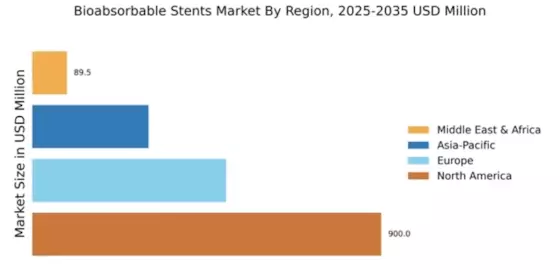
North America is poised to maintain its leadership in the bioabsorbable stents market, holding a significant share of 900.0 million in 2024. The region's growth is driven by increasing cardiovascular diseases, advancements in medical technology, and supportive regulatory frameworks. The FDA's focus on innovative medical devices further propels market demand, ensuring a robust pipeline of new products and therapies. The competitive landscape in North America is characterized by the presence of major players such as Abbott Laboratories, Boston Scientific, and Medtronic. These companies are investing heavily in R&D to enhance product offerings and improve patient outcomes. The U.S. remains the largest market, supported by a well-established healthcare infrastructure and high healthcare expenditure, which fosters innovation and adoption of advanced medical technologies.

Europe : Emerging Market with Growth Potential

Europe's bioabsorbable stents market is projected to reach 600.0 million by 2024, driven by an aging population and rising prevalence of cardiovascular diseases. Regulatory bodies like the European Medicines Agency (EMA) are actively promoting the development of innovative medical devices, which enhances market growth. The region's focus on improving healthcare access and quality further supports the demand for advanced stenting solutions. Leading countries in Europe include Germany, France, and the UK, where key players like Biotronik and B. Braun Melsungen are making significant strides. The competitive landscape is marked by collaborations and partnerships aimed at enhancing product portfolios. The presence of a robust healthcare system and increasing investment in medical technology are pivotal in shaping the market dynamics in Europe.

Asia-Pacific : Rapidly Growing Market Segment

The Asia-Pacific bioabsorbable stents market is expected to grow significantly, reaching 250.0 million by 2024. Factors such as increasing healthcare expenditure, rising awareness of cardiovascular diseases, and improvements in healthcare infrastructure are driving this growth. Governments in the region are implementing policies to enhance healthcare access, which is crucial for the adoption of advanced medical technologies like bioabsorbable stents. Countries like Japan, China, and India are leading the market, with key players such as Terumo Corporation and Cardinal Health expanding their presence. The competitive landscape is evolving, with local manufacturers emerging alongside established global players. This dynamic environment fosters innovation and enhances the availability of advanced stenting solutions across the region.

Middle East and Africa : Untapped Market with Opportunities

The Middle East and Africa bioabsorbable stents market is relatively small, valued at 39.48 million in 2024, but it presents significant growth opportunities. The region is witnessing an increase in cardiovascular diseases, prompting governments to invest in healthcare infrastructure and medical technologies. Regulatory bodies are beginning to recognize the importance of innovative solutions, which is expected to drive market growth in the coming years. Countries like South Africa and the UAE are at the forefront of this emerging market, with a growing number of healthcare facilities adopting advanced medical technologies. The presence of key players is limited, but there is potential for new entrants to capture market share. As healthcare access improves, the demand for bioabsorbable stents is likely to rise, making this region an attractive market for investment.

Key Players and Competitive Insights

The Bioabsorbable Stents Market is currently characterized by a dynamic competitive landscape, driven by innovation, strategic partnerships, and a focus on enhancing patient outcomes. Key players such as Abbott Laboratories (US), Boston Scientific Corporation (US), and Medtronic plc (IE) are at the forefront, each employing distinct strategies to solidify their market positions. Abbott Laboratories (US) emphasizes innovation in its product offerings, particularly in developing advanced bioabsorbable materials that enhance stent performance. Meanwhile, Boston Scientific Corporation (US) focuses on strategic partnerships to expand its technological capabilities and market reach, while Medtronic plc (IE) is heavily investing in digital transformation initiatives to streamline operations and improve patient engagement. Collectively, these strategies contribute to a competitive environment that is increasingly focused on technological advancement and patient-centric solutions.

In terms of business tactics, companies are localizing manufacturing to reduce costs and improve supply chain efficiency. This approach is particularly relevant in a moderately fragmented market where smaller players also seek to carve out niches. The competitive structure is influenced by the collective actions of these key players, who are not only competing on product quality but also on operational efficiency and customer service.

In November 2025, Abbott Laboratories (US) announced the launch of a new bioabsorbable stent designed to reduce the risk of restenosis, a significant concern in cardiovascular interventions. This strategic move is likely to enhance Abbott's competitive edge by addressing a critical clinical need, thereby potentially increasing market share and reinforcing its reputation for innovation.

In October 2025, Boston Scientific Corporation (US) entered into a partnership with a leading technology firm to integrate AI-driven analytics into its stent development process. This collaboration aims to leverage data insights for improving stent design and patient outcomes, indicating a shift towards data-driven decision-making in product development. Such initiatives may position Boston Scientific as a leader in the integration of technology within the bioabsorbable stents sector.

In September 2025, Medtronic plc (IE) expanded its manufacturing capabilities in Europe, focusing on sustainable practices and reducing environmental impact. This expansion not only enhances production capacity but also aligns with growing regulatory pressures for sustainability in medical device manufacturing. Medtronic's commitment to sustainability may resonate well with environmentally conscious consumers and healthcare providers, potentially influencing purchasing decisions.

As of December 2025, the Bioabsorbable Stents Market is witnessing trends such as digitalization, sustainability, and the integration of AI technologies. Strategic alliances are increasingly shaping the competitive landscape, allowing companies to pool resources and expertise. Looking ahead, competitive differentiation is likely to evolve from traditional price-based competition to a focus on innovation, technological advancements, and supply chain reliability. This shift underscores the importance of not only meeting clinical needs but also addressing broader market demands for sustainability and efficiency.

Key Companies in the Bioabsorbable Stents Market market include

Industry Developments

  • Q1 2024: Abbott Receives CE Mark for New Generation Bioabsorbable Stent Abbott announced it has received CE Mark approval for its latest generation bioabsorbable stent, enabling commercial launch in select European markets. The device is designed to provide temporary vessel support and then fully dissolve over time.
  • Q2 2024: Elixir Medical Announces FDA Breakthrough Device Designation for Bioabsorbable Scaffold Elixir Medical Corporation reported that its bioabsorbable scaffold for coronary artery disease has received Breakthrough Device Designation from the U.S. FDA, expediting the regulatory review process for the innovative product.
  • Q2 2024: BIOTRONIK Launches New Bioabsorbable Magnesium Stent in Europe BIOTRONIK announced the commercial launch of its new bioabsorbable magnesium stent in several European countries following regulatory clearance, expanding its portfolio of resorbable vascular scaffolds.
  • Q3 2024: Kyoto Medical Planning Receives Japanese PMDA Approval for Bioabsorbable Stent Kyoto Medical Planning Co., Ltd. received regulatory approval from Japan's PMDA for its bioabsorbable stent, allowing the company to begin marketing the device in Japan for coronary interventions.
  • Q3 2024: Boston Scientific Announces Strategic Partnership with Amaranth Medical for Bioabsorbable Stent Development Boston Scientific entered into a strategic partnership with Amaranth Medical to co-develop next-generation bioabsorbable stent technologies, aiming to accelerate innovation and commercialization in the sector.
  • Q4 2024: Elixir Medical Raises $40 Million in Series C Funding to Advance Bioabsorbable Stent Portfolio Elixir Medical secured $40 million in Series C funding to support clinical trials and commercialization of its bioabsorbable stent products, with participation from new and existing investors.
  • Q4 2024: Abbott Expands Manufacturing Facility for Bioabsorbable Stents Market in Ireland Abbott announced the expansion of its manufacturing facility in Ireland to increase production capacity for its bioabsorbable stent products, responding to growing global demand.
  • Q1 2025: QualiMed Receives CE Mark for Next-Generation Bioabsorbable Peripheral Stent QualiMed announced CE Mark approval for its next-generation bioabsorbable stent designed for peripheral artery disease, enabling commercial launch in the European Union.
  • Q1 2025: Arterial Remodeling Technologies SA Announces Completion of First-in-Human Trial for Bioabsorbable Stent Arterial Remodeling Technologies SA completed its first-in-human clinical trial for its bioabsorbable stent, reporting positive safety and efficacy results that will support further regulatory submissions.
  • Q2 2025: ENDOCOR GmbH Signs Distribution Agreement for Bioabsorbable Stent in Southeast Asia ENDOCOR GmbH entered into a distribution agreement with a leading Southeast Asian medical device company to market its bioabsorbable stent products in the region.
  • Q2 2025: BIOTRONIK Receives FDA IDE Approval for U.S. Clinical Trial of Bioabsorbable Magnesium Stent BIOTRONIK received FDA Investigational Device Exemption (IDE) approval to initiate a U.S. clinical trial evaluating the safety and efficacy of its bioabsorbable magnesium stent.
  • Q3 2025: Elixir Medical Announces European Commercial Launch of New Bioabsorbable Coronary Stent Elixir Medical launched its latest bioabsorbable coronary stent in Europe following CE Mark approval, expanding its presence in the region's interventional cardiology market.

Future Outlook

Bioabsorbable Stents Market Future Outlook

The Bioabsorbable Stents Market is projected to grow at a 10.12% CAGR from 2024 to 2035, driven by technological advancements, increasing cardiovascular diseases, and rising healthcare expenditure.

New opportunities lie in:

  • Development of customized stent designs for specific patient demographics.
  • Expansion into emerging markets with tailored pricing strategies.
  • Integration of bioabsorbable stents with drug-eluting technologies for enhanced efficacy.

By 2035, the Bioabsorbable Stents Market is expected to achieve substantial growth and innovation.

Market Segmentation

Bioabsorbable Stents Market End User Outlook

  • Hospitals
  • Ambulatory Surgical Centers
  • Cardiology Clinics

Bioabsorbable Stents Market Application Outlook

  • Coronary Artery Disease
  • Peripheral Artery Disease
  • Other Vascular Diseases

Bioabsorbable Stents Market Material Type Outlook

  • Polylactic Acid
  • Polyglycolic Acid
  • Polycaprolactone
  • Composite Materials

Bioabsorbable Stents Market Delivery Method Outlook

  • Percutaneous Coronary Intervention
  • Transcatheter Aortic Valve Replacement
  • Endovascular Aneurysm Repair

Report Scope

MARKET SIZE 20241789.48(USD Million)
MARKET SIZE 20251970.61(USD Million)
MARKET SIZE 20355168.25(USD Million)
COMPOUND ANNUAL GROWTH RATE (CAGR)10.12% (2024 - 2035)
REPORT COVERAGERevenue Forecast, Competitive Landscape, Growth Factors, and Trends
BASE YEAR2024
Market Forecast Period2025 - 2035
Historical Data2019 - 2024
Market Forecast UnitsUSD Million
Key Companies ProfiledAbbott Laboratories (US), Boston Scientific Corporation (US), Medtronic plc (IE), Biotronik SE & Co. KG (DE), Terumo Corporation (JP), B. Braun Melsungen AG (DE), Cardinal Health, Inc. (US), Essen BioScience, Inc. (US)
Segments CoveredApplication, Material Type, End User, Delivery Method
Key Market OpportunitiesAdvancements in materials science enhance performance and safety in the Bioabsorbable Stents Market.
Key Market DynamicsTechnological advancements and regulatory shifts drive innovation and competition in the bioabsorbable stents market.
Countries CoveredNorth America, Europe, APAC, South America, MEA

Leave a Comment

FAQs

What is the projected growth of the Bioabsorbable Stents market?

The Bioabsorbable Stents market is the expected increase in total market value of 5.17 USD billion over a defined forecast period 2025–2035. It is driven by factors such as demand trends, technological advances, regulatory changes, and geographic expansion.

What is the size of the Bioabsorbable Stents market?

Bioabsorbable Stents market size was valued at approximately 1.79 billion USD in 2024. This figure will reach 5.17 billion USD covering all regions (America, Europe, Asia, MEA and ROW), focusing its segments / services / distribution channels till 2035.

What is the CAGR of the Bioabsorbable Stents market?

Bioabsorbable Stents market is expected to grow at a CAGR of 10.12% between 2025 and 2035.

How much will the Bioabsorbable Stents market be worth by 2035?

Bioabsorbable Stents market is expected to be worth of 5.17 billion USD, reflecting growth driven by usage, technology and global demands by the end of 2035.

How will the Bioabsorbable Stents market perform over the next 10 years?

Over the next 10 years the Bioabsorbable Stents market is expected to shift from usd billion 1.79 to 5.17 billion USD, led by adoption of advanced tech, demographic trends, regulatory approvals, with potential headwinds from 2025 to 2035.

Which region holds the largest market share for Bioabsorbable Stents in 2035?

North America is projected to hold the largest share, valued at 1.4 USD Billion in 2035.

What is the market size of Polymer-based Stents in 2035?

The Polymer-based Stents segment is expected to reach a market size of 1.73 USD Billion in 2035.

What is the market size of Metal-based Stents in 2035?

The Metal-based Stents segment is anticipated to have a market size of 1.28 USD Billion in 2035.

Which are the key players in the Bioabsorbable Stents Market?

Key players in the market include St. Jude Medical, Medtronic, and Abbott Laboratories, among others.

What is the expected market size of Composite Stents in 2035?

The Composite Stents segment is projected to be valued at 0.49 USD Billion in 2035.

Download Free Sample

Kindly complete the form below to receive a free sample of this Report

Compare Licence

×
Features License Type
Single User Multiuser License Enterprise User
Price $4,950 $5,950 $7,250
Maximum User Access Limit 1 User Upto 10 Users Unrestricted Access Throughout the Organization
Free Customization
Direct Access to Analyst
Deliverable Format
Platform Access
Discount on Next Purchase 10% 15% 15%
Printable Versions