Download Free Sample
Kindly complete the form below to receive a free sample of this Report
Biosimilar Testing and Development Service Market Research Report By Testing Type (Analytical Testing, Functional Testing, Immunogenicity Testing, Stability Testing, Other Testing Types), By Development Phase (Preclinical Development, Clinical Development, Regulatory Approval, Post-Approval Development), By Target Indication (Oncology, Autoimmune Diseases, Infectious Diseases, Rare Diseases, Other Target Indications), By Biosimilar Type (Monoclonal Antibodies, Growth Factors, Enzymes, Hormones, Other Biosimilar Types) and By Regional (North America, Europe, South America, Asia Pacific, Middle East and Africa) - Growth & Industry Forecast 2025 To 2035
As per MRFR analysis, the Biosimilar Testing Development Services Market was estimated at 5.03 USD Billion in 2024. The biosimilar testing industry is projected to grow from 5.72 USD Billion in 2025 to 20.5 USD Billion by 2035, exhibiting a compound annual growth rate (CAGR) of 13.62% during the forecast period 2025 - 2035.
The Biosimilar Testing Development Services Market is poised for substantial growth driven by regulatory support and increasing collaboration among stakeholders.
| 2024 Market Size | 5.03 (USD Billion) |
| 2035 Market Size | 20.5 (USD Billion) |
| CAGR (2025 - 2035) | 13.62% |
Amgen (US), Sandoz (CH), Mylan (US), Boehringer Ingelheim (DE), Pfizer (US), Samsung Bioepis (KR), Roche (CH), Teva (IL), Eisai (JP)
Our Impact
Enabled $4.3B Revenue Impact for Fortune 500 and Leading Multinationals
Partnering with 2000+ Global Organizations Each Year
30K+ Citations by Top-Tier Firms in the Industry
The Biosimilar Testing Development Services Market is currently experiencing a notable evolution, driven by the increasing demand for cost-effective alternatives to expensive biologic therapies. As healthcare systems worldwide seek to manage rising pharmaceutical costs, biosimilars present a viable solution. This market encompasses a range of services, including analytical testing, clinical trial support, and regulatory compliance assistance, all aimed at ensuring the safety and efficacy of biosimilar products. The growing emphasis on personalized medicine and the need for rigorous testing protocols further contribute to the expansion of this sector. Additionally, the collaboration between biopharmaceutical companies and testing service providers appears to be strengthening, fostering innovation and enhancing the overall quality of biosimilar development. Moreover, the regulatory landscape surrounding biosimilars is evolving, with various health authorities implementing guidelines to streamline the approval process. This shift may encourage more companies to enter the market, thereby increasing competition and driving advancements in testing methodologies. The rising prevalence of chronic diseases and the aging population are also likely to fuel the demand for biosimilars, as these factors necessitate more affordable treatment options. Overall, the Biosimilar Testing Development Services Market seems poised for growth, with numerous opportunities for stakeholders to capitalize on emerging trends and technologies.
The Biosimilar Testing Development Services Market is witnessing a heightened emphasis on regulatory compliance. As biosimilars gain traction, regulatory bodies are refining their guidelines to ensure safety and efficacy. This trend compels testing service providers to adapt their methodologies, ensuring alignment with evolving standards.
There is a growing trend of collaboration between biopharmaceutical companies and testing service providers. Such partnerships are likely to enhance the development process, allowing for shared expertise and resources. This synergy may lead to more efficient testing protocols and improved product quality.
The market is increasingly adopting advanced analytical techniques to improve biosimilar testing. Innovations in technology, such as high-resolution mass spectrometry and bioassays, are becoming more prevalent. These advancements may enhance the accuracy and reliability of testing outcomes, ultimately benefiting the entire biosimilar development process.
The Global Biosimilar Testing and Development Service Market Industry experiences a notable surge in demand for biologics, driven by their efficacy in treating chronic diseases. As the global population ages, the prevalence of conditions such as cancer and autoimmune disorders increases, necessitating innovative therapeutic solutions. In 2024, the market is projected to reach 5.03 USD Billion, reflecting the growing reliance on biologics. This trend is expected to continue, with the market anticipated to expand significantly as more biosimilars enter the market, thereby enhancing patient access to essential therapies.
In the Biosimilar Testing Development Services Market, Clinical Trials hold the largest share among the application segment values, driven by the increasing need for rigorous testing and validation of biosimilar products. This segment is pivotal as it encompasses essential processes from early-phase trials to late-stage studies, ensuring that biosimilars meet safety and efficacy standards. In contrast, Regulatory Compliance is rapidly gaining momentum, reflecting growing global regulatory scrutiny and the desire for conformity to international standards, particularly in emerging markets.
As regulatory bodies continue to update guidelines and frameworks surrounding biosimilars, Regulatory Compliance is becoming increasingly important to stakeholders, which fuels its growth. The rise in biopharmaceutical investments further amplifies the demand for comprehensive compliance programs, stimulating innovation in testing methodologies and fostering alliances between companies to facilitate efficient entry into the market. With these dynamics, the application segment is poised for significant evolution in the coming years.
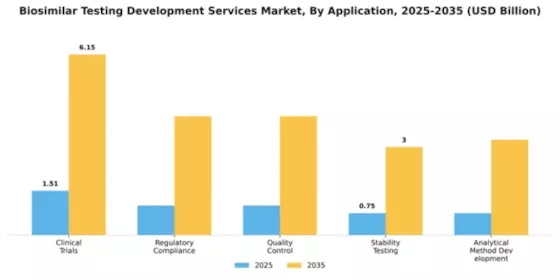
Quality Control (Dominant) vs. Stability Testing (Emerging)
Quality Control serves as the dominant application in the Biosimilar Testing Development Services Market, ensuring that biosimilar products consistently meet predefined standards of quality and efficacy. This segment focuses on implementing rigorous testing protocols throughout the production process, ensuring reliability and patient safety. Its established processes and methodologies create a significant barrier to entry for new players. Conversely, Stability Testing is an emerging segment as it addresses the growing emphasis on product shelf-life and storage conditions. With the increasing complexity of biosimilar products, Stability Testing is becoming vital for assessing how these products maintain their quality over time and under various environmental conditions. The interplay between these segments highlights the industry's commitment to delivering safe and effective biosimilar medications.
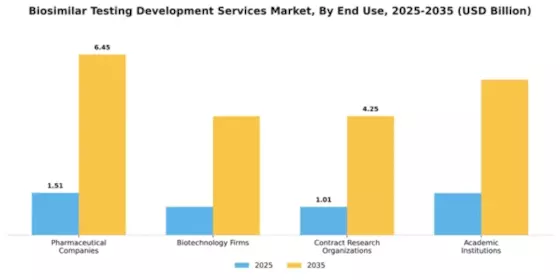
In the Biosimilar Testing Development Services Market, pharmaceutical companies hold the largest market share, leveraging their extensive resources, advanced technologies, and established distribution networks. These companies are heavily investing in biosimilar development to enhance their portfolios and address patent expirations of their biologics. In contrast, biotechnology firms are rapidly gaining traction, driven by innovative approaches in drug development and a growing emphasis on personalized medicine. Their agile nature allows for quicker adaptation to emerging trends in biosimilars, contributing to their increasing market prominence.
Pharmaceutical Companies (Dominant) vs. Biotechnology Firms (Emerging)
Pharmaceutical companies have solidified their dominance in the Biosimilar Testing Development Services Market due to their robust infrastructure and experience in managing complex regulatory landscapes. They tend to prioritize biosimilars that offer significant therapeutic benefits, maintaining a strategic focus on patient outcomes while maximizing profit margins. Conversely, biotechnology firms, marked by their innovative capabilities and flexibility, are emerging as potent competitors. They are often at the forefront of novel biosimilar applications, tapping into niche markets and leveraging cutting-edge technologies to accelerate development timelines. This dynamic positions them to rapidly respond to changing healthcare needs and regulatory frameworks.
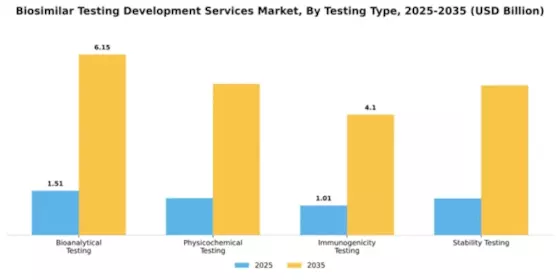
The Biosimilar Testing Development Services Market demonstrates a diverse distribution among testing types, notably with Bioanalytical Testing commanding the largest share due to its critical role in analyzing drug effects and validating bioequivalence. This segment is established as the backbone of biosimilar development, while Physicochemical Testing and Stability Testing also contribute significantly, albeit at a smaller scale, focusing on the stability and qualitative aspects of biosimilar products.
Immunogenicity Testing is emerging as the fastest-growing segment, driven by increasing regulatory requirements and the necessity for rigorous safety measures. The rapid growth of this testing type can be attributed to the heightened awareness of adverse immune reactions that could arise from biosimilar therapies, making it essential for developers to prioritize immunogenicity assessments as part of their testing strategies.
Bioanalytical Testing (Dominant) vs. Immunogenicity Testing (Emerging)
Bioanalytical Testing remains the dominant segment in the Biosimilar Testing Development Services Market, characterized by its comprehensive approach to evaluating the pharmacokinetic and pharmacodynamic properties of biosimilars. This testing type is essential for determining the therapeutic equivalence of biosimilars to their reference products. It includes highly sophisticated methodologies like LC-MS/MS and ELISA, ensuring high accuracy and reliability in results. On the other hand, Immunogenicity Testing is rapidly becoming an emerging segment, reflecting the industry's shift towards more rigorous assessments of immune responses triggered by biosimilars. Given the complexity of the immune system and regulatory landscape, this segment focuses on characterizing immune responses and understanding the implications of immunogenicity on patient safety and drug efficacy.
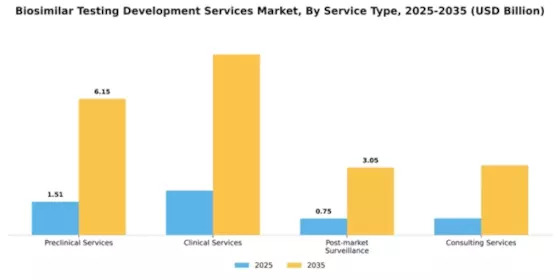
Among the various service types in the Biosimilar Testing Development Services Market, Clinical Services holds the largest market share, driven by ongoing biopharmaceutical research and regulatory compliance demands. Preclinical Services, while smaller in share, is experiencing rapid growth as companies prioritize early-phase testing to ensure safety and efficacy. The focus on patient-centric approaches has intensified the importance of these services, making them vital for successful biosimilar development. Growth trends indicate that Preclinical Services are advancing swiftly, catalyzed by innovations in biotechnology and increasing investment in biopharmaceuticals. This shift reflects a proactive strategy where companies seek to mitigate risks early in the development process. Concurrently, Clinical Services remain a robust segment, buoyed by an increasing number of clinical trials and the need for rigorous testing protocols to meet regulatory standards.
Clinical Services (Dominant) vs. Preclinical Services (Emerging)
Clinical Services are characterized by their critical role in the final stages of biosimilar development, encompassing rigorous testing for safety and effectiveness. This dominant segment benefits from large-scale biopharmaceutical pipelines and stringent regulatory requirements, ensuring its continued relevance in the market. In contrast, Preclinical Services are emerging as a key player, providing essential groundwork for biosimilar projects. This service type focuses on safety assessments and efficacy studies before human trials begin, speaking to the industry's shifting priorities toward early-stage development. The growing complexity of biosimilars necessitates innovative preclinical methodologies, thereby propelling investment and research in this space.
Get more detailed insights about Biosimilar Testing Development Services Market Request Free Sample
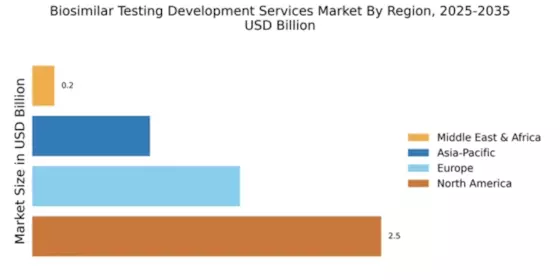
North America is poised to maintain its leadership in the Biosimilar Testing Development Services Market, holding a market size of $2.52B in 2025. Key growth drivers include a robust regulatory framework, increasing healthcare costs, and a rising demand for affordable biologics. The FDA's supportive policies for biosimilars are expected to further enhance market dynamics, fostering innovation and competition in the sector. The United States stands as the largest contributor, with significant investments from major players like Amgen, Pfizer, and Mylan. The competitive landscape is characterized by strategic collaborations and mergers, aimed at enhancing service offerings and expanding market reach. The presence of established companies and a growing number of biosimilar approvals are expected to drive market growth in the region.
Europe is emerging as a significant player in the Biosimilar Testing Development Services Market, with a market size of $1.5B in 2025. The region benefits from a favorable regulatory environment, with the European Medicines Agency (EMA) actively promoting biosimilar development. Increasing healthcare expenditure and a shift towards cost-effective treatment options are key drivers of market growth, alongside rising patient awareness regarding biosimilars. Leading countries such as Germany, France, and the UK are at the forefront of this growth, supported by strong healthcare systems and a high demand for biologics. Major companies like Sandoz and Boehringer Ingelheim are expanding their biosimilar portfolios, enhancing competition. The European market is characterized by a mix of established players and new entrants, fostering innovation and improving access to biosimilars.
The Asia-Pacific region is witnessing rapid growth in the Biosimilar Testing Development Services Market, with a projected market size of $0.85B in 2025. Key growth drivers include increasing healthcare investments, a rising prevalence of chronic diseases, and a growing demand for affordable treatment options. Regulatory bodies in countries like India and China are also streamlining approval processes, which is expected to boost market dynamics significantly. Countries such as India and China are leading the charge, with a burgeoning number of biosimilar approvals and a strong presence of local manufacturers. Companies like Samsung Bioepis and Teva are actively expanding their operations in the region. The competitive landscape is evolving, with both local and international players vying for market share, thereby enhancing the overall growth potential of the biosimilar market in Asia-Pacific.
The Middle East and Africa (MEA) region is gradually emerging in the Biosimilar Testing Development Services Market, with a market size of $0.16B in 2025. The growth is driven by increasing healthcare investments, a rising prevalence of chronic diseases, and a growing demand for affordable biologics. Regulatory bodies are beginning to establish frameworks for biosimilar approvals, which is expected to catalyze market growth in the coming years. Countries like South Africa and the UAE are leading the way, with initiatives aimed at enhancing healthcare access and affordability. The competitive landscape is still developing, with a mix of local and international players entering the market. As awareness of biosimilars increases, the region is expected to see a rise in biosimilar approvals and market participation, paving the way for future growth.
The Biosimilar Testing Development Services Market is characterized by a dynamic competitive landscape, driven by the increasing demand for cost-effective biologics and the growing emphasis on regulatory compliance. Key players such as Amgen (US), Sandoz (CH), and Boehringer Ingelheim (DE) are strategically positioned to leverage their extensive experience in biologics to enhance their service offerings. Amgen (US) focuses on innovation through advanced analytical techniques, while Sandoz (CH) emphasizes partnerships with regulatory bodies to streamline approval processes. Boehringer Ingelheim (DE) is investing in digital transformation to optimize its testing services, collectively shaping a competitive environment that prioritizes efficiency and compliance.The market structure appears moderately fragmented, with several players vying for market share through localized manufacturing and supply chain optimization. Companies are increasingly adopting tactics that enhance their operational efficiency, such as establishing regional testing facilities to reduce turnaround times and costs. This competitive structure allows for a diverse range of services, although the influence of major players remains significant in setting industry standards and practices.
In November Pfizer (US) announced a strategic partnership with a leading technology firm to develop AI-driven testing protocols for biosimilars. This collaboration aims to enhance the accuracy and speed of biosimilar testing, reflecting Pfizer's commitment to innovation in the testing landscape. The integration of AI is likely to streamline processes and reduce costs, positioning Pfizer as a leader in the adoption of cutting-edge technologies in biosimilar testing.
In October Mylan (US) expanded its biosimilar testing capabilities by acquiring a specialized laboratory in Europe. This acquisition is expected to bolster Mylan's presence in the European market, allowing for localized testing services that cater to regional regulatory requirements. The move signifies Mylan's strategic focus on enhancing its operational footprint and responsiveness to market demands, potentially increasing its competitive edge in the biosimilar sector.
In September Samsung Bioepis (KR) launched a new initiative aimed at improving sustainability in biosimilar testing through eco-friendly practices. This initiative includes the implementation of green technologies in their testing facilities, which not only reduces environmental impact but also aligns with global sustainability trends. Samsung Bioepis's proactive approach may resonate well with stakeholders increasingly concerned about environmental responsibility, thereby enhancing its market reputation.
As of December the competitive trends in the Biosimilar Testing Development Services Market are increasingly defined by digitalization, sustainability, and the integration of AI technologies. Strategic alliances are becoming pivotal in shaping the landscape, as companies seek to combine resources and expertise to enhance their service offerings. The shift from price-based competition to a focus on innovation, technology, and supply chain reliability is evident, suggesting that future competitive differentiation will hinge on the ability to adapt to these evolving trends.


The rising prevalence of chronic diseases, increasing demand for affordable biologics, and technological advancements in biosimilar development drive market growth. Key recent developments include:
In January 2023, Merck entered a strategic partnership with Samsung Biologics to enhance its biosimilar development and manufacturing capabilities.
In February 2024, Lonza announced the expansion of its biosimilar manufacturing facility in Singapore to meet the growing demand for biosimilars in the Asia-Pacific region.
The US Food and Drug Administration (FDA) has issued several guidance documents to streamline the biosimilar approval process, further propelling market growth.
The Biosimilar Testing Development Services Market is projected to grow at a 13.62% CAGR from 2025 to 2035, driven by increasing demand for cost-effective biologics and regulatory support.
New opportunities lie in:
By 2035, the market is expected to be robust, reflecting substantial growth and innovation.
| MARKET SIZE 2024 | 5.03(USD Billion) |
| MARKET SIZE 2025 | 5.72(USD Billion) |
| MARKET SIZE 2035 | 20.5(USD Billion) |
| COMPOUND ANNUAL GROWTH RATE (CAGR) | 13.62% (2025 - 2035) |
| REPORT COVERAGE | Revenue Forecast, Competitive Landscape, Growth Factors, and Trends |
| BASE YEAR | 2024 |
| Market Forecast Period | 2025 - 2035 |
| Historical Data | 2019 - 2024 |
| Market Forecast Units | USD Billion |
| Key Companies Profiled | Amgen (US), Sandoz (CH), Mylan (US), Boehringer Ingelheim (DE), Pfizer (US), Samsung Bioepis (KR), Roche (CH), Teva (IL), Eisai (JP) |
| Segments Covered | Application, End Use, Testing Type, Service Type |
| Key Market Opportunities | Advancements in analytical techniques enhance biosimilar testing accuracy and regulatory compliance in the Biosimilar Testing Development Services Market. |
| Key Market Dynamics | Rising demand for cost-effective biologics drives innovation in biosimilar testing development services and regulatory compliance. |
| Countries Covered | North America, Europe, APAC, South America, MEA |
The projected market valuation for the Biosimilar Testing Development Services Market is 20.5 USD Billion by 2035.
The overall market valuation was 5.03 USD Billion in 2024.
The expected CAGR for the market during the forecast period 2025 - 2035 is 13.62%.
Key players in the market include AbbVie, Amgen, Sandoz, Boehringer Ingelheim, Mylan, Samsung Bioepis, Fresenius Kabi, Teva Pharmaceutical Industries, and Celltrion.
The main applications include Clinical Trials, Regulatory Compliance, Quality Control, Stability Testing, and Analytical Method Development.
The Clinical Services segment is projected to reach 8.15 USD Billion by 2035.
The Pharmaceutical Companies segment is expected to be valued at 6.45 USD Billion by 2035.
The types of testing include Bioanalytical Testing, Physicochemical Testing, Immunogenicity Testing, and Stability Testing.
The Stability Testing segment is projected to be valued at 5.1 USD Billion by 2035.
Services offered include Preclinical Services, Clinical Services, Post-market Surveillance, and Consulting Services.


Kindly complete the form below to receive a free sample of this Report

“This is really good guys. Excellent work on a tight deadline. I will continue to use you going forward and recommend you to others. Nice job”


“Thanks. It’s been a pleasure working with you, please use me as reference with any other Intel employees.”


“Thanks for sending the report it gives us a good global view of the Betaïne market.”


“Thank you, this will be very helpful for OQS.”


“We found the report very insightful! we found your research firm very helpful. I'm sending this email to secure our future business.”


“I am very pleased with how market segments have been defined in a relevant way for my purposes (such as "Portable Freezers & refrigerators" and "last-mile"). In general the report is well structured. Thanks very much for your efforts.”


“I have been reading the first document or the study, ,the Global HVAC and FP market report 2021 till 2026. Must say, good info! I have not gone in depth at all parts, but got a good indication of the data inside!”


“We got the report in time, we really thank you for your support in this process. I also thank to all of your team as they did a great job.”


“The Automotive 48V ECU Components Procurement Intelligence Study” was a complex project, but the Market Research Future (MRFR) team handled it with quality, agility, and customer-centricity. They delivered all requested data on time and within the agreed scope. The team, including Shubhendra Anand and Rahul Gotadki, was always readily available to clarify questions and swiftly implement necessary adjustments, driving the project to a successful conclusion within a very demanding timeframe.
I would also like to specifically commend Akshay Agarwal for his responsiveness and support at every stage—from our initial inquiry on May 6th through to final delivery on June 18th. His dedication made the entire process seamless.”



