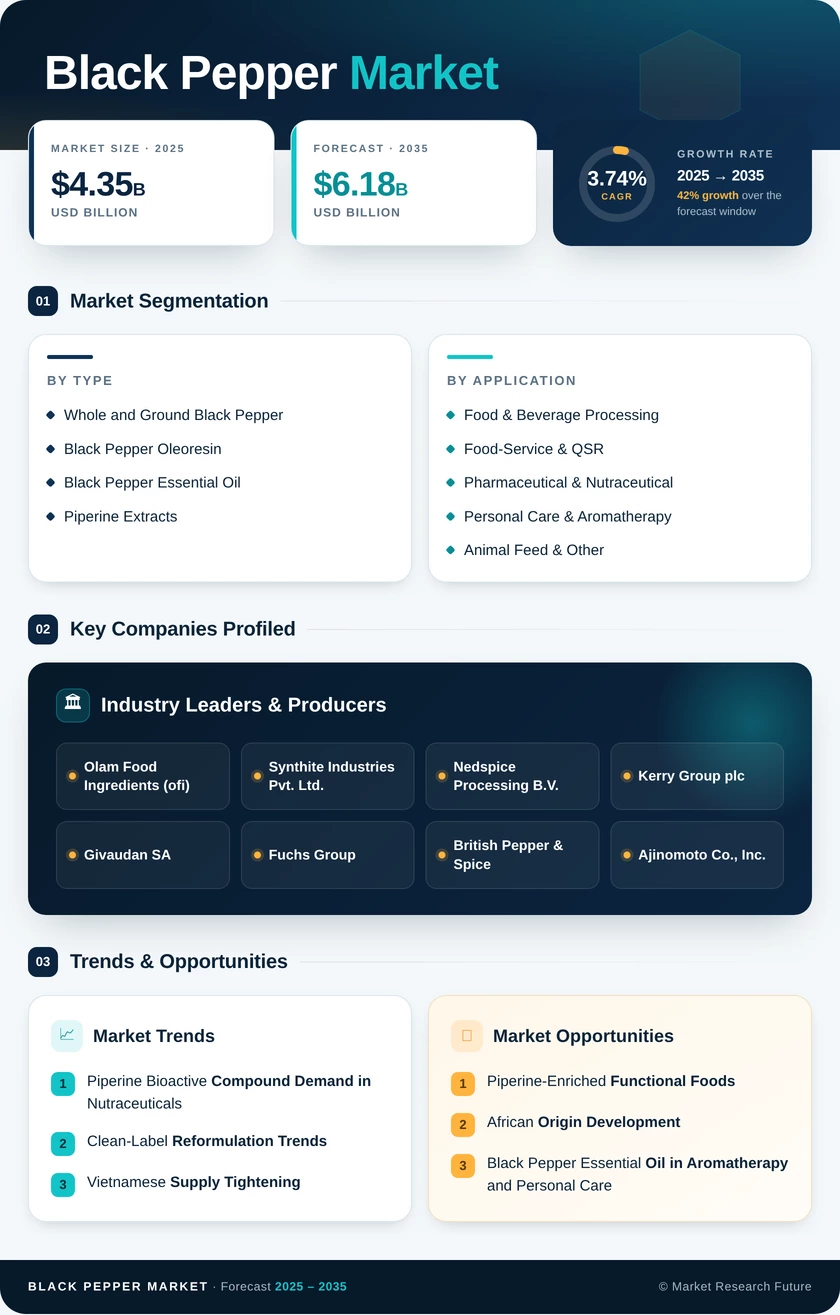
Black Pepper Market

ID: MRFR/FnB/30161-HCR
128 Pages
Sakshi Gupta
Last Updated: June 06, 2026
Black Pepper Market Size, Share, Industry Trend & Analysis Research Report By Product Type (Whole and Ground Black Pepper, Black Pepper Oleoresin, Black Pepper Essential Oil, Piperine Extracts), By Application (Food & Beverage Processing, Food-Service & QSR, Pharmaceutical & Nutraceutical, Personal Care & Aromatherapy, Animal Feed & Other), By Region (North America, Europe, Asia-Pacific, South America, Middle East & Africa) - Forecast to 2035.
Download PDF ×

We do not share your information with anyone. However, we may send you emails based on your report interest from time to time. You may contact us at any time to opt-out.

  1. 1 Market Overview |
    1. 1.1 Study Assumptions & Market Definition |
    2. 1.2 Scope of the Study |
    3. 1.3 Research Methodology
  2. 2 Market Summary & Key Takeaways
  3. 3 Market Size and Forecast (2021–2035) |
    1. 3.1 Historical Market Size (2021–2025) |
    2. 3.2 Current & Forecast Market Size (2026–2035) |
    3. 3.3 Market Size by Revenue (USD Billion) |
    4. 3.4 Year-over-Year Growth Analysis
  4. 4 Market Dynamics |
    1. 4.1 Market Drivers Analysis | |
      1. 4.1.1 Rising Piperine Bioactive Compound Demand in Nutraceuticals | |
      2. 4.1.2 Clean-Label Reformulation in Processed Foods | |
      3. 4.1.3 Vietnamese Supply Tightening and Export Price Escalation | |
      4. 4.1.4 Blockchain Traceability and Sustainability Certification | |
      5. 4.1.5 Expansion of Pepper Cultivation and Harvesting in Africa | |
      6. 4.1.6 QSR Menu Diversification and Spice-Forward Flavoring | |
      7. 4.1.7 Black Pepper Essential Oil Adoption in Personal Care |
    2. 4.2 Market Restraints Analysis | |
      1. 4.2.1 Climate Volatility and El Niño-Induced Yield Disruptions | |
      2. 4.2.2 Pesticide Residue Compliance and MRL Tightening | |
      3. 4.2.3 Adulteration and Quality Fraud in Ground Pepper | |
      4. 4.2.4 Price Volatility Discouraging Long-Term Procurement Contracts | |
      5. 4.2.5 Smallholder Fragmentation Limiting Quality Consistency |
    3. 4.3 Market Opportunity Analysis | |
      1. 4.3.1 Piperine-Enriched Functional Foods | |
      2. 4.3.2 African Origin Development | |
      3. 4.3.3 Black Pepper Essential Oil in Aromatherapy and Personal Care | |
      4. 4.3.4 Digital Commodity Platforms and Direct Trade Models | |
      5. 4.3.5 Sustainable Certification as a Premium Channel |
    4. 4.4 Industry Value Chain Analysis |
    5. 4.5 Porter's Five Forces Analysis
  5. 5 Segmentation Analysis |
    1. 5.1 By Product Type | |
      1. 5.1.1 Whole and Ground Black Pepper | |
      2. 5.1.2 Black Pepper Oleoresin | |
      3. 5.1.3 Black Pepper Essential Oil | |
      4. 5.1.4 Piperine Extracts |
    2. 5.2 By Application | |
      1. 5.2.1 Food & Beverage Processing | |
      2. 5.2.2 Food-Service & QSR | |
      3. 5.2.3 Pharmaceutical & Nutraceutical | |
      4. 5.2.4 Personal Care & Aromatherapy | |
      5. 5.2.5 Animal Feed & Other
  6. 6 Regional Analysis |
    1. 6.1 North America | |
      1. 6.1.1 United States | |
      2. 6.1.2 Canada | |
      3. 6.1.3 Mexico |
    2. 6.2 Europe | |
      1. 6.2.1 Germany | |
      2. 6.2.2 United Kingdom | |
      3. 6.2.3 France | |
      4. 6.2.4 Italy | |
      5. 6.2.5 Spain | |
      6. 6.2.6 Nordic Countries | |
      7. 6.2.7 Russia | |
      8. 6.2.8 Rest of Europe |
    3. 6.3 Asia-Pacific | |
      1. 6.3.1 China | |
      2. 6.3.2 India | |
      3. 6.3.3 Japan | |
      4. 6.3.4 South Korea | |
      5. 6.3.5 ASEAN | |
      6. 6.3.6 Rest of Asia-Pacific |
    4. 6.4 South America | |
      1. 6.4.1 Brazil | |
      2. 6.4.2 Argentina | |
      3. 6.4.3 Rest of South America |
    5. 6.5 Middle East & Africa | |
      1. 6.5.1 Saudi Arabia | |
      2. 6.5.2 UAE | |
      3. 6.5.3 South Africa | |
      4. 6.5.4 Egypt | |
      5. 6.5.5 Rest of MEA
  7. 7 Competitive Landscape |
    1. 7.1 Market Share Analysis (2025) |
    2. 7.2 Competitive Benchmarking Matrix |
    3. 7.3 Company Profiles | |
      1. 7.3.1 Olam Food Ingredients (ofi) | |
      2. 7.3.2 McCormick & Company, Inc. | |
      3. 7.3.3 Synthite Industries Pvt. Ltd. | |
      4. 7.3.4 Nedspice Processing B.V. | |
      5. 7.3.5 Kerry Group plc | |
      6. 7.3.6 Givaudan SA | |
      7. 7.3.7 Fuchs Group | |
      8. 7.3.8 British Pepper & Spice | |
      9. 7.3.9 Ajinomoto Co., Inc. | |
      10. 7.3.10 PT Motasa Indonesia
  8. 8 Future Outlook & Strategic Recommendations (2026–2035) |
    1. 8.1 Precision Agriculture and Digital Plantation Management |
    2. 8.2 Supply Chain Digitization and Transparent Trade |
    3. 8.3 Climate Adaptation and Resilient Varieties |
    4. 8.4 Value-Added Product Diversification
  9. 9 Recent Developments & News
  10. 10 Frequently Asked Questions (FAQs)
  11. 11 Report Scope & Methodology |
    1. 11.1 Study Period & Base Year |
    2. 11.2 Data Sources & Citations |
    3. 11.3 Abbreviations
  12. 12 LIST OF TABLES |
  13. TABLE 1 Global Black Pepper Market Size & Forecast, by Revenue (USD Billion), 2021–2035 |
  14. TABLE 2 Global Black Pepper Market — Year-over-Year Growth Analysis, 2021–2035 |
  15. TABLE 3 Global Black Pepper Market — Driver Impact Analysis, 2026–2035 |
  16. TABLE 4 Global Black Pepper Market — Restraint Impact Analysis, 2026–2035 |
  17. TABLE 5 Global Black Pepper Market — Regional Summary, 2025 |
  18. TABLE 6 North America Black Pepper Market Size, by Country, 2021–2035 (USD Billion) |
  19. TABLE 7 Europe Black Pepper Market Size, by Country, 2021–2035 (USD Billion) |
  20. TABLE 8 Asia-Pacific Black Pepper Market Size, by Country, 2021–2035 (USD Billion) |
  21. TABLE 9 South America Black Pepper Market Size, by Country, 2021–2035 (USD Billion) |
  22. TABLE 10 Middle East & Africa Black Pepper Market Size, by Country, 2021–2035 (USD Billion) |
  23. TABLE 11 Global Black Pepper Market Size, by Product Type, 2021–2035 (USD Billion) |
  24. TABLE 12 Global Black Pepper Market Size, by Application, 2021–2035 (USD Billion) |
  25. TABLE 13 Competitive Benchmarking Matrix — Global Black Pepper Market, 2025 |
  26. TABLE 14 Company Profiles — Key Players, Global Black Pepper Market |
  27. TABLE 15 Recent Developments & Strategic Announcements, 2023–2025 |
  28. TABLE 16 Report Scope & Methodology Summary |
  29. TABLE 17 Detailed Sources and Citations
  30. 13 LIST OF FIGURES |
  31. FIGURE 1 Global Black Pepper Market — Market Dynamics Overview |
  32. FIGURE 2 Global Black Pepper Market — Value Chain Analysis |
  33. FIGURE 3 Global Black Pepper Market — Porter's Five Forces Analysis |
  34. FIGURE 4 Global Black Pepper Market Size Trend (USD Billion), 2021–2035 |
  35. FIGURE 5 Global Black Pepper Market — Product Type Segment Share, 2025 |
  36. FIGURE 6 Global Black Pepper Market — Application Segment Share, 2025 |
  37. FIGURE 7 Global Black Pepper Market — Regional Share, 2025 |
  38. FIGURE 8 Global Black Pepper Market — Regional CAGR Comparison, 2026–2035 |
  39. FIGURE 9 Global Black Pepper Market — Competitive Landscape Heat Map, 2025

Segmentation Quick Reference

DimensionSub-SegmentsDominant SegmentFastest Growing Segment
By Product TypeWhole and Ground Black Pepper; Black Pepper Oleoresin; Black Pepper Essential Oil; Piperine ExtractsWhole and Ground Black PepperBlack Pepper Essential Oil
By ApplicationFood & Beverage Processing; Food-Service & QSR; Pharmaceutical & Nutraceutical; Personal Care & Aromatherapy; Animal Feed & OtherFood & Beverage ProcessingPersonal Care & Aromatherapy
By RegionNorth America; Europe; Asia-Pacific; South America; Middle East & AfricaAsia-PacificAfrica


Market Segmentation Overview

By Product Type

Sub-SegmentKey Trend
Whole and Ground Black PepperStable high-volume demand from food manufacturing and retail private-label expansion
Black Pepper OleoresinStandardized flavor delivery for processed foods; replacing crude ground pepper in industrial applications
Black Pepper Essential OilRapid growth in aromatherapy, personal care formulations, and premium fragrance compositions
Piperine ExtractsClinical validation of bioavailability-enhancement properties driving nutraceutical co-formulation demand


Whole and ground black pepper remains the backbone of global trade volumes, while value-added segments — particularly black pepper essential oil and piperine extracts — are redefining margin profiles across the supply chain. Processors with both commodity-scale throughput and specialized extraction capabilities are best positioned to serve the full product spectrum.

By Application

Sub-SegmentKey Trend
Food & Beverage ProcessingClean-label reformulation mandates increasing per-unit pepper content in seasoning blends and ready meals
Food-Service & QSRSpice-forward menu innovation driving whole and ground black pepper procurement in quick-service chains
Pharmaceutical & NutraceuticalStandardized piperine extracts specified in over 400 commercially available dietary supplement formulations
Personal Care & AromatherapyBeta-caryophyllene content positioning black pepper essential oil as a functional aromatherapy ingredient
Animal Feed & OtherNiche applications in poultry feed additives for gut health and growth promotion


Food and beverage processing dominates application-level demand, but pharmaceutical and personal care channels are capturing an increasing share of high-value pepper output. The diversification of end-use applications supports pricing resilience across the black pepper market even during periods of commodity-price volatility.

By Region

Sub-SegmentKey Trend
Asia-PacificProduction and export dominance; plantation modernization; domestic consumption growth in India and China
EuropeStringent MRL compliance reshaping sourcing; clean-label and organic certification demand
North AmericaConsumption-driven market; QSR innovation; nutraceutical piperine sourcing
South AmericaBrazilian export competitiveness; currency-driven pricing advantage
Middle East & AfricaAfrican origin development; UAE re-export hub; fastest regional growth trajectory


Asia-Pacific's combined production and consumption leadership defines the geographic structure of the black pepper market, while Africa's emergence as a new-origin supply base introduces competitive dynamics that will reshape global trade flows through 2035.