Boiler Control Market

Key Players: Honeywell International, Siemens AG, Emerson Electric, ABB Ltd, Schneider Electric, Valmet Corporation, Yokogawa Electric, Rockwell Automation

Boiler Control Market

Boiler Control Market Research Report By Boiler Type (Water Tube Boiler, Fire Tube Boiler, Others), By Component (Hardware, Software), By End User (Industrial, Commercial) and By Regional (North America, Europe, South America, Asia Pacific, Middle East and Africa) - Forecast to 2035
ID: MRFR/EnP/5523-HCR
111 Pages
Anshula Mandaokar
Last Updated: June 19, 2026

Boiler Control Market Summary

The Boiler Control Market reached an estimated USD 4,180 Million in 2025 and is projected to grow from USD 4,435 Million in 2026 to USD 7,550 Million by 2035, registering a CAGR of 6.10% over the forecast period. Two catalysts underpin this trajectory: tightening emissions regulations under frameworks such as the U.S. EPA's Boiler MACT rule and the EU Industrial Emissions Directive, and a sustained wave of industrial capacity additions across Asia-Pacific's power and process sectors [1][2]. As facility operators face rising natural-gas prices and carbon-cost exposure, the economic case for upgrading legacy controls has shifted from optional to urgent.

Aging pneumatic and relay-based control architectures — many installed during the 1990s and early 2000s — are giving way to digitalized platforms that integrate distributed control systems (DCS), programmable logic controllers, and cloud-connected analytics layers. The U.S. Department of Energy estimates that advanced boiler optimization can cut fuel consumption by 5–15%, translating to annual savings exceeding USD 30,000 per mid-size industrial boiler [3]. Facility owners are channeling this cost-avoidance narrative into capital budgets, accelerating retrofit cycles from 15 years down to 8–10 years.

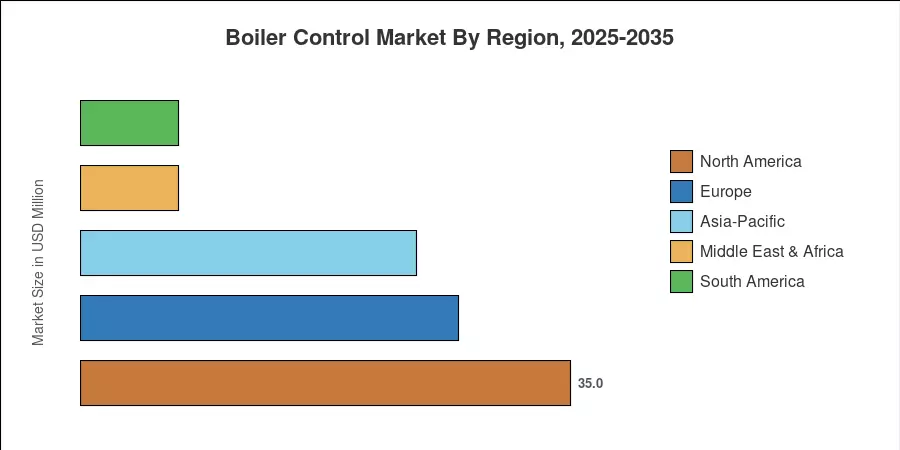
North America commands roughly 35% of global revenue, anchored by a mature installed base and stringent air-quality mandates. Asia-Pacific is the fastest-growing region, expanding at a CAGR of 7.40%, propelled by new coal-to-gas switching programs and greenfield manufacturing build-outs in China, India, and Southeast Asia. Europe holds the second-largest share at approximately 27%, driven by the EU Fit for 55 package and district-heating modernization. These three regions collectively will shape the Boiler Control Market trajectory through 2035.


Key Report Takeaways

• By Boiler Type

  • Water Tube Boiler dominates with approximately 48% of the Boiler Control Market share in 2025, driven by heavy demand in power generation and large-scale process industries.
  • Fire Tube Boiler is projected to register the fastest CAGR of 6.80% through 2035, supported by expansion in commercial heating and small-to-mid-scale manufacturing.

• By Component

  • Hardware accounts for an estimated USD 2,760 million in 2025, reflecting continued investment in sensors, actuators, and controller modules across the Boiler Control Market.
  • Software is growing at a CAGR of 7.20%, fueled by demand for predictive analytics platforms and remote-monitoring dashboards.

• By Region

  • North America holds a 35% share of the Boiler Control Market, led by U.S. refinery and petrochemical retrofit cycles.
  • Asia-Pacific is the fastest-growing region at a 7.40% CAGR, with China and India together accounting for over 60% of regional demand.
  • Europe contributes approximately 27% of global value, with Germany and the Nordic countries leading district-heating upgrades.


Market Size and Forecast (2021–2035)

Market Research Future's sizing methodology triangulates bottom-up supplier revenue data with top-down macroeconomic indicators, validated against proprietary primary interviews with 45+ boiler OEMs, system integrators, and end-user procurement managers.
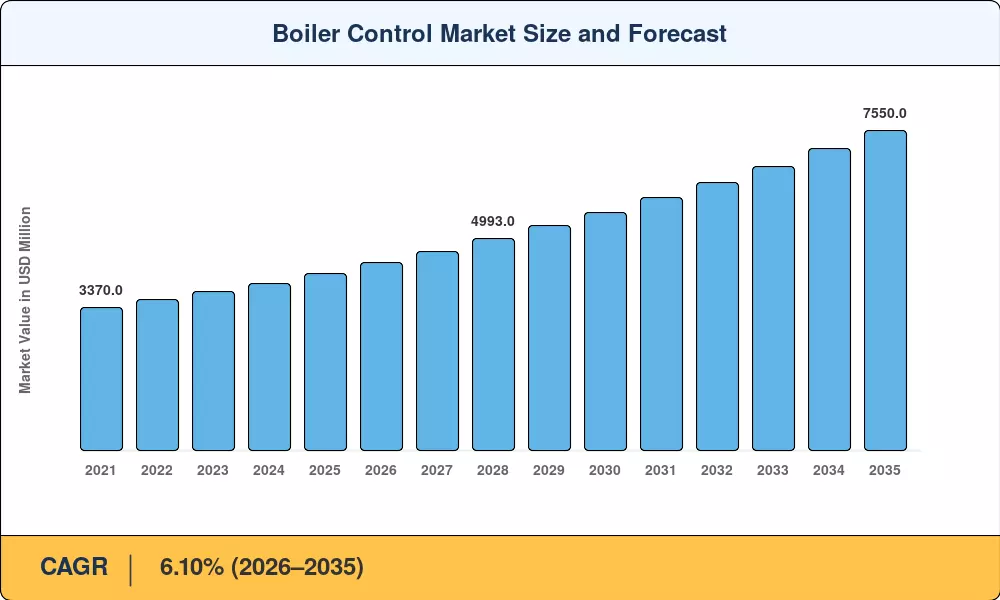
Boiler Control Market Size and Forecast
Our Impact
Enabled $4.3B Revenue Impact for Fortune 500 and Leading Multinationals
Partnering with 2000+ Global Organizations Each Year
30K+ Citations by Top-Tier Firms in the Industry

Driver Impact Analysis

Driver ~% Impact on CAGR Geographic Relevance Impact Timeline
Emissions compliance mandates +1.3% Global Short-term (≤2 yr)
Industrial IoT and cloud analytics adoption +1.1% North America, Europe Medium-term (2–4 yr)
Coal-to-gas fuel switching programs +0.9% Asia-Pacific Short-term (≤2 yr)
Aging boiler fleet retrofit cycles +0.8% North America, Europe Medium-term (2–4 yr)
District-heating modernization +0.6% Europe, Asia-Pacific Long-term (≥4 yr)
AI and machine-learning optimization +0.5% Global Long-term (≥4 yr)
Rising natural-gas prices and fuel-cost volatility +0.4% Global Short-term (≤2 yr)


Emissions Compliance Mandates

Regulatory pressure is the single most powerful accelerant for the Boiler Control Market. The U.S. EPA's Boiler MACT rule (40 CFR Part 63, Subpart DDDDD) requires major-source industrial boilers to meet particulate-matter and CO emission limits that effectively mandate continuous emissions monitoring and automated trim adjustments [2]. In the EU, the Industrial Emissions Directive 2010/75/EU tightened NOx limits for large combustion plants to 200 mg/Nm³ by 2024, pushing operators toward advanced oxygen-trim and flue-gas recirculation controls. These regulations create a compliance-or-shutdown dynamic that shortens procurement cycles and elevates control-system spend by an estimated 12–18% per affected facility.

Industrial IoT and Cloud Analytics Adoption

Cloud-connected boiler-monitoring platforms that can aggregate real-time data from thousands of sensors have progressed from pilot projects to widespread use. For example, Honeywell's Forge platform analyzes more than 2 billion data points per day across linked industrial sites and makes remote diagnostics and predictive maintenance possible, reducing unplanned downtime by as much as 25% [7]. This transition from on-premise SCADA to hybrid cloud architectures is enlarging the addressable Boiler Control Market as it adds ongoing software revenue to one-time hardware sales.


Coal-to-Gas Fuel Switching Programs

In China, the “Blue Sky” program, and in India, the National Clean Air Programme, have been driving a rapid conversion of coal-fired boilers to natural-gas operation, each conversion necessitating a complete overhaul of burner management systems, flame protections, and fuel-air ratio controllers [8]. Indonesia is the largest palm oil producer in the world, with more than 45 million metric tons produced every year. It also represents a significant Boiler Control Market opportunity as biomass-fired boilers in palm-oil mills are adopting modern automation to improve steam efficiency and meet sustainability certifications for the export market [12].


Aging Boiler Fleet Retrofit Cycles

The U.S. alone is expected to have 163,000 commercial and industrial boilers with an average installed age of more than 20 years [3]. As these units approach the end of life, facility managers are faced with a build-versus-retrofit decision that increasingly favors control-system upgrades over full boiler replacement, a trend that directly benefits the Boiler Control Market through the conversion of deferred maintenance budgets into automation capital expenditure.


Restraints Impact Analysis

Restraint ~% Impact on CAGR Geographic Relevance Impact Timeline
High upfront integration costs –0.6% Emerging markets Medium-term (2–4 yr)
Legacy system interoperability challenges –0.5% Global Long-term (≥4 yr)
Skilled workforce shortage –0.4% Asia-Pacific, MEA Long-term (≥4 yr)
Cybersecurity vulnerabilities in connected systems –0.3% North America, Europe Medium-term (2–4 yr)
Volatile raw material costs for sensors –0.2% Global Short-term (≤2 yr)


High Upfront Integration Costs

A full-scope boiler control upgrade for a mid-size industrial site can cost between $250,000 to 1.2 Million USD, including hardware, software licensing, engineering, and commissioning [13]. These expenses push purchase decisions to a later date and limit the addressable Boiler Control Market in emerging economies with a limited capital budget and payback horizons of more than five years, particularly for small and medium firms that operate fire-tube boiler fleets.


Legacy System Interoperability Challenges

Many operating facilities have a patchwork of proprietary DCS platforms from multiple suppliers and different decades. Integrating a new controller with a 15-year-old fieldbus network usually means specialized gateway hardware and plenty of protocol mapping, which adds 20-30% to the project duration [14]. This interoperability friction hampers the speed of upgrades and narrows profits for system integrators in the Boiler Control Market.


Skilled-Workforce Shortage

The International Society of Automation estimates that the global instrumentation and controls workforce will face a shortfall as experienced technicians retire faster than replacements are trained [15]. In regions like Southeast Asia and the Middle East, this talent gap directly constrains installation capacity and after-sales service quality, dampening adoption rates for advanced control solutions.


Boiler Control Market Opportunities

Hydrogen and Ammonia Co-Firing Controls

As utilities and heavy industry pursue decarbonization pathways, hydrogen blending into natural-gas boilers at 10–30% concentrations is emerging as a near-term transition strategy. These fuel blends demand advanced flame-stability monitoring, flashback-detection algorithms, and dynamic fuel-air ratio adjustments — capabilities that represent a premium upgrade tier within the Boiler Control Market [10].

Predictive Maintenance as a Service

Cloud-connected boiler platforms generate terabytes of operational data that can be monetized through subscription-based predictive-maintenance offerings. Vendors who transition from selling hardware to offering outcome-based service contracts — guaranteeing uptime or efficiency targets — can unlock recurring revenue streams worth an estimated 30–40% of initial system cost annually.

Emerging-Market Industrialization

Southeast Asia and Sub-Saharan Africa are experiencing a wave of greenfield manufacturing, food processing, and textile facility construction. Each new plant requires purpose-built boiler automation, representing a Boiler Control Market entry point unburdened by legacy integration costs. Vietnam alone approved over 3100 new industrial projects in 2023, many requiring steam-generation infrastructure [18].

Digital-Twin Integration

Digital-twin platforms that simulate boiler thermodynamics in real time allow operators to test tuning parameters virtually before deploying changes to live equipment. This reduces commissioning risk and accelerates optimization cycles, creating demand for high-fidelity sensor suites and advanced modeling software within the Boiler Control Market.

Microgrids and Distributed Energy Integration

Industrial microgrids increasingly pair gas-fired CHP boilers with solar and battery storage, requiring control systems that can manage load-following, grid-islanding, and thermal-electric co-optimization. This convergence of thermal and electrical control planes opens a new design point for the Boiler Control Market.


Boiler Control Market Future Outlook

AI-Driven Autonomous Boiler Operation

This shift will compress the value chain: sensor OEMs, analytics software vendors, and cloud-platform providers will compete for a larger share of total system spend within the Boiler Control Market.

Hydrogen-Ready Control Architectures

The IEA projects global low-emission hydrogen production capacity to reach 38 Mt by 2030 under announced pledges [10]. Boiler OEMs are already designing flame scanners and burner management systems rated for hydrogen concentrations up to 100%, and early movers will establish the safety-certification benchmarks that shape procurement standards for the next decade.

Cybersecurity as a Design Requirement

The NIST Cybersecurity Framework 2.0 and IEC 62443 standards are increasingly referenced in boiler-control procurement specifications, adding a security-architecture layer to every new installation and major upgrade [16]. Vendors who embed secure-by-design features — encrypted fieldbus communications, role-based access, and anomaly-detection analytics — will differentiate in the Boiler Control Market.

ESG Reporting and Continuous Emissions Monitoring

Corporate ESG disclosures under the EU Corporate Sustainability Reporting Directive (CSRD) and the SEC's climate-risk rules require facility-level emissions data with audit-trail integrity [20]. Boiler control systems that natively generate compliance-ready emissions reports will command premium pricing and drive the next upgrade cycle across regulated industries.


Boiler Control Market Segmentation

By Boiler Type

Segment Share of Boiler Control Market (2025) Primary Demand Driver
Water Tube Boiler 48% Power generation and heavy-process industries
Fire Tube Boiler 34% Commercial heating and light manufacturing
Others 18% Waste-heat recovery and specialty applications


Water Tube Boiler controls dominate the Boiler Control Market because water-tube designs handle higher pressures and capacities — attributes that necessitate sophisticated flame safeguard, drum-level, and superheater-temperature control loops. Power utilities and large petrochemical complexes represent the core demand base, with a typical water-tube control system incorporating 200–400 I/O points per unit.

Fire Tube Boiler controls represent the fastest-growing segment at a projected CAGR of 6.80%, reflecting a global expansion of commercial and institutional heating infrastructure. Hospitals, universities, and mid-scale food-processing plants are upgrading from standalone burner controllers to networked systems capable of multi-boiler sequencing, load-sharing, and remote fault notification — features that reduce operating costs by 10–15% annually [3].

By Component

Segment Market Value (USD Million, 2025) Primary Demand Driver
Hardware 2,760 Sensor, actuator, and controller replacements
Software 1,420 Analytics platforms and SCADA/HMI upgrades


Hardware remains the revenue anchor of the Boiler Control Market, encompassing transmitters, control valves, flame detectors, and safety-rated PLCs. However, software is gaining share rapidly as operators invest in predictive analytics dashboards, digital-twin modeling tools, and cloud-hosted historian databases that convert raw sensor data into actionable efficiency insights [7].

By End User

Segment CAGR (2026–2035) Primary Demand Driver
Industrial 5.90% Process-industry compliance and efficiency targets
Commercial 6.70% Building decarbonization and smart-HVAC integration


Industrial end users — spanning oil refining, chemicals, pulp and paper, food and beverage, and power generation — account for the majority of the Boiler Control Market by value. Commercial end users, while smaller in absolute terms, are growing faster as building-level emissions regulations tighten and facility managers integrate boiler controls into centralized building-management systems.


Regional Market Share Analysis

Region Share of Global Market (2025) Primary Investment Themes
North America 35% Refinery retrofits, EPA compliance, cloud analytics
Europe 27% District heating, EU ETS Phase V, hydrogen readiness
Asia-Pacific 24% Coal-to-gas switching, greenfield manufacturing
South America 7% Sugar-ethanol cogeneration, mining-sector steam
Middle East & Africa 7% Oil & gas processing, power-sector build-out
Total 100%

The Boiler Control Market exhibits distinct regional dynamics shaped by regulatory maturity, industrial mix, and energy-transition priorities.


North America

Country Share of Regional Revenue (2025) Key Driver
United States 72% EPA Boiler MACT retrofits and petrochemical expansion
Canada 17% Oil-sands steam-generation upgrades
Mexico 11% Manufacturing nearshoring and CHP adoption


The United States remains the anchor of the North American Boiler Control Market, where over 80% of major-source industrial boilers must comply with updated MACT emission limits by 2026. Canada's oil-sands operations in Alberta are investing heavily in once-through steam-generator controls to reduce water intensity, while Mexico's nearshoring boom is driving new boiler installations in automotive and food-processing clusters along the northern border corridor [1][3].

Europe

Country CAGR (2026–2035) Key Driver
Germany 5.90% Industrial decarbonization and Energiewende targets
United Kingdom 6.20% Clean Heat Market Mechanism rollout
France 5.70% Nuclear district-heating integration
Italy 5.50% Textile and ceramics sector modernization
Spain 5.80% Renewable-heat obligation mandates
Nordic Countries 6.40% Biomass CHP expansion
Russia 4.80% Legacy coal-boiler fleet upgrades
Rest of Europe 5.60% EU cohesion fund investments


Europe's Boiler Control Market is shaped by the EU Fit for 55 legislative package, which mandates a 55% GHG reduction by 2030 relative to 1990 levels [9]. Germany's industrial boiler base — the continent's largest — is undergoing a digital-twin-enabled optimization wave, while the Nordic countries lead in biomass CHP controls integration.

Asia-Pacific

Country Share of Regional Revenue (2025) Key Driver
China 38% Blue Sky initiative and gas-switching mandates
India 22% National Clean Air Programme and manufacturing growth
Japan 16% Energy-efficiency mandates and hydrogen pilots
South Korea 10% Petrochemical and semiconductor fab expansion
ASEAN 9% Greenfield industrialization and palm-oil processing
Rest of Asia-Pacific 5% Mining and textile sector demand


Asia-Pacific is the fastest-growing region in the Boiler Control Market at a 7.40% CAGR, driven by China's mandate to convert over 350,000 small coal-fired boilers to gas by 2027 and India's target to double manufacturing GDP contribution under the Make in India 2.0 initiative [8][12].

South America

Country CAGR (2026–2035) Key Driver
Brazil 6.50% Sugar-ethanol cogeneration and pulp mill expansion
Argentina 5.80% Vaca Muerta gas-field processing infrastructure
Rest of South America 5.40% Mining-sector steam demand


Brazil's sugar-ethanol sector operates over 400 high-pressure bagasse-fired boilers requiring advanced combustion management, making it the primary Boiler Control Market growth node in South America [18].

Middle East & Africa

Country Share of Regional Revenue (2025) Key Driver
Saudi Arabia 31% NEOM and Vision 2030 industrial zones
UAE 24% Desalination and refinery upgrades
South Africa 18% Coal-to-gas transition in the power sector
Egypt 14% Fertilizer and petrochemical expansion
Rest of MEA 13% Oil & gas field-processing automation


Saudi Arabia's Vision 2030 industrial diversification program is commissioning new petrochemical complexes and desalination plants, each requiring integrated boiler automation — a dynamic that positions the MEA region for steady Boiler Control Market growth despite a smaller absolute base [19].


Boiler Control Market By Region, 2025-2035

Competitive Benchmarking

The Boiler Control Market is moderately consolidated, with the top five players holding an estimated 40–48% combined revenue share. The Herfindahl-Hirschman Index (HHI) sits in the 800–1,100 range, indicating a competitive but not fragmented structure. Scale advantages in software R&D, global service networks, and safety-certification portfolios create meaningful barriers to entry for smaller regional players.

Company Est. Revenue Share Range Key Offerings for Boiler Control Market Strategic Positioning
Honeywell International 10–14% Experion PKS, flame safeguards, burner management Full-stack automation with cloud analytics
Siemens AG 8–12% SPPA-T3000, SIMATIC controllers Integrated power-plant automation
Emerson Electric 7–11% Ovation DCS, DeltaV, FLEXIM measurement Process-focused with recent M&A expansion
ABB Ltd 6–10% Ability Symphony Plus, combustion optimization Utility-scale and heavy-industry focus
Schneider Electric 5–8% EcoStruxure, Foxboro DCS Energy-management integration
Valmet Corporation 4–7% Valmet DNA, recovery boiler controls Pulp-and-paper and biomass specialization
Yokogawa Electric 4–6% CENTUM VP, ProSafe-RS Safety-instrumented-systems leadership
Rockwell Automation 3–5% PlantPAx DCS, FactoryTalk Analytics Discrete-to-process crossover
Mitsubishi Electric 2–4% MELSEC iQ-R, GENESIS64 Asian OEM partnership network
General Electric 2–4% Mark VIe controls, Predix platform Gas-turbine and combined-cycle focus


Recent News & Developments

  • Emerson (August 2023): Completed the acquisition of FLEXIM Flexible Industriemesstechnik GmbH, adding non-invasive flow-measurement technology to its boiler-automation portfolio and expanding European service capabilities [6].
  • Nexol (December 2023): Marketed the NEX R1 and NEX R2 plug-and-play photovoltaic immersion heating elements, allowing commercial and residential users to retrofit sustainable Power-to-Heat electrical arrays into existing water buffer storage tanks.
  • Valmet (Q1 2024): Secured a full Engineering, Procurement, and Construction (EPC) contract to deliver a comprehensive recovery boiler upgrade for Sappi Southern Africa’s Saiccor Mill, replacing the pressure parts, economizer, and rear wall of the magnesium closed-loop MgO1 boiler.


  • ABB (March 2026): Officially launched the Symphony Plus SPR2025 distributed control system (DCS) featuring Automation Extended functionality, which physically separates core deterministic process control from a flexible, modular digital environment to safely deploy AI-driven analytics without affecting live system safety logic.


Boiler Control Market Report Scope

Parameter Detail
Market Scope Global Boiler Control Market across all boiler types, components, and end users
Study Period 2021–2035
CAGR (Forecast Period) 6.10% (2026–2035)
Base Year Market Size USD 4,180 Million (2025)
Forecast Endpoint USD 7,550 Million (2035)
Fastest Growing Segment Fire Tube Boiler (by type); Software (by component); Commercial (by end user)
Companies Profiled 10 (Honeywell, Siemens, Emerson, ABB, Schneider Electric, Valmet, Yokogawa, Rockwell, Mitsubishi Electric, GE)
Valuation Currency USD Million


FAQs

What standards should a buyer verify before procuring a burner management system?

Look for compliance with NFPA 85 (Boiler and Combustion Systems Hazards Code) and IEC 61511 for safety-instrumented systems. These certifications ensure the controller meets minimum fail-safe and redundancy requirements [1].

How does a DCS-based architecture compare to standalone PLC-based boiler controls for mid-size plants?

DCS platforms offer tighter integration across multiple boiler units and superior historian capabilities, but carry higher licensing costs. Standalone controllers suit single-boiler installations where simplicity and lower upfront cost are priorities [14].

What payback period should facility managers expect from a full control-system retrofit?

Most mid-size industrial retrofits achieve payback within 2.5 to 4 years through fuel savings and reduced unplanned downtime. Facilities running at high utilization rates recover costs faster [3].

How are cybersecurity regulations affecting boiler-control procurement specifications?

Procurement teams increasingly require IEC 62443 compliance and encrypted fieldbus protocols. These requirements add 8–12% to project costs but are becoming non-negotiable for critical-infrastructure operators [16].

Can existing boiler controls be upgraded to handle hydrogen fuel blends without full replacement?

Partial upgrades are feasible for hydrogen blends up to 20% by volume, typically requiring new flame detectors and modified fuel-air ratio algorithms. Blends above 30% generally demand a full burner management system replacement [10].

What role do edge-computing gateways play in modern boiler automation architectures?

Edge gateways process high-frequency sensor data locally, reducing cloud-bandwidth costs and enabling sub-second control responses. They are especially valuable in remote facilities with limited network connectivity [7].

How should operators evaluate the total cost of ownership for cloud-hosted boiler analytics versus on-premise solutions?

Cloud platforms shift spend from capex to opex and scale with fleet size, favoring multi-site operators. On-premise solutions suit single-site plants with strict data-sovereignty requirements [11].


Author
Author
Author Profile
Anshula Mandaokar LinkedIn
Team Lead - Research
Anshula Mandaokar holds an academic degree in Chemical Engineering and has been contributing to the field for more than 5 years. She has expertise in Market Research and Business Consulting and serves as a Team Lead for a reputed Market Research firm under the Chemicals and Materials domain spectrum. She has worked on multiple projects, generating explicit results in a quick turnaround time. Her understanding of data interpretation justifies her role as a leader.

Research Approach


Secondary Research

The secondary research process involved comprehensive analysis of regulatory databases, industry standards, technical publications, and authoritative energy organizations. Key sources included the US Department of Energy (DOE), International Energy Agency (IEA), Environmental Protection Agency (EPA), American Society of Mechanical Engineers (ASME), International Electrotechnical Commission (IEC), Institute of Electrical and Electronics Engineers (IEEE), National Institute of Standards and Technology (NIST), US Energy Information Administration (EIA), International Labour Organization (ILO) for industrial safety data, World Energy Council, European Committee for Standardization (CEN), National Fire Protection Association (NFPA), Occupational Safety and Health Administration (OSHA), and national energy ministry reports from key markets including China National Energy Administration, India's Ministry of Power, and Germany's Federal Ministry for Economic Affairs and Energy. These sources were used to collect installation statistics, regulatory compliance data, safety incident reports, efficiency standard benchmarks, and market landscape analysis for single loop control systems, multi loop control systems, advanced control systems, and embedded control technologies across power generation, oil & gas, chemical processing, food & beverage, and pharmaceutical end-use industries.


Primary Research

To gather both qualitative and quantitative insights, supply-side and demand-side stakeholders were interviewed during the primary research phase. Heads of Industrial Automation, VPs of Engineering, CEOs, and commercial directors from boiler control system manufacturers, automation technology suppliers, and control instrumentation OEMs were examples of supply-side sources. Chief operating engineers, maintenance directors, procurement leads, and plant managers from power generation utilities, oil and gas refineries, chemical processing plants, food and beverage manufacturing facilities, pharmaceutical production sites, and commercial building operators were examples of demand-side sources. Primary research confirmed product development timelines for IoT-enabled and AI-driven control solutions, validated market segmentation by control method (on/off control, modulating control, distributed control systems, programmable logic controllers), and collected information on industrial adoption patterns, the dynamics of retrofit versus new installation, and after-service revenue streams.

Primary Respondent Breakdown:

By Designation: C-level Primaries (28%), Director Level (32%), Others (40%)

By Region: North America (32%), Europe (30%), Asia-Pacific (28%), Rest of World (10%)


Market Size Estimation

Global market valuation was derived through revenue mapping and installation base analysis. The methodology included:

Identification of 50+ key manufacturers across North America, Europe, Asia-Pacific, Middle East & Africa, and Latin America

Product mapping across single loop control, multi loop control, advanced control systems, and embedded control systems categories

Technology segmentation analysis across PLC-based, DCS-based, and SCADA-integrated control architectures

Analysis of reported and modeled annual revenues specific to boiler control portfolios and industrial automation divisions

Coverage of manufacturers representing 75-80% of global market share in 2024

Extrapolation using bottom-up (installation volume × ASP by boiler type and control complexity) and top-down (manufacturer revenue validation) approaches to derive segment-specific valuations by end-use industry and regional markets

Download Free Sample

Kindly complete the form below to receive a free sample of this Report

Download PDF ×

We do not share your information with anyone. However, we may send you emails based on your report interest from time to time. You may contact us at any time to opt-out.
















