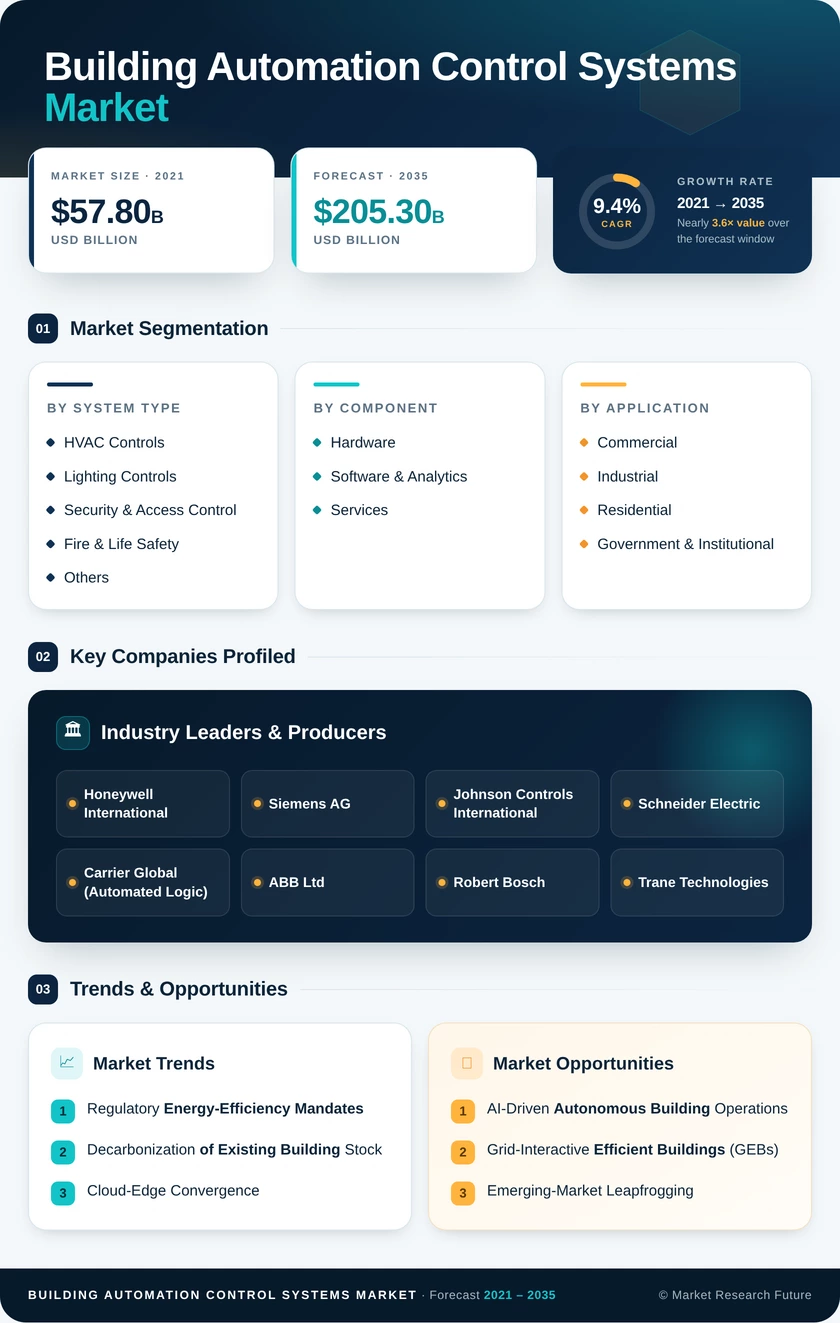
Building Automation Control Systems Market (2026 - 2035)

ID: MRFR/Equip/20993-HCR
128 Pages
Snehal Singh
Last Updated: July 10, 2026
Building Automation Control Systems Market Research Report By System Type (HVAC Controls, Lighting Controls, Security & Access Control, Fire & Life Safety, Others (Elevator, Shade, EV Charging)), By Component (Hardware (Controllers, Sensors, Actuators), Software & Analytics, Services (Integration, Maintenance)), By Application (Commercial (Office, Retail, Hospitality), Industrial (Manufacturing, Warehousing), Residential (Multi-Family, Luxury), Government & Institutional) and By Regional (North America, Europe, South America, Asia Pacific, Middle East and Africa) - Industry Forecast to 2035
Building Automation Control Systems Market
Market Size
Forecast Period2026-2035
CAGR (2026-2035)9.4%
2025 Market SizeUSD 83.6 Billion
2035 Market SizeUSD 205.3 Billion
Key Players
Honeywell International
Siemens AG
Johnson Controls International
Schneider Electric
Carrier Global
ABB Ltd
Opportunities
  • AI-Driven Autonomous Building Operations
  • Grid-Interactive Efficient Buildings (GEBs)
  • Emerging-Market Leapfrogging
  1. 1 Market Overview |
    1. 1.1 Study Assumptions & Market Definition |
    2. 1.2 Scope of the Study |
    3. 1.3 Research Methodology
  2. 2 Market Summary & Key Takeaways
  3. 3 Market Dynamics |
    1. 3.1 Market Drivers Analysis | |
      1. 3.1.1 Regulatory Energy-Efficiency Mandates | |
      2. 3.1.2 Decarbonization of Existing Building Stock | |
      3. 3.1.3 Cloud-Edge Convergence in Supervisory Platforms | |
      4. 3.1.4 Urbanization and Smart-City Programs | |
      5. 3.1.5 Grid-Interactive Efficient Building Standards | |
      6. 3.1.6 Cybersecurity Compliance for Operational Technology | |
      7. 3.1.7 Insurance and ESG Disclosure Incentives |
    2. 3.2 Market Restraints Analysis | |
      1. 3.2.1 High Retrofit Cost and Long Payback Periods | |
      2. 3.2.2 Cybersecurity Vulnerabilities in OT Networks | |
      3. 3.2.3 Skilled-Workforce Shortage for Commissioning | |
      4. 3.2.4 Interoperability Gaps Between Proprietary Systems | |
      5. 3.2.5 Economic Cyclicality in Commercial Construction |
    3. 3.3 Market Opportunity Analysis | |
      1. 3.3.1 AI-Driven Autonomous Building Operations | |
      2. 3.3.2 Grid-Interactive Efficient Buildings (GEBs) | |
      3. 3.3.3 Emerging-Market Leapfrogging | |
      4. 3.3.4 Automation-as-a-Service Business Models | |
      5. 3.3.5 Data Monetization Through Digital Twins |
    4. 3.4 Industry Value Chain Analysis |
    5. 3.5 Porter's Five Forces Analysis
  4. 4 Global Building Automation Control Systems Market Size & Forecast (2021–2035) |
    1. 4.1 Historical Market Size (2021–2025) |
    2. 4.2 Current & Forecast Market Size (2026–2035) |
    3. 4.3 Market Size by Revenue (USD Billion) |
    4. 4.4 Year-over-Year Growth Analysis
  5. 5 Segmentation Analysis |
    1. 5.1 By System Type | |
      1. 5.1.1 HVAC Controls | |
      2. 5.1.2 Lighting Controls | |
      3. 5.1.3 Security & Access Control | |
      4. 5.1.4 Fire & Life Safety | |
      5. 5.1.5 Others (Elevator, Shade, EV Charging) |
    2. 5.2 By Component | |
      1. 5.2.1 Hardware (Controllers, Sensors, Actuators) | |
      2. 5.2.2 Software & Analytics | |
      3. 5.2.3 Services (Integration, Maintenance) |
    3. 5.3 By Application | |
      1. 5.3.1 Commercial (Office, Retail, Hospitality) | |
      2. 5.3.2 Industrial (Manufacturing, Warehousing) | |
      3. 5.3.3 Residential (Multi-Family, Luxury) | |
      4. 5.3.4 Government & Institutional
  6. 6 Regional Analysis |
    1. 6.1 North America | |
      1. 6.1.1 United States | |
      2. 6.1.2 Canada | |
      3. 6.1.3 Mexico |
    2. 6.2 Europe | |
      1. 6.2.1 Germany | |
      2. 6.2.2 United Kingdom | |
      3. 6.2.3 France | |
      4. 6.2.4 Rest of Europe |
    3. 6.3 Asia-Pacific | |
      1. 6.3.1 China | |
      2. 6.3.2 India | |
      3. 6.3.3 Japan | |
      4. 6.3.4 South Korea | |
      5. 6.3.5 Rest of Asia-Pacific |
    4. 6.4 South America | |
      1. 6.4.1 Brazil | |
      2. 6.4.2 Argentina | |
      3. 6.4.3 Rest of South America |
    5. 6.5 Middle East & Africa | |
      1. 6.5.1 UAE | |
      2. 6.5.2 Saudi Arabia | |
      3. 6.5.3 South Africa | |
      4. 6.5.4 Rest of Middle East & Africa
  7. 7 Competitive Landscape |
    1. 7.1 Market Share Analysis (2025) |
    2. 7.2 Competitive Benchmarking Matrix |
    3. 7.3 Company Profiles | |
      1. 7.3.1 Honeywell International | |
      2. 7.3.2 Siemens AG | |
      3. 7.3.3 Johnson Controls International | |
      4. 7.3.4 Schneider Electric | |
      5. 7.3.5 Carrier Global (Automated Logic) | |
      6. 7.3.6 ABB Ltd | |
      7. 7.3.7 Robert Bosch | |
      8. 7.3.8 Trane Technologies | |
      9. 7.3.9 Distech Controls (Acuity Brands) | |
      10. 7.3.10 Delta Electronics
  8. 8 Future Outlook & Strategic Recommendations (2026–2035) |
    1. 8.1 AI and Autonomous Building Operations |
    2. 8.2 Platform Economics and Ecosystem Consolidation |
    3. 8.3 Electrification Supercycle and Heat-Pump Integration |
    4. 8.4 ESG Reporting and Carbon-Accounting Compliance
  9. 9 Recent Developments & News
  10. 10 Frequently Asked Questions (FAQs)
  11. 11 Report Scope & Methodology |
    1. 11.1 Study Period & Base Year |
    2. 11.2 Data Sources & Citations |
    3. 11.3 Abbreviations
  12. 12 LIST OF TABLES |
  13. TABLE 1 Global Building Automation Control Systems Market Size & Forecast, by Revenue (USD Billion), 2021–2035 |
  14. TABLE 2 Global Building Automation Control Systems Market — Year-over-Year Growth Analysis, 2021–2035 |
  15. TABLE 3 Market Driver Impact Analysis — Building Automation Control Systems Market |
  16. TABLE 4 Market Restraint Impact Analysis — Building Automation Control Systems Market |
  17. TABLE 5 Regional Market Share Summary — Building Automation Control Systems Market, 2025 |
  18. TABLE 6 North America Building Automation Control Systems Market Size, by Country, 2021–2035 (USD Billion) |
  19. TABLE 7 Europe Building Automation Control Systems Market Size, by Country, 2021–2035 (USD Billion) |
  20. TABLE 8 Asia-Pacific Building Automation Control Systems Market Size, by Country, 2021–2035 (USD Billion) |
  21. TABLE 9 South America Building Automation Control Systems Market Size, by Country, 2021–2035 (USD Billion) |
  22. TABLE 10 Middle East & Africa Building Automation Control Systems Market Size, by Country, 2021–2035 (USD Billion) |
  23. TABLE 11 Global Building Automation Control Systems Market Size, by System Type, 2021–2035 (USD Billion) |
  24. TABLE 12 Global Building Automation Control Systems Market Size, by Component, 2021–2035 (USD Billion) |
  25. TABLE 13 Global Building Automation Control Systems Market Size, by Application, 2021–2035 (USD Billion) |
  26. TABLE 14 Competitive Benchmarking Matrix — Building Automation Control Systems Market, 2025 |
  27. TABLE 15 Company Profiles — Key Players, Building Automation Control Systems Market |
  28. TABLE 16 Recent Developments & Strategic Announcements, 2023–2025 |
  29. TABLE 17 Report Scope & Methodology Summary |
  30. TABLE 18 Detailed Sources and Citations |
  31. TABLE 19 North America Building Automation Control Systems Market Size, by System Type, 2021–2035 (USD Billion) |
  32. TABLE 20 North America Building Automation Control Systems Market Size, by Component, 2021–2035 (USD Billion) |
  33. TABLE 21 North America Building Automation Control Systems Market Size, by Application, 2021–2035 (USD Billion) |
  34. TABLE 22 Europe Building Automation Control Systems Market Size, by System Type, 2021–2035 (USD Billion) |
  35. TABLE 23 Europe Building Automation Control Systems Market Size, by Component, 2021–2035 (USD Billion) |
  36. TABLE 24 Europe Building Automation Control Systems Market Size, by Application, 2021–2035 (USD Billion) |
  37. TABLE 25 Asia-Pacific Building Automation Control Systems Market Size, by System Type, 2021–2035 (USD Billion) |
  38. TABLE 26 Asia-Pacific Building Automation Control Systems Market Size, by Component, 2021–2035 (USD Billion) |
  39. TABLE 27 Asia-Pacific Building Automation Control Systems Market Size, by Application, 2021–2035 (USD Billion) |
  40. TABLE 28 South America Building Automation Control Systems Market Size, by System Type, 2021–2035 (USD Billion) |
  41. TABLE 29 South America Building Automation Control Systems Market Size, by Component, 2021–2035 (USD Billion) |
  42. TABLE 30 South America Building Automation Control Systems Market Size, by Application, 2021–2035 (USD Billion) |
  43. TABLE 31 Middle East & Africa Building Automation Control Systems Market Size, by System Type, 2021–2035 (USD Billion) |
  44. TABLE 32 Middle East & Africa Building Automation Control Systems Market Size, by Component, 2021–2035 (USD Billion) |
  45. TABLE 33 Middle East & Africa Building Automation Control Systems Market Size, by Application, 2021–2035 (USD Billion) |
  46. TABLE 34 United States Building Automation Control Systems Market Size, by System Type, 2021–2035 (USD Billion) |
  47. TABLE 35 United States Building Automation Control Systems Market Size, by Component, 2021–2035 (USD Billion) |
  48. TABLE 36 United States Building Automation Control Systems Market Size, by Application, 2021–2035 (USD Billion) |
  49. TABLE 37 Canada Building Automation Control Systems Market Size, by System Type, 2021–2035 (USD Billion) |
  50. TABLE 38 Canada Building Automation Control Systems Market Size, by Component, 2021–2035 (USD Billion) |
  51. TABLE 39 Canada Building Automation Control Systems Market Size, by Application, 2021–2035 (USD Billion) |
  52. TABLE 40 Mexico Building Automation Control Systems Market Size, by System Type, 2021–2035 (USD Billion) |
  53. TABLE 41 Mexico Building Automation Control Systems Market Size, by Component, 2021–2035 (USD Billion) |
  54. TABLE 42 Mexico Building Automation Control Systems Market Size, by Application, 2021–2035 (USD Billion) |
  55. TABLE 43 Germany Building Automation Control Systems Market Size, by System Type, 2021–2035 (USD Billion) |
  56. TABLE 44 Germany Building Automation Control Systems Market Size, by Component, 2021–2035 (USD Billion) |
  57. TABLE 45 Germany Building Automation Control Systems Market Size, by Application, 2021–2035 (USD Billion) |
  58. TABLE 46 United Kingdom Building Automation Control Systems Market Size, by System Type, 2021–2035 (USD Billion) |
  59. TABLE 47 United Kingdom Building Automation Control Systems Market Size, by Component, 2021–2035 (USD Billion) |
  60. TABLE 48 United Kingdom Building Automation Control Systems Market Size, by Application, 2021–2035 (USD Billion) |
  61. TABLE 49 France Building Automation Control Systems Market Size, by System Type, 2021–2035 (USD Billion) |
  62. TABLE 50 France Building Automation Control Systems Market Size, by Component, 2021–2035 (USD Billion) |
  63. TABLE 51 France Building Automation Control Systems Market Size, by Application, 2021–2035 (USD Billion) |
  64. TABLE 52 China Building Automation Control Systems Market Size, by System Type, 2021–2035 (USD Billion) |
  65. TABLE 53 China Building Automation Control Systems Market Size, by Component, 2021–2035 (USD Billion) |
  66. TABLE 54 China Building Automation Control Systems Market Size, by Application, 2021–2035 (USD Billion) |
  67. TABLE 55 India Building Automation Control Systems Market Size, by System Type, 2021–2035 (USD Billion) |
  68. TABLE 56 India Building Automation Control Systems Market Size, by Component, 2021–2035 (USD Billion) |
  69. TABLE 57 India Building Automation Control Systems Market Size, by Application, 2021–2035 (USD Billion) |
  70. TABLE 58 Japan Building Automation Control Systems Market Size, by System Type, 2021–2035 (USD Billion) |
  71. TABLE 59 Japan Building Automation Control Systems Market Size, by Component, 2021–2035 (USD Billion) |
  72. TABLE 60 Japan Building Automation Control Systems Market Size, by Application, 2021–2035 (USD Billion) |
  73. TABLE 61 Brazil Building Automation Control Systems Market Size, by System Type, 2021–2035 (USD Billion) |
  74. TABLE 62 Brazil Building Automation Control Systems Market Size, by Component, 2021–2035 (USD Billion) |
  75. TABLE 63 Brazil Building Automation Control Systems Market Size, by Application, 2021–2035 (USD Billion) |
  76. TABLE 64 UAE Building Automation Control Systems Market Size, by System Type, 2021–2035 (USD Billion) |
  77. TABLE 65 UAE Building Automation Control Systems Market Size, by Component, 2021–2035 (USD Billion) |
  78. TABLE 66 UAE Building Automation Control Systems Market Size, by Application, 2021–2035 (USD Billion) |
  79. TABLE 67 Saudi Arabia Building Automation Control Systems Market Size, by System Type, 2021–2035 (USD Billion) |
  80. TABLE 68 Saudi Arabia Building Automation Control Systems Market Size, by Component, 2021–2035 (USD Billion) |
  81. TABLE 69 Saudi Arabia Building Automation Control Systems Market Size, by Application, 2021–2035 (USD Billion)
  82. 13 LIST OF FIGURES |
  83. FIGURE 1 Building Automation Control Systems Market Dynamics — Drivers, Restraints, Opportunities |
  84. FIGURE 2 Industry Value Chain Analysis — Building Automation Control Systems Market |
  85. FIGURE 3 Porter's Five Forces Analysis — Building Automation Control Systems Market |
  86. FIGURE 4 Global Building Automation Control Systems Market Size Trend (USD Billion), 2021–2035 |
  87. FIGURE 5 Building Automation Control Systems Market Share, by System Type, 2025 (%) |
  88. FIGURE 6 Building Automation Control Systems Market Share, by Component, 2025 (%) |
  89. FIGURE 7 Building Automation Control Systems Market Share, by Application, 2025 (%) |
  90. FIGURE 8 Building Automation Control Systems Market Share, by Region, 2025 (%) |
  91. FIGURE 9 North America Building Automation Control Systems Market Size Trend, 2021–2035 |
  92. FIGURE 10 Europe Building Automation Control Systems Market Size Trend, 2021–2035 |
  93. FIGURE 11 Asia-Pacific Building Automation Control Systems Market Size Trend, 2021–2035 |
  94. FIGURE 12 South America Building Automation Control Systems Market Size Trend, 2021–2035 |
  95. FIGURE 13 Middle East & Africa Building Automation Control Systems Market Size Trend, 2021–2035 |
  96. FIGURE 14 Competitive Landscape — Market Share Distribution, 2025 |
  97. FIGURE 15 Competitive Positioning Matrix — Building Automation Control Systems Market

Segmentation Quick Reference

DimensionSub-SegmentsDominant SegmentFastest Growing Segment
By System TypeHVAC Controls, Lighting Controls, Security & Access Control, Fire & Life Safety, OthersHVAC Controls (42.3% share)Security & Access Control (CAGR 11.2%)
By ComponentHardware, Software & Analytics, ServicesHardware (48.5% share)Software & Analytics (CAGR 12.1%)
By ApplicationCommercial, Industrial, Residential, Government & InstitutionalCommercial (52.7% share)Industrial (CAGR 10.6%)


Market Segmentation Overview

By System Type

Sub-SegmentKey Trend
HVAC ControlsModel-predictive control and chiller-plant optimization replacing rule-based scheduling.
Lighting ControlsLED-integrated daylight harvesting converging with occupancy analytics.
Security & Access ControlPhysical-cyber convergence is driving SIEM integration requirements.
Fire & Life SafetyIoT-enabled smoke and gas detection reduces false-alarm rates.
Others (Elevator, Shade, EV Charging)EV-charging load orchestration emerging as a new automation discipline


HVAC controls continue to dominate system-type segmentation, propelled by energy-code mandates and the outsized contribution of heating and cooling to total building energy use. Security and access control is the fastest-growing sub-segment as converged physical-cyber threat management becomes a baseline insurance and compliance requirement across Class A commercial portfolios.

By Component

Sub-SegmentKey Trend
Hardware (Controllers, Sensors, Actuators)IP-native controllers replacing legacy serial-bus architectures
Software & AnalyticsCloud-based supervisory platforms and AI fault detection are displacing on-premise servers.
Services (Integration, Maintenance)Managed-building-operations contracts growing through performance-guarantee models.


Hardware retains the largest share but faces margin pressure as controller and sensor unit costs decline annually. Software and analytics is the fastest-growing component segment, driven by the industry's transition from CAPEX hardware sales to recurring SaaS subscription revenues and AI-driven energy-optimization services.

By Application

Sub-SegmentKey Trend
Commercial (Office, Retail, Hospitality)ESG-linked lease premiums incentivizing whole-building automation
Industrial (Manufacturing, Warehousing)IT/OT convergence enabling shared HVAC and process-control platforms
Residential (Multi-Family, Luxury)Smart-home ecosystems expanding into multi-family demand-response participation
Government & InstitutionalPublic-sector net-zero mandates requiring advanced metering and automated load management


Commercial applications dominate the Building Automation Control Systems Market due to the intersection of tenant-comfort expectations, green-lease requirements, and mandatory ESG disclosure regimes. The industrial segment is accelerating as manufacturers recognize that building-level environmental controls and production-floor automation share common protocols and supervisory architectures, enabling consolidated investment.


Download PDF ×

We do not share your information with anyone. However, we may send you emails based on your report interest from time to time. You may contact us at any time to opt-out.