Cable Tray Market

Key Players: Eaton Corporation, Atkore International, Legrand SA, Schneider Electric, ABB Ltd, Hubbell Incorporated, Niedax Group, Oglaend System (Hilti)

Cable Tray Market

Cable Tray Market Size, Share & Growth Analysis Report By Material (Steel, Aluminum, Fiber-Reinforced Polymers (FRP)), By End-User Industry (Power and Utilities, Construction, Industrial and Others), By End-User Industries (IT & Telecom, Data Centers, etc.) and By Regional (North America, Europe, South America, Asia Pacific, Middle East and Africa) - Trends & Industry Forecast to 2035
ID: MRFR/EnP/41375-HCR
128 Pages
Aarti Dhapte
Last Updated: June 19, 2026

Cable Tray Market Summary

The cable tray market reached an estimated USD 5.38 billion in 2025, setting the stage for a forecast period that begins at USD 5.89 billion in 2026 and climbs to USD 13.33 billion by 2035, expanding at a CAGR of 9.5%. Two forces are doing the heavy lifting here: a global construction boom anchored by urbanization policies across Asia and the Middle East, and a parallel surge in data center investment that JLL projects will bring roughly 10 GW of new hyperscale and colocation capacity online by late 2025 alone, representing an estimated asset value near USD 170 billion [1].

Cable management is evolving well past basic wire routing. Legacy conduit-based systems — rigid, labor-intensive, and difficult to modify — are steadily giving way to modular tray architectures that accommodate higher cable densities, easier reconfiguration, and better airflow management. The U.S. Department of Energy's grid modernization initiatives and the EU's revised Construction Products Regulation are both pushing facility owners toward cable tray solutions that meet stricter fire-safety and ventilation codes [2][3].

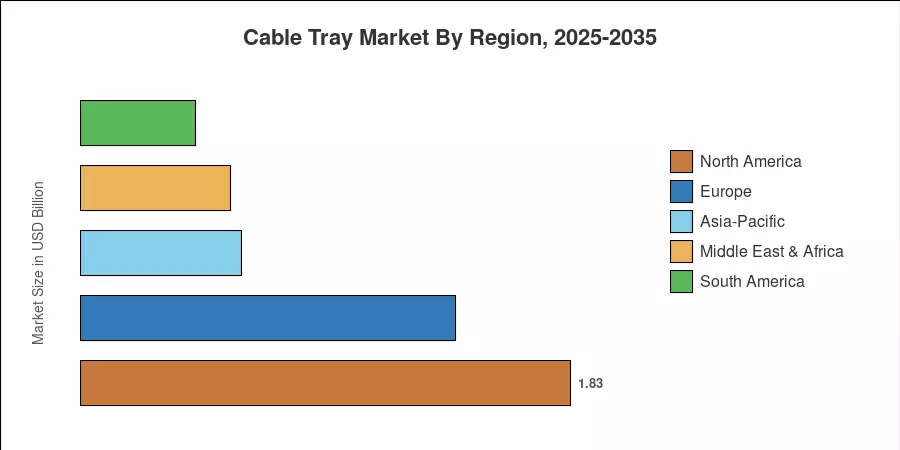
North America holds the dominant position in the cable tray market with roughly 34% of global revenue, driven by sustained utility infrastructure spending and data center expansion. Asia-Pacific is the fastest-growing region at a CAGR exceeding 11%, fueled by India's smart-city mission and China's 5G rollout. Europe accounts for the second-largest share at approximately 26%, supported by industrial modernization across Germany and the Nordic countries. The decade ahead will reward suppliers who can deliver lightweight, code-compliant systems at scale.


Key Report Takeaways

• By Material

  • Steel remains the backbone of the cable tray market, commanding roughly 48% of global revenue in 2025, thanks to its load-bearing capacity and widespread availability in heavy-industrial environments.
  • Aluminum is the fastest-growing material segment with a CAGR of 10.8% through 2035, favored for its corrosion resistance and lighter weight.
  • Fiber-Reinforced Polymers (FRP) hold approximately 20% share, carving a niche in chemical plants and coastal installations where corrosion is a primary concern.

• By End-User Industry

  • Power and Utilities represent the largest end-user group in the cable tray market, accounting for an estimated USD 2.04 billion in 2025.
  • Construction contributes roughly 30% of total demand, propelled by commercial real-estate development and smart-building mandates.

• By Region

  • North America generated the highest cable tray market revenue in 2025, led by the United States.
  • Asia-Pacific is projected to grow at the steepest CAGR through 2035, with India and China as principal contributors.
  • Europe's share sits near 26%, anchored by industrial retrofitting across Western economies.


Market Size and Forecast (2021–2035)

Market Research Future derives historical estimates from trade-association shipment data, customs records, and company filings, while the forecast model applies bottom-up demand projections across material, end-user, and regional dimensions, triangulated against top-down macroeconomic indicators including construction output and data center capital expenditure.
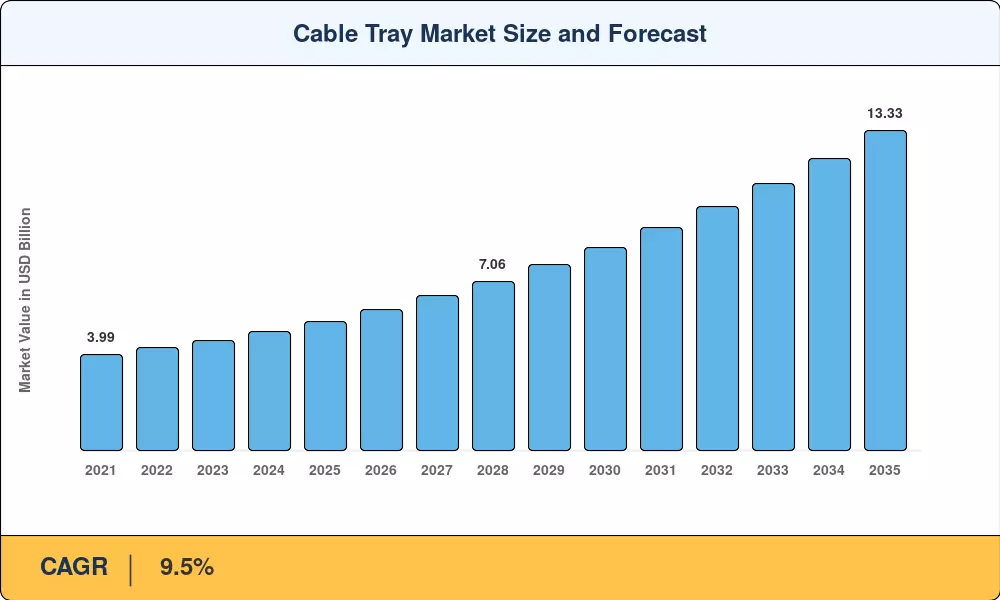
Cable Tray Market Size and Forecast
Our Impact
Enabled $4.3B Revenue Impact for Fortune 500 and Leading Multinationals
Partnering with 2000+ Global Organizations Each Year
30K+ Citations by Top-Tier Firms in the Industry

Driver Impact Analysis

Driver ~% Impact on CAGR Geographic Relevance Impact Timeline
Data Center Capacity Expansion ~22% Global Short-term (≤2 yr)
Urbanization & Smart-City Programs ~18% Asia-Pacific, MEA Medium-term (2–4 yr)
Grid Modernization & Utility Capex ~16% North America, Europe Long-term (≥4 yr)
Tightening Fire & Safety Codes ~14% Europe, North America Medium-term (2–4 yr)
Industrial Automation & Plant Upgrades ~12% Global Long-term (≥4 yr)
5G & Telecom Infrastructure Rollout ~10% Asia-Pacific Short-term (≤2 yr)
Renewable Energy Project Buildout ~8% Global Long-term (≥4 yr)


Data Center Capacity Expansion

The rapid expansion of data centre development is the single biggest short-term driver of the cable tray market. According to JLL's 2025 forecast, around 10 GW of new hyperscale and colocation capacity will begin construction worldwide, with an additional 7 GW scheduled for completion; these projects will total about USD 170 billion [1]. Cable trays serve as the foundation for arranging power distribution, fibre optics, and network cabling across these buildings. Each megawatt of data centre capacity necessitates substantial structured cabling systems. Currently, the majority of this investment is absorbed by North America and Europe, but Southeast Asia and the Middle East are rapidly catching up.


Urbanization and Smart-City Programs

India's Smart Cities Mission, now covering more than 100 cities, directs over USD 30 billion in cumulative investment toward digital infrastructure, transportation, and building modernization [7]. China's 14th Five-Year Plan allocates significant funding to new-type urbanization. Each commercial high-rise, metro station, or mixed-use development requires cable management solutions that meet modern density and fire-safety standards, translating directly into cable tray market demand growth across the Asia-Pacific region.

Grid Modernization and Utility Capital Expenditure

The U.S. Infrastructure Investment and Jobs Act (IIJA) earmarks over USD 65 billion for power-grid upgrades, including substation expansions and transmission-line hardening [2]. Utilities replacing aging switchgear and adding distributed energy resource interconnections specify cable trays for organized, code-compliant routing within substations and control rooms. Europe's REPowerEU strategy reinforces similar spending commitments, ensuring sustained cable tray market demand from the power and utilities sector through 2035.

Tightening Fire and Safety Regulations

The EU's revised Construction Products Regulation (CPR) now mandates enhanced reaction-to-fire classifications for cable support systems installed in public buildings, tunnels, and transportation hubs [3]. In North America, updates to the National Electrical Code (NEC) Article 392 continue to raise minimum standards for cable tray fill ratios and grounding. These regulatory shifts compel building owners and contractors to upgrade or replace legacy conduit installations, creating a recurring replacement demand cycle within the cable tray market.


Restraints Impact Analysis

Restraint ~% Drag on CAGR Geographic Relevance Impact Timeline
High Installation Complexity & Cost ~-25% Global Short-term (≤2 yr)
Raw Material Price Volatility ~-22% Global Medium-term (2–4 yr)
Competition from Conduit Alternatives ~-20% Emerging Markets Long-term (≥4 yr)
Skilled Labor Shortages ~-18% North America, Europe Medium-term (2–4 yr)
Lengthy Permitting & Compliance Cycles ~-15% MEA, South America Long-term (≥4 yr)


High Installation Complexity and Cost

Cable tray installation in large-scale projects — nuclear plants, petrochemical facilities, and mega data centers — demands specialized equipment, precision surveying, and supplementary mounting hardware, including brackets, splicing connectors, and seismic bracing. These added components and labor hours can inflate installed costs by 30–40% relative to basic conduit solutions [11]. For budget-constrained developers in emerging economies, that cost premium often tilts procurement decisions away from cable tray systems and toward simpler alternatives, tempering the cable tray market growth rate in price-sensitive segments.

Raw Material Price Volatility

The two most common materials used in the production of cable trays are steel and aluminium. Between 2022 and 2024, the London Metal Exchange aluminium benchmark changed by about 25%, which directly reduced manufacturing profits and caused end customers' prices to fluctuate [12]. Project developers may postpone cable management procurement or lower specifications when raw material costs rise, which would decrease order intake throughout the cable tray market.


Skilled Labor Shortages

Installation of cable tray systems requires trained electricians and structural technicians — trades currently experiencing acute shortages in North America and Europe. The U.S. Bureau of Labor Statistics projects a shortfall exceeding 80,000 electricians by 2030 [14]. Labor bottlenecks delay project timelines and increase installed costs, acting as a structural headwind for the cable tray market in developed economies.


Cable Tray Market Opportunities

Modular and Pre-Fabricated Tray Systems

Pre-fabricated cable tray assemblies reduce on-site labor time by up to 40%, addressing both cost and skilled-labor constraints. Manufacturers offering factory-configured tray runs with pre-drilled mounting points and integrated grounding are gaining traction in data center and commercial construction segments. This shift toward off-site manufacturing represents a USD 1+ Billion incremental opportunity within the cable tray market by 2030.

Emerging-Market Infrastructure Buildout

Sub-Saharan Africa, Southeast Asia, and the Middle East remain significantly under-penetrated for modern cable management systems. Saudi Arabia's NEOM project alone budgets tens of billions of dollars for smart-city construction, with cable tray systems specified across transportation tunnels, utilities, and building cores. Early movers who establish local distribution and technical support in these markets will capture outsized share.

Data Monetization through IoT-Enabled Tray Systems

A new class of cable tray systems embeds temperature sensors, load monitors, and airflow detectors, feeding real-time operational data to building management platforms. Facility operators pay premiums of 15–20% for these smart trays because the data enables predictive maintenance, reducing unplanned downtime in mission-critical environments like hospitals and financial-sector data centers.

Renewable Energy and EV Charging Infrastructure

Solar farms, wind installations, and EV charging networks all require extensive cable routing from generation or charging points to switchgear and grid interconnection points. The IEA projects global renewable capacity additions exceeding 500 GW annually through 2030 [10], each installation demanding durable, UV-resistant cable tray solutions. This vertical offers the cable tray market a growth vector largely independent of traditional construction cycles.

Lightweight Composite and Hybrid Materials

In offshore platforms, water treatment facilities, and food processing facilities where corrosion resistance and weight reductions exceed upfront cost surcharges, FRP and aluminium-composite hybrid trays are becoming more and more popular. Advances in material science are lowering the cost of producing composites by an estimated 5-7% each year, improving their competitiveness versus conventional steel options and creating new market niches for cable trays.


Cable Tray Market Future Outlook

Electrification Supercycle and Cable Density Growth

The global electrification supercycle — driven by EV charging networks, heat-pump adoption, and industrial process electrification — will push cable densities higher in both new and existing buildings. The IEA estimates global electricity demand will grow by over 30% between 2025 and 2035 [10]. Cable tray systems designed for higher fill ratios and modular expansion will become the default specification for forward-looking facility designs, sustaining cable tray market growth well beyond the current forecast window.

AI-Driven Facility Design and Digital Twins

Building information modeling (BIM) platforms now integrate cable tray routing as a core discipline alongside HVAC and structural engineering. AI-powered design tools optimize tray pathways to minimize material usage and installation time, reducing waste by an estimated 10–15%. As digital twins become standard for data centers and industrial complexes, the cable tray market will increasingly be shaped by software-driven specification decisions rather than traditional contractor preference [16].

Sustainability Reporting and Circular-Economy Pressures

Construction owners and builders are being forced by ESG regulations to record the environmental impact of each construction component, including cable management. In LEED and BREEAM-certified projects, manufacturers of steel and aluminium trays with high recycled-content inputs and published Environmental Product Declarations (EPDs) are obtaining specified advantages. As smaller producers without sustainability credentials lose access to premium project pipelines in the cable tray sector, this transparency trend will hasten market consolidation [17].


Convergence of Power and Data Cabling

The proliferation of Power over Ethernet (PoE) lighting, IoT sensors, and edge computing nodes is blurring the boundary between power and data cabling. Cable tray systems that can accommodate both high-voltage and low-voltage runs with integrated separation barriers and EMI shielding are emerging as a distinct product category. This convergence creates cross-selling opportunities and shifts the cable tray market toward higher-value, engineered solutions rather than commodity steel channels [18].


Cable Tray Market Segmentation

By Material

Segment Key Metric Primary Demand Driver
Steel 48% share (2025) Heavy industrial, power plants, and large commercial
Aluminum CAGR 10.8% Data centers, commercial buildings, and weight-sensitive retrofits
Fiber-Reinforced Polymers (FRP) USD 1.08 Billion (2025) Chemical plants, wastewater facilities, coastal sites


Steel trays dominate the cable tray market by revenue because heavy-industrial end users — power plants, refineries, and manufacturing facilities — prioritize load-bearing capacity above all other attributes. Hot-dip galvanized steel remains the default specification for outdoor and industrial environments where corrosion resistance matters but weight constraints are secondary. Aluminum is gaining ground rapidly in data center and commercial construction segments, where lighter tray weights reduce structural support requirements and speed installation. Projects in seismic zones increasingly prefer aluminum for its favorable strength-to-weight ratio.

FRP trays occupy a specialized but growing position within the cable tray market. Chemical processing plants, wastewater treatment facilities, and offshore platforms specify FRP where exposure to aggressive chemicals or saltwater would degrade metal alternatives within a few years. Production cost reductions in pultrusion technology are gradually making FRP price-competitive with coated steel in moderate-corrosion applications.

By End-User Industry

Segment Key Metric Primary Demand Driver
Power and Utilities USD 2.04 Billion (2025) Substation upgrades, grid expansion, and renewable integration
Construction 30% share (2025) Commercial real estate, smart buildings, transit hubs
Industrial and Other (IT & Telecom, Data Centers, Etc.) CAGR 11.3% Hyperscale data centers, 5G rollout, factory automation


Power and Utilities constitute the largest single end-user vertical in the cable tray market. Substation expansions, transmission-line upgrades, and renewable energy integration projects all require structured cable routing systems that meet stringent utility-grade specifications. The IIJA-funded grid hardening programs in the U.S. alone will sustain multi-year procurement cycles for heavy-duty tray systems.

The Industrial and Other segment — which includes IT & Telecom, data centers, and general manufacturing — is the fastest-growing end-user group. Data center operators increasingly specify cable tray systems over raised-floor cabling because overhead tray routing improves airflow management and simplifies cable additions as server rack densities increase. This architectural shift from under-floor to overhead cable management is a structural tailwind for the cable tray market across all major data center geographies.


Regional Market Share Analysis

Region Key Metric Primary Investment Themes
North America 34% share (2025) Data centers, grid hardening, and NEC compliance
Europe 26% share (2025) Industrial retrofitting, CPR fire codes, green building
Asia-Pacific CAGR 11.2% (2026–2035) Smart cities, 5G, manufacturing plant expansion
South America USD 0.43 Billion (2025) Mining infrastructure, commercial real estate
Middle East & Africa CAGR 10.4% (2026–2035) Mega-projects, oil & gas, urban development
Total USD 5.38 Billion (2025)

The cable tray market spans five major regions, each at a different stage of infrastructure maturity and growth. North America and Europe account for the bulk of current revenue, while Asia-Pacific is rapidly closing the gap on the strength of construction volume and industrial expansion.


North America

Country Key Metric Key Driver
United States 74% of regional share Hyperscale data centers, IIJA grid spending
Canada CAGR 8.9% Mining sector electrification, transit upgrades
Mexico USD 0.09 Billion (2025) Nearshoring manufacturing investment


The United States dominates the North American cable tray market, fueled by a data center construction pipeline that exceeds 5 GW of planned capacity in Virginia, Texas, and Arizona alone. Canada's mining electrification initiatives in Ontario and British Columbia are creating new demand corridors, while Mexico's manufacturing nearshoring wave — particularly in Monterrey and Guadalajara — is drawing fresh cable management spend from automotive and electronics OEMs [6].

Europe

Country Key Metric Key Driver
Germany 22% of the regional share Industrial plant modernization
United Kingdom CAGR 9.1% Data center expansion, HS2 rail project
France USD 0.18 Billion (2025) Nuclear facility refurbishment
Italy 10% of the regional share Renewable energy integration
Spain CAGR 8.7% Solar farm construction
Nordic Countries 12% of regional share Green data centers, wind energy
Russia USD 0.08 Billion (2025) Domestic industrial replacement
Rest of Europe CAGR 8.3% Mixed industrial and commercial


Germany's Industrie 4.0 agenda continues to drive cable tray market adoption in automated manufacturing plants, while the UK's planned hyperscale data center campuses in London's Docklands and Slough create concentrated pockets of demand. The Nordic countries punch above their weight, with sustainable data center developments in Sweden and Finland leveraging cold-climate cooling advantages and specifying high-density cable tray systems to manage server rack interconnections [3].

Asia-Pacific

Country Key Metric Key Driver
China 38% of regional share 5G base stations, industrial zones
India CAGR 12.6% Smart Cities Mission, data center hubs
Japan USD 0.16 Billion (2025) Semiconductor fab construction
South Korea 11% of regional share Chipmaking facilities, transit systems
ASEAN CAGR 11.8% FDI-driven manufacturing clusters
Rest of Asia-Pacific USD 0.07 Billion (2025) General construction growth


Asia-Pacific is the fastest-growing region in the cable tray market. India stands out, with the government's National Data Centre Policy targeting 20+ hyperscale facilities by 2030, each requiring extensive cable management infrastructure. China's ongoing 5G network densification — targeting over 4 million base stations by 2025 — creates downstream tray demand at each cell-site shelter and regional switching center [9].

South America

Country Key Metric Key Driver
Brazil 58% of regional share Mining, petroleum infrastructure
Argentina CAGR 8.4% Lithium extraction projects
Rest of South America USD 0.07 Billion (2025) Commercial building construction


Brazil accounts for the majority of the South American cable tray market revenue, driven by Petrobras refinery upgrades and large-scale mining operations in Minas Gerais that specify heavy-duty steel tray systems for underground cable routing [15].

Middle East & Africa

Country Key Metric Key Driver
Saudi Arabia 32% of regional share NEOM, Vision 2030 construction
UAE CAGR 10.9% Expo-legacy development, data centers
South Africa USD 0.05 Billion (2025) Power utility upgrades
Egypt CAGR 9.8% New Administrative Capital construction
Rest of MEA 20% of regional share Oil & gas, industrial diversification


Saudi Arabia's Vision 2030 mega-projects, including NEOM, The Line, and Red Sea Global, are generating extraordinary cable tray market demand. The UAE continues to expand its data center footprint in Dubai and Abu Dhabi, while Egypt's New Administrative Capital — a USD 58 billion endeavor — specifies modern cable management systems across government buildings, transportation hubs, and residential towers [7].


Cable Tray Market By Region, 2025-2035

Competitive Benchmarking

The cable tray market exhibits low concentration, with the top five players holding an estimated combined share of 28–35%. The remaining revenue is distributed across hundreds of regional manufacturers and local fabricators, resulting in a fragmented competitive environment. The Herfindahl-Hirschman Index (HHI) for this market sits well below 1,000, confirming a structurally competitive landscape where pricing, distribution reach, and code-compliance certifications are the primary differentiators.

Company Est. Revenue Share Range Key Offerings Strategic Positioning
Eaton Corporation ~7–9% Power distribution trays, data center solutions Broad portfolio across utility and commercial segments
Atkore International ~5–8% Steel and aluminum tray systems, fittings Vertically integrated U.S. manufacturer
Legrand SA ~5–7% Cablofil wire mesh trays, modular systems Premium positioning in commercial and data center
Schneider Electric ~4–6% Wibe tray systems, integrated building solutions Cross-selling with the electrical distribution portfolio
ABB Ltd ~3–5% Thomas & Betts cable management products Global distribution, utility-sector strength
Hubbell Incorporated ~3–5% Cable tray, supports, fittings Strong North American utility channel
Niedax Group ~2–4% Ladder and channel trays, European standards European market leader, DIN/EN compliance
Oglaend System (Hilti) ~2–4% Multi-discipline support systems Oil & gas, marine, and industrial specialization
Snake Tray ~1–3% Hand-bendable trays, power distribution Innovation-led positioning, rapid install
Pemsa Cable Management ~1–3% Wire mesh, perforated, and channel trays Southern European and Latin American distribution


Recent News & Developments

  • Eaton Corporation (March 2025): Launched a next-generation aluminum cable tray series designed specifically for hyperscale data centers, featuring integrated cable retainers and a 20% weight reduction versus prior designs [19].
  • Atkore International (January 2025): Completed acquisition of a regional FRP tray manufacturer in the southeastern U.S. to expand its corrosion-resistant product portfolio and serve chemical and water infrastructure customers [20].
  • Legrand SA (October 2024): Introduced a BIM-integrated cable tray configurator that automates specification and quantity takeoff for Cablofil wire-mesh systems, reducing design time by up to 35% [21].
  • National Electrical Code (NEC) (August 2024): Published updated Article 392 provisions tightening cable fill and grounding requirements for tray installations in commercial and industrial occupancies, effective January 2026 [3].
  • Schneider Electric (June 2024): Expanded Wibe cable tray manufacturing capacity at its Swedish facility by 25% to address growing demand from Nordic data center projects [22].
  • Hubbell Incorporated (February 2024): Entered a strategic partnership with a leading modular data center builder to co-develop pre-fabricated overhead cable management assemblies for edge-computing deployments [23].
  • Niedax Group (November 2023): Received EU certification for a fire-rated cable tray system achieving E90 classification under EN 1366-1, targeting metro and rail tunnel applications across Europe [24].
  • ABB Ltd (September 2023): Launched an IoT-enabled cable tray monitoring solution that provides real-time temperature and load data through integration with ABB Ability building management platforms [25].


Cable Tray Market Report Scope

Parameter Detail
Market Scope Global cable tray market covering material types, end-user industries, and five geographic regions
Study Period 2021–2035
Historical Period 2021–2024
Base Year 2025
Forecast Period 2026–2035
CAGR (2026–2035) 9.5%
Market Size (2025) USD 5.38 Billion
Market Size (2035) USD 13.33 Billion
Fastest Growing Material Segment Aluminum (CAGR 10.8%)
Fastest Growing End-User Segment Industrial and Other (CAGR 11.3%)
Companies Profiled 10 (Eaton, Atkore, Legrand, Schneider Electric, ABB, Hubbell, Niedax, Oglaend/Hilti, Snake Tray, Pemsa)
Valuation Currency USD Billion


FAQs

What total cost of ownership factors should procurement teams weigh when specifying cable tray systems?

Installed cost, not unit price, drives TCO — installation labor typically accounts for 40–50% of total project expense. Teams should also factor in maintenance access, future cable additions, and seismic bracing requirements [11].

How do fire-rating classifications differ between North American and European cable tray standards?

NEC Article 392 governs fill ratios and grounding in the U.S., while Europe's EN 1366-1 classifies fire resistance by duration (E30, E60, E90). Specifiers working across both regions must dual-certify systems [3].

What role do cable trays play in data center airflow management compared to raised-floor cabling?

Overhead tray routing eliminates under-floor cable congestion, improving cold-aisle airflow by 15–25%. This thermal benefit increasingly makes cable trays the preferred choice over legacy raised-floor approaches [5].

Are FRP cable trays cost-competitive with coated steel in moderate-corrosion environments?

FRP trays carry a 20–30% upfront premium, but their 25+ year service life in corrosive settings eliminates recurring coating and replacement costs. Lifecycle breakeven typically occurs around year eight.

How is the cable tray market affected by modular construction trends?

Modular and pre-fabricated building methods favor factory-assembled tray runs that arrive ready to install, cutting on-site labor by up to 40%. This trend benefits manufacturers with off-site fabrication capabilities.

What cable tray market segments are most resilient during construction downturns?

Power and utilities spending is budget-cycle driven, not real-estate-cycle driven, making it the most counter-cyclical segment. Maintenance and retrofit demand also provides a revenue floor during downturns.

How do emerging smart-tray technologies with embedded sensors change procurement decisions?

IoT-enabled trays cost 15–20% more but provide real-time load and temperature monitoring, which reduces unplanned maintenance. Facilities prioritizing uptime — hospitals, financial data centers — increasingly justify the premium [25].


Author
Author
Author Profile
Aarti Dhapte LinkedIn
AVP - Research
A consulting professional focused on helping businesses navigate complex markets through structured research and strategic insights. I partner with clients to solve high-impact business problems across market entry strategy, competitive intelligence, and opportunity assessment. Over the course of my experience, I have led and contributed to 100+ market research and consulting engagements, delivering insights across multiple industries and geographies, and supporting strategic decisions linked to $500M+ market opportunities. My core expertise lies in building robust market sizing, forecasting, and commercial models (top-down and bottom-up), alongside deep-dive competitive and industry analysis. I have played a key role in shaping go-to-market strategies, investment cases, and growth roadmaps, enabling clients to make confident, data-backed decisions in dynamic markets.
Download Free Sample

Kindly complete the form below to receive a free sample of this Report

Download PDF ×

We do not share your information with anyone. However, we may send you emails based on your report interest from time to time. You may contact us at any time to opt-out.