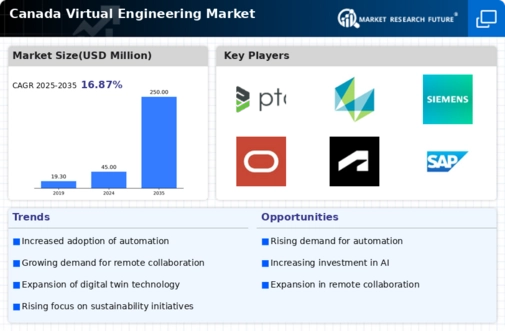
The virtual engineering market in Canada is characterized by a dynamic competitive landscape, driven by rapid technological advancements and increasing demand for digital solutions across various sectors. Key players such as Siemens (CA), Autodesk (CA), and Dassault Systemes (CA) are at the forefront, each adopting distinct strategies to enhance their market positioning. Siemens (CA) emphasizes innovation through its digital twin technology, which integrates real-time data analytics to optimize engineering processes. Meanwhile, Autodesk (CA) focuses on expanding its cloud-based solutions, facilitating collaboration and efficiency in design workflows. Dassault Systemes (CA) leverages its 3D modeling capabilities to cater to industries ranging from aerospace to healthcare, thereby shaping a competitive environment that prioritizes technological integration and customer-centric solutions.
In terms of business tactics, companies are increasingly localizing their operations to better serve the Canadian market, optimizing supply chains to enhance responsiveness and reduce costs. The competitive structure of the market appears moderately fragmented, with several players vying for market share. However, the collective influence of major companies like PTC (CA) and ANSYS (CA) suggests a trend towards consolidation, as these firms seek to enhance their technological offerings and expand their customer bases.
In November 2025, Siemens (CA) announced a strategic partnership with a leading Canadian university to develop advanced simulation technologies aimed at improving manufacturing processes. This collaboration is likely to bolster Siemens' position in the market by fostering innovation and attracting top talent, thereby enhancing its competitive edge. Similarly, in October 2025, Autodesk (CA) launched a new suite of AI-driven design tools, which are expected to streamline workflows and reduce project timelines significantly. This move not only reinforces Autodesk's commitment to innovation but also positions it as a leader in the integration of AI within engineering processes.
Furthermore, in September 2025, Dassault Systemes (CA) expanded its cloud offerings by acquiring a Canadian startup specializing in data analytics for engineering applications. This acquisition is anticipated to enhance Dassault's capabilities in providing comprehensive solutions that integrate data-driven insights, thereby strengthening its market presence. Such strategic actions reflect a broader trend of companies seeking to enhance their technological capabilities through acquisitions and partnerships.
As of December 2025, the competitive trends in the virtual engineering market are increasingly defined by digitalization, sustainability, and the integration of AI technologies. Strategic alliances are becoming pivotal in shaping the landscape, as companies collaborate to leverage complementary strengths. Looking ahead, it appears that competitive differentiation will evolve from traditional price-based competition to a focus on innovation, technological advancement, and supply chain reliability. This shift suggests that companies that prioritize these elements are likely to thrive in an increasingly complex and competitive environment.





























Leave a Comment