×
Request Free Sample ×

Kindly complete the form below to receive a free sample of this Report

* Please use a valid business email

Leading companies partner with us for data-driven Insights

clients tt-cursor
Hero Background

US Virtual Engineering Market

ID: MRFR/ICT/18206-HCR
100 Pages
Garvit Vyas
October 2025

US Virtual Engineering Market Research Report: By Software Type (Computer-Aided Designing (CAD), Computer-Aided Manufacturing (CAM), Computer-Aided Engineering (CAE), Architecture, Engineering and Construction (AEC), Electronic Design Automation (EDA)Others), By Deployment Type (On-premises, Cloud), By Organization Size (SME’s, Large Enterprises), By Application (Automation Design, Plant Design, Product Design, 3D MODELLING, Others) and By Industry Vertical (Commercial Industry Vertical, Defense Industry Vertical) - Forecast to 2035

Share:
Download PDF ×

We do not share your information with anyone. However, we may send you emails based on your report interest from time to time. You may contact us at any time to opt-out.

US Virtual Engineering Market Infographic
Purchase Options

US Virtual Engineering Market Summary

As per analysis, the US virtual engineering market is projected to grow from USD 194.08 Million in 2024 to USD 221.35 Million by 2025, exhibiting a compound annual growth rate (CAGR) of 15.64% during the forecast period (2025 - 2035).

Key Market Trends & Highlights

The US virtual engineering market is experiencing robust growth driven by technological advancements and evolving industry needs.

  • The adoption of digital twins is increasingly prevalent in the product design segment, enhancing efficiency and innovation.
  • Remote collaboration tools are gaining traction, particularly in the automotive sector, as teams adapt to new working environments.
  • Sustainability initiatives are becoming a focal point, with companies striving to reduce their environmental impact through virtual engineering solutions.
  • The growing demand for automation in engineering processes and advancements in simulation technologies are key drivers propelling market expansion.

Market Size & Forecast

2024 Market Size 194.08 (USD Million)
2035 Market Size 959.77 (USD Million)
CAGR (2025 - 2035) 15.64%

Major Players

Siemens (US), Autodesk (US), PTC (US), ANSYS (US), Dassault Systemes (US), Altair Engineering (US), Hexagon (US), Bentley Systems (US)

US Virtual Engineering Market Trends

The US virtual engineering market is currently experiencing a transformative phase, characterized by the integration of advanced technologies and innovative methodologies. This sector encompasses a wide array of applications, including simulation, modeling, and digital twin technologies, which are increasingly utilized across various industries such as manufacturing, aerospace, and automotive. The emphasis on enhancing efficiency and reducing costs has led organizations to adopt virtual engineering solutions, thereby streamlining their operations and improving product development cycles. Furthermore, the growing demand for remote collaboration tools has accelerated the adoption of virtual engineering practices, enabling teams to work seamlessly across geographical boundaries. In addition, the US government has shown a commitment to fostering innovation within this domain, providing support through funding initiatives and research programs. This backing is likely to stimulate further advancements in virtual engineering technologies, encouraging companies to invest in research and development. As the market evolves, it appears that the focus will shift towards sustainability and resilience, with organizations seeking to leverage virtual engineering to address environmental challenges and enhance their competitive edge. Overall, the US virtual engineering market is poised for substantial growth, driven by technological advancements and a strong emphasis on collaboration and efficiency.

Increased Adoption of Digital Twins

The US virtual engineering market is witnessing a notable rise in the adoption of digital twin technology. This approach allows organizations to create virtual replicas of physical assets, enabling real-time monitoring and analysis. By utilizing digital twins, companies can optimize performance, predict maintenance needs, and enhance decision-making processes, thereby improving overall operational efficiency.

Focus on Remote Collaboration Tools

There is a growing emphasis on remote collaboration tools within the US virtual engineering market. As organizations increasingly embrace flexible work arrangements, these tools facilitate seamless communication and project management among distributed teams. This trend not only enhances productivity but also fosters innovation by allowing diverse teams to collaborate effectively, regardless of their physical locations.

Sustainability Initiatives

Sustainability is becoming a central theme in the US virtual engineering market. Companies are increasingly leveraging virtual engineering solutions to address environmental concerns and promote sustainable practices. By simulating various scenarios, organizations can assess the environmental impact of their projects and make informed decisions that align with sustainability goals.

Market Segment Insights

By Application: Product Design (Largest) vs. Simulation (Fastest-Growing)

In the US virtual engineering market, Product Design holds the largest share among the various applications, showcasing its critical role in the innovation process across industries. This segment facilitates the creation of highly accurate models, leading to enhanced collaboration and efficiency in engineering tasks. In contrast, Simulation, while smaller in market share, is the fastest-growing segment, reflecting a growing need for accurate testing and prediction in product performance before production, thereby minimizing costs and maximizing output quality.

Simulation (Dominant) vs. Prototyping (Emerging)

The Simulation segment has solidified its position as a dominant player within the US virtual engineering market, providing vital insights into performance and functionality before products reach the manufacturing phase. It is heavily favored for its ability to reduce the time and cost associated with physical testing. In comparison, Prototyping represents an emerging value, leveraging rapid advancements in technologies such as 3D printing to create physical models from digital designs. While currently less established, Prototyping is rapidly evolving, driven by the demand for more iterative design processes that can accommodate faster product development cycles.

By End Use: Automotive (Largest) vs. Aerospace (Fastest-Growing)

In the US virtual engineering market, the end use segmentation is prominent, with the automotive sector holding the largest share. This sector's reliance on advanced simulation tools and modeling has spurred its dominance, driven by the industry's need for innovation and efficiency in design and production processes. Following automotive, aerospace is emerging as a significant contender, leveraging virtual engineering to enhance safety, reduce costs, and streamline operations. Both sectors are witnessing robust adoption of virtual engineering techniques due to their ability to facilitate complex designs and accelerate project timelines. The growth trends in the US virtual engineering market reveal a promising trajectory for the aerospace sector, which is currently the fastest-growing area. A surge in investments in aviation technology and an emphasis on sustainability are key drivers of this growth. Moreover, the increasing complexity of aircraft design is leading firms to invest more in virtual testing and simulations, allowing them to optimize performance and comply with stringent regulations. The automotive sector, while currently the largest, is also adapting by integrating electric and autonomous vehicle technologies, ensuring its continued relevance and expansion within this dynamic market.

Automotive: Traditional Vehicles (Dominant) vs. Electric Vehicles (Emerging)

In the US virtual engineering market, the automotive sector is distinctly categorized into traditional vehicles and the rapidly emerging electric vehicle segment. Traditional vehicles represent the dominant force, as established manufacturers rely heavily on virtual engineering for design, prototyping, and testing. This segment benefits from a longstanding integration of virtual tools, enhancing efficiency and lowering production costs. On the other hand, electric vehicles are marking their territory as an emerging sector within the market. As consumer demand shifts toward eco-friendly alternatives, companies are increasingly leveraging virtual engineering to innovate battery technologies and optimize electric drivetrains. This shift not only promotes sustainability but also reflects a significant transformation in consumer preferences, pushing traditional automotive players to adapt swiftly.

By Technology: Computer-Aided Design (Largest) vs. Virtual Reality (Fastest-Growing)

In the US virtual engineering market, Computer-Aided Design (CAD) holds a significant share, dominating the technology segment. Positioned as a fundamental tool for engineers and designers, CAD enables precision in drafting and modeling, leading the charge in adoption among various industries. Following closely behind, Finite Element Analysis (FEA) and Computational Fluid Dynamics (CFD) also maintain substantial market shares, showcasing the crucial role of simulation technologies. Augmented Reality (AR), while smaller, contributes to enriching the design experience, further enhancing the collaborative efforts in engineering projects. As the industry evolves, the growth trends suggest a robust increase in the use of Virtual Reality (VR) within engineering applications. Companies increasingly recognize VR's potential to revolutionize design and prototyping phases, offering immersive experiences that enhance understanding and collaboration. The drive toward digital transformation and increasing demands for efficiency are propelling investment into these technologies, particularly VR and AR, which are becoming essential tools for engineers aiming to innovate and optimize their processes.

Technology: Computer-Aided Design (Dominant) vs. Virtual Reality (Emerging)

Computer-Aided Design (CAD) has established itself as the backbone of engineering and design processes in the US virtual engineering market, frequently regarded as indispensable for producing high-quality models and technical drawings. Its widespread adoption stems from the need for precision, the reduction of errors, and enhanced productivity. In contrast, Virtual Reality is emerging as a transformative technology that is reshaping how engineers visualize and interact with complex designs. With its ability to simulate realistic environments, VR is gaining traction among firms looking for innovative solutions to improve design visualization and collaboration among stakeholders. While CAD dominates in terms of traditional engineering applications, VR's unique capabilities present new opportunities for engagement and insight in the engineering workflow.

By Service Type: Consulting (Largest) vs. Support (Fastest-Growing)

In the US virtual engineering market, the service type segment exhibits a diverse distribution among major players, with Consulting holding the largest share, largely due to its essential role in guiding businesses through virtual transitions. This segment addresses the growing demand for strategic planning and integration of virtual engineering solutions into traditional practices. Conversely, the Support service is emerging as the fastest-growing segment, driven by increasing reliance on technology and the demand for ongoing assistance as businesses adopt virtual engineering frameworks.

Consulting: Traditional (Dominant) vs. Support: On-Demand (Emerging)

The Consulting sector remains dominant within the US virtual engineering market, characterized by firms providing strategic insights and tailored solutions that facilitate clients' adaptation to virtual ecosystems. These consulting services encompass a blend of project management, systems integration, and innovative strategy formulations. On the other hand, the Support segment has become increasingly important as an emerging value, highlighting the need for immediate assistance and troubleshooting for users. This sector focuses on offering prompt and effective solutions, ensuring that clients can efficiently navigate technological challenges while maximizing the utility of their virtual engineering tools. The contrast in their characteristics emphasizes the evolving landscape of service needs in this market.

By Deployment Model: Cloud-Based (Largest) vs. On-Premises (Fastest-Growing)

In the US virtual engineering market, the deployment model segment comprises On-Premises, Cloud-Based, and Hybrid solutions. Currently, Cloud-Based solutions hold the largest market share due to their scalability, flexibility, and ease of integration with other cloud services. As organizations increasingly transition to digital operations, Cloud-Based deployment models are becoming the preferred choice for many firms seeking efficient engineering solutions. Conversely, On-Premises deployment is emerging as the fastest-growing segment. While historically associated with traditional infrastructure, recent advancements enable companies to leverage on-premises solutions with hybrid capabilities. This change is driven by businesses prioritizing data security and control, leading to a resurgence of interest and investment in On-Premises engineering solutions.

Cloud-Based (Dominant) vs. On-Premises (Emerging)

In the current landscape of the US virtual engineering market, Cloud-Based solutions are recognized as the dominant deployment model, offering unmatched scalability and accessibility. Companies benefit from the ability to quickly deploy engineering applications without heavy initial investments in hardware. On the other hand, On-Premises solutions are classified as emerging within this context. They provide a level of security and customization that many organizations find compelling, especially in industries where data sensitivity is crucial. The integration of hybrid approaches further fuels the growth of On-Premises deployments, presenting a balanced option for firms looking to maintain some control over their infrastructure while still enjoying the benefits of cloud technologies.

Get more detailed insights about US Virtual Engineering Market

Key Players and Competitive Insights

The virtual engineering market is currently characterized by a dynamic competitive landscape, driven by rapid technological advancements and an increasing demand for innovative solutions across various sectors. Key players such as Siemens (US), Autodesk (US), and ANSYS (US) are strategically positioning themselves to leverage these growth opportunities. Siemens (US) focuses on digital transformation and smart infrastructure, while Autodesk (US) emphasizes cloud-based solutions and design automation. ANSYS (US) is heavily invested in simulation software, which is critical for product development in engineering. Collectively, these strategies not only enhance their operational capabilities but also intensify competition, as companies strive to differentiate themselves through innovation and customer-centric solutions.

In terms of business tactics, companies are increasingly localizing manufacturing and optimizing supply chains to enhance efficiency and responsiveness. The competitive structure of the market appears moderately fragmented, with several key players exerting influence over various segments. This fragmentation allows for niche players to emerge, yet the collective strength of major companies like Siemens (US) and Autodesk (US) shapes market dynamics significantly, as they set benchmarks for technology and service delivery.

In November 2025, Siemens (US) announced a strategic partnership with a leading AI firm to enhance its digital twin technology, which is expected to revolutionize predictive maintenance in manufacturing. This move underscores Siemens' commitment to integrating AI into its offerings, potentially providing clients with unprecedented insights into operational efficiencies. Such advancements may not only solidify Siemens' market position but also compel competitors to accelerate their own AI initiatives.

In October 2025, Autodesk (US) launched a new suite of tools aimed at improving collaboration in remote engineering projects. This initiative reflects a growing trend towards remote work solutions, which have become essential in the current business environment. By enhancing collaborative capabilities, Autodesk (US) is likely to attract a broader customer base, particularly among firms seeking to streamline their engineering processes in a hybrid work setting.

In September 2025, ANSYS (US) expanded its cloud-based simulation offerings through the acquisition of a smaller tech firm specializing in machine learning algorithms. This acquisition is strategically significant as it allows ANSYS (US) to enhance its simulation capabilities, making them more accessible and efficient for users. The integration of machine learning into simulation processes could lead to faster product development cycles, thereby providing ANSYS (US) with a competitive edge in the market.

As of December 2025, the virtual engineering market is witnessing trends that emphasize digitalization, sustainability, and AI integration. Strategic alliances are increasingly shaping the competitive landscape, as companies recognize the value of collaboration in driving innovation. The shift from price-based competition to a focus on technological advancement and supply chain reliability is evident, suggesting that future competitive differentiation will hinge on the ability to innovate and adapt to evolving market demands.


Key Companies in the US Virtual Engineering Market market include

Industry Developments

The US Virtual Engineering Market has witnessed significant advancements lately, driven by companies like ANSYS, Emerson Electric, SAP, and PTC, which are enhancing their offerings in simulation and modeling technologies. In September 2023, 3D Systems launched a new line of industrial 3D printers aimed at increasing production efficiency, which is anticipated to reshape manufacturing processes. Concurrently, NVIDIA announced in August 2023 a strategic partnership with Siemens to integrate AI capabilities into engineering workflows, further emphasizing the trend toward digital transformation in the sector.

In terms of mergers and acquisitions, Rockwell Automation acquired AVEVA in July 2023, enhancing its capabilities in engineering software solutions, which has garnered positive attention in the market. This trend of consolidation among leading firms is being driven by the desire to create comprehensive digital engineering solutions. Over the past few years, key developments include IBM's investment in cloud-based engineering platforms and Hexagon's expansion into artificial intelligence applications in May 2022. The overall growth trajectory in market valuation indicates a robust interest in virtual engineering, underscoring its pivotal role in modern engineering practices across various industries in the US market.

Future Outlook

US Virtual Engineering Market Future Outlook

The US virtual engineering market is projected to grow at a 15.64% CAGR from 2024 to 2035, driven by advancements in AI, automation, and demand for remote collaboration.

New opportunities lie in:

  • Development of AI-driven simulation tools for real-time decision-making.
  • Integration of virtual reality in training programs for engineers.
  • Expansion of cloud-based platforms for collaborative engineering projects.

By 2035, the market is expected to be robust, driven by innovation and increased adoption across industries.

Market Segmentation

US Virtual Engineering Market End Use Outlook

  • Automotive
  • Aerospace
  • Consumer Electronics
  • Healthcare
  • Industrial Equipment

US Virtual Engineering Market Technology Outlook

  • Computer-Aided Design
  • Finite Element Analysis
  • Computational Fluid Dynamics
  • Virtual Reality
  • Augmented Reality

US Virtual Engineering Market Application Outlook

  • Product Design
  • Simulation
  • Prototyping
  • Testing
  • Manufacturing

US Virtual Engineering Market Service Type Outlook

  • Consulting
  • Training
  • Support
  • Maintenance
  • Customization

US Virtual Engineering Market Deployment Model Outlook

  • On-Premises
  • Cloud-Based
  • Hybrid

Report Scope

MARKET SIZE 2024194.08(USD Million)
MARKET SIZE 2025221.35(USD Million)
MARKET SIZE 2035959.77(USD Million)
COMPOUND ANNUAL GROWTH RATE (CAGR)15.64% (2024 - 2035)
REPORT COVERAGERevenue Forecast, Competitive Landscape, Growth Factors, and Trends
BASE YEAR2024
Market Forecast Period2025 - 2035
Historical Data2019 - 2024
Market Forecast UnitsUSD Million
Key Companies ProfiledSiemens (US), Autodesk (US), PTC (US), ANSYS (US), Dassault Systemes (US), Altair Engineering (US), Hexagon (US), Bentley Systems (US)
Segments CoveredApplication, End Use, Technology, Service Type, Deployment Model
Key Market OpportunitiesIntegration of artificial intelligence in design processes enhances efficiency in the US virtual engineering market.
Key Market DynamicsRising demand for advanced simulation tools drives innovation in the US virtual engineering market.
Countries CoveredUS

Leave a Comment

FAQs

What is the expected market size of the US Virtual Engineering Market by 2024?

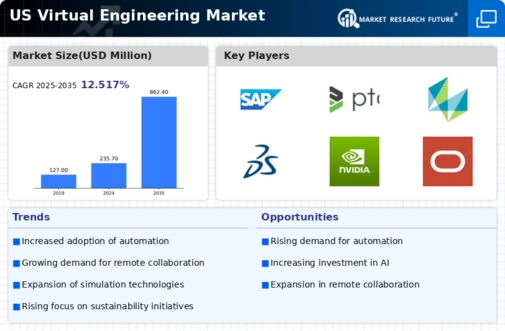
The US Virtual Engineering Market is expected to be valued at 235.68 million USD by the year 2024.

What will be the projected market size of the US Virtual Engineering Market by 2035?

By 2035, the US Virtual Engineering Market is projected to reach a value of 862.4 million USD.

What is the CAGR for the US Virtual Engineering Market from 2025 to 2035?

The expected compound annual growth rate (CAGR) for the US Virtual Engineering Market from 2025 to 2035 is 12.517%.

Which software segment will dominate the US Virtual Engineering Market by 2035?

By 2035, the Computer-Aided Designing (CAD) segment is anticipated to dominate the US Virtual Engineering Market, reaching a valuation of 220 million USD.

What is the market value for Computer-Aided Manufacturing (CAM) in 2024?

In 2024, the market value for Computer-Aided Manufacturing (CAM) will be 40 million USD.

Who are the major players in the US Virtual Engineering Market?

Major players in the US Virtual Engineering Market include ANSYS, Emerson Electric, SAP, PTC, Hexagon, and more.

What is the expected value of the Electronic Design Automation (EDA) segment in 2035?

The Electronic Design Automation (EDA) segment is projected to value at 62.4 million USD by 2035.

What are the growth opportunities for the US Virtual Engineering Market?

Key growth opportunities are driven by technological advancements and increasing demand for automation in engineering processes.

How will the Architecture, Engineering and Construction (AEC) segment perform by 2035?

The Architecture, Engineering and Construction (AEC) segment is expected to perform well, reaching a market size of 240 million USD by 2035.

What challenges does the US Virtual Engineering Market face?

Challenges include the need for continuous innovation and integration of advanced technologies in engineering processes.

Download Free Sample

Kindly complete the form below to receive a free sample of this Report

Compare Licence

×
Features License Type
Single User Multiuser License Enterprise User
Price $4,950 $5,950 $7,250
Maximum User Access Limit 1 User Upto 10 Users Unrestricted Access Throughout the Organization
Free Customization
Direct Access to Analyst
Deliverable Format
Platform Access
Discount on Next Purchase 10% 15% 15%
Printable Versions