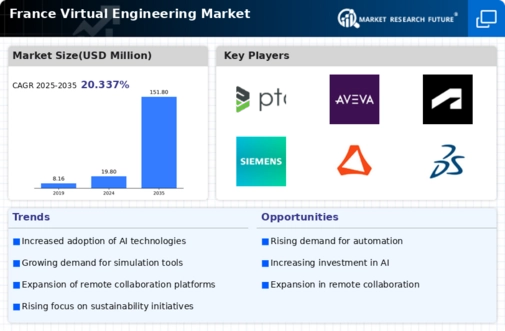
The virtual engineering market in France is characterized by a dynamic competitive landscape, driven by rapid technological advancements and increasing demand for digital solutions across various sectors. Key players such as Dassault Systèmes (France), Siemens (Germany), and Ansys (USA) are at the forefront, leveraging their expertise in simulation and modeling to enhance product development processes. These companies are strategically positioned to capitalize on the growing trend of digital transformation, with a focus on innovation and partnerships that foster collaborative engineering solutions. Their collective efforts contribute to a moderately fragmented market structure, where competition is intensified by the presence of both established firms and emerging startups.
In terms of business tactics, companies are increasingly localizing their operations to better serve the French market, optimizing supply chains to enhance efficiency and responsiveness. The competitive structure remains moderately fragmented, with key players exerting significant influence over market dynamics. This fragmentation allows for a diverse range of offerings, catering to various customer needs while fostering innovation through competition.
In November 2025, Dassault Systèmes (France) announced a strategic partnership with a leading automotive manufacturer to develop advanced simulation tools aimed at accelerating electric vehicle design. This collaboration underscores the importance of integrating cutting-edge technology into traditional engineering practices, positioning Dassault Systèmes as a pivotal player in the transition towards sustainable mobility solutions. The partnership is expected to enhance the company's market share and reinforce its commitment to innovation in the automotive sector.
In October 2025, Siemens (Germany) unveiled its new cloud-based platform designed to streamline engineering workflows across industries. This initiative reflects Siemens' ongoing commitment to digitalization, enabling clients to leverage real-time data for improved decision-making. The platform's launch is likely to strengthen Siemens' competitive edge by providing clients with enhanced capabilities to optimize their engineering processes, thereby driving efficiency and reducing time-to-market.
In September 2025, Ansys (USA) expanded its portfolio by acquiring a software startup specializing in AI-driven simulation technologies. This acquisition is indicative of Ansys' strategy to integrate artificial intelligence into its offerings, enhancing the predictive capabilities of its simulation tools. By incorporating AI, Ansys aims to provide clients with more accurate insights, thereby improving product performance and reliability.
As of December 2025, the competitive trends in the virtual engineering market are increasingly defined by digitalization, sustainability, and the integration of AI technologies. Strategic alliances are becoming more prevalent, as companies recognize the need to collaborate in order to innovate and meet evolving customer demands. The shift from price-based competition to a focus on technological advancement and supply chain reliability is evident, suggesting that future competitive differentiation will hinge on the ability to deliver innovative solutions that address complex engineering challenges.


























Leave a Comment