×
Request Free Sample ×

Kindly complete the form below to receive a free sample of this Report

* Please use a valid business email

Leading companies partner with us for data-driven Insights

clients tt-cursor
Hero Background

Carbon Foam Battery Market

ID: MRFR/EnP/9002-HCR
128 Pages
Priya Nagrale
October 2025

Carbon Foam Battery Market Research Report By Application (Electric Vehicles, Consumer Electronics, Renewable Energy Storage, Aerospace), By Type (Solid State Carbon Foam Battery, Lithium-ion Carbon Foam Battery, Nickel Metal Hydride Carbon Foam Battery), By Capacity (Low Capacity, Medium Capacity, High Capacity), By End Use (Automotive, Telecommunications, Industrial) and By Regional (North America, Europe, South America, Asia Pacific, Middle East and Africa) - Forecast to 2035

Share:
Download PDF ×

We do not share your information with anyone. However, we may send you emails based on your report interest from time to time. You may contact us at any time to opt-out.

Carbon Foam Battery Market Infographic
Purchase Options

Carbon Foam Battery Market Summary

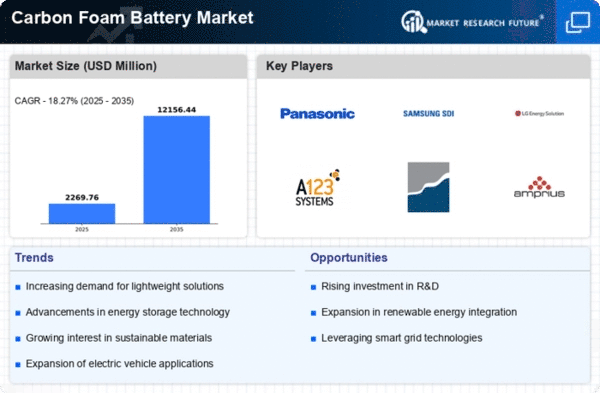
As per MRFR analysis, the Carbon Foam Battery Market Size was estimated at 1919.13 USD Million in 2024. The Carbon Foam Battery industry is projected to grow from 2269.79 in 2025 to 12156.44 by 2035, exhibiting a compound annual growth rate (CAGR) of 18.27 during the forecast period 2025 - 2035.

Key Market Trends & Highlights

The Carbon Foam Battery Market is poised for substantial growth driven by sustainability and technological advancements.

  • North America remains the largest market for carbon foam batteries, driven by increasing investments in sustainable energy solutions.
  • Asia-Pacific is recognized as the fastest-growing region, reflecting a surge in demand for innovative energy storage technologies.
  • The electric vehicle segment dominates the market, while the telecommunications segment is emerging as the fastest-growing application for carbon foam batteries.
  • Key market drivers include the rising demand for energy storage solutions and advancements in battery technology, particularly in the automotive sector.

Market Size & Forecast

2024 Market Size 1919.13 (USD Million)
2035 Market Size 12156.44 (USD Million)
CAGR (2025 - 2035) 18.27%

Major Players

Panasonic (JP), Samsung SDI (KR), LG Energy Solution (KR), A123 Systems (US), Sion Power (US), Amprius Technologies (US), Nexeon (GB), Enevate (US)

Carbon Foam Battery Market Trends

The Carbon Foam Battery Market is currently experiencing a notable transformation, driven by advancements in energy storage technologies and the increasing demand for sustainable solutions. This market appears to be gaining traction due to its potential to offer lightweight, high-performance batteries that could outperform traditional options. The unique properties of carbon foam, such as its high conductivity and structural integrity, suggest that it may play a pivotal role in the future of energy storage systems. As industries seek to enhance efficiency and reduce environmental impact, the adoption of carbon foam batteries seems to be on the rise, particularly in sectors like electric vehicles and renewable energy storage. Moreover, the Carbon Foam Battery Market is likely to benefit from ongoing research and development efforts aimed at improving battery performance and longevity. Innovations in manufacturing processes and material science may lead to cost-effective production methods, further encouraging market growth. Additionally, the increasing focus on reducing carbon footprints and enhancing energy efficiency across various sectors indicates a promising outlook for carbon foam batteries. Stakeholders in the energy sector are expected to explore this technology as a viable alternative to conventional batteries, potentially reshaping the landscape of energy storage solutions in the coming years.

Sustainability Focus

The emphasis on sustainable energy solutions is driving interest in the Carbon Foam Battery Market. As organizations strive to minimize their environmental impact, the demand for eco-friendly battery technologies is likely to increase. Carbon foam batteries, with their potential for reduced waste and improved recyclability, may align well with these sustainability goals.

Technological Advancements

Ongoing innovations in battery technology are shaping the Carbon Foam Battery Market. Research into enhancing the performance and efficiency of carbon foam batteries suggests that they could soon rival or surpass traditional battery technologies. This trend indicates a shift towards more advanced energy storage solutions.

Electric Vehicle Integration

The integration of carbon foam batteries into electric vehicles is emerging as a significant trend. As the automotive industry seeks to improve battery performance and reduce weight, carbon foam batteries may offer a compelling alternative. This trend could lead to increased adoption in the electric vehicle sector, further propelling market growth.

Carbon Foam Battery Market Drivers

Market Growth Projections

The Global Carbon Foam Battery Market Industry is poised for substantial growth, with projections indicating a market size of 10.3 USD Billion by 2035. This anticipated growth reflects the increasing recognition of carbon foam batteries as a viable energy storage solution across various sectors. The market is expected to experience a compound annual growth rate (CAGR) of 18.24% from 2025 to 2035, driven by advancements in technology, rising demand for sustainable energy solutions, and the growing adoption of electric vehicles. These projections highlight the potential for carbon foam batteries to become a cornerstone of future energy systems.

Advancements in Battery Technology

Technological advancements in battery design and materials are propelling the Global Carbon Foam Battery Market Industry forward. Innovations in carbon foam structures enhance battery performance, leading to improved energy efficiency and longevity. These advancements not only optimize the battery's operational capabilities but also contribute to cost reductions in manufacturing processes. As a result, the market is expected to grow significantly, with projections indicating a rise to 10.3 USD Billion by 2035. This growth is indicative of the industry's commitment to research and development, fostering a competitive landscape that encourages further innovation in carbon foam battery technologies.

Increasing Electric Vehicle Adoption

The rise in electric vehicle (EV) adoption is a major driver for the Global Carbon Foam Battery Market Industry. As more consumers and manufacturers embrace electric mobility, the demand for advanced battery technologies intensifies. Carbon foam batteries, with their superior energy density and lightweight properties, are becoming increasingly attractive for EV applications. This trend is expected to contribute to a compound annual growth rate (CAGR) of 18.24% from 2025 to 2035, underscoring the potential for carbon foam batteries to play a pivotal role in the future of transportation. The integration of these batteries into EVs could revolutionize the automotive industry.

Rising Investment in Renewable Energy

Investment in renewable energy sources is a crucial factor driving the Global Carbon Foam Battery Market Industry. As countries transition towards sustainable energy systems, the need for efficient energy storage solutions becomes more pronounced. Carbon foam batteries offer a promising alternative due to their high performance and environmental benefits. The increasing allocation of funds towards renewable projects is likely to bolster the demand for carbon foam batteries, facilitating their integration into various applications. This trend not only supports the growth of the market but also aligns with global efforts to achieve energy independence and sustainability.

Growing Demand for Energy Storage Solutions

The Global Carbon Foam Battery Market Industry is experiencing a surge in demand for energy storage solutions, driven by the increasing need for efficient and sustainable energy systems. As renewable energy sources gain traction, the requirement for reliable storage technologies becomes paramount. Carbon foam batteries, with their lightweight and high energy density characteristics, are well-positioned to meet this demand. In 2024, the market is projected to reach 1.62 USD Billion, reflecting a growing recognition of carbon foam batteries as viable alternatives to traditional storage systems. This trend is likely to continue, as global energy policies increasingly favor sustainable technologies.

Environmental Regulations and Sustainability Initiatives

The Global Carbon Foam Battery Market Industry is significantly influenced by stringent environmental regulations and sustainability initiatives. Governments worldwide are implementing policies aimed at reducing carbon emissions and promoting cleaner energy technologies. Carbon foam batteries, known for their lower environmental impact compared to conventional batteries, align well with these regulatory frameworks. As industries and consumers increasingly prioritize sustainability, the demand for eco-friendly battery solutions is likely to rise. This shift not only supports the growth of the carbon foam battery market but also encourages manufacturers to adopt greener practices in their production processes.


Market Segment Insights

By Application: Electric Vehicle (Largest) vs. Energy Storage System (Fastest-Growing)

In the Carbon Foam Battery Market, the application segment showcases a significant distribution of market share among various sectors. Electric Vehicles (EVs) stand out as the largest segment, driven by the increasing demand for environmentally friendly transportation solutions. Following closely is the Energy Storage System (ESS), which is rapidly gaining traction as the need for efficient energy management solutions intensifies, especially with the rise in renewable energy sources.

Electric Vehicle (Dominant) vs. Industrial Equipment (Emerging)

Electric vehicles dominate the application segment of the Carbon Foam Battery Market as automakers increasingly adopt high-performance energy solutions for superior range and efficiency. The batteries' lightweight and high conductivity characteristics make them ideal for EVs, ensuring optimal performance. On the other hand, the Industrial Equipment sector is emerging as a notable player due to its need for durable and efficient energy solutions. As industries focus on minimizing carbon footprints and investing in sustainable technologies, Carbon Foam Batteries offer an advantageous option due to their resilience and energy density, propelling their growth in this sector.

By End Use: Automotive (Largest) vs. Telecommunications (Fastest-Growing)

The Carbon Foam Battery Market exhibits a diverse array of applications across various end-use sectors. Among these, the automotive segment holds the largest market share, driven by the increasing demand for high-performance energy storage solutions in electric vehicles. Meanwhile, the telecommunications sector is rapidly emerging, leveraging carbon foam batteries for their superior energy density and longer cycle life, poised to capture a significant share in the coming years.

Automotive: Dominant vs. Telecommunications: Emerging

The automotive sector is currently the dominant force in the Carbon Foam Battery Market, taking advantage of advancements in battery technology to enhance electric vehicle performance. These batteries are appreciated for their lightweight properties, allowing prolonged vehicle ranges and faster charging times. In contrast, the telecommunications segment is emerging as a strong competitor, characterized by the need for reliable energy storage to support continuous connectivity and the deployment of 5G technology. The telecom industry's transition towards renewable energy sources and efficient battery systems further boosts its growth potential, making it a key player in this evolving market.

By Technology: Lithium-ion (Largest) vs. Solid State (Fastest-Growing)

The Carbon Foam Battery Market showcases a diverse range of technologies, with Lithium-ion batteries holding the largest market share due to their established performance and widespread adoption across various applications. In contrast, Solid State batteries, while currently holding a smaller share, are poised for rapid growth driven by advancements in materials and technology, as well as increasing consumer demand for safer and more efficient energy storage solutions. Together, these technologies represent the dual landscape of dominance and innovation within the sector. The growth trajectory of the Carbon Foam Battery Market indicates a significant shift towards more advanced battery technologies. Solid State batteries are attracting considerable investment and research focus as manufacturers strive to enhance energy density and safety. Concurrently, Lithium-ion technology remains crucial, particularly in electric vehicles and portable electronics, driving continuous improvements in battery efficiency. The interplay between mature technologies and emerging innovations is shaping the future of the market, leading to exciting opportunities for both established manufacturers and new entrants.

Technology: Lithium-ion (Dominant) vs. Solid State (Emerging)

Lithium-ion batteries are the dominant technology in the Carbon Foam Battery Market, known for their high energy density, efficiency, and versatility in applications ranging from consumer electronics to electric vehicles. Their well-entrenched supply chains and manufacturing infrastructure contribute to their prevalent use. In comparison, Solid State batteries are an emerging technology, gaining traction due to their potential to enhance safety and performance by utilizing solid electrolytes instead of liquids. This shift promises to reduce risks such as leakage and flammability, making Solid State an attractive option for future energy storage solutions. As research continues, the competitive landscape is likely to evolve, with Solid State positioning itself as a strong alternative to traditional Lithium-ion batteries.

By Form Factor: Prismatic (Largest) vs. Cylindrical (Fastest-Growing)

In the Carbon Foam Battery Market, the form factor segment is diverse, consisting of prismatic, cylindrical, pouch, stacked, and modular designs. Among these, prismatic batteries hold the largest market share due to their efficiency in space utilization and energy density. They are particularly favored in automotive and consumer electronics applications, where performance is critical. In contrast, cylindrical batteries, known for their superior thermal regulation and robust build quality, have emerged as the fastest-growing segment. Their growing usage in electric vehicles is driving this rapid expansion.

Prismatic (Dominant) vs. Cylindrical (Emerging)

Prismatic batteries are recognized for their design that optimizes space and provides high energy density, which makes them ideal for applications where size and weight are critical, such as in electric vehicles and portable electronic devices. They offer excellent thermal management and can be manufactured in large formats, catering to high-capacity applications. On the other hand, cylindrical batteries are gaining traction due to their durability and performance under diverse environmental conditions. Their cylindrical shape allows for efficient heat dissipation and a robust mechanical structure, making them suitable for various applications including power tools and electric bicycles. Both forms provide unique advantages that cater to specific applications, aiding in their respective market positions.

By Material Composition: Carbon Foam (Largest) vs. Graphene (Fastest-Growing)

In the Carbon Foam Battery Market, the material composition plays a significant role in determining performance and efficiency. Carbon Foam is currently the largest segment, benefiting from its excellent electrical conductivity and lightweight properties. This material has established a strong foothold in the market, dominating due to its suitability for various battery applications. Meanwhile, Graphene is emerging as a fast-growing segment, characterized by its superior mechanical strength and conductivity. As the demand for high-performance batteries increases, Graphene is gradually capturing market attention and share.

Material Composition: Carbon Foam (Dominant) vs. Graphene (Emerging)

Carbon Foam, as the dominant material in the battery segment, is renowned for its unique structure that enhances charge storage capacity and thermal stability. It offers manufacturers an edge in developing batteries that are lightweight and efficient, particularly in portable electronics and electric vehicles. In contrast, Graphene is seen as an emerging powerhouse due to its unmatched electrical conductivity and flexibility, positioning it for breakthroughs in next-generation batteries. Its ability to deliver rapid charging and superior longevity makes it highly sought after in advanced battery technologies, paving the way for innovative applications.

Get more detailed insights about Carbon Foam Battery Market

Regional Insights

North America : Market Leader in Innovation

North America is poised to maintain its leadership in the Carbon Foam Battery market, holding a significant share of 800.0M in 2025. The region's growth is driven by increasing demand for energy-efficient solutions and supportive government regulations promoting sustainable technologies. The push for electric vehicles (EVs) and renewable energy storage is further catalyzing market expansion, with investments in R&D enhancing product performance and reducing costs. The competitive landscape in North America is robust, featuring key players like Panasonic, A123 Systems, and Sion Power. The U.S. leads the charge, supported by a strong manufacturing base and innovation ecosystem. Collaborations between industry leaders and research institutions are fostering advancements in battery technology, ensuring that North America remains at the forefront of the Carbon Foam Battery market.

Europe : Emerging Market with Potential

Europe is rapidly emerging as a significant player in the Carbon Foam Battery market, with a market size of 500.0M in 2025. The region's growth is fueled by stringent environmental regulations and a strong commitment to reducing carbon emissions. Initiatives like the European Green Deal are driving investments in sustainable energy solutions, creating a favorable environment for battery technology advancements and adoption. Leading countries such as Germany, France, and the UK are at the forefront of this transformation, with major companies like LG Energy Solution and Nexeon actively participating. The competitive landscape is characterized by collaborations between automotive manufacturers and battery producers, enhancing the region's capacity to meet the growing demand for electric vehicles and energy storage solutions. "The European Union aims to be climate-neutral by 2050, which will significantly boost the battery market," European Commission report states.

Asia-Pacific : Rapid Growth and Adoption

Asia-Pacific is witnessing a rapid expansion in the Carbon Foam Battery market, projected to reach 550.0M in 2025. The region's growth is driven by increasing urbanization, rising energy demands, and government initiatives promoting clean energy technologies. Countries like China and South Korea are leading the charge, with substantial investments in battery research and development, enhancing the region's competitive edge in the global market. China, in particular, is a powerhouse in battery production, with companies like Samsung SDI and Amprius Technologies playing pivotal roles. The competitive landscape is marked by aggressive pricing strategies and technological innovations, positioning Asia-Pacific as a key player in The Carbon Foam Battery. The region's focus on sustainable energy solutions is expected to further accelerate market growth.

Middle East and Africa : Emerging Market Opportunities

The Middle East and Africa region is gradually emerging in the Carbon Foam Battery market, with a market size of 69.13M in 2025. The growth is primarily driven by increasing energy needs and a shift towards renewable energy sources. Governments in the region are beginning to recognize the importance of sustainable technologies, leading to investments in battery production and energy storage solutions. Countries like South Africa and the UAE are taking the lead in adopting innovative energy solutions, with local companies exploring partnerships with global players. The competitive landscape is still developing, but the presence of key players and growing interest in clean energy technologies indicate a promising future for the Carbon Foam Battery market in this region.

Key Players and Competitive Insights

The Carbon Foam Battery Market is currently characterized by a dynamic competitive landscape, driven by advancements in energy storage technologies and increasing demand for sustainable solutions. Key players such as Panasonic (JP), Samsung SDI (KR), and LG Energy Solution (KR) are at the forefront, each adopting distinct strategies to enhance their market positioning. Panasonic (JP) focuses on innovation in battery chemistry, aiming to improve energy density and reduce costs, while Samsung SDI (KR) emphasizes strategic partnerships to bolster its supply chain and expand its global footprint. LG Energy Solution (KR) is actively pursuing mergers and acquisitions to enhance its technological capabilities, thereby shaping a competitive environment that is increasingly reliant on innovation and strategic collaborations.

In terms of business tactics, companies are localizing manufacturing to mitigate supply chain disruptions and optimize operational efficiency. The market appears moderately fragmented, with a mix of established players and emerging companies vying for market share. This competitive structure allows for a diverse range of products and innovations, as key players leverage their strengths to influence market dynamics collectively.

In November 2025, Panasonic (JP) announced a groundbreaking partnership with a leading automotive manufacturer to develop next-generation carbon foam batteries aimed at electric vehicles (EVs). This collaboration is poised to enhance Panasonic's position in the EV market, as it seeks to deliver batteries with superior performance and sustainability. The strategic importance of this partnership lies in its potential to accelerate the adoption of carbon foam technology in the rapidly growing EV sector.

In October 2025, Samsung SDI (KR) unveiled a new production facility dedicated to carbon foam battery manufacturing in South Korea. This facility is expected to increase production capacity significantly, allowing Samsung SDI to meet the rising demand for high-performance batteries. The establishment of this facility underscores the company's commitment to innovation and its proactive approach to scaling operations in response to market needs.

In September 2025, LG Energy Solution (KR) completed the acquisition of a startup specializing in advanced battery materials, which is anticipated to enhance its R&D capabilities in carbon foam technology. This acquisition reflects LG's strategy to integrate cutting-edge materials into its product offerings, thereby improving battery efficiency and sustainability. The move is likely to position LG Energy Solution as a leader in the development of next-generation battery technologies.

As of December 2025, the competitive trends in the Carbon Foam Battery Market are increasingly defined by digitalization, sustainability, and the integration of artificial intelligence (AI) in manufacturing processes. Strategic alliances are becoming more prevalent, as companies recognize the value of collaboration in driving innovation. Looking ahead, competitive differentiation is expected to evolve, shifting from price-based competition to a focus on technological advancements, supply chain reliability, and sustainable practices. This transition may redefine market dynamics, as companies strive to offer superior products that meet the growing demand for environmentally friendly energy solutions.

Key Companies in the Carbon Foam Battery Market market include

Industry Developments

  • Q4 2024: November 2024: A start-up secures substantial funding to scale up its carbon foam battery manufacturing operations. A carbon foam battery start-up announced a significant funding round in November 2024 to expand its manufacturing capabilities, aiming to meet growing demand for high-energy density batteries in electric vehicles and grid-scale energy storage.

Future Outlook

Carbon Foam Battery Market Future Outlook

The Carbon Foam Battery Market is projected to grow at an 18.27% CAGR from 2024 to 2035, driven by advancements in energy storage technology and increasing demand for sustainable solutions.

New opportunities lie in:

  • Development of high-capacity carbon foam battery systems for electric vehicles.
  • Integration of carbon foam batteries in renewable energy storage solutions.
  • Partnerships with tech firms for innovative battery management systems.

By 2035, the Carbon Foam Battery Market is expected to be a pivotal player in energy storage solutions.

Market Segmentation

Carbon Foam Battery Market End Use Outlook

  • Automotive
  • Telecommunications
  • Renewable Energy
  • Military
  • Medical Devices

Carbon Foam Battery Market Technology Outlook

  • Lithium-ion
  • Solid State
  • Flow Battery
  • Lead Acid
  • Nickel Metal Hydride

Carbon Foam Battery Market Application Outlook

  • Electric Vehicle
  • Energy Storage System
  • Consumer Electronics
  • Aerospace
  • Industrial Equipment

Carbon Foam Battery Market Form Factor Outlook

  • Prismatic
  • Cylindrical
  • Pouch
  • Stacked
  • Modular

Carbon Foam Battery Market Material Composition Outlook

  • Carbon Foam
  • Graphene
  • Conductive Polymers
  • Metal Oxides
  • Composite Materials

Report Scope

MARKET SIZE 20241919.13(USD Million)
MARKET SIZE 20252269.79(USD Million)
MARKET SIZE 203512156.44(USD Million)
COMPOUND ANNUAL GROWTH RATE (CAGR)18.27% (2024 - 2035)
REPORT COVERAGERevenue Forecast, Competitive Landscape, Growth Factors, and Trends
BASE YEAR2024
Market Forecast Period2025 - 2035
Historical Data2019 - 2024
Market Forecast UnitsUSD Million
Key Companies ProfiledPanasonic (JP), Samsung SDI (KR), LG Energy Solution (KR), A123 Systems (US), Sion Power (US), Amprius Technologies (US), Nexeon (GB), Enevate (US)
Segments CoveredApplication, End Use, Technology, Form Factor, Material Composition
Key Market OpportunitiesGrowing demand for lightweight, high-capacity energy storage solutions in electric vehicles drives Carbon Foam Battery Market expansion.
Key Market DynamicsTechnological advancements in energy density and sustainability drive competitive dynamics in the Carbon Foam Battery Market.
Countries CoveredNorth America, Europe, APAC, South America, MEA

Leave a Comment

FAQs

What is the expected market size of the Global Carbon Foam Battery Market by 2032?

The Global Carbon Foam Battery Market is expected to reach a value of 6.2 USD Billion by 2032.

What is the expected CAGR for the Global Carbon Foam Battery Market from 2024 to 2032?

The expected CAGR for the Global Carbon Foam Battery Market from 2024 to 2032 is 18.27%.

Which application segment will have the highest market value by 2032?

The Electric Vehicles application segment is projected to have the highest market value at 2.5 USD Billion by 2032.

Which region is anticipated to dominate the Global Carbon Foam Battery Market by 2032?

North America is anticipated to dominate the Global Carbon Foam Battery Market with a value of 2.03 USD Billion by 2032.

What is the projected market size of the Consumer Electronics segment by 2032?

The Consumer Electronics segment is projected to have a market size of 1.6 USD Billion by 2032.

What are the key players in the Global Carbon Foam Battery Market?

Major players in the Global Carbon Foam Battery Market include A123 Systems, Samsung SDI, Nissan, Envision AESC and more.

What is the expected market size of the Renewable Energy Storage segment by 2032?

The Renewable Energy Storage segment is expected to reach a market size of 1.5 USD Billion by 2032.

How much is the Aerospace application expected to contribute to the market by 2032?

The Aerospace application is expected to contribute 0.6 USD Billion to the market by 2032.

What will be the market size of South America in 2032?

The market size in South America is expected to reach 0.49 USD Billion by 2032.

What is the market value of the APAC region in 2032?

The APAC region is projected to have a market value of 1.8 USD Billion by 2032.

Download Free Sample

Kindly complete the form below to receive a free sample of this Report

Compare Licence

×
Features License Type
Single User Multiuser License Enterprise User
Price $4,950 $5,950 $6,250
Maximum User Access Limit 1 User Upto 10 Users Unrestricted Access Throughout the Organization
Free Customization
Direct Access to Analyst
Deliverable Format
Platform Access
Discount on Next Purchase 10% 15% 15%
Printable Versions