×
Request Free Sample ×

Kindly complete the form below to receive a free sample of this Report

* Please use a valid business email

Leading companies partner with us for data-driven Insights

clients tt-cursor
Hero Background

Carbon Steel Market

ID: MRFR/CnM/8820-HCR
128 Pages
Garvit Vyas
October 2025

Carbon Steel Market Research Report Information By Type (Low carbon steel, Medium carbon steel, High carbon steel, and Others), By End user (Building and construction, Automotive, Shipbuilding, and Others), Product (Carbon steel, Alloy steel, and Stainless steel), And By Region (North America, Europe, Asia-Pacific, And Rest Of The World) –Market Forecast Till 2035

Share:
Download PDF ×

We do not share your information with anyone. However, we may send you emails based on your report interest from time to time. You may contact us at any time to opt-out.

Carbon Steel Market Infographic
Purchase Options

Carbon Steel Market Summary

As per MRFR analysis, the Carbon Steel Market Size was estimated at 1065.67 USD Billion in 2024. The Carbon Steel industry is projected to grow from 1110.45 USD Billion in 2025 to 1675.95 USD Billion by 2035, exhibiting a compound annual growth rate (CAGR) of 4.2 during the forecast period 2025 - 2035.

Key Market Trends & Highlights

The Carbon Steel Market is currently experiencing robust growth driven by various factors across key regions and segments.

  • North America remains the largest market for carbon steel, primarily fueled by extensive construction activities.
  • Asia-Pacific is recognized as the fastest-growing region, with rapid urbanization and infrastructure development driving demand.
  • The construction segment continues to dominate the market, while the automotive segment is emerging as the fastest-growing area.
  • Rising demand from the construction sector and technological innovations in steel production are key drivers of market expansion.

Market Size & Forecast

2024 Market Size 1065.67 (USD Billion)
2035 Market Size 1675.95 (USD Billion)
CAGR (2025 - 2035) 4.2%

Major Players

ArcelorMittal (LU), Nippon Steel Corporation (JP), China Baowu Steel Group Corporation (CN), POSCO (KR), Tata Steel Limited (IN), JFE Steel Corporation (JP), Thyssenkrupp AG (DE), United States Steel Corporation (US), Steel Authority of India Limited (IN)

Carbon Steel Market Trends

The Carbon Steel Market is currently experiencing a dynamic phase characterized by evolving demand patterns and technological advancements. The increasing emphasis on sustainability and environmental considerations is shaping production processes, leading to innovations in manufacturing techniques. As industries seek to reduce their carbon footprint, the integration of eco-friendly practices within the Carbon Steel Market appears to be gaining traction. Furthermore, the ongoing urbanization and infrastructure development across various regions are likely to bolster the demand for carbon steel products, particularly in construction and automotive sectors. In addition, the Carbon Steel Market is witnessing a shift towards higher-grade materials that offer enhanced performance and durability. This trend suggests that manufacturers are focusing on producing specialized steel grades to meet the specific requirements of diverse applications. The competitive landscape is also evolving, with companies exploring strategic partnerships and collaborations to enhance their market presence. Overall, the Carbon Steel Market seems poised for growth, driven by innovation, sustainability, and the increasing need for high-quality materials across multiple industries.

Sustainability Initiatives

The Carbon Steel Market is increasingly influenced by sustainability initiatives, as manufacturers adopt eco-friendly practices to minimize environmental impact. This trend indicates a shift towards greener production methods, which may involve the use of recycled materials and energy-efficient technologies.

Technological Advancements

Technological advancements are playing a crucial role in the Carbon Steel Market, with innovations in manufacturing processes enhancing efficiency and product quality. This trend suggests that companies are investing in research and development to create superior steel grades that cater to specific industry needs.

Urbanization and Infrastructure Growth

Urbanization and infrastructure growth are driving demand within the Carbon Steel Market, particularly in construction and transportation sectors. This trend indicates that as cities expand and new projects emerge, the need for durable and reliable carbon steel products will likely increase.

Carbon Steel Market Drivers

Rising Infrastructure Development

The Global Carbon Steel Market Industry is experiencing a surge in demand due to extensive infrastructure development across various regions. Governments are investing heavily in transportation, energy, and urban development projects, which require substantial amounts of carbon steel for construction. For instance, the global infrastructure spending is projected to reach approximately 1065.7 USD Billion in 2024, driving the need for robust materials. This trend is particularly evident in emerging economies, where urbanization is accelerating. As infrastructure projects expand, the demand for carbon steel is likely to grow, contributing to the overall market expansion.

Market Segment Insights

By Application: Construction (Largest) vs. Automotive (Fastest-Growing)

The Carbon Steel Market exhibits a diverse application landscape, with construction capturing the largest share due to its extensive use in building infrastructure and residential projects. Following closely, the automotive industry is gaining significant traction with increasing demand for lightweight and durable materials, positioning it as a key player. Manufacturing and shipbuilding also contribute to market dynamics, yet their presence is overshadowed by the leading sectors. Overall, these applications reflect a strong reliance on carbon steel's inherent properties, catering to various industrial requirements.

Construction: Dominant vs. Automotive: Emerging

The construction sector remains the dominant application of carbon steel, characterized by its high demand for structural integrity and longevity in buildings and infrastructure projects. With a growing emphasis on sustainable construction practices, carbon steel is favored for its recyclability and performance. Conversely, the automotive sector is emerging as a significant player, driven by innovations in vehicle design and efficiency. The need for lighter materials to enhance fuel economy is propelling the use of carbon steel while maintaining strength, making it a preferred choice for manufacturers. This shift demonstrates an evolving market landscape where both sectors can coexist and thrive.

By End Use: Infrastructure (Largest) vs. Transportation (Fastest-Growing)

The Carbon Steel Market's end-use segment showcases a diverse distribution among five key categories. Infrastructure holds the prominent position, commanding the largest market share due to ongoing urbanization and the demand for robust construction materials. In contrast, transportation, driven by increasing vehicle production and infrastructure upgrades, is rapidly gaining traction as an essential segment. As manufacturers innovate to meet evolving standards in safety and efficiency, this sector is poised for significant growth.

Infrastructure: Dominant vs. Transportation: Emerging

Infrastructure remains the dominant end-use segment in the carbon steel market, driven by mega construction projects and government initiatives aimed at enhancing connectivity. The materials are favored for their strength, durability, and versatility, ensuring long-lasting structures. On the other hand, the transportation segment is emerging with rapid growth, fueled by trends toward greener technologies and lightweight materials. Innovations in electric vehicle production and the modernization of transport systems increase the demand for specific carbon steel grades, creating new opportunities for manufacturers to adapt and expand their offerings.

By Product Type: Carbon Steel Plate (Largest) vs. Carbon Steel Pipe (Fastest-Growing)

The carbon steel market showcases a diverse range of product types, with carbon steel plate holding the largest market share due to its widespread use in manufacturing, construction, and diverse industrial applications. Meanwhile, carbon steel pipe is witnessing significant growth as it is increasingly utilized in various industries for transportation, oil and gas, and construction purposes. Together, these product types represent a substantial portion of the market, indicating strong demand across multiple sectors. Growth trends in the carbon steel segment are driven by a surge in infrastructure projects and a rising demand in the automotive and manufacturing sectors. The carbon steel pipe segment, in particular, is forecasted to expand rapidly, buoyed by advancements in pipeline installation technologies and increasing investments in infrastructure. Overall, the evolution of industrial operations and construction activities is set to fuel further growth in this segment.

Carbon Steel Plate (Dominant) vs. Carbon Steel Bar (Emerging)

Carbon steel plate is recognized as the dominant product type in the carbon steel segment, primarily due to its extensive application in various industries, including construction and manufacturing. Its robustness and versatility make it a preferred choice for structural components. In contrast, carbon steel bar is emerging as a significant player in the market, thanks to its growing adoption in the production of construction materials and machinery components. As the demand for lightweight yet strong materials continues to rise, carbon steel bar is benefiting from industrial trends that favor durable yet cost-effective solutions. This dynamic landscape positions both product types uniquely within the market, catering to evolving customer needs and preferences.

By Form: Hot Rolled (Largest) vs. Cold Rolled (Fastest-Growing)

The Carbon Steel Market is categorized into various forms, with Hot Rolled steel commanding the largest share due to its widespread use in construction and manufacturing. Cold Rolled steel follows closely, gaining traction for its superior finish and mechanical properties, appealing to applications needing tighter tolerances and improved surface quality. Galvanized and Coated steels also play significant roles by providing enhanced corrosion resistance, while Alloyed steels are increasingly preferred for specialized applications where additional elements improve strength. In terms of growth trends, Cold Rolled steel emerges as the fastest-growing segment, driven by rising industrial applications and demand for lightweight materials in automotive and appliances. Meanwhile, Hot Rolled steel maintains strong market positioning due to ongoing infrastructure projects and robust demand from construction, showcasing resilience in an ever-evolving market landscape. Innovations in processes and sustainability measures are also contributing to growth across these forms as industries push for efficiency and environmental responsibility.

Hot Rolled (Dominant) vs. Alloyed (Emerging)

Hot Rolled steel stands as the dominant form in the Carbon Steel Market, recognized for its strength, ductility, and cost-effectiveness, catering to a vast array of applications including structural components and heavy machinery. Its manufacturing process involves rolling at high temperatures, allowing for significant shaping and forming, which contributes to its widespread industrial use. Conversely, Alloyed steel is on the rise as an emerging player, with properties enhanced by the addition of various elements such as chromium and nickel, making it well-suited for demanding environments. This adaptability enables Alloyed steel to meet the specific requirements of sectors like aerospace and oil and gas, experiencing increased adoption as industries prioritize material performance and longevity.

By Grade: Low Carbon Steel (Largest) vs. High Carbon Steel (Fastest-Growing)

The carbon steel market exhibits a distinctive distribution among various grades. Low carbon steel holds the largest share, favored for its excellent weldability and versatility across industries like construction and automotive. In contrast, high carbon steel has been emerging as a fast-growing segment, driven by high strength and durability requirements in specialized applications such as manufacturing of cutting tools and springs. The need for enhanced performance materials fuels the popularity of this grade among segments that demand precision and resilience. As industries seek to improve efficiency and performance, the demand for high carbon steel is expected to rise significantly. The trend towards automation and advanced manufacturing processes contributes to this growth, as high carbon steel provides the essential properties required for high-stress applications. Furthermore, technological innovations in material science are leading to the development of high carbon steel with superior characteristics, thus accelerating its adoption in various sectors such as aerospace and heavy machinery.

Low Carbon Steel (Dominant) vs. Ultra High Carbon Steel (Emerging)

Low carbon steel, characterized by a carbon content less than 0.3%, is widely recognized for its malleability and ductility, making it highly sought after in various applications including structural components and automotive parts. Its cost-effectiveness and ease of manufacturing contribute to its dominance in the market. Conversely, ultra high carbon steel, containing over 1.0% carbon, serves a niche market where extreme hardness and wear resistance are required. This emerging segment is increasingly being utilized in specific applications like cutting tools and high-strength components that necessitate superior performance. Despite its smaller share, the growth potential for ultra high carbon steel is substantial as industries push towards high-performance materials.

Get more detailed insights about Carbon Steel Market

Regional Insights

North America : Growing Demand for Carbon Steel

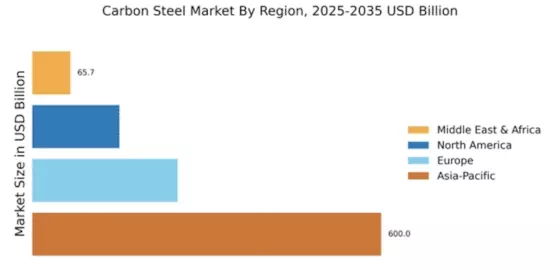
The North American carbon steel market is poised for growth, driven by increasing demand in construction and automotive sectors. With a market size of $150.0 million, the region is witnessing a resurgence in manufacturing activities, supported by favorable government policies aimed at infrastructure development. Regulatory initiatives promoting sustainable practices are also catalyzing market expansion, as industries seek to reduce carbon footprints and enhance efficiency. Leading the charge in this market are the United States and Canada, where major players like United States Steel Corporation and ArcelorMittal are investing in advanced technologies. The competitive landscape is characterized by a focus on innovation and sustainability, with companies striving to meet the rising demand for high-quality carbon steel products. As the region continues to recover from economic challenges, the outlook for carbon steel remains optimistic, with significant opportunities for growth.

Europe : Innovation and Sustainability Focus

Europe's carbon steel market, valued at $250.0 million, is undergoing a significant transformation driven by innovation and sustainability. The region is focusing on reducing carbon emissions and enhancing energy efficiency, aligning with the European Union's Green Deal objectives. Regulatory frameworks are encouraging investments in cleaner technologies, which are expected to boost demand for carbon steel in various applications, including renewable energy and automotive sectors. Germany, France, and Italy are leading the market, with key players like Thyssenkrupp AG and ArcelorMittal at the forefront of this transition. The competitive landscape is marked by collaborations and partnerships aimed at developing advanced steel solutions. As Europe strives to maintain its position as a global leader in steel production, the emphasis on sustainable practices and innovation will continue to shape the market dynamics.

Asia-Pacific : Dominating Global Steel Production

The Asia-Pacific region dominates The Carbon Steel, with a staggering market size of $600.0 million. This growth is fueled by rapid industrialization, urbanization, and increasing infrastructure investments across countries like China, India, and Japan. The region's demand for carbon steel is bolstered by its robust construction and automotive sectors, alongside government initiatives aimed at enhancing manufacturing capabilities and sustainability practices. China, as the largest producer and consumer of carbon steel, significantly influences the market dynamics. Key players such as China Baowu Steel Group and Nippon Steel Corporation are pivotal in driving innovation and efficiency. The competitive landscape is characterized by aggressive pricing strategies and technological advancements, ensuring that the Asia-Pacific region remains a powerhouse in carbon steel production and consumption.

Middle East and Africa : Emerging Market Opportunities

The Middle East and Africa region, with a market size of $65.67 million, is witnessing emerging opportunities in the carbon steel sector. Driven by infrastructural developments and increasing investments in construction, the demand for carbon steel is on the rise. Governments are implementing policies to boost local manufacturing and reduce reliance on imports, which is expected to further stimulate market growth in the coming years. Countries like South Africa and the UAE are leading the charge, with key players such as Steel Authority of India Limited and local manufacturers expanding their operations. The competitive landscape is evolving, with a focus on enhancing production capabilities and meeting the growing demand for high-quality steel products. As the region continues to develop, the carbon steel market is set to play a crucial role in supporting economic growth and infrastructure development.

Key Players and Competitive Insights

The Carbon Steel Market is currently characterized by a dynamic competitive landscape, driven by factors such as increasing demand from construction and automotive sectors, as well as a growing emphasis on sustainability. Major players like ArcelorMittal (LU), Nippon Steel Corporation (JP), and China Baowu Steel Group Corporation (CN) are strategically positioning themselves through innovation and regional expansion. ArcelorMittal (LU) has focused on enhancing its production capabilities while investing in green technologies, which appears to be a response to the rising regulatory pressures for sustainable practices. Meanwhile, Nippon Steel Corporation (JP) has been actively pursuing partnerships to bolster its technological advancements, thereby enhancing its competitive edge in high-strength steel production. Collectively, these strategies indicate a shift towards a more sustainable and technologically advanced market environment.

In terms of business tactics, companies are increasingly localizing manufacturing to reduce transportation costs and enhance supply chain efficiency. The market structure is moderately fragmented, with several key players exerting considerable influence. This fragmentation allows for a variety of competitive strategies, as companies seek to differentiate themselves through innovation and operational excellence. The collective influence of these major players shapes the market dynamics, fostering an environment where agility and responsiveness to market demands are paramount.

In November 2025, China Baowu Steel Group Corporation (CN) announced a significant investment in a new production facility aimed at increasing its output of high-quality carbon steel. This strategic move is expected to enhance its market share and meet the growing demand for advanced steel products, particularly in the automotive sector. The establishment of this facility not only signifies a commitment to expanding production capabilities but also reflects a broader trend of companies investing in infrastructure to support future growth.

In October 2025, Tata Steel Limited (IN) launched a new line of eco-friendly carbon steel products, which are produced using innovative methods that reduce carbon emissions. This initiative aligns with global sustainability goals and positions Tata Steel as a leader in environmentally responsible manufacturing. The introduction of these products is likely to attract environmentally conscious consumers and businesses, thereby enhancing Tata Steel's competitive positioning in the market.

In September 2025, Thyssenkrupp AG (DE) entered into a strategic partnership with a technology firm to develop AI-driven solutions for optimizing steel production processes. This collaboration aims to enhance operational efficiency and reduce costs, which could provide Thyssenkrupp with a significant competitive advantage. The integration of AI technologies into production processes is indicative of a broader trend towards digitalization within the industry, suggesting that companies are increasingly leveraging technology to improve their operational frameworks.

As of December 2025, the competitive trends in the Carbon Steel Market are heavily influenced by digitalization, sustainability, and the integration of advanced technologies such as AI. Strategic alliances are becoming more prevalent, as companies recognize the need to collaborate in order to innovate and remain competitive. The shift from price-based competition to a focus on innovation, technology, and supply chain reliability is evident, indicating that future differentiation will likely hinge on these factors. Companies that can effectively navigate these trends are poised to thrive in an increasingly complex market landscape.

Key Companies in the Carbon Steel Market market include

Industry Developments

  • Q2 2024: Nippon Steel to acquire U.S. Steel for $14.9 billion in cash deal Nippon Steel announced a definitive agreement to acquire United States Steel Corporation in an all-cash transaction valued at $14.9 billion, aiming to expand its global footprint and strengthen its position in the carbon steel market.
  • Q2 2024: ArcelorMittal to invest $1.2 Billion in decarbonization of Spanish steel plant ArcelorMittal revealed plans to invest $1.2 billion in its Gijón, Spain facility to transition to low-carbon steel production, including the installation of a new electric arc furnace and direct reduced iron unit.
  • Q2 2024: Tata Steel secures UK government funding for Port Talbot decarbonisation Tata Steel received a significant funding package from the UK government to support the decarbonisation of its Port Talbot steelworks, focusing on the shift to electric arc furnace technology for carbon steel production.
  • Q1 2024: POSCO launches new high-strength carbon steel product for automotive sector POSCO introduced a new high-strength carbon steel grade designed for automotive applications, targeting increased demand for lightweight and durable materials in electric vehicle manufacturing.
  • Q2 2024: JSW Steel inaugurates new carbon steel pipe manufacturing facility in India JSW Steel officially opened a new carbon steel pipe manufacturing plant in Maharashtra, India, expanding its production capacity to meet growing infrastructure and energy sector demand.
  • Q2 2024: Nucor announces $860 million investment in new carbon steel plate mill in West Virginia Nucor Corporation announced the groundbreaking of a new carbon steel plate mill in Mason County, West Virginia, with an $860 million investment to enhance domestic supply for construction and manufacturing.
  • Q1 2024: Baosteel and Rio Tinto sign partnership for low-carbon steelmaking Baosteel and Rio Tinto entered a strategic partnership to develop and implement low-carbon steelmaking technologies, focusing on reducing emissions in carbon steel production.
  • Q2 2024: Liberty Steel secures $350 million financing to support carbon steel operations Liberty Steel obtained $350 million in new financing to stabilize and expand its carbon steel operations in Europe, following a period of financial restructuring.
  • Q1 2024: SSAB appoints new CEO to drive carbon steel transformation SSAB announced the appointment of a new Chief Executive Officer, with a mandate to accelerate the company's transition to sustainable carbon steel production.
  • Q2 2024: Hyundai Steel wins major contract to supply carbon steel for South Korean infrastructure projects Hyundai Steel secured a significant contract to supply carbon steel products for multiple large-scale infrastructure projects in South Korea, reinforcing its domestic market leadership.
  • Q1 2024: JFE Steel launches new carbon steel product line for renewable energy sector JFE Steel introduced a new line of carbon steel products specifically engineered for use in wind turbine towers and other renewable energy infrastructure.
  • Q2 2024: Cleveland-Cliffs announces $500 million upgrade to carbon steel production facilities Cleveland-Cliffs unveiled a $500 million investment plan to modernize its carbon steel production facilities in the United States, aiming to improve efficiency and product quality.

Future Outlook

Carbon Steel Market Future Outlook

The Carbon Steel Market is projected to grow at a 4.2% CAGR from 2024 to 2035, driven by infrastructure development, automotive demand, and energy sector investments.

New opportunities lie in:

  • Expansion into high-strength steel variants for automotive applications.
  • Development of carbon capture technologies in steel production.
  • Strategic partnerships with renewable energy firms for sustainable steel solutions.

By 2035, the Carbon Steel Market is expected to solidify its position as a key player in global manufacturing.

Market Segmentation

Carbon Steel Market Form Outlook

  • Hot Rolled
  • Cold Rolled
  • Galvanized
  • Coated
  • Alloyed

Carbon Steel Market Grade Outlook

  • Low Carbon Steel
  • Medium Carbon Steel
  • High Carbon Steel
  • Ultra High Carbon Steel
  • Micro Alloyed Steel

Carbon Steel Market End Use Outlook

  • Infrastructure
  • Transportation
  • Industrial Equipment
  • Consumer Goods
  • Aerospace

Carbon Steel Market Application Outlook

  • Construction
  • Automotive
  • Manufacturing
  • Shipbuilding
  • Energy

Carbon Steel Market Product Type Outlook

  • Carbon Steel Plate
  • Carbon Steel Pipe
  • Carbon Steel Bar
  • Carbon Steel Wire
  • Carbon Steel Sheet

Report Scope

MARKET SIZE 20241065.67(USD Billion)
MARKET SIZE 20251110.45(USD Billion)
MARKET SIZE 20351675.95(USD Billion)
COMPOUND ANNUAL GROWTH RATE (CAGR)4.2% (2024 - 2035)
REPORT COVERAGERevenue Forecast, Competitive Landscape, Growth Factors, and Trends
BASE YEAR2024
Market Forecast Period2025 - 2035
Historical Data2019 - 2024
Market Forecast UnitsUSD Billion
Key Companies ProfiledArcelorMittal (LU), Nippon Steel Corporation (JP), China Baowu Steel Group Corporation (CN), POSCO (KR), Tata Steel Limited (IN), JFE Steel Corporation (JP), Thyssenkrupp AG (DE), United States Steel Corporation (US), Steel Authority of India Limited (IN)
Segments CoveredApplication, End Use, Product Type, Form, Grade
Key Market OpportunitiesAdoption of advanced manufacturing technologies enhances efficiency in the Carbon Steel Market.
Key Market DynamicsRising demand for carbon steel in construction and automotive sectors drives competitive dynamics and supply chain adjustments.
Countries CoveredNorth America, Europe, APAC, South America, MEA

Market Highlights

Author
Garvit Vyas
Analyst

Explore the profile of Garvit Vyas, one of our esteemed authors at Market Research Future, and access their expert research contributions in the field of market research and industry analysis

Leave a Comment

FAQs

How much is the carbon steel market?

The carbon steel market size was valued at USD 1,065.67 Billion in 2024.

What is the growth rate of the carbon steel market?

Carbon Steel Market is expected to grow with a CAGR of 4.2% in the period 2025-2035

Which region held the largest market share in the carbon steel market?

North America had the largest share in the market

Who are the key players in the carbon steel market?

The key players in the market are Nippon Steel Corporation, United States Steel Corporation, Marcegaglia, Daido Steel Co., Ltd., HBIS Group Co., Ltd., NLMK, Dongbei Special Steel Group International Trade Co., Ltd., ArcelorMittal, Kobe Steel, Ltd., AK Steel International B.V.

Which Type led the carbon steel market?

The Medium carbon steel category dominated the market in 2022.

Which End user had the largest market share in the carbon steel market?

The Automotive had the largest share in the market.

Download Free Sample

Kindly complete the form below to receive a free sample of this Report

Compare Licence

×
Features License Type
Single User Multiuser License Enterprise User
Price $4,950 $5,950 $7,250
Maximum User Access Limit 1 User Upto 10 Users Unrestricted Access Throughout the Organization
Free Customization
Direct Access to Analyst
Deliverable Format
Platform Access
Discount on Next Purchase 10% 15% 15%
Printable Versions