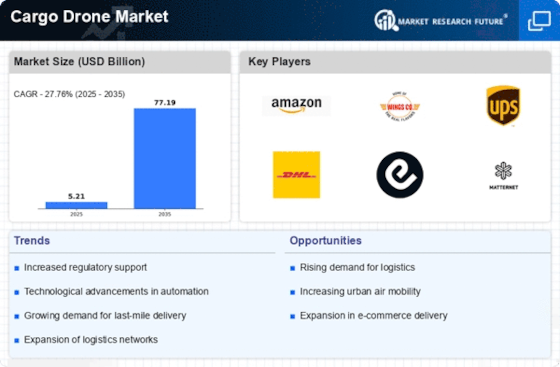
The Cargo Drone Market is currently characterized by a dynamic competitive landscape, driven by technological advancements and increasing demand for efficient logistics solutions. Major players such as Amazon (US), Zipline (US), and UPS (US) are at the forefront, each adopting distinct strategies to enhance their market positioning. Amazon (US) continues to innovate with its Prime Air service, focusing on rapid delivery capabilities, while Zipline (US) emphasizes its role in healthcare logistics, particularly in remote areas. UPS (US) is leveraging its extensive logistics network to integrate drone technology, aiming to streamline operations and reduce delivery times. Collectively, these strategies contribute to a competitive environment that is increasingly focused on efficiency, reliability, and customer satisfaction.
In terms of business tactics, companies are localizing manufacturing and optimizing supply chains to enhance operational efficiency. The market appears moderately fragmented, with a mix of established players and emerging startups. This structure allows for diverse approaches to market entry and expansion, as companies seek to carve out niches in specific segments, such as medical supply delivery or e-commerce logistics. The collective influence of these key players shapes the market dynamics, fostering innovation and competition.
In August 2025, Amazon (US) announced the expansion of its Prime Air service to include urban areas, significantly broadening its delivery capabilities. This strategic move is likely to enhance Amazon's competitive edge by allowing faster delivery times in densely populated regions, thereby meeting the growing consumer demand for immediate fulfillment. The expansion aligns with Amazon's overarching goal of integrating advanced technologies into its logistics framework, potentially setting new standards in the industry.
In September 2025, Zipline (US) launched a new drone delivery service in partnership with a major healthcare provider, aimed at improving access to medical supplies in underserved communities. This initiative underscores Zipline's commitment to leveraging drone technology for social impact, while also expanding its operational footprint. The partnership not only enhances Zipline's service offerings but also positions the company as a leader in the healthcare logistics sector, where timely delivery can be critical.
In October 2025, UPS (US) unveiled a new drone delivery hub designed to facilitate last-mile deliveries in urban environments. This development is indicative of UPS's strategy to integrate drone technology into its existing logistics network, thereby enhancing efficiency and reducing operational costs. The establishment of this hub may serve as a model for future urban logistics solutions, reflecting a broader trend towards the adoption of innovative delivery methods.
As of October 2025, the Cargo Drone Market is witnessing trends that emphasize digitalization, sustainability, and the integration of artificial intelligence. Strategic alliances among key players are increasingly shaping the competitive landscape, fostering collaboration that enhances technological capabilities and market reach. Looking ahead, competitive differentiation is likely to evolve, with a shift from traditional price-based competition towards innovation, technological advancement, and supply chain reliability. Companies that can effectively leverage these trends will likely emerge as leaders in the rapidly evolving cargo drone sector.





















Leave a Comment