×
Request Free Sample ×

Kindly complete the form below to receive a free sample of this Report

* Please use a valid business email

Leading companies partner with us for data-driven Insights

clients tt-cursor
Hero Background

Cargo Shipping Market

ID: MRFR/Equip/2287-HCR
188 Pages
Harshita Gorade
February 2026

Cargo Shipping Market Research Report Information By Cargo Type (Container Cargo, Bulk Cargo, General Cargo and Liquid Cargo), End-Use Industry (Food, Manufacturing, Oil & Ores, and Electrical & Electronics), And By Region (North America, Europe, Asia-Pacific, And Rest Of The World) – Market Forecast Till 2035

Share:
Download PDF ×

We do not share your information with anyone. However, we may send you emails based on your report interest from time to time. You may contact us at any time to opt-out.

Cargo Shipping Market Infographic
Purchase Options

Cargo Shipping Market Summary

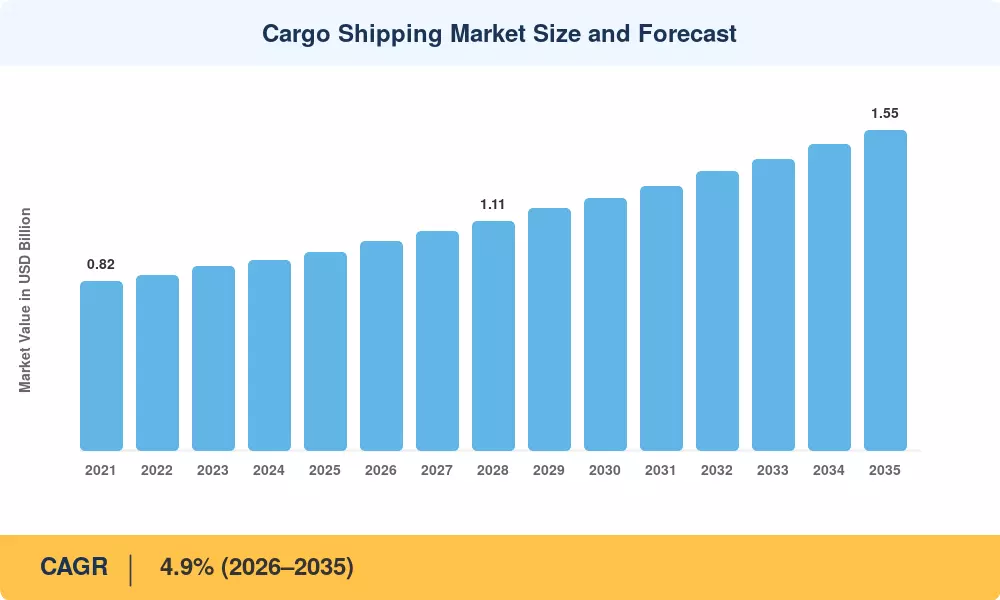
As per Market Research Future analysis, the Cargo Shipping Market Size was estimated at 15.77 USD Billion in 2024. The Cargo Shipping industry is projected to grow from 16.57 USD Billion in 2025 to 27.15 USD Billion by 2035, exhibiting a compound annual growth rate (CAGR) of 5.06% during the forecast period 2025 - 2035

Key Market Trends & Highlights

The Cargo Shipping Market is currently experiencing a dynamic evolution driven by technological advancements and shifting consumer demands.

  • North America remains the largest market for cargo shipping, characterized by robust infrastructure and high demand for container cargo.
  • Asia-Pacific is the fastest-growing region, propelled by increasing trade activities and investments in logistics infrastructure.
  • Container cargo continues to dominate the market, while liquid cargo is emerging as the fastest-growing segment due to rising energy demands.
  • E-commerce growth and infrastructure development are key drivers, significantly influencing market expansion and operational strategies.

Market Size & Forecast

2024 Market Size 15.77 (USD Billion)
2035 Market Size 27.15 (USD Billion)
CAGR (2025 - 2035) 5.06%

Major Players

A.P. Moller - Maersk (DK), Mediterranean Shipping Company (CH), CMA CGM (FR), Hapag-Lloyd (DE), Evergreen Marine Corporation (TW), COSCO Shipping (CN), Yang Ming Marine Transport Corporation (TW), Hanjin Shipping (KR)

Our Impact
Enabled $4.3B Revenue Impact for Fortune 500 and Leading Multinationals
Partnering with 2000+ Global Organizations Each Year
30K+ Citations by Top-Tier Firms in the Industry

Cargo Shipping Market Trends

The Cargo Shipping Market is currently experiencing a dynamic evolution, driven by various factors that shape its landscape. Current cargo shipping market trends show a definitive shift toward digitalization, with blockchain technology being integrated to streamline customs documentation and reduce administrative bottlenecks.  Shipping companies are likely to invest in innovative solutions to enhance their logistics capabilities, thereby improving customer satisfaction. 

Furthermore, sustainability initiatives are gaining traction, as stakeholders recognize the importance of reducing environmental impact. This shift towards greener practices may redefine industry standards and operational frameworks. In addition, geopolitical factors and regulatory changes are also playing a crucial role in shaping the Cargo Shipping Market. Trade agreements and tariffs can significantly affect shipping routes and costs, leading to a need for adaptability among service providers. As the market continues to evolve, it seems essential for companies to remain agile and responsive to these external pressures. The interplay of these elements suggests a complex yet promising future for the Cargo Shipping Market, where innovation and sustainability will likely be at the forefront of strategic planning.

Technological Advancements

The Cargo Shipping Market is witnessing a surge in technological innovations that enhance operational efficiency. Automation, artificial intelligence, and data analytics are being integrated into logistics processes, streamlining operations and reducing costs. These advancements may lead to improved tracking systems and better resource management, ultimately benefiting both service providers and customers.

Sustainability Initiatives

There is a growing emphasis on sustainability within the Cargo Shipping Market, as companies strive to minimize their environmental footprint. This trend includes the adoption of cleaner fuels, energy-efficient vessels, and waste reduction practices. Stakeholders are increasingly prioritizing eco-friendly solutions, which could reshape industry standards and consumer expectations.

Geopolitical Influences

The Cargo Shipping Market is significantly affected by geopolitical dynamics, including trade policies and international relations. Changes in tariffs, trade agreements, and regional conflicts can alter shipping routes and costs. As a result, companies must remain vigilant and adaptable to navigate these complexities, ensuring resilience in their operations.

Cargo Shipping Market Drivers

E-commerce Growth

The surge in e-commerce activities has profoundly impacted the Cargo Shipping Market. As online shopping continues to gain traction, the demand for efficient and reliable shipping solutions has escalated. In 2025, e-commerce sales are projected to reach approximately 6 trillion USD, necessitating robust logistics frameworks. This growth compels shipping companies to enhance their operational capabilities, ensuring timely deliveries and customer satisfaction. The Cargo Shipping Market must adapt to the evolving needs of e-commerce, integrating advanced tracking systems and optimizing supply chains to meet consumer expectations. Furthermore, the rise of cross-border e-commerce presents additional challenges and opportunities, as companies seek to navigate international shipping regulations and tariffs. Thus, the interplay between e-commerce growth and cargo shipping is likely to shape the industry's future landscape.

Regulatory Changes

Regulatory changes significantly influence the Cargo Shipping Market, as governments worldwide implement new policies to enhance safety, security, and environmental sustainability. Recent regulations aimed at reducing carbon emissions have prompted shipping companies to invest in cleaner technologies and alternative fuels. For instance, the International Maritime Organization has set ambitious targets for reducing greenhouse gas emissions by at least 50% by 2050. Compliance with such regulations necessitates substantial investments in fleet modernization and operational adjustments. Moreover, changes in trade policies and tariffs can also impact shipping routes and costs, compelling companies to adapt their strategies accordingly. The dynamic nature of regulatory frameworks suggests that stakeholders in the Cargo Shipping Market must remain vigilant and responsive to ensure compliance while maintaining competitiveness.

Rising Consumer Demand

Rising consumer demand is a key driver of the Cargo Shipping Market, as the need for timely and reliable delivery services intensifies. With consumers increasingly expecting faster shipping options, companies are compelled to enhance their logistics capabilities. In 2025, the demand for express shipping services is anticipated to grow by approximately 20%, reflecting changing consumer preferences. This trend necessitates that shipping companies invest in advanced project logistics solutions, such as real-time tracking and automated warehousing systems, to meet these expectations. Additionally, the growth of the subscription-based business model in various sectors further fuels demand for efficient shipping solutions. As consumer behavior continues to evolve, the Cargo Shipping Market must adapt to these trends, ensuring that it remains responsive to the needs of its clientele.

Technological Innovations

Technological innovations are transforming the Cargo Shipping Market, driving efficiency and enhancing operational capabilities. The adoption of automation, artificial intelligence, and blockchain technology is reshaping logistics and supply chain management. For instance, the implementation of AI-driven analytics allows shipping companies to optimize routes and reduce fuel consumption, potentially lowering operational costs by up to 15%. Furthermore, blockchain technology is being utilized to enhance transparency and traceability in cargo movements, thereby reducing the risk of fraud and improving trust among stakeholders. As these technologies continue to evolve, they are likely to play a crucial role in addressing the challenges faced by the Cargo Shipping Market, such as capacity constraints and rising customer expectations. The ongoing digital transformation indicates a future where technology will be integral to the industry's growth and sustainability.

Infrastructure Development

Infrastructure development plays a pivotal role in shaping the Cargo Shipping Market. Investments in ports, roads, and rail networks are essential for facilitating efficient cargo movement. In recent years, several countries have embarked on extensive infrastructure projects aimed at enhancing their logistics capabilities. For instance, the expansion of major ports has been observed, with some facilities increasing their container handling capacity by over 30%. Such developments not only improve operational efficiency but also reduce transit times, thereby attracting more shipping companies to utilize these upgraded facilities. Additionally, the integration of smart technologies in infrastructure, such as automated cargo handling systems, is becoming increasingly prevalent. This trend indicates a shift towards more streamlined operations within the Cargo Shipping Market, ultimately benefiting stakeholders across the supply chain.

Market Segment Insights

Cargo Shipping Market Cargo Type Insights

The Cargo Shipping Market segmentation, based on Cargo type, includes Container Cargo, Bulk Cargo, General Cargo and Liquid Cargo. Due to market characteristics, including high container flexibility, it has been predicted that the general cargo category will develop at the fastest CAGR.

Cargo Shipping Market End-User Insights

Based on End-User, the Cargo Shipping Market segmentation includes Food, Manufacturing, Oil & Ores, and Electrical & Electronics. In 2022, the market was anticipated to be dominated by the Manufacturing sector. The expansion of this Cargo Shipping Market is fueled by factors including the acceleration of economic growth, particularly in developing nations in the Asia Pacific and the Middle East. The Cargo Shipping Market is also anticipated to significantly expand in the oil, gas, and ores categories.

Some of the reasons driving the expansion of this category include a rise in exports from the United States and increased demand in nations like China and India due to the high production levels of conventional fuel automobiles.

Get more detailed insights about Cargo Shipping Market

Regional Insights

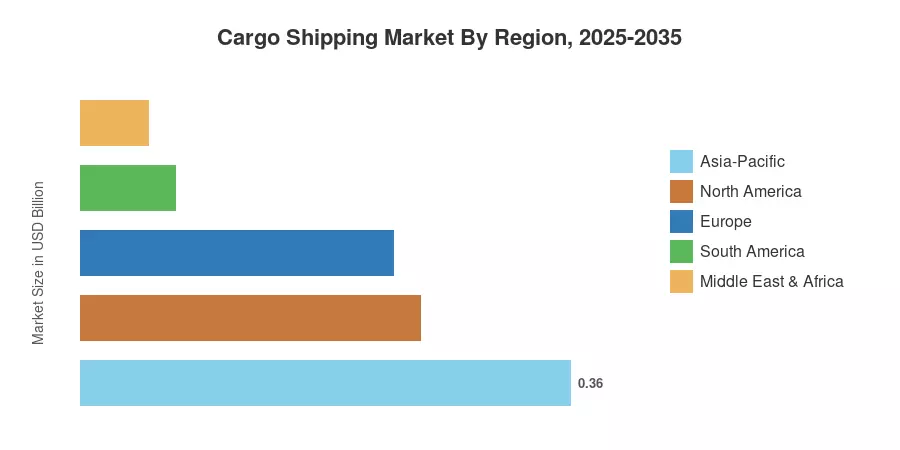
North America : Logistics and Trade Hub

North America is witnessing robust growth in the cargo shipping market, driven by increasing e-commerce activities and a strong manufacturing base. The region holds approximately 30% of the global market share, making it the largest market. Regulatory support, such as the implementation of the Infrastructure Investment and Jobs Act, is enhancing port infrastructure and logistics efficiency, further boosting demand. The United States and Canada are the leading countries in this region, with major ports like Los Angeles and Vancouver facilitating significant cargo traffic. Key players such as A.P. Moller - Maersk and Mediterranean Shipping Company are actively expanding their operations. Additionally, Mexico-Inland cargo shipping market is also rising to be a critical player in this region. The competitive landscape is characterized by strategic alliances and investments in technology to improve service delivery and operational efficiency. 

Europe : Sustainable Shipping Initiatives

Europe is emerging as a leader in sustainable cargo shipping, driven by stringent environmental regulations and a commitment to reducing carbon emissions. The region accounts for approximately 25% of the global market share, making it the second-largest market. Initiatives like the European Green Deal are catalyzing investments in eco-friendly shipping technologies and infrastructure, enhancing the overall market dynamics. Countries like Germany, France, and the Netherlands are at the forefront, with major ports such as Hamburg and Rotterdam playing crucial roles in cargo logistics. The competitive landscape features key players like CMA CGM and Hapag-Lloyd, who are investing in green technologies and digital solutions to enhance operational efficiency. The focus on sustainability is reshaping the market, attracting new investments and partnerships.

Asia-Pacific : Emerging Market Dynamics

The Asia-Pacific region is experiencing rapid growth in the cargo shipping market, driven by increasing trade activities and a booming manufacturing sector. This region holds approximately 20% of the global market share, making it a significant player. The rise of e-commerce and government initiatives to enhance port infrastructure are key drivers of this growth, creating a favorable regulatory environment for shipping companies. China, Japan, and South Korea are the leading countries in this region, with major ports like Shanghai and Busan facilitating substantial cargo volumes. The competitive landscape is dominated by players such as COSCO Shipping and Evergreen Marine Corporation, who are expanding their fleets and investing in technology to improve service efficiency. The region's dynamic market is characterized by innovation and strategic partnerships among key stakeholders.

Middle East and Africa : Strategic Trade Routes

The Middle East and Africa region is increasingly recognized for its strategic importance in the cargo shipping market, driven by its location along key trade routes. This region holds approximately 15% of the global market share, with significant growth potential. Investments in port infrastructure and logistics capabilities are being prioritized to enhance trade efficiency and attract international shipping lines. Countries like the United Arab Emirates and South Africa are leading the way, with major ports such as Jebel Ali and Durban facilitating substantial cargo traffic. The competitive landscape features key players like Hanjin Shipping and Yang Ming Marine Transport Corporation, who are expanding their operations in response to growing demand. The region's unique position as a trade hub is fostering partnerships and investments, further enhancing its market dynamics.

Cargo Shipping Market Regional Image

Key Players and Competitive Insights

The Cargo Shipping Market is currently characterized by a dynamic competitive landscape, driven by factors such as globalization, e-commerce growth, and increasing demand for efficient logistics solutions. Major players like A.P. Moller - Maersk (Denmark), Mediterranean Shipping Company (Switzerland), and CMA CGM (France) are at the forefront, each adopting distinct strategies to enhance their market positioning. A.P. Moller - Maersk (Denmark) has been focusing on digital transformation and sustainability initiatives, aiming to reduce carbon emissions and improve operational efficiency. Mediterranean Shipping Company (Switzerland) emphasizes fleet expansion and service diversification, while CMA CGM (France) is investing heavily in technological advancements and strategic partnerships to bolster its competitive edge. The business tactics employed by these companies reflect a trend towards supply chain optimization and localized operations. The market structure appears moderately fragmented, with a few dominant players exerting considerable influence. This competitive environment is shaped by the collective actions of these key players, who are increasingly collaborating through strategic alliances to enhance service offerings and operational capabilities. In August 2025, A.P. Moller - Maersk (Denmark) announced a partnership with a leading technology firm to develop an AI-driven platform aimed at optimizing shipping routes and reducing fuel consumption. This strategic move underscores the company's commitment to sustainability and operational efficiency, potentially setting a new standard in the industry. Similarly, in July 2025, Mediterranean Shipping Company (Switzerland) expanded its fleet by acquiring several new vessels equipped with advanced eco-friendly technologies. This acquisition not only enhances their capacity but also aligns with the growing demand for sustainable shipping solutions. In September 2025, CMA CGM (France) launched a new digital platform designed to streamline customer interactions and improve supply chain visibility. This initiative reflects the company's focus on leveraging technology to enhance customer experience and operational transparency, which is increasingly vital in today's competitive landscape. These strategic actions illustrate how these companies are not merely reacting to market demands but are actively shaping the future of cargo shipping through innovation and strategic foresight. As of October 2025, the competitive trends in the Cargo Shipping Market are heavily influenced by digitalization, sustainability, and the integration of advanced technologies such as AI. Strategic alliances are becoming more prevalent, allowing companies to pool resources and expertise to tackle common challenges. Looking ahead, it is likely that competitive differentiation will increasingly hinge on innovation, technological advancements, and the reliability of supply chains, rather than solely on price. This shift suggests a transformative phase in the industry, where companies that prioritize these elements may emerge as leaders in the evolving market.

Key Companies in the Cargo Shipping Market include

Industry Developments

September 2020 – The CMA CGM Group sent one of its biggest container ships, the CMA CGM BRAZIL, to the U.S. East Coast to work on the weekly Columbus JAX route.

August 2020 – HMM disclosed that it had sold the CMA CGM Group a 49% ownership in the TTI Algeciras (Total Port International Algeciras), a container terminal in Spain.

May 2021 – To maintain service continuity and streamline impacted operations, MSC is collaborating with blockchain platform WAVE to promote wider use of its (charges connected to loading products) in India.

Future Outlook

Cargo Shipping Market Future Outlook

The Cargo Shipping Market is projected to grow at a 5.06% CAGR from 2025 to 2035, driven by technological advancements, increasing global trade, and sustainability initiatives. The cargo shipping market size is expanding as a direct result of the continued globalization of manufacturing and the growing middle-class demand for imported consumer goods.

New opportunities lie in:

  • Investment in automated cargo handling systems Development of eco-friendly shipping vessels Expansion of digital freight platforms for real-time tracking

By 2035, the Cargo Shipping Market is expected to be robust, driven by innovation and increased demand.

Market Segmentation

Cargo Shipping Market End User Outlook

  • Food
  • Manufacturing
  • Oil & Ores
  • Electrical & Electronics

Cargo Shipping Market Cargo Type Outlook

  • Container Cargo
  • Bulk Cargo
  • General Cargo
  • Liquid Cargo

Report Scope

MARKET SIZE 2024 15.77(USD Billion)
MARKET SIZE 2025 16.57(USD Billion)
MARKET SIZE 2035 27.15(USD Billion)
COMPOUND ANNUAL GROWTH RATE (CAGR) 5.06% (2025 - 2035)
REPORT COVERAGE Revenue Forecast, Competitive Landscape, Growth Factors, and Trends
BASE YEAR 2024
Market Forecast Period 2025 - 2035
Historical Data 2019 - 2024
Market Forecast Units USD Billion
Key Companies Profiled A.P. Moller - Maersk (DK), Mediterranean Shipping Company (CH), CMA CGM (FR), Hapag-Lloyd (DE), Evergreen Marine Corporation (TW), COSCO Shipping (CN), Yang Ming Marine Transport Corporation (TW), Hanjin Shipping (KR)
Segments Covered Cargo Type, Region
Key Market Opportunities Integration of advanced digital technologies enhances efficiency in the Cargo Shipping Market.
Key Market Dynamics Technological advancements and regulatory changes are reshaping competitive dynamics in the cargo shipping market.
Countries Covered North America, Europe, APAC, South America, MEA

Market Highlights

Author
Harshita Gorade
Research Analyst

Harshita Post graduate MBA in Business Administration from Welingkar Institute, Mumbai and 5 years of experience in the field of product market research. As a Research Analyst, I have cross-domain experience in packaging, and industrial Automation & Equipment. I am currently looking after the research process of packaging, logistics & transportation, and industrial automation & equipment at Market Research Future Reports. My responsibilities at the organization involve handling syndicate and custom reports as well as responding to client inquiries, and organize, co-ordinate with a group of 5 to 6 persons to manage all workflows.

Leave a Comment

FAQs

What is the current valuation of the Cargo Shipping Market in 2025?

The Cargo Shipping Market is valued at approximately 15.77 USD Billion in 2024, and it is expected to grow significantly by 2035.

What is the projected market valuation for the Cargo Shipping Market by 2035?

The market is projected to reach a valuation of 27.15 USD Billion by 2035, indicating robust growth.

What is the expected CAGR for the Cargo Shipping Market during the forecast period 2025 - 2035?

The expected CAGR for the Cargo Shipping Market during the forecast period 2025 - 2035 is 5.06%.

Which cargo types are expected to show significant growth in the market?

Container Cargo and Liquid Cargo are anticipated to show notable growth, with valuations projected to rise from 5.0 to 8.5 USD Billion and 3.77 to 7.15 USD Billion, respectively.

What are the key segments of the Cargo Shipping Market?

The key segments of the Cargo Shipping Market include Container Cargo, Bulk Cargo, General Cargo, and Liquid Cargo.

Who are the leading players in the Cargo Shipping Market?

Key players in the Cargo Shipping Market include A.P. Moller - Maersk, Mediterranean Shipping Company, and CMA CGM, among others.

Research Approach

Research Methodology on Cargo Shipping Market

1. Introduction:


The cargo shipping market is expected to witness steady growth over the forecast period 2023 to 2030 with increasing investments from major key players in the market. The accelerated trend towards digitization and rising demand for efficient transportation management systems are the major factors driving the growth of the cargo shipping market. The major factor elevating the market growth is the increased demand for cost-effective transportation solutions for transportation, enhancing customer experience, and improved efficiency in the supply chain. According to a report published by Market Research Future (MRFR), the global cargo shipping market is anticipated to register a strong CAGR during the forecast period from 2023 to 2030.

2. Research Design, Objectives and Scope:

The research design adopted for this research study was a mix of both primary and secondary sources of data. The primary research objective for the study was to gain a comprehensive understanding of the cargo shipping market including qualitative insights on drivers, trends, challenges, and market size. For gathering primary data, in-depth interviews were conducted with experts in the field of cargo shipping. Secondary research sources included white papers, company websites, annual reports, paid database services, and industry association journals. The secondary research objective was to obtain an in-depth understanding of the cargo shipping market dynamics and to validate the primary research findings. This research study covered both the demand side and the supply side as well as geographic analysis.

3. Research Approach:

The following research approach was used to complete the research study:

• Bottom-up Approach – This approach begins with individual components or sub-elements and gradually builds upon them to ultimately come to a conclusion. This approach was used to understand the entire cargo shipping market, its various components, their relevance in the global market, and their impact on the entire market.

• Top-down Approach – This approach provides an understanding of the entire market based on its various components, interconnectedness, and their impact on the overall market structure. A top-down approach was followed to understand the drivers and challenges in the cargo shipping market as well as its various end-use segments.

• Factor Analysis – This analysis was done to identify and analyze the key factors driving the cargo shipping market.

• Time-Series Analysis – This analysis was performed to analyze the cargo shipping market over different periods to identify the trends and opportunities.

• Demand Side and Supply Side Data Triangulation – This analysis was utilized to synchronize and cross-validate the secondary data collected through extensive primary research and document review.

4. Primary Research:

The primary research methodology included in-depth interviews with the market experts. The experts included industry veterans, users, representatives from various associations, and industry service providers. All participants had very good knowledge of the cargo shipping market. The insights collected from the interviews revealed the market insights of cargo shipping as well as its future prospects.

5. Secondary Research:

Secondary research was conducted to gather data about the various parameters of the cargo shipping market. This includes data on economically active populations, labour costs, technological advancements, customer preferences, and other relevant factors. The data sources for the secondary research included white papers, company websites, industry journals, SEC filings, and paid database services.

6. Data Analysis:

Data was collected and analyzed from both primary and secondary sources. After the data was collected, the collected data was converted to actionable intelligence which was used for further analysis. The analysis was conducted using multiple approaches including the bottom-up approach, top-down approach, factor analysis, time-series analysis and demand-side and supply-side data triangulation.

7. Market Estimates and Forecasts:

The market forecast is made based on Market Research Future’s proprietary technology which uses historical data combined with machine learning algorithms to provide accurate market size and growth rate estimates for the cargo shipping market. The market estimates and forecasts were verified and validated based on the primary and secondary research findings.

Conclusion:

The research methodology used for this research study was a mix of both primary and secondary sources of data. Primary data was gathered through in-person interviews with experts in the field and secondary data was gathered from paid database services, industry journals, and company websites. The data collected was then analyzed using multiple approaches such as bottom-up approach, top-down approach, factor analysis, time-series analysis, and demand side and supply side data triangulation. Market estimates and forecasts were made using Market Research Future’s proprietary technology which utilizes historical data combined with machine learning algorithms. Overall, the research methodology adopted for this research study was comprehensive and ensured the accuracy of the market estimates and forecasts till 2030.

Download Free Sample

Kindly complete the form below to receive a free sample of this Report

Compare Licence

×
Features License Type
Single User Multiuser License Enterprise User
Price $4,950 $5,950 $7,250
Maximum User Access Limit 1 User Upto 10 Users Unrestricted Access Throughout the Organization
Free Customization
Direct Access to Analyst
Deliverable Format
Platform Access
Discount on Next Purchase 10% 15% 15%
Printable Versions