×
Request Free Sample ×

Kindly complete the form below to receive a free sample of this Report

* Please use a valid business email

Leading companies partner with us for data-driven Insights

clients tt-cursor
Hero Background

Cassia Gum Market

ID: MRFR/FnB/39823-HCR
200 Pages
Snehal Singh
October 2025

Cassia Gum Market Research Report: By Application (Food and Beverage, Pharmaceuticals, Cosmetics, Oil and Gas, Textiles), By Formulation (Powdered, Granulated, Liquid), By End Use Industry (Food Processing, Personal Care, Industrial), By Source (Natural, Synthetic) and By Regional (North America, Europe, South America, Asia Pacific, Middle East and Africa) - Forecast to 2035.

Share:
Download PDF ×

We do not share your information with anyone. However, we may send you emails based on your report interest from time to time. You may contact us at any time to opt-out.

Cassia Gum Market Infographic
Purchase Options

Cassia Gum Market Summary

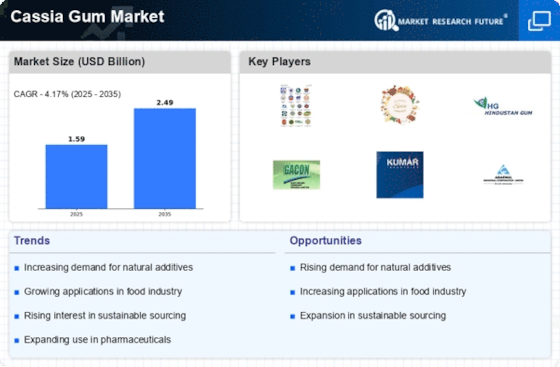
As per MRFR analysis, the Cassia Gum Market Size was estimated at 1.59 USD Billion in 2024. The Cassia Gum industry is projected to grow from 1.656 in 2025 to 2.492 by 2035, exhibiting a compound annual growth rate (CAGR) of 4.17 during the forecast period 2025 - 2035.

Key Market Trends & Highlights

The Cassia Gum Market is experiencing robust growth driven by increasing demand for natural ingredients and technological advancements.

  • North America remains the largest market for cassia gum, driven by its extensive applications in the food and beverage sector.
  • The Asia-Pacific region is emerging as the fastest-growing market, fueled by rising consumer preferences for natural and organic products.
  • The food and beverage segment continues to dominate the market, while the pharmaceutical segment is witnessing the most rapid growth.
  • Key market drivers include the increasing applications in the food industry and the rising demand for natural and organic products.

Market Size & Forecast

2024 Market Size 1.59 (USD Billion)
2035 Market Size 2.492 (USD Billion)
CAGR (2025 - 2035) 4.17%

Major Players

Sambavanam Agencies (IN), Sambavanam Spices (IN), Hindustan Gum & Chemicals (IN), Gum Arabic Company (SD), Kumar Industries (IN), Agarwal Industrial Corporation (IN), Gum Technology (US), Shaanxi Hengtong Chemical (CN)

Cassia Gum Market Trends

The Cassia Gum Market is currently experiencing a notable evolution, driven by various factors that influence its demand and supply dynamics. This natural thickening agent, derived from the seeds of the Cassia tree, finds extensive applications across multiple industries, including food, pharmaceuticals, and cosmetics. The growing inclination towards natural and organic products appears to be a significant driver, as consumers increasingly seek alternatives to synthetic additives. Furthermore, the rising awareness regarding health benefits associated with natural gums may contribute to the market's expansion. As industries adapt to changing consumer preferences, the Cassia Gum Market is likely to witness a shift towards sustainable sourcing and production practices. In addition to the demand for natural ingredients, the Cassia Gum Market is also influenced by advancements in processing technologies. Innovations in extraction and refinement methods may enhance the quality and functionality of cassia gum, making it more appealing to manufacturers. Moreover, the globalization of trade could facilitate broader access to this versatile ingredient, potentially leading to increased competition among suppliers. As the market continues to evolve, stakeholders must remain vigilant to emerging trends and consumer preferences, ensuring that they align their strategies accordingly.

Rising Demand for Natural Ingredients

The Cassia Gum Market is witnessing a surge in demand for natural ingredients, as consumers increasingly prefer products that are free from synthetic additives. This trend is particularly evident in the food and beverage sector, where natural thickeners are favored for their perceived health benefits.

Technological Advancements in Processing

Innovations in processing technologies are transforming the Cassia Gum Market. Enhanced extraction and refinement methods are likely to improve the quality and functionality of cassia gum, making it more attractive to various industries, including cosmetics and pharmaceuticals.

Sustainability and Ethical Sourcing

There is a growing emphasis on sustainability within the Cassia Gum Market. Stakeholders are increasingly focusing on ethical sourcing practices, which may lead to a more responsible supply chain. This trend aligns with consumer preferences for environmentally friendly products.

Cassia Gum Market Drivers

Growth in Pharmaceutical Applications

The Cassia Gum Market is witnessing an expansion in its applications within the pharmaceutical sector. Cassia gum is recognized for its potential as a binding agent in tablet formulations and as a stabilizer in liquid medications. The pharmaceutical industry is projected to grow at a compound annual growth rate of around 4% over the next few years, which may positively impact the demand for cassia gum. As pharmaceutical companies continue to prioritize the development of innovative drug delivery systems, the unique properties of cassia gum, such as its ability to enhance bioavailability, are likely to be increasingly valued. This trend suggests that the Cassia Gum Market could see a significant uptick in demand as more pharmaceutical applications are explored, thereby diversifying its market reach and enhancing revenue potential.

Increasing Applications in Food Industry

The Cassia Gum Market is experiencing a notable surge in demand due to its diverse applications in the food sector. Cassia gum, derived from the seeds of the Cassia tree, serves as a thickening and stabilizing agent in various food products, including sauces, dressings, and baked goods. The food industry is projected to account for a significant share of the market, with estimates suggesting a growth rate of approximately 5% annually. This trend is driven by the rising consumer preference for natural and clean-label ingredients, as manufacturers seek to replace synthetic additives with plant-based alternatives. Consequently, the Cassia Gum Market is likely to benefit from this shift, as food producers increasingly incorporate cassia gum to enhance texture and shelf life, thereby meeting consumer expectations for quality and safety.

Rising Demand for Natural and Organic Products

The Cassia Gum Market is significantly influenced by the growing consumer demand for natural and organic products. As health-conscious consumers become more aware of the benefits of natural ingredients, the preference for cassia gum as a natural thickener and stabilizer is likely to increase. Market data indicates that the organic food sector is expanding at a rate of approximately 8% annually, which may drive the demand for cassia gum in organic formulations. This trend is further supported by regulatory bodies promoting the use of natural ingredients in food and cosmetics. Consequently, the Cassia Gum Market stands to gain from this shift towards organic and natural products, as manufacturers seek to align their offerings with consumer preferences and regulatory standards.

Expanding Applications in Personal Care Products

The Cassia Gum Market is also experiencing growth due to its expanding applications in personal care products. Cassia gum is utilized as a thickening agent and stabilizer in various cosmetics and personal care formulations, including lotions, creams, and shampoos. The personal care industry is projected to grow at a rate of around 5% annually, which may lead to increased demand for cassia gum as manufacturers seek to enhance product performance and consumer appeal. The trend towards natural and organic personal care products is likely to further bolster the Cassia Gum Market, as consumers increasingly favor products that contain plant-based ingredients. This shift presents a significant opportunity for the industry to diversify its applications and cater to the evolving preferences of consumers.

Technological Innovations in Extraction Processes

The Cassia Gum Market is benefiting from advancements in extraction technologies that enhance the efficiency and quality of cassia gum production. Innovations such as cold extraction and enzymatic processes are being adopted to improve yield and preserve the functional properties of cassia gum. These technological advancements not only reduce production costs but also ensure a higher quality product, which is essential for meeting the stringent requirements of various industries. As the market for cassia gum continues to evolve, these innovations are likely to play a crucial role in increasing competitiveness and expanding market share. The Cassia Gum Market may see a rise in new entrants and increased investment in research and development, further driving growth and sustainability in the sector.


Market Segment Insights

By Application: Food and Beverage (Largest) vs. Pharmaceuticals (Fastest-Growing)

In the Cassia Gum Market, the application segment is primarily dominated by the Food and Beverage sector, which commands a significant share due to its versatile use as a thickening and gelling agent. This sector benefits from the increasing consumer demand for natural ingredients, particularly in processed foods and beverages, thus reinforcing its major market share. Moreover, other sectors, such as Pharmaceuticals, Cosmetics, Oil and Gas, and Textiles, collectively cater to niche markets that also utilize cassia gum for its beneficial properties, albeit at a smaller scale in comparison to Food and Beverage.

Food and Beverage (Dominant) vs. Pharmaceuticals (Emerging)

The Food and Beverage sector remains the dominant application for cassia gum, leveraging its thickening and stabilizing properties. It finds extensive use in various products ranging from sauces to dairy items, appealing to a health-conscious consumer base seeking clean label ingredients. Conversely, the Pharmaceutical sector is emerging rapidly as a crucial application area, driven by increasing demand for natural excipients in drug formulations. With growing awareness about the benefits of plant-derived ingredients, pharmaceuticals are turning towards cassia gum for its binding and protective qualities in formulations, making it a key player in future industry innovations.

By Formulation: Powdered (Largest) vs. Granulated (Fastest-Growing)

In the Cassia Gum Market, the formulation segment reveals a diverse landscape characterized by distinct applications and preferences among users. The powdered form dominates the market, enjoying a substantial share due to its versatility and ease of use in various food and industrial applications. In contrast, the granulated form is emerging rapidly, appealing to specific niche segments that prioritize convenience and specific texture applications. While powdered formulations lead overall, granulated options are quickly gaining traction among consumers seeking innovative solutions. The growth trends within the formulation segment are fueled by increasing demand for natural and clean-label food products, highlighting the importance of formulations that align with consumer preferences for health and wellness. The granulated segment, in particular, is experiencing notable growth as manufacturers respond to these emerging trends by incorporating cassia gum in convenient packaging, thus attracting a younger demographic. Additionally, advancements in processing technologies are enabling improvements in product characteristics, further driving market dynamics within this segment.

Powdered (Dominant) vs. Liquid (Emerging)

The powdered formulation of cassia gum continues to be the dominant player in the market, renowned for its broad applicability in both culinary and industrial sectors. Its fine texture and ability to blend seamlessly with other ingredients make it a preferred choice for manufacturers. On the other hand, the liquid formulation is emerging as an appealing option, particularly in the beverage and ready-to-eat food markets. With the trend moving towards easy-to-use liquid forms, companies are innovating to introduce cassia gum in liquid format for quick incorporation into various products. The liquid form attracts consumers seeking convenience and formulation flexibility, positioning it as a contemporary alternative. As these two formulations vie for market preference, the dynamics of consumer choice will shape the future landscape of the cassia gum market.

By End Use Industry: Food Processing (Largest) vs. Personal Care (Fastest-Growing)

In the Cassia Gum Market, the 'End Use Industry' segment shows significant distribution across various sectors. Food Processing emerges as the largest segment, driven by consistent demand for natural thickening and gelling agents in food applications. Personal Care follows as a rapidly growing segment, as there is an increasing trend towards natural and organic products within skincare and cosmetic formulations. Furthermore, the Industrial segment holds a respectable share, particularly in applications such as adhesives and textiles, but lags behind the food and personal care sectors in terms of growth potential.

Food Processing: Dominant vs. Personal Care: Emerging

The Food Processing segment remains dominant in the Cassia Gum Market as manufacturers seek natural alternatives to synthetic additives, capitalizing on consumer trends favoring health and wellness. Cassia gum is utilized for its thickening and stabilizing properties in various food products, ranging from sauces to baked goods. In contrast, the Personal Care segment is emerging rapidly, fueled by the rising consumer preference for clean ingredients in beauty and personal hygiene products. Brands are increasingly incorporating cassia gum into formulations for its natural emulsifying and moisturizing benefits, which align with the clean beauty movement. This juxtaposition of dominant and emerging sectors underscores the diverse applications and robust demand for cassia gum across industries.

By Source: Natural (Largest) vs. Synthetic (Fastest-Growing)

In the Cassia Gum Market, the distribution of market share between natural and synthetic sources reveals a predominance of natural cassia gum. This segment has established itself as the largest player due to its desirable characteristics, including being plant-derived and favored by consumers seeking natural ingredients. Meanwhile, the synthetic segment, while currently smaller, is gaining traction as manufacturers explore innovative applications for synthetic cassia gum in various industries, thereby expanding its market presence.

Cassia Gum Market: Natural (Dominant) vs. Synthetic (Emerging)

Natural cassia gum is renowned for its authenticity and has become the dominant choice in the market, primarily due to its wide acceptance and preference for clean-label products among consumers. Its sourced from Cassia trees, ensuring quality and a traditional appeal. In contrast, synthetic cassia gum represents an emerging trend, driven by technological advances that allow for the modification of gum properties for specific applications. While synthetic options may offer cost-effectiveness and scalability, they lack the natural appeal that drives much of the current market demand. The dichotomy between these two sources underscores a dynamic landscape, where natural remains strong while synthetic options are carving their niche.

Get more detailed insights about Cassia Gum Market

Regional Insights

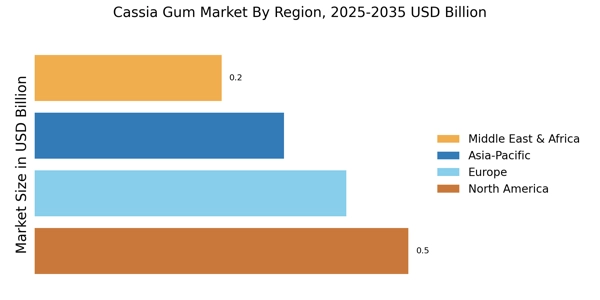
The Cassia Gum Market exhibits substantial regional variation, with North America projected to hold a significant position, valued at 0.45 USD Billion in 2024 and growing to 0.72 USD Billion by 2035. This region is characterized by its robust demand in the food and pharmaceutical industries, which drives continued market growth. Europe follows with a valuation of 0.3 USD Billion in 2024 and an increase to 0.5 USD Billion in 2035, reflecting a steady interest in natural thickening agents and preservatives.

The APAC region demonstrates a promising outlook, starting at 0.6 USD Billion in 2024 and reaching 0.95 USD Billion by 2035, primarily due to the rising consumer preference for natural products and ongoing urbanization.

South America, currently valued at 0.15 USD Billion in 2024, is anticipated to grow to 0.25 USD Billion by 2035, although it remains the least dominant market, reflecting regional economic constraints. Meanwhile, the MEA region, with values of 0.09 USD Billion in 2024 and 0.18 USD Billion in 2035, showcases a slow yet progressive demand for Cassia gum in local food applications. Overall, each region contributes to the diverse landscape of the Cassia Gum Market revenue, influenced by local industry trends and consumer preferences, which can create both challenges and opportunities for market participants.

Cassia Gum Market Regional Image

Key Players and Competitive Insights

The Cassia Gum Market has shown considerable growth due to the rising demand for natural and organic additives in various industries, including food, pharmaceuticals, and cosmetics. The competition within this market is driven by factors such as product quality, distribution channels, and pricing strategies. Key players are continuously innovating to develop new formulations and applications of cassia gum while also focusing on sustainable sourcing and supply chain management. 

The market dynamics are influenced by both the availability of raw materials and the regulatory landscape surrounding food and industrial products. With numerous companies vying for market share, competitive insights reveal a landscape characterized by strategic partnerships, mergers and acquisitions, and a growing emphasis on customer-centric approaches.Amsar India has established a notable presence in the Cassia Gum Market, leveraging its strengths to cater to diverse customer needs. The company is recognized for its commitment to quality and consistency, which enhances its credibility among clients in various sectors. 

Amsar India's focus on innovative processing techniques allows for the extraction of high-quality cassia gum, making its products highly sought after. Additionally, its well-developed distribution network ensures a steady supply of products to both domestic and international markets. The company's ability to adapt to changing consumer preferences while maintaining stringent quality control measures has positioned it as a reliable partner for businesses looking for cassia gum solutions.

As a prominent player, Amsar India continues to strengthen its market foothold through strategic initiatives and collaborations that enhance product offerings.Nexira is another key competitor in the Cassia Gum Market, distinguished for its emphasis on natural ingredients and sustainable practices. 

The company has a strong market presence thanks to its extensive portfolio, which includes a variety of applications for cassia gum in food, cosmetic, and pharmaceutical products. Nexira is recognized for its investment in research and development, allowing it to lead in innovation and meet specific customer demands effectively. The company's dedication to organic sourcing and minimal environmental impact resonates with customers who prioritize sustainability. Furthermore, Nexira's strong reputation for technical expertise and customized solutions has enabled it to build robust relationships with clients across different industries, further solidifying its position in the competitive landscape of cassia gum.

Key Companies in the Cassia Gum Market market include

Industry Developments

The Cassia Gum Market has recently seen significant developments, particularly in the areas of product innovation and demand expansion. Companies like Amsar India and Nexira have been focusing on enhancing their product offerings to cater to diverse applications, including food, pharmaceuticals, and cosmetics. The rising demand for natural and organic food ingredients has propelled growth for key players such as Starwest Botanicals and Kumar Organic Products. Emerging trends highlight increased investments in sustainable sourcing and processing technologies, impacting operational efficiencies.

Furthermore, mergers and acquisitions are gaining traction within this market, although recent activities are limited regarding major consolidations among the specific companies of interest, including Hindustan Gum and Chemicals and Ashland. Nonetheless, overall growth in market valuation is evident, largely driven by the expanding health and wellness sector, indicating an uplifting trajectory for firms like Fufeng Group and TIC Gums. As companies scale their operations and enhance their supply chains, they are also likely to improve their competitive edge in this dynamic environment.

This is reflected in an increased focus on strategic partnerships and distribution networks, ensuring improved market penetration and customer reach.

Future Outlook

Cassia Gum Market Future Outlook

The Cassia Gum Market is projected to grow at a 4.17% CAGR from 2024 to 2035, driven by increasing demand in food, pharmaceuticals, and cosmetics.

New opportunities lie in:

  • Expansion into emerging markets with tailored product offerings.
  • Development of sustainable sourcing practices to enhance brand value.
  • Investment in R&D for innovative applications in food and industrial sectors.

By 2035, the Cassia Gum Market is expected to achieve robust growth, solidifying its global presence.

Market Segmentation

Cassia Gum Market Source Outlook

  • Natural
  • Synthetic

Cassia Gum Market Application Outlook

  • Food and Beverage
  • Pharmaceuticals
  • Cosmetics
  • Oil and Gas
  • Textiles

Cassia Gum Market Formulation Outlook

  • Powdered
  • Granulated
  • Liquid

Cassia Gum Market End Use Industry Outlook

  • Food Processing
  • Personal Care
  • Industrial

Report Scope

MARKET SIZE 20241.59(USD Billion)
MARKET SIZE 20251.656(USD Billion)
MARKET SIZE 20352.492(USD Billion)
COMPOUND ANNUAL GROWTH RATE (CAGR)4.17% (2024 - 2035)
REPORT COVERAGERevenue Forecast, Competitive Landscape, Growth Factors, and Trends
BASE YEAR2024
Market Forecast Period2025 - 2035
Historical Data2019 - 2024
Market Forecast UnitsUSD Billion
Key Companies ProfiledMarket analysis in progress
Segments CoveredMarket segmentation analysis in progress
Key Market OpportunitiesGrowing demand for natural thickening agents in food and cosmetics drives opportunities in the Cassia Gum Market.
Key Market DynamicsRising demand for natural thickeners drives competition and innovation in the Cassia Gum market.
Countries CoveredNorth America, Europe, APAC, South America, MEA

Leave a Comment

FAQs

What is the current valuation of the Cassia Gum Market?

The Cassia Gum Market was valued at 1.59 USD Billion in 2024.

What is the projected market size for Cassia Gum by 2035?

The market is projected to reach 2.492 USD Billion by 2035.

What is the expected CAGR for the Cassia Gum Market during the forecast period?

The expected CAGR for the Cassia Gum Market from 2025 to 2035 is 4.17%.

Which segments are driving the Cassia Gum Market's growth?

Key segments include Food and Beverage, Pharmaceuticals, and Personal Care, with Food and Beverage projected to grow from 0.8 to 1.2 USD Billion.

Who are the key players in the Cassia Gum Market?

Key players include Sambavanam Agencies, Hindustan Gum & Chemicals, and Gum Technology, among others.

What are the different formulations available in the Cassia Gum Market?

The market features powdered, granulated, and liquid formulations, with powdered expected to grow from 0.636 to 0.996 USD Billion.

How does the source of Cassia Gum impact its market valuation?

Natural sources are projected to increase from 0.95 to 1.45 USD Billion, indicating a strong preference for natural products.

What end-use industries are contributing to the Cassia Gum Market?

End-use industries such as Food Processing and Personal Care are significant, with Food Processing expected to grow from 0.8 to 1.2 USD Billion.

What is the market outlook for synthetic versus natural Cassia Gum?

The synthetic segment is projected to grow from 0.64 to 1.04 USD Billion, suggesting a competitive landscape between natural and synthetic sources.

How does the Cassia Gum Market compare to other gum markets?

While specific comparisons are not provided, the growth trajectory and key players suggest a robust and expanding market presence.

Download Free Sample

Kindly complete the form below to receive a free sample of this Report

Compare Licence

×
Features License Type
Single User Multiuser License Enterprise User
Price $4,950 $5,950 $7,250
Maximum User Access Limit 1 User Upto 10 Users Unrestricted Access Throughout the Organization
Free Customization
Direct Access to Analyst
Deliverable Format
Platform Access
Discount on Next Purchase 10% 15% 15%
Printable Versions