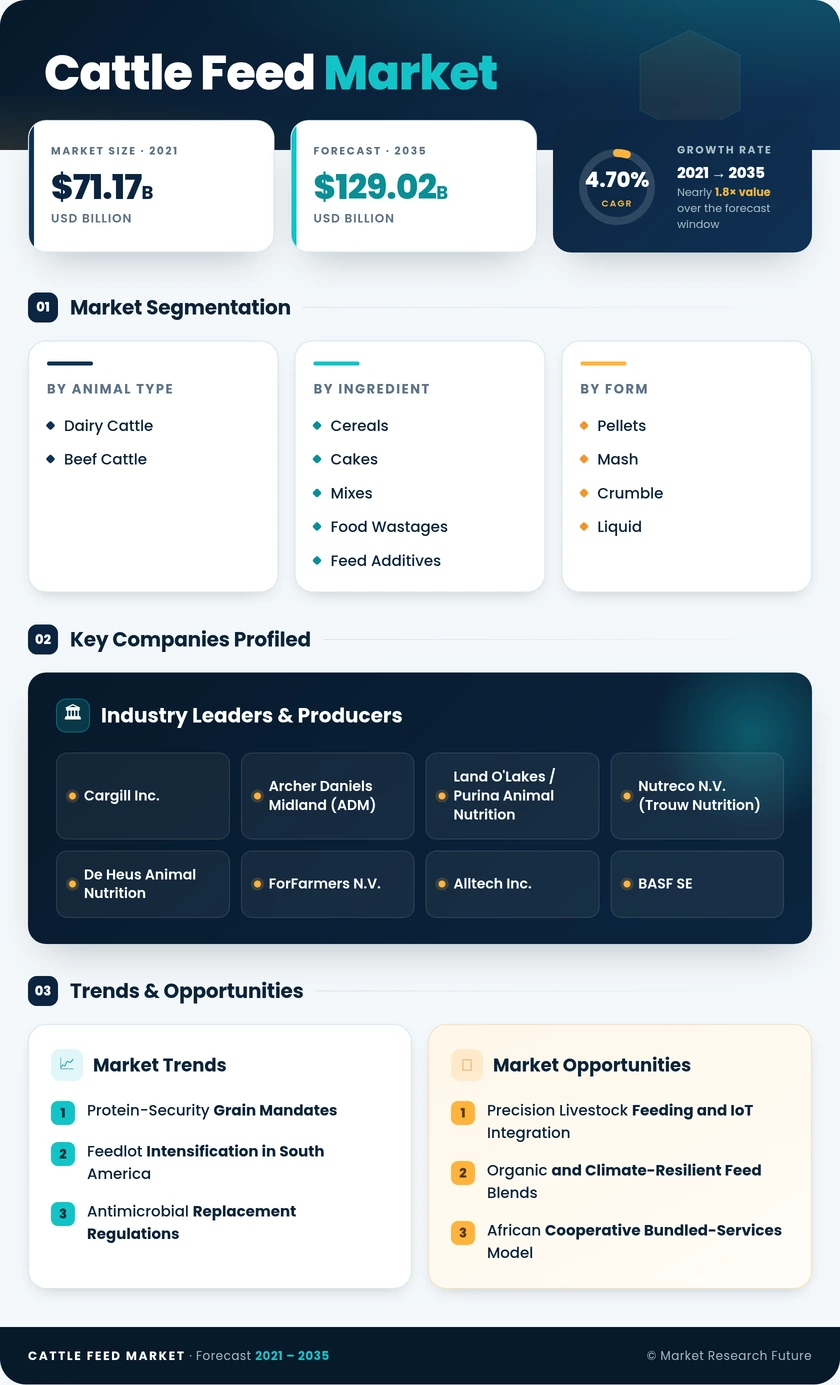
Cattle Feed Market (2025 - 2035)

Cattle Feed Market Size, Share, Industry Trend & Analysis Research Report Information By Animal Type (Dairy Cattle, Beef Cattle), By Ingredient (Cereals, Cakes and Mixes, Food Wastages, Feed Additives, Other Ingredients), By Form (Pellets, Mash, Crumble, Liquid), By Geography (North America, Europe, Asia-Pacific, South America, Middle East & Africa) – Forecast Till 2035

Forecast Period
2025-2035
CAGR
4.70%
2025 Market Size
USD 81.50 Billion
2035 Market Size
USD 129.02 Billion
Agriculture ● Updated June 2026 Report ID: MRFR/Agri/2321-CR 110 Pages Snehal Singh, Tejas Chaudhary
  1. 1 Market Overview |
    1. 1.1 Study Assumptions & Market Definition |
    2. 1.2 Scope of the Study |
    3. 1.3 Research Methodology
  2. 2 Market Summary & Key Takeaways
  3. 3 Market Dynamics |
    1. 3.1 Market Drivers Analysis | |
      1. 3.1.1 Protein-Security Grain Mandates | |
      2. 3.1.2 Feedlot Intensification in South America | |
      3. 3.1.3 Antimicrobial Replacement Regulations | |
      4. 3.1.4 Dairy Cooperative Expansion in Emerging Markets | |
      5. 3.1.5 Automation and Liquid Feeding Adoption | |
      6. 3.1.6 Rising Per-Capita Meat Consumption | |
      7. 3.1.7 Climate-Resilient Ingredient R&D |
    2. 3.2 Market Restraints Analysis | |
      1. 3.2.1 Grain Price Volatility | |
      2. 3.2.2 Water Scarcity and Drought Risk | |
      3. 3.2.3 Fragmented Regulatory Standards | |
      4. 3.2.4 High Capital Cost of Automated Feed Systems | |
      5. 3.2.5 Competition from Alternative Protein Sources |
    3. 3.3 Market Opportunity Analysis | |
      1. 3.3.1 Precision Livestock Feeding and IoT Integration | |
      2. 3.3.2 Organic and Climate-Resilient Feed Blends | |
      3. 3.3.3 African Cooperative Bundled-Services Model | |
      4. 3.3.4 Data Monetization Through Feed-Performance Analytics | |
      5. 3.3.5 Insect-Protein and Single-Cell Protein Integration |
    4. 3.4 Industry Value Chain Analysis |
    5. 3.5 Porter's Five Forces Analysis
  4. 4 Global Cattle Feed Market Size & Forecast (2021–2035) |
    1. 4.1 Historical Market Size (2021–2025) |
    2. 4.2 Current & Forecast Market Size (2026–2035) |
    3. 4.3 Market Size by Revenue (USD Billion) |
    4. 4.4 Year-over-Year Growth Analysis
  5. 5 Segmentation Analysis |
    1. 5.1 By Animal Type | |
      1. 5.1.1 Dairy Cattle | |
      2. 5.1.2 Beef Cattle |
    2. 5.2 By Ingredient | |
      1. 5.2.1 Cereals | |
      2. 5.2.2 Cakes and Mixes | |
      3. 5.2.3 Food Wastages | |
      4. 5.2.4 Feed Additives | |
      5. 5.2.5 Other Ingredients |
    3. 5.3 By Form | |
      1. 5.3.1 Pellets | |
      2. 5.3.2 Mash | |
      3. 5.3.3 Crumble | |
      4. 5.3.4 Liquid
  6. 6 Regional Analysis |
    1. 6.1 North America | |
      1. 6.1.1 United States | |
      2. 6.1.2 Canada | |
      3. 6.1.3 Mexico |
    2. 6.2 Europe | |
      1. 6.2.1 Germany | |
      2. 6.2.2 United Kingdom | |
      3. 6.2.3 France | |
      4. 6.2.4 Italy | |
      5. 6.2.5 Spain | |
      6. 6.2.6 Nordic Countries | |
      7. 6.2.7 Russia | |
      8. 6.2.8 Rest of Europe |
    3. 6.3 Asia-Pacific | |
      1. 6.3.1 China | |
      2. 6.3.2 India | |
      3. 6.3.3 Japan | |
      4. 6.3.4 South Korea | |
      5. 6.3.5 ASEAN | |
      6. 6.3.6 Rest of Asia-Pacific |
    4. 6.4 South America | |
      1. 6.4.1 Brazil | |
      2. 6.4.2 Argentina | |
      3. 6.4.3 Rest of South America |
    5. 6.5 Middle East & Africa | |
      1. 6.5.1 Saudi Arabia | |
      2. 6.5.2 UAE | |
      3. 6.5.3 South Africa | |
      4. 6.5.4 Egypt | |
      5. 6.5.5 Rest of MEA
  7. 7 Competitive Landscape |
    1. 7.1 Market Share Analysis (2025) |
    2. 7.2 Competitive Benchmarking Matrix |
    3. 7.3 Company Profiles | |
      1. 7.3.1 Cargill Inc. | |
      2. 7.3.2 Archer Daniels Midland (ADM) | |
      3. 7.3.3 Land O'Lakes / Purina Animal Nutrition | |
      4. 7.3.4 Nutreco N.V. (Trouw Nutrition) | |
      5. 7.3.5 De Heus Animal Nutrition | |
      6. 7.3.6 ForFarmers N.V. | |
      7. 7.3.7 Alltech Inc. | |
      8. 7.3.8 BASF SE | |
      9. 7.3.9 Kemin Industries | |
      10. 7.3.10 Evonik Industries
  8. 8 Future Outlook & Strategic Recommendations (2026–2035) |
    1. 8.1 AI-Driven Precision Feeding |
    2. 8.2 Sustainability-Linked Feed Certification |
    3. 8.3 Methane-Reducing Feed Additives |
    4. 8.4 Regional Feed-Ingredient Sovereignty
  9. 9 Recent Developments & News
  10. 10 Frequently Asked Questions (FAQs)
  11. 11 Report Scope & Methodology |
    1. 11.1 Study Period & Base Year |
    2. 11.2 Data Sources & Citations |
    3. 11.3 Abbreviations
  12. 12 LIST OF TABLES |
  13. TABLE 1 Global Cattle Feed Market Size & Forecast, by Revenue (USD Billion), 2021–2035 |
  14. TABLE 2 Global Cattle Feed Market — Year-over-Year Growth Analysis, 2021–2035 |
  15. TABLE 3 Global Cattle Feed Market — Driver Impact Analysis |
  16. TABLE 4 Global Cattle Feed Market — Restraint Impact Analysis |
  17. TABLE 5 Global Cattle Feed Market Size, by Animal Type, 2021–2035 (USD Billion) |
  18. TABLE 6 Global Cattle Feed Market Size, by Ingredient, 2021–2035 (USD Billion) |
  19. TABLE 7 Global Cattle Feed Market Size, by Form, 2021–2035 (USD Billion) |
  20. TABLE 8 Global Cattle Feed Market Size, by Region, 2021–2035 (USD Billion) |
  21. TABLE 9 North America Cattle Feed Market Size, by Country, 2021–2035 (USD Billion) |
  22. TABLE 10 Europe Cattle Feed Market Size, by Country, 2021–2035 (USD Billion) |
  23. TABLE 11 Asia-Pacific Cattle Feed Market Size, by Country, 2021–2035 (USD Billion) |
  24. TABLE 12 South America Cattle Feed Market Size, by Country, 2021–2035 (USD Billion) |
  25. TABLE 13 Middle East & Africa Cattle Feed Market Size, by Country, 2021–2035 (USD Billion) |
  26. TABLE 14 Competitive Benchmarking Matrix — Global Cattle Feed Market, 2025 |
  27. TABLE 15 Company Profiles — Key Players, Global Cattle Feed Market |
  28. TABLE 16 Recent Developments & Strategic Announcements, 2023–2025 |
  29. TABLE 17 Report Scope & Methodology Summary |
  30. TABLE 18 Detailed Sources and Citations |
  31. TABLE 19 North America Cattle Feed Market Size, by Animal Type, 2021–2035 (USD Billion) |
  32. TABLE 20 North America Cattle Feed Market Size, by Ingredient, 2021–2035 (USD Billion) |
  33. TABLE 21 North America Cattle Feed Market Size, by Form, 2021–2035 (USD Billion) |
  34. TABLE 22 Europe Cattle Feed Market Size, by Animal Type, 2021–2035 (USD Billion) |
  35. TABLE 23 Europe Cattle Feed Market Size, by Ingredient, 2021–2035 (USD Billion) |
  36. TABLE 24 Europe Cattle Feed Market Size, by Form, 2021–2035 (USD Billion) |
  37. TABLE 25 Asia-Pacific Cattle Feed Market Size, by Animal Type, 2021–2035 (USD Billion) |
  38. TABLE 26 Asia-Pacific Cattle Feed Market Size, by Ingredient, 2021–2035 (USD Billion) |
  39. TABLE 27 Asia-Pacific Cattle Feed Market Size, by Form, 2021–2035 (USD Billion) |
  40. TABLE 28 South America Cattle Feed Market Size, by Animal Type, 2021–2035 (USD Billion) |
  41. TABLE 29 South America Cattle Feed Market Size, by Ingredient, 2021–2035 (USD Billion) |
  42. TABLE 30 South America Cattle Feed Market Size, by Form, 2021–2035 (USD Billion) |
  43. TABLE 31 Middle East & Africa Cattle Feed Market Size, by Animal Type, 2021–2035 (USD Billion) |
  44. TABLE 32 Middle East & Africa Cattle Feed Market Size, by Ingredient, 2021–2035 (USD Billion) |
  45. TABLE 33 Middle East & Africa Cattle Feed Market Size, by Form, 2021–2035 (USD Billion)
  46. 13 LIST OF FIGURES |
  47. FIGURE 1 Global Cattle Feed Market Dynamics — Drivers, Restraints, and Opportunities |
  48. FIGURE 2 Cattle Feed Industry Value Chain Analysis |
  49. FIGURE 3 Porter's Five Forces Analysis — Global Cattle Feed Market |
  50. FIGURE 4 Global Cattle Feed Market Size Trend (USD Billion), 2021–2035 |
  51. FIGURE 5 Global Cattle Feed Market Share, by Animal Type (%), 2025 |
  52. FIGURE 6 Global Cattle Feed Market Share, by Ingredient (%), 2025 |
  53. FIGURE 7 Global Cattle Feed Market Share, by Form (%), 2025 |
  54. FIGURE 8 Global Cattle Feed Market Share, by Region (%), 2025 |
  55. FIGURE 9 North America Cattle Feed Market Size Trend (USD Billion), 2021–2035 |
  56. FIGURE 10 Europe Cattle Feed Market Size Trend (USD Billion), 2021–2035 |
  57. FIGURE 11 Asia-Pacific Cattle Feed Market Size Trend (USD Billion), 2021–2035 |
  58. FIGURE 12 South America Cattle Feed Market Size Trend (USD Billion), 2021–2035 |
  59. FIGURE 13 Middle East & Africa Cattle Feed Market Size Trend (USD Billion), 2021–2035 |
  60. FIGURE 14 Competitive Landscape — Market Share Distribution, 2025
Share::
Request Free Sample

Segmentation Quick Reference

DimensionSub-SegmentsDominant SegmentFastest Growing Segment
By Animal TypeDairy Cattle, Beef CattleDairy Cattle (57.0% share, 2025)Beef Cattle (5.7% CAGR)
By IngredientCereals, Cakes and Mixes, Food Wastages, Feed Additives, Other IngredientsCereals (45.4% share, 2025)Feed Additives (5.8% CAGR)
By FormPellets, Mash, Crumble, LiquidPellets (56.5% share, 2025)Liquid (5.1% CAGR)
By GeographyNorth America, Europe, Asia-Pacific, South America, Middle East & AfricaAsia-Pacific (39.5% share, 2025)Africa (5.9% CAGR)


Market Segmentation Overview

By Animal Type

Sub-SegmentKey Trend
Dairy CattleCooperative modernization and balanced-ration penetration are driving consistent feed volumes
Beef CattleFeedlot intensification in South America and ASEAN is shifting cattle from pasture to formulated rations


Dairy cattle remain the volume anchor of global cattle feed consumption due to year-round lactation-cycle feeding requirements, while beef cattle segments are experiencing accelerated growth as confined feeding operations expand across export-oriented markets.

By Ingredient

Sub-SegmentKey Trend
CerealsMaize and barley remain the energy backbone, with sourcing strategies shifting toward local procurement
Cakes and MixesSoybean and canola meal provide cost-effective protein supplementation
Food WastagesCircular economy mandates expanding the use of food industry byproducts in rations
Feed AdditivesRegulatory antimicrobial phase-outs are accelerating phytogenic and probiotic adoption
Other IngredientsVitamin, mineral, and trace-element premixes supporting precision nutrition formulations


Ingredient innovation is concentrated in feed additives, where regulatory pressure has created a multi-billion-dollar reformulation opportunity, while cereal procurement strategies are evolving toward greater regional self-sufficiency.

By Form

Sub-SegmentKey Trend
PelletsPreferred format for automated dispensing systems and long-distance transport
MashCost-effective option for smallholder and semi-commercial operations
CrumbleGrowing demand in calf starter and early-life nutrition programs
LiquidGaining adoption in automated dairies for real-time nutrient dosing


Pellets dominate due to handling efficiency and shelf stability, while liquid feed is the fastest-growing form as dairy automation investments expand across developed and emerging markets alike.

By Geography

Sub-SegmentKey Trend
North AmericaPrecision feeding adoption and Veterinary Feed Directive compliance are shaping formulation upgrades
EuropeFarm-to-Fork Strategy driving organic and phytogenic additive premiums
Asia-PacificChina's herd consolidation and India's cooperative expansion, anchoring volume leadership
South AmericaThe Brazilian feedlot corridor is creating concentrated high-energy ration demand
Middle East & AfricaCooperative-bundled service models enabling smallholder access to fortified feeds


Asia-Pacific holds the largest regional base, supported by government-led herd industrialization, while Africa's cooperative-driven growth model positions the region as the fastest-expanding geography through 2035.


Share::
Request Free Sample
Download PDF ×

We do not share your information with anyone. However, we may send you emails based on your report interest from time to time. You may contact us at any time to opt-out.