China Electric Vehicle Market (2026 - 2035)

China Electric Vehicle Market Size, Share & Growth Analysis Report By Vehicle Type (Battery Electric Vehicle (BEV), Plug-in Hybrid Electric Vehicle (PHEV), Fuel Cell Electric Vehicle (FCEV)), By Application (Passenger Vehicles, Light Commercial Vehicles, Buses and Coaches, Medium/Heavy-Duty Trucks), By Battery Chemistry (Lithium Iron Phosphate (LFP), Nickel Manganese Cobalt (NMC), Sodium-Ion (Na-ion), Solid-State (Emerging)) and By Regional (North America, Europe, South America, Asia Pacific, Middle East and Africa) – Industry Growth & Forecast to 2035
ID: MRFR/AT/19953-HCR
128 Pages
Triveni Bhoyar, Swapnil Palwe
Last Updated: June 29, 2026
China Electric Vehicle Market
Market Size
Forecast Period2026-2035
CAGR (2026-2035)14.8%
2025 Market SizeUSD 197.3 Billion
2035 Market SizeUSD 784.6 Billion
Key Players
BYD
Tesla
SAIC Motor
Geely-Zeekr
NIO
Li Auto
Opportunities
  • Solid-State Battery Commercialization
  • Vehicle-to-Grid and Energy Services
  • Rural and Lower-Tier City Penetration

China Electric Vehicle Market Summary

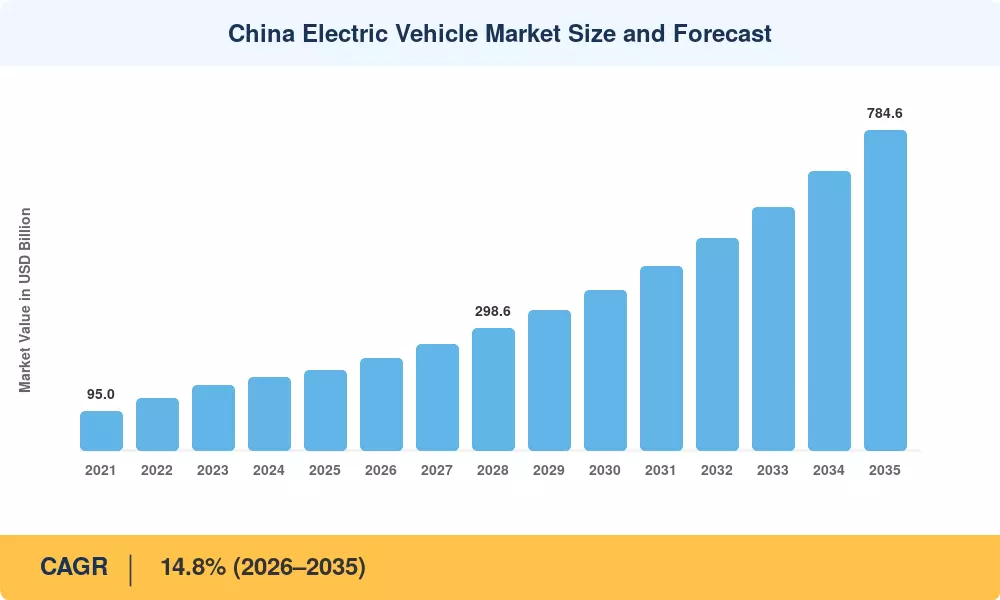
The China Electric Vehicle Market reached an estimated USD 197.3 billion in 2025, positioning the country as the single largest electric vehicle ecosystem on the planet. From a 2026 forecast starting point of USD 226.5 billion, the China Electric Vehicle Market is projected to expand at a compound annual growth rate of 14.8% through 2035, reaching USD 784.6 billion by the end of the forecast period. This trajectory is anchored in Beijing's dual-carbon goals — peak carbon by 2030, carbon neutrality by 2060 — and the State Council's New Energy Vehicle Industry Development Plan (2021–2035), which mandates that NEVs account for 50% of all new vehicle sales by 2035 [1]. Provincial purchase incentives, license-plate lottery exemptions in megacities, and aggressive charging-station rollout targets collectively underpin sustained demand.

A technological transformation is well underway. Internal combustion engine platforms that dominated Chinese roads for three decades are rapidly being displaced by battery-electric and plug-in hybrid architectures built on dedicated EV-native platforms. CATL's Qilin battery and BYD's Blade Battery have pushed pack-level energy density past 200 Wh/kg, while cumulative battery manufacturing capacity across China exceeded 1,500 GWh in 2024 [2]. The Ministry of Industry and Information Technology channeled over CNY 180 billion in NEV-related subsidies between 2015 and 2023 before pivoting to tax-exemption mechanisms, ensuring a smooth transition from direct subsidy to market-driven adoption [3].

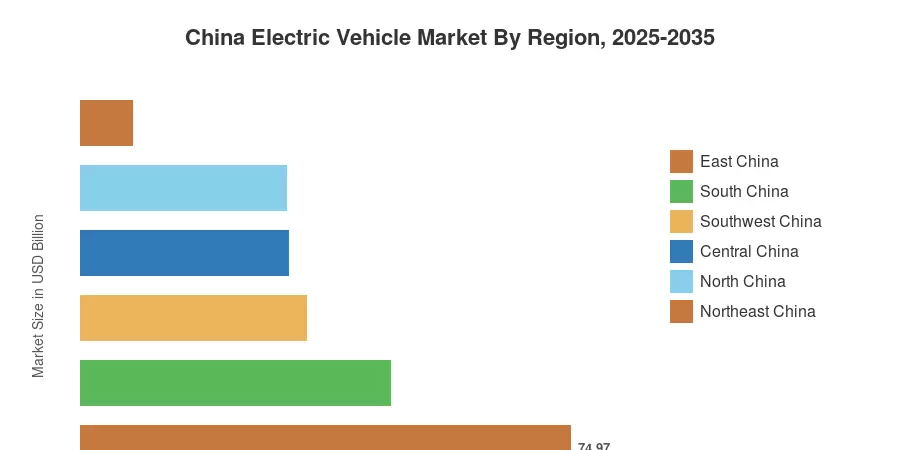
East China — led by Shanghai, Jiangsu, and Zhejiang — commands roughly 38% of the China Electric Vehicle Market, buoyed by OEM headquarters clusters and Tier-1 supplier concentration. Southwest China is the fastest-growing region, posting a CAGR of approximately 17.5% as Chongqing and Chengdu scale production capacity. South China, anchored by Guangdong's BYD-Shenzhen nexus, accounts for about 24% of domestic EV revenue. As battery costs continue declining and provincial governments accelerate rural electrification, the China Electric Vehicle Market is poised for a decade of structural expansion that will reshape global automotive supply chains.


Key Report Takeaways

• By Vehicle Type

  • Battery Electric Vehicles (BEVs) hold approximately 72% share of the China Electric Vehicle Market, driven by declining pack costs and range improvements above 600 km
  • Plug-in Hybrid Electric Vehicles (PHEVs) are registering a CAGR of 18.3%, the fastest among vehicle types, as range-anxiety-conscious buyers in Tier-3 and Tier-4 cities prefer dual-powertrain flexibility
  • Fuel Cell Electric Vehicles (FCEVs) are valued at approximately USD 4.1 billion in 2025, concentrated in heavy-duty trucking corridors across northern provinces

• By Application

  • Passenger vehicles represent roughly 82% of the China Electric Vehicle Market by revenue, reflecting mass-market adoption of compact and midsize BEVs
  • Commercial vehicles — buses, logistics vans, and medium-duty trucks — are growing at a CAGR of 16.2%, supported by municipal fleet electrification mandates

• By Region

  • East China leads with a 38% share, powered by manufacturing density along the Yangtze River Delta
  • Southwest China is expanding at the fastest CAGR of 17.5% as Sichuan and Chongqing invest in lithium processing and assembly capacity
  • South China contributes approximately USD 47.4 billion in 2025, anchored by Guangdong's vertically integrated EV supply chain


Market Size and Forecast (2021–2035)

Market Research Future's sizing model integrates bottom-up OEM shipment data from the China Association of Automobile Manufacturers (CAAM), top-down macroeconomic indicators from the National Bureau of Statistics, and proprietary pricing surveys across 28 provincial markets. Historical figures (2021–2024) rely on audited industry filings, while the forecast (2026–2035) applies a regression-adjusted growth model calibrated to battery cost trajectories, policy timelines, and infrastructure deployment curves.
China Electric Vehicle Market Size and Forecast
Our Impact
Enabled $4.3B Revenue Impact for Fortune 500 and Leading Multinationals
Partnering with 2000+ Global Organizations Each Year
30K+ Citations by Top-Tier Firms in the Industry

Driver Impact Analysis

Driver ~% Impact on CAGR Geographic Relevance Impact Timeline
National dual-carbon policy framework +3.2% Nationwide Long-term (≥4 yr)
Battery cost reduction below USD 80/kWh +2.8% Nationwide Medium-term (2–4 yr)
Charging infrastructure expansion mandate +2.5% Tier-2 to Tier-5 cities Medium-term (2–4 yr)
Provincial license-plate & purchase-tax incentives +2.1% Megacities, coastal provinces Short-term (≤2 yr)
Export growth to Southeast Asia and Europe +1.8% South China, East China Medium-term (2–4 yr)
Autonomous driving software monetization +1.5% East China, North China Long-term (≥4 yr)
Fleet electrification mandates for logistics +1.2% Nationwide Short-term (≤2 yr)


National Dual-Carbon Policy Framework

The primary structural driver of the Chinese electric vehicle market is China's pledge to reach carbon neutrality by 2060 and peak carbon emissions before 2030. The State Council's 2020 directive set a 50% objective for 2035 and required NEVs to reach 20% of sales by 2025, a goal China exceeded ahead of schedule [1]. This has been turned into legally obligatory fleet-turnover plans by provincial governments; for example, Shanghai has mandated that ride-hailing fleets be fully electrified by 2028, while Hainan has banned the sale of new ICE passenger cars starting in 2030. The China Electric Vehicle Market is protected from cyclical downturns by a policy bottom beneath demand created by the cascading effect of these tiered mandates.


Battery Cost Deflation

Pack-level costs have fallen from approximately USD 150/kWh in 2020 to an estimated USD 92/kWh by mid-2025, driven by LFP chemistry scaling and vertical integration by manufacturers such as CATL and BYD [2]. BloombergNEF projects that Chinese pack costs will breach the USD 75/kWh threshold by 2027, eliminating the upfront price premium over comparable ICE models in the compact sedan segment. This cost crossover will unlock mass adoption in Tier-3 and Tier-4 cities where price sensitivity remains high, adding an estimated 2.5 million incremental annual unit sales to the China Electric Vehicle Market by 2030.

Charging Infrastructure Buildout

The National Development and Reform Commission's 2023 guidelines call for 12 million public and semi-public charging points by 2030 — roughly triple the 2024 installed base of 3.8 million [6]. Highway ultra-fast charging corridors now cover over 80% of national expressways, and the China Electric Vehicle Market benefits directly from reduced range anxiety among prospective buyers. Provincial subsidy programs reimburse up to 30% of installation costs for rural and suburban charging stations, accelerating grid coverage in previously underserved inland provinces.

Export Expansion to New Geographies

In 2025, Chinese OEMs shipped more than 2.5 million EVs to Southeast Asia, Latin America, and Europe, with BYD, MG (SAIC), and Chery leading the way. Chinese companies can get around tariff obstacles by using overseas assembly plants, like BYD's Thailand facility and SAIC's Indonesia plant, to meet demand in emerging markets. In addition to accelerating economies of scale and supporting domestic capacity utilization rates, this strong export channel contributes to reducing unit costs throughout the Chinese electric vehicle market.


Restraints Impact Analysis

The restraint impact percentages below are directional estimates and should not be subtracted directly from the CAGR. They represent headwinds that moderate growth velocity under specific scenarios.

Restraint ~% Impact on CAGR Geographic Relevance Impact Timeline
Grid capacity constraints in rural regions −1.4% Central, Southwest, Northeast China Medium-term (2–4 yr)
Overcapacity and price-war margin erosion −1.2% Nationwide Short-term (≤2 yr)
Tariff escalation in key export markets −1.0% South China, East China (export hubs) Medium-term (2–4 yr)
Lithium and rare-earth supply volatility −0.8% Nationwide Long-term (≥4 yr)
Consumer fatigue with rapid model turnover −0.5% Tier-1, Tier-2 cities Short-term (≤2 yr)


Grid Capacity and Distribution Bottlenecks

Rural and semi-urban power grids in China's central and western provinces were not designed for the simultaneous high-amperage loads that mass EV charging demands. The State Grid Corporation reported that transformer upgrades in over 1,200 county-level districts will require CNY 380 billion in cumulative investment through 2030 [15]. Until grid reinforcement catches up, localized charging deserts will suppress EV adoption in lower-tier cities and slow the geographic broadening of the China Electric Vehicle Market.

Overcapacity and Margin Pressure

With domestic sales of about 12 million NEVs in 2024, Chinese OEMs' combined yearly manufacturing capacity exceeds 40 million units, resulting in a utilization rate of less than 30% for many smaller brands [16]. The ensuing price war, which was sparked by Tesla's early-2023 reduction and intensified by BYD, Wuling, and Changan, reduced most industry competitors' gross margins to single digits. While consumers gain, persistent margin pressure puts R&D reinvestment at risk and may lead to a wave of consolidation that briefly upsets the Chinese electric vehicle market.


Trade Friction and Tariff Barriers

In addition to changing US Section 301 tariffs, the European Union's temporary anti-subsidy taxes of up to 37.6% on Chinese-made EVs limit the addressable export market and divert excess inventory into domestic channels [17]. Tariff uncertainty creates planning risk that influences capital expenditure decisions within the China Electric Vehicle Market, Chinese OEMs are partially offsetting this through overseas CKD assembly.


China Electric Vehicle Market Opportunities

Solid-State Battery Commercialization

CATL, QuantumScape-licensed Chinese partners, and NIO's battery subsidiary have targeted 2027–2028 for semi-solid-state pack commercialization at automotive scale [7]. Achieving 350+ Wh/kg energy density would extend BEV range past 1,000 km on a single charge, repositioning EVs as viable alternatives for long-haul intercity travel and creating a premium segment within the China Electric Vehicle Market.

Vehicle-to-Grid and Energy Services

China's nascent V2G ecosystem — piloted in Shanghai and Shenzhen — allows EV batteries to serve as distributed energy storage assets during peak grid demand [10]. The National Energy Administration projects V2G-capable vehicles could supply 50 GW of dispatchable capacity by 2032, opening a revenue stream estimated at CNY 60 billion annually for fleet operators and aggregator platforms within the China Electric Vehicle Market.

Rural and Lower-Tier City Penetration

NEV penetration in Tier-4 and Tier-5 cities remains below 15%, compared with over 45% in Tier-1 cities [8]. Micro-EVs priced below CNY 80,000 — led by Wuling's HongGuang Mini EV and its successors — address the short-range commuting patterns and limited household budgets prevalent in rural China. Provincial trade-in subsidies of CNY 10,000–20,000 for ICE-to-EV swaps further catalyze adoption in these underserved markets.

Autonomous Driving Software Monetization

Baidu Apollo, Huawei ADS, and XPeng XNGP are transitioning autonomous driving from a hardware-cost burden to a subscription-based revenue layer [9]. Monthly fees of CNY 600–800 for Level 2+ highway and urban navigation functions generate recurring software margins that could contribute USD 18–25 billion annually to the China Electric Vehicle Market by 2032.

Battery Recycling and Circular Economy

China's Ministry of Ecology and Environment mandates producer-responsibility recycling for all traction batteries reaching end-of-life. With the first wave of mass-market EV batteries entering retirement between 2026 and 2028, the recycled-materials value chain — lithium, cobalt, nickel recovery — represents a USD 12 billion incremental opportunity for the China Electric Vehicle Market by 2030 [11].


China Electric Vehicle Market Future Outlook

Intelligent Driving and Software-Defined Vehicles

Value distribution in the Chinese electric vehicle (EV) market is being redefined by the convergence of autonomous driving, over-the-air updates, and AI-powered cockpit systems. The industry is moving away from speculative profit-pool forecasts and toward concrete, feature-based monetization methods, even though software and digital services are becoming more and more important. Leading autonomous driving systems, such as Baidu Apollo and Huawei's ADS, are aggressively implementing cutting-edge driver-assistance capabilities in China's main urban pilots. As regulatory frameworks develop, they will gradually expand into more city-level markets.


Battery Technology Leapfrogging

The shift to improved battery chemistries is shaping competitive dynamics through 2035. Although CATL's condensed-matter battery technology aims for a high energy density of 500 Wh/kg at the cell level, industrial-grade mass manufacturing for automotive platforms is a strategic goal for the 2030 timeframe, with pilot validation procedures still in progress. Concurrently, sodium-ion battery technology has attained full commercial maturity for stationary storage applications, offering a cost-effective substitute that fortifies the raw-material resilience of the Chinese EV industry.


Electrification of Heavy Transport

The China Electric Vehicle Market's next growth frontier lies in medium and heavy-duty commercial vehicles. The Ministry of Transport's 2024 Green Freight Action Plan targets 25% electrification of urban logistics fleets by 2030, supported by battery-swap corridors along major freight routes [14]. Hydrogen fuel-cell trucks are expected to handle long-haul routes exceeding 500 km, with the Beijing–Zhangjiakou hydrogen corridor serving as a proof-of-concept for national scaling.

ESG Reporting and Carbon-Credit Monetization

China's national carbon trading market, launched in 2021 and expanded to include the transport sector by 2028 under current planning, will create direct financial incentives for EV adoption. OEMs meeting NEV credit targets under the dual-credit policy can sell surplus credits to ICE-heavy competitors, generating USD 3–5 billion in annual cross-subsidization flows [20]. This regulatory architecture ensures that ESG compliance becomes a revenue lever, not merely a cost center, for participants in the China Electric Vehicle Market.


China Electric Vehicle Market Segmentation

By Vehicle Type

Segment Primary Metric Primary Demand Driver
Battery Electric Vehicle (BEV) 72% market share (2025) Pack cost decline; range above 600 km
Plug-in Hybrid Electric Vehicle (PHEV) CAGR 18.3% Tier-3/4 city range-anxiety mitigation
Fuel Cell Electric Vehicle (FCEV) USD 4.1 B (2025) Heavy-duty trucking hydrogen corridors


BEVs dominate the China Electric Vehicle Market by a wide margin, accounting for nearly three-quarters of total revenue. BYD's Han, Seal, and Qin families, alongside Tesla's locally produced Model 3 and Model Y, anchor the high-volume BEV segments between CNY 150,000 and CNY 300,000. The BEV segment benefits from the broadest charging-infrastructure compatibility and the strongest provincial incentive coverage.

PHEVs have staged a remarkable resurgence since 2023, driven by extended-range electric vehicle (EREV) architectures from Li Auto and Huawei-Seres's AITO brand. These vehicles offer 150–200 km of pure-electric range paired with a range-extending gasoline generator, effectively eliminating range anxiety while maintaining eligibility for green license plates in most cities. The China Electric Vehicle Market's PHEV segment is expected to sustain above-average growth through 2030 before gradually ceding share as BEV infrastructure reaches full national coverage.

By Application

Segment Primary Metric Primary Demand Driver
Passenger Vehicles 82% market share (2025) Mass-market compact and midsize BEV adoption
Light Commercial Vehicles CAGR 16.2% Last-mile logistics fleet electrification
Buses and Coaches USD 9.8 B (2025) Municipal zero-emission transit mandates
Medium/Heavy-Duty Trucks CAGR 19.7% Green freight corridors; battery-swap networks


Passenger vehicles form the revenue backbone of the China Electric Vehicle Market. Within this category, compact sedans priced below CNY 200,000 represent the highest-volume sub-segment, while premium electric SUVs from NIO, XPeng, and Li Auto contribute disproportionately to value share. The ongoing premiumization trend — average transaction prices rising 8% annually — reflects consumer willingness to pay for intelligent-driving features and premium interiors.

Commercial vehicle electrification, while smaller in absolute terms, is accelerating rapidly. Yutong and BYD have electrified over 180 Chinese city bus networks, and the medium/heavy-duty truck segment is posting the highest growth rate in the China Electric Vehicle Market as battery-swap technology from companies like CATL's EVOGO addresses range and downtime constraints for freight operators.

By Battery Chemistry

Segment Primary Metric Primary Demand Driver
Lithium Iron Phosphate (LFP) 67% market share (2025) Cost advantage; thermal stability; domestic supply
Nickel Manganese Cobalt (NMC) USD 52.3 B (2025) High energy density for premium/long-range BEVs
Sodium-Ion (Na-ion) CAGR 42.5% Ultra-low-cost micro-EVs; resource independence
Solid-State (Emerging) CAGR 38.2% Next-gen range and safety improvements


LFP chemistry has become the default choice for the majority of the China Electric Vehicle Market, powered by CATL and BYD's dominance in cell manufacturing and the absence of cobalt in the supply chain. LFP's cost — now below USD 55/kWh at the cell level — and superior cycle life make it ideally suited for the price-sensitive mass-market segments that drive volume in China.

NMC batteries retain a strong position in the premium segment, where consumers prioritize range and charging speed over upfront cost. NIO's 150-kWh semi-solid-state NMC pack, deployed in the ET7 sedan, delivers over 1,000 km of CLTC range and represents the performance ceiling within the China Electric Vehicle Market's battery landscape.


Regional Market Share Analysis

Region Primary Metric Primary Investment Themes
East China 38% market share (2025) OEM headquarters, battery supply chain, port-based exports
South China USD 47.4 B (2025) BYD ecosystem, cross-border trade with ASEAN
North China 16% market share (2025) Government fleet electrification, BAIC and Great Wall hubs
Central China CAGR 16.1% (2026–2035) Lithium processing, Dongfeng production base
Southwest China CAGR 17.5% (2026–2035) Lithium resource extraction, Changan/Geely expansion
Northeast China USD 7.9 B (2025) Cold-climate EV testing, FAW Group legacy plants
Total USD 197.3 B (2025)

The China Electric Vehicle Market exhibits significant geographic concentration driven by industrial clustering, provincial policy variation, and consumer income distribution. East China's manufacturing corridor dominates production and sales, while inland regions are posting faster growth rates on smaller bases.


East China

Province/City Primary Metric Key Driver
Shanghai 14% of regional revenue Tesla Giga Shanghai; SAIC headquarters
Jiangsu CAGR 15.2% Battery manufacturing cluster (Changzhou)
Zhejiang USD 21.8 B (2025) Geely-Zeekr, Leapmotor production base
Anhui CAGR 16.8% NIO and JAC joint-venture campus in Hefei


East China's Yangtze River Delta corridor has evolved into the world's densest EV supply-chain ecosystem. Shanghai's free-trade zone hosts Tesla's highest-output global plant, while Changzhou in Jiangsu has become China's "new energy capital," housing CATL, BYD, and Svolt battery gigafactories within a 50-km radius. The China Electric Vehicle Market draws roughly 38% of its total value from this region, reflecting both manufacturing output and high per-capita EV adoption rates in affluent coastal cities.

South China

Province/City Primary Metric Key Driver
Guangdong 68% of regional share BYD Shenzhen HQ; vertically integrated supply chain
Fujian CAGR 14.9% CATL Ningde proximity; Yudo Auto
Guangxi USD 2.1 B (2025) SGMW (Wuling) micro-EV production


Guangdong province alone accounts for over two-thirds of South China's EV output, with BYD's Shenzhen campus operating as the world's most vertically integrated EV manufacturing complex — spanning battery cells, semiconductors, and vehicle assembly under one corporate umbrella. The province's proximity to Hong Kong and Shenzhen's port infrastructure makes it the primary gateway for EV exports to Southeast Asia, supporting the China Electric Vehicle Market's growing international footprint.

North China

Province/City Primary Metric Key Driver
Beijing USD 9.5 B (2025) Government fleet mandates; BAIC Group
Hebei 22% of the regional share Great Wall Motor (Baoding HQ)
Tianjin CAGR 14.5% FAW-Toyota BEV joint venture


Beijing's stringent license-plate lottery system, which exempts NEVs, remains one of the most effective demand-side policy tools in the China Electric Vehicle Market. BAIC Group's BluePark subsidiary has pivoted entirely to electric platforms, while Great Wall Motor's Hebei operations are scaling the ORA and Tank PHEV lines for both domestic consumption and export to the Middle East.

Central China

Province Primary Metric Key Driver
Hubei USD 8.2 B (2025) Dongfeng Group restructuring toward EV
Hunan CAGR 16.5% BYD Changsha plant; CRRC electric buses
Henan 28% of the regional share Yutong electric bus dominance


Central China's emergence as a growth corridor within the China Electric Vehicle Market is closely linked to Dongfeng Motor's aggressive pivot from legacy ICE platforms. Hubei province's "Automotive Corridor" development plan allocates CNY 50 billion in infrastructure investment to modernize the Wuhan–Xiangyang manufacturing belt for electric and intelligent vehicle production through 2030.

Southwest China

Province/City Primary Metric Key Driver
Sichuan CAGR 18.1% Lithium resource base; Volvo-Geely plant
Chongqing USD 7.6 B (2025) Changan Automobile smart EV campus


Southwest China's rapid ascent in the China Electric Vehicle Market is resource-driven: Sichuan holds over 50% of China's proven lithium reserves, and the province's low-cost hydroelectric power provides a cost advantage for energy-intensive battery manufacturing. Chongqing's Changan Automobile has committed CNY 100 billion through 2028 to develop its Avatr and Deepal EV sub-brands, making the city a focal point for smart-EV innovation.


China Electric Vehicle Market By Region, 2025-2035

Competitive Benchmarking

The China Electric Vehicle Market is moderately concentrated, with an estimated Herfindahl–Hirschman Index of approximately 1,100–1,300. The top five players collectively account for an estimated 48–54% of domestic NEV revenue, while a long tail of over 100 smaller OEMs and new entrants contributes the remainder. Consolidation is accelerating — at least 15 EV startups ceased operations between 2023 and 2025 — but the market retains a dynamic, innovation-driven competitive structure.

Company Est. Revenue Share Range Key Offerings for the China Electric Vehicle Market Strategic Positioning
BYD ~28–32% Han, Seal, Qin, Dolphin, Blade Battery Vertically integrated cost leader
Tesla (China) ~8–10% Model 3, Model Y (Giga Shanghai) Premium volume; software monetization
SAIC Motor ~6–8% IM (Zhiji), Roewe, MG EV lines State-owned multi-brand portfolio
Geely-Zeekr ~5–7% Zeekr 001/X, Galaxy, Geometry Premium-to-mass dual brand strategy
NIO ~3–5% ET5, ET7, ES6; battery-as-a-service Battery swap; premium service ecosystem
Li Auto ~4–6% L7, L8, L9 (EREV architecture) Extended-range family SUV niche
XPeng ~3–4% G6, P7+, XNGP autonomous stack Technology-first; autonomous driving
Changan (Avatr/Deepal) ~4–6% Avatr 11/12, Deepal S07/L07 Huawei ADS partnership
Great Wall (ORA/Tank) ~2–4% ORA Good Cat, Tank 300 PHEV Female-oriented branding; off-road PHEV
Wuling (SGMW) ~3–5% HongGuang Mini EV, Bingo, Starlight Ultra-low-cost micro-EV specialist


Recent News & Developments

  • BYD (March 2025): Launched the fifth-generation Blade Battery with 230 Wh/kg pack energy density and integrated cell-to-body architecture, targeting a 15% weight reduction across its passenger vehicle lineup. This positions BYD to widen its cost advantage in the China Electric Vehicle Market [2].
  • CATL (January 2025): Announced a CNY 38 billion investment in a new 100-GWh sodium-ion battery production campus in Jining, Shandong, signaling commercial-scale readiness for Na-ion chemistry by late 2026 [12].
  • Tesla China (November 2024): Commenced production of the refreshed Model Y ("Juniper") at Giga Shanghai, incorporating a 4680 battery option and Hardware 5.0 FSD computer for the China Electric Vehicle Market [21].
  • NIO (September 2024): Opened its 2,500th battery-swap station in China, achieving a target of covering all major highway corridors nationally and reducing average swap time to 3 minutes [22].
  • Ministry of Finance (June 2024): Extended the NEV purchase-tax exemption through December 2027, with a phased reduction to 50% exemption in 2028–2029, providing multi-year demand visibility for the China Electric Vehicle Market [6].
  • Huawei-Seres (April 2024): Launched the AITO M9, integrating Huawei's ADS 3.0 autonomous driving system with lidar-based urban navigation across 45 cities, becoming the fastest-selling luxury SUV in its launch quarter [23].
  • XPeng (August 2023): Acquired Didi's autonomous driving division for approximately USD 740 million, accelerating its robotaxi development timeline and expanding its autonomous-driving dataset to over 100 petabytes [24].
  • European Commission (October 2023): Initiated anti-subsidy investigations into Chinese-made BEVs, ultimately imposing provisional duties of up to 37.6% in July 2024 — a pivotal trade development shaping export strategies within the China Electric Vehicle Market [17].


China Electric Vehicle Market Report Scope

Parameter Details
Market Scope China Electric Vehicle Market — passenger vehicles, commercial vehicles, buses, trucks; battery-electric, plug-in hybrid, fuel cell architectures
Study Period 2021–2035
CAGR (Forecast) 14.8% (2026–2035)
Base Year Market Size USD 197.3 Billion (2025)
Forecast Endpoint USD 784.6 Billion (2035)
Fastest Growing Segments PHEVs by vehicle type (18.3%); medium/heavy-duty trucks by application (19.7%); sodium-ion by chemistry (42.5%)
Companies Profiled BYD, Tesla China, SAIC, Geely-Zeekr, NIO, Li Auto, XPeng, Changan, Great Wall, Wuling (SGMW)
Valuation Currency USD (Billion)


FAQs

How does the dual-credit policy directly affect OEM profitability in China's EV sector?
OEMs earning surplus NEV credits sell them to ICE-heavy competitors at CNY 500–1,200 per credit, generating direct revenue. BYD reportedly earned over CNY 4 billion from credit sales in 2024 alone [20].
What are the primary technical differences between cell-to-pack and cell-to-body battery integration?
Cell-to-pack eliminates modules, improving volumetric efficiency by 15–20%. Cell-to-body goes further, using the pack as a structural floor, reducing chassis weight by up to 10% [2].
How do battery-swap stations compare to ultra-fast charging in total cost of ownership?
Battery-swap stations require higher upfront capital (CNY 5–8 million per station) but offer a 3-minute turnaround. Ultra-fast charging costs less to deploy but demands 15–25 minutes per session [22].
What role do provincial governments play beyond central policy in shaping EV adoption?
Provinces set their own license-plate exemptions, local purchase rebates, and charging-subsidy rates. Hainan and Shanghai have adopted the most aggressive timelines, banning new ICE registrations by 2030 [6].
How are Chinese OEMs addressing cold-climate battery performance in northern provinces?
Thermal preconditioning systems, insulated battery enclosures, and heat-pump HVAC replaced resistive heaters. NIO and BYD report less than 15% winter range loss with current thermal management [22].
What financing mechanisms are most common for fleet EV procurement in China?
Operating leases and battery-as-a-service models dominate fleet procurement. NIO's BaaS reduces upfront vehicle cost by CNY 70,000–128,000 while shifting battery depreciation risk to the leasing entity [22].
How does China's carbon-credit trading price compare to the EU ETS, and what does this mean for EV economics?
China's national carbon price averaged CNY 80–90 per tonne in 2024, roughly one-fifth of the EU ETS price. The lower price limits direct financial incentives, but expected price escalation to CNY 200+ by 2030 will strengthen the EV cost case [20].    
Author
Author
Author Profile
Triveni Bhoyar LinkedIn
Senior Research Analyst
Triveni Bhoyar has over 5 years of experience in the market research industry, specializing in the Automotive and Aerospace & Defense sectors. She has contributed to 200+ reports, including numerous custom projects for leading global companies, delivering solutions to complex business challenges. Renowned for her ability to generate valuable insights, Triveni excels in addressing unique market dynamics with precision and depth. Her expertise spans market sizing, competitive intelligence, and trend analysis, enabling clients to craft data-driven growth strategies. With strong analytical rigor and a client-centric approach, she plays a pivotal role in driving impactful, strategic decision-making.
Co-Author
Co-Author Profile
Swapnil Palwe LinkedIn
Team Lead - Research
With a technical background as Bachelor's in Mechanical Engineering, with MBA in Operations Management , Swapnil has 6+ years of experience in market research, consulting and analytics with the tasks of data mining, analysis, and project execution. He is the POC for our clients, for their consulting projects running under the Automotive/A&D domain. Swapnil has worked on major projects in verticals such as Aerospace & Defense, Automotive and many other domain projects. He has worked on projects for fortune 500 companies' syndicate and consulting projects along with several government projects.
Download Free Sample

Kindly complete the form below to receive a free sample of this Report

Download PDF ×

We do not share your information with anyone. However, we may send you emails based on your report interest from time to time. You may contact us at any time to opt-out.
















