×
Request Free Sample ×

Kindly complete the form below to receive a free sample of this Report

* Please use a valid business email

Leading companies partner with us for data-driven Insights

clients tt-cursor
Hero Background

China iPS Cell Derived Organoids Market

ID: MRFR/LS/51886-HCR
200 Pages
Rahul Gotadki
October 2025

China IPS Cell-Derived Organoids Market Research Report By Type (Brain Organoids, Heart Organoids, Lung Organoids, Liver Organoids, Kidney Organoids, Others), By Application (Drug Discovery and Development, Disease Modelling, Regenerative Medicine) and By End User (Pharmaceutical and Biotechnology Companies, Academic and Research Institutes, Contract Research Organization) - Forecast to 2035

Share:
Download PDF ×

We do not share your information with anyone. However, we may send you emails based on your report interest from time to time. You may contact us at any time to opt-out.

China iPS Cell Derived Organoids Market Infographic
Purchase Options

China iPS Cell Derived Organoids Market Summary

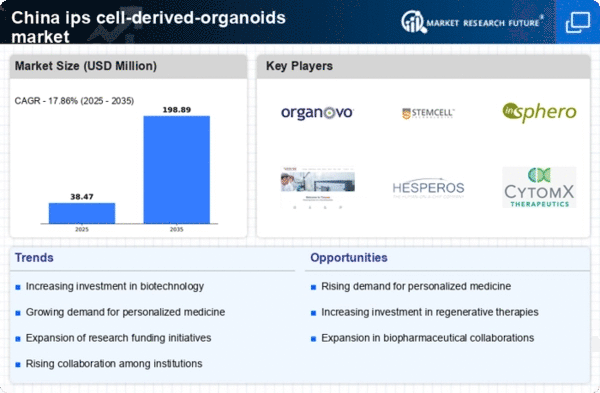
As per MRFR analysis, the ips cell-derived-organoids market size was estimated at 32.64 USD Million in 2024. The ips cell-derived-organoids market is projected to grow from 38.47 USD Million in 2025 to 198.89 USD Million by 2035, exhibiting a compound annual growth rate (CAGR) of 17.86% during the forecast period 2025 - 2035.

Key Market Trends & Highlights

The China ips cell-derived-organoids market is poised for substantial growth driven by technological advancements and increasing research investments.

  • Rising research investments are propelling the development of ips cell-derived organoids, particularly in the therapeutic segment.
  • The regulatory support and framework in China are enhancing the market's credibility and fostering innovation.
  • Technological advancements are likely to improve the efficiency and scalability of organoid production, especially in the research segment.
  • Growing demand for personalized medicine and increased government funding for stem cell research are key drivers of market expansion.

Market Size & Forecast

2024 Market Size 32.64 (USD Million)
2035 Market Size 198.89 (USD Million)
CAGR (2025 - 2035) 17.86%

Major Players

Organovo Holdings Inc (US), Stemcell Technologies Inc (CA), InSphero AG (CH), TissUse GmbH (DE), Hesperos Inc (US), CytomX Therapeutics Inc (US), Asterand Bioscience Inc (US), Reprocell Inc (JP)

China iPS Cell Derived Organoids Market Trends

The ips cell-derived-organoids market is experiencing notable growth, driven by advancements in stem cell research and regenerative medicine. In recent years, there has been an increasing focus on the development of organoids, which are three-dimensional structures derived from induced pluripotent stem cells (iPSCs). These organoids mimic the architecture and functionality of actual organs, providing researchers with valuable tools for drug testing, disease modeling, and personalized medicine. The rising demand for innovative therapeutic solutions is likely to propel the market forward, as researchers and pharmaceutical companies seek to harness the potential of these organoids for various applications. Moreover, the regulatory landscape in China appears to be evolving, with authorities showing a willingness to support research initiatives in the field of stem cell technology. This supportive environment may encourage investment and collaboration among academic institutions, biotechnology firms, and healthcare providers. As the ips cell-derived-organoids market continues to mature, it is expected that the integration of advanced technologies, such as artificial intelligence and machine learning, will further enhance the capabilities of organoid research, leading to more efficient and effective drug discovery processes. Overall, the future of this market seems promising, with significant opportunities for growth and innovation on the horizon.

Rising Research Investments

There is a noticeable increase in funding directed towards research in the ips cell-derived-organoids market. This trend is likely fueled by the growing recognition of the potential applications of organoids in drug development and disease modeling. Academic institutions and private companies are collaborating to explore innovative solutions, which may lead to breakthroughs in personalized medicine.

Regulatory Support and Framework

The regulatory environment surrounding stem cell Market Research Future appears to be becoming more favorable. Authorities are reportedly implementing guidelines that facilitate the development and commercialization of ips cell-derived organoids. This supportive framework may encourage more stakeholders to enter the market, fostering innovation and collaboration.

Technological Advancements

The integration of cutting-edge technologies into the ips cell-derived-organoids market is becoming increasingly prevalent. Innovations such as 3D bioprinting and advanced imaging techniques are enhancing the capabilities of organoid research. These advancements may lead to more accurate models for studying diseases and testing new therapies, potentially transforming the landscape of biomedical research.

China iPS Cell Derived Organoids Market Drivers

Rising Incidence of Chronic Diseases

The prevalence of chronic diseases in China is on the rise, creating a pressing need for innovative research tools such as iPSC-derived organoids. Conditions like diabetes, cardiovascular diseases, and cancer are becoming more common, necessitating advanced models for understanding disease mechanisms and testing new therapies. The ips cell-derived-organoids market is poised to benefit from this trend, as organoids provide a more accurate representation of human physiology compared to traditional cell cultures. The market for chronic disease management in China is expected to exceed $200 billion by 2025, suggesting a growing demand for effective research solutions. This increasing incidence of chronic diseases is likely to drive the adoption of organoid technology in research and drug development.

Growing Demand for Personalized Medicine

The increasing emphasis on personalized medicine in China is driving the ips cell-derived-organoids market. As healthcare shifts towards tailored treatments, organoids derived from induced pluripotent stem cells (iPSCs) offer a promising avenue for drug testing and disease modeling. This trend is particularly evident in oncology, where organoids can mimic patient-specific tumor environments, enhancing the efficacy of targeted therapies. The market for personalized medicine in China is projected to reach approximately $100 billion by 2025, indicating a robust growth trajectory. This demand for customized therapeutic solutions is likely to propel the ips cell-derived-organoids market, as researchers and pharmaceutical companies seek innovative tools to develop and test new drugs.

Advancements in Biomanufacturing Techniques

Recent advancements in biomanufacturing techniques are enhancing the production of iPSC-derived organoids, thereby impacting the ips cell-derived-organoids market. Innovations in 3D bioprinting and microfluidics are enabling the creation of more complex and functional organoid models. These technologies allow for high-throughput screening and more efficient drug discovery processes. In China, the biomanufacturing sector is projected to grow at a CAGR of 15% through 2025, indicating a strong potential for integrating these advancements into organoid production. As biomanufacturing techniques continue to evolve, they are likely to improve the scalability and reproducibility of organoid models, further driving the ips cell-derived-organoids market.

Collaborations Between Academia and Industry

Collaborative efforts between academic institutions and industry players are fostering innovation in the ips cell-derived-organoids market. These partnerships facilitate the exchange of knowledge and resources, leading to the development of cutting-edge organoid technologies. In China, numerous universities are partnering with biotech firms to advance research in stem cell-derived organoids. Such collaborations are essential for translating basic research into practical applications, enhancing the market's growth potential. The increasing number of joint ventures and research consortia is indicative of a thriving ecosystem that supports the advancement of organoid technologies. This collaborative landscape is likely to propel the ips cell-derived-organoids market forward, as new discoveries and applications emerge.

Increased Government Funding for Stem Cell Research

The Chinese government has been actively promoting stem cell research, which significantly impacts the ips cell-derived-organoids market. With substantial investments in biotechnology and regenerative medicine, funding initiatives are designed to foster innovation and accelerate research. In 2023, the government allocated over $1 billion to support stem cell research projects, which is expected to enhance the development of iPSC-derived organoids. This financial backing not only facilitates advanced research but also encourages collaboration between academic institutions and industry players. As a result, the growing government support is likely to stimulate advancements in the ips cell-derived-organoids market, leading to novel applications and increased market penetration.


Market Segment Insights

By Type: Brain Organoids (Largest) vs. Lung Organoids (Fastest-Growing)

In the China ips cell-derived-organoids market, brain organoids command the largest share due to their extensive application in neurological research and drug development. Their ability to mimic brain functionality offers invaluable insights, driving significant investment and adoption. Conversely, lung organoids are witnessing rapid growth, fueled by increasing interest in respiratory diseases and the urgent need for effective therapy models, which positions them as a quickly emerging segment within the market. The growth trends for these organoids are heavily influenced by advancements in stem cell technology and increasing funding for regenerative medicine. Specifically, the surge in respiratory ailments has led to heightened demand for lung organoids. As research deepens and more applications emerge, including potential therapeutic uses and personalized medicine, both segments are expected to thrive, showcasing dynamic potentials in the evolving landscape.

Brain Organoids (Dominant) vs. Lung Organoids (Emerging)

Brain organoids hold a dominant position in the China ips cell-derived-organoids market, primarily because of their unique ability to recreate human brain tissue and functionality. They are extensively utilized in research related to neurological disorders such as Alzheimer's and Parkinson's disease, enabling breakthroughs in drug development and testing. On the other hand, lung organoids are classified as an emerging segment, rapidly gaining traction due to their relevance in modeling lung diseases and understanding viral infections. Their growth is propelled by rising health concerns surrounding respiratory conditions. As the relevance of personalized medicine increases, both organoid types demonstrate remarkable potential, with brain organoids being widely entrenched and lung organoids rapidly establishing relevance in therapeutic contexts.

By Application: Drug Discovery (Largest) vs. Disease Modelling (Fastest-Growing)

In the China ips cell-derived-organoids market, the application segment is primarily composed of Drug Discovery and Development, Disease Modelling, and Regenerative Medicine. Drug Discovery commands a significant share of the market, as it is extensively utilized for screening potential drug candidates and understanding drug interactions at a cellular level. Disease Modelling follows closely, with a growing interest in its application for replicating disease-specific conditions in vitro, thereby offering valuable insights into disease mechanisms and therapeutic approaches. The growth trends within this segment are driven by the increasing demand for personalized medicine and the need for innovative drug development strategies. Disease Modelling is witnessing rapid advancements due to enhanced research funding and the push for market-ready therapies, making it the fastest-growing application. Meanwhile, Drug Discovery remains the dominant application, attributed to its established role in pharmaceutical development and the integration of advanced technologies such as AI and bioinformatics in drug development processes.

Drug Discovery (Dominant) vs. Disease Modelling (Emerging)

Drug Discovery is characterized by its extensive utilization in identifying and optimizing therapeutic candidates before they reach clinical trials, making it integral to pharmaceutical research and development. This application benefits from a well-established framework and regulatory pathways, ensuring a steady demand. In contrast, Disease Modelling is emerging rapidly, as it allows researchers to simulate human diseases using organoids derived from ips cells. This innovative approach not only provides a more accurate representation of human disease but also accelerates the development of new treatments tailored to specific patient needs. As research progresses, Disease Modelling is expected to play a pivotal role in bridging gaps in drug discovery and regenerative medicine, shaping the future of healthcare.

By End User: Pharmaceutical and Biotechnology Companies (Largest) vs. Academic and Research Institutes (Fastest-Growing)

In the China ips cell-derived-organoids market, pharmaceutical and biotechnology companies represent the largest segment, leveraging advanced technologies for drug discovery and development. These organizations have a significant market share due to their ongoing investments in research and innovative capabilities. Conversely, academic and research institutes are emerging as a rapidly growing segment, driven by increased funding and collaborations that enhance capabilities in disease modeling and regenerative medicine. The growth trends for these segments indicate a robust demand for ips cell-derived organoids, fueled by advancements in personalized medicine and regenerative therapies. Pharmaceutical companies aim to enhance their pipelines with these technologies, while academic institutes focus on groundbreaking research initiatives. The rising trend toward collaboration between these entities is expected to further propel growth and enhance the overall market landscape.

Pharmaceutical and Biotechnology Companies (Dominant) vs. Academic and Research Institutes (Emerging)

The pharmaceutical and biotechnology companies dominate the sector, benefiting from established infrastructure and deep expertise in high-throughput screening and drug testing. These organizations are pivotal in integrating ips cell-derived organoids into their research workflows, facilitating rapid progression from laboratory research to clinical applications. In contrast, academic and research institutes are increasingly recognized for their innovative approaches to bioscience. They focus on pioneering studies that explore fundamental biological processes, thereby driving the emergent use of organoids in academic settings. This has led to increased partnerships with commercial entities, positioning academic institutes as significant contributors to the evolution of this market.

Get more detailed insights about China iPS Cell Derived Organoids Market

Key Players and Competitive Insights

The ips cell-derived-organoids market in China is characterized by a dynamic competitive landscape, driven by advancements in regenerative medicine and personalized therapies. Key players such as Organovo Holdings Inc (US), Stemcell Technologies Inc (CA), and InSphero AG (CH) are at the forefront, each adopting distinct strategies to enhance their market presence. Organovo Holdings Inc (US) focuses on innovation in 3D bioprinting technologies, aiming to revolutionize tissue engineering. Meanwhile, Stemcell Technologies Inc (CA) emphasizes partnerships with academic institutions to foster research and development, thereby enhancing its product offerings. InSphero AG (CH) is leveraging its expertise in organ-on-a-chip technology to create more accurate models for drug testing, which positions it favorably in the competitive environment.

The business tactics employed by these companies include localizing manufacturing and optimizing supply chains to meet the growing demand for organoids. The market structure appears moderately fragmented, with several players vying for market share. However, the collective influence of these key players is shaping a more consolidated environment, as they engage in strategic collaborations and partnerships to enhance their capabilities and market reach.

In August 2025, Organovo Holdings Inc (US) announced a collaboration with a leading pharmaceutical company to develop custom organoid models for drug discovery. This strategic move is likely to enhance Organovo's position in the market by providing tailored solutions that meet specific client needs, thereby increasing its competitive edge. The partnership not only expands its product portfolio but also reinforces its commitment to innovation in bioprinting technologies.

In September 2025, Stemcell Technologies Inc (CA) launched a new line of organoid culture media designed to improve the growth and maintenance of various organoid types. This product introduction is significant as it addresses a critical need in the market for high-quality culture systems, potentially increasing Stemcell's market share and reinforcing its reputation as a leader in stem cell research tools. The launch reflects the company's ongoing commitment to enhancing research capabilities in the field.

In October 2025, InSphero AG (CH) secured a major funding round aimed at expanding its organ-on-a-chip technology platform. This funding is expected to accelerate the development of new applications in drug testing and toxicity screening, positioning InSphero as a key player in the evolving landscape of organoid technology. The investment underscores the growing interest in innovative solutions that can provide more reliable preclinical models.

As of November 2025, current competitive trends in the ips cell-derived-organoids market include a strong emphasis on digitalization, sustainability, and the integration of artificial intelligence (AI) in research processes. Strategic alliances are increasingly shaping the landscape, as companies recognize the value of collaboration in driving innovation. Looking ahead, competitive differentiation is likely to evolve from traditional price-based competition to a focus on technological advancements, innovation, and supply chain reliability, suggesting a shift towards more sustainable and efficient practices in the industry.

Key Companies in the China iPS Cell Derived Organoids Market market include

Industry Developments

The China iPS Cell-Derived Organoids Market has seen significant developments recently, with companies like Stemcell Technologies and ReproCELL actively contributing to advancements in cellular research. In September 2023, Beijing Genomics Institute announced a strategic collaboration focused on enhancing organoid technology to bridge gaps between data generation and clinical applications. Furthermore, WuXi AppTec expanded its capabilities in iPS cell research, enabling broader access to its cutting-edge technologies in the market. In terms of mergers and acquisitions, Asterand Bioscience underwent strategic reevaluation in August 2023, aligning itself with growing market opportunities, though no official acquisition was noted during this period. 

The valuation of companies within this sector continues to grow, with Organovo and Boyalife reported to have significant investment influxes that are expected to enhance innovative product offerings. This growth has led to improved research outputs, facilitating further development in regenerative medicine and disease modeling. Looking back, in February 2022, Cytoviva reported a notable partnership aimed at integrating advanced imaging technologies with organoid studies, signaling a trend towards multi-disciplinary approaches within the industry.

Future Outlook

China iPS Cell Derived Organoids Market Future Outlook

The IPS Cell Derived Organoids Market in China is projected to grow at a 17.86% CAGR from 2024 to 2035, driven by advancements in regenerative medicine and personalized therapies.

New opportunities lie in:

  • Development of high-throughput screening platforms for drug discovery
  • Partnerships with biotech firms for tailored organoid solutions
  • Expansion into educational institutions for research and training programs

By 2035, the market is expected to achieve substantial growth and innovation.

Market Segmentation

China iPS Cell Derived Organoids Market Type Outlook

  • Brain Organoids
  • Heart Organoids
  • Lung Organoids
  • Liver Organoids
  • Kidney Organoids
  • Others

China iPS Cell Derived Organoids Market End User Outlook

  • Pharmaceutical and Biotechnology Companies
  • Academic and Research Institutes
  • Contract Research Organization

China iPS Cell Derived Organoids Market Application Outlook

  • Drug Discovery and Development
  • Disease Modelling
  • Regenerative Medicine

Report Scope

MARKET SIZE 2024 32.64(USD Million)
MARKET SIZE 2025 38.47(USD Million)
MARKET SIZE 2035 198.89(USD Million)
COMPOUND ANNUAL GROWTH RATE (CAGR) 17.86% (2024 - 2035)
REPORT COVERAGE Revenue Forecast, Competitive Landscape, Growth Factors, and Trends
BASE YEAR 2024
Market Forecast Period 2025 - 2035
Historical Data 2019 - 2024
Market Forecast Units USD Million
Key Companies Profiled Organovo Holdings Inc (US), Stemcell Technologies Inc (CA), InSphero AG (CH), TissUse GmbH (DE), Hesperos Inc (US), CytomX Therapeutics Inc (US), Asterand Bioscience Inc (US), Reprocell Inc (JP)
Segments Covered Type, Application, End User
Key Market Opportunities Advancements in personalized medicine drive demand for innovative applications of ips cell-derived-organoids.
Key Market Dynamics Rising demand for personalized medicine drives innovation in ips cell-derived-organoids within the Chinese market.
Countries Covered China

Leave a Comment

FAQs

What is the projected market size of the China iPS Cell-Derived Organoids Market in 2024?

The China iPS Cell-Derived Organoids Market is projected to be valued at 25.5 million USD in 2024.

What is the expected market size for the China iPS Cell-Derived Organoids Market in 2035?

By 2035, the China iPS Cell-Derived Organoids Market is expected to reach a valuation of 154.73 million USD.

What is the anticipated compound annual growth rate (CAGR) for the China iPS Cell-Derived Organoids Market from 2025 to 2035?

The market is expected to exhibit a CAGR of 17.811% from 2025 to 2035.

Which type of organoids is projected to have the highest market value in 2035?

Brain Organoids are expected to have the highest market value at 39.5 million USD in 2035.

What is the market size of Lung Organoids in 2024 and 2035?

Lung Organoids are estimated to be valued at 5.5 million USD in 2024 and 33.5 million USD in 2035.

Who are some of the key players in the China iPS Cell-Derived Organoids Market?

Major players in the market include Stemcell Technologies, ReproCELL, and WuXi AppTec among others.

How is the market for Heart Organoids expected to grow from 2024 to 2035?

The market for Heart Organoids is expected to grow from 5 million USD in 2024 to 30 million USD in 2035.

What challenges could affect the growth of the China iPS Cell-Derived Organoids Market?

Potential challenges include regulatory hurdles and high research and development costs.

What trends are influencing the China iPS Cell-Derived Organoids Market currently?

Growing interest in personalized medicine and regenerative therapies are key trends influencing the market.

What market dynamics can impact the growth of the China iPS Cell-Derived Organoids Market?

Factors like increasing funding for stem cell research and technological advancements in organoid development can significantly impact market growth.

Download Free Sample

Kindly complete the form below to receive a free sample of this Report

Compare Licence

×
Features License Type
Single User Multiuser License Enterprise User
Price $4,950 $5,950 $7,250
Maximum User Access Limit 1 User Upto 10 Users Unrestricted Access Throughout the Organization
Free Customization
Direct Access to Analyst
Deliverable Format
Platform Access
Discount on Next Purchase 10% 15% 15%
Printable Versions