×
Request Free Sample ×

Kindly complete the form below to receive a free sample of this Report

Leading companies partner with us for data-driven Insights

clients tt-cursor
Hero Background

Chocolate Ice Cream Market

ID: MRFR/FnB/6227-CR
95 Pages
Snehal Singh
April 2019

Chocolate Ice Cream Market Research Report By Type (Soft Serve, Hard Ice Cream, Gelato, Frozen Yogurt), By Flavor Variants (Milk Chocolate, Dark Chocolate, Chocolate Mint, Chocolate Fudge), By Distribution Channel (Supermarkets, Convenience Stores, Online Retail, Specialty Stores), By Packaging (Multipack, Single Serve, Family Size, Bulk Packaging) and By Regional (North America, Europe, South America, Asia Pacific, Middle East and Africa) - Forecast to 2035

Share:
Download PDF ×

We do not share your information with anyone. However, we may send you emails based on your report interest from time to time. You may contact us at any time to opt-out.

Chocolate Ice Cream Market Infographic
Purchase Options

Chocolate Ice Cream Market Summary

As per MRFR analysis, the Chocolate Ice Cream Market Size was estimated at 10.08 USD Billion in 2024. The Chocolate Ice Cream industry is projected to grow from 10.46 USD Billion in 2025 to 15.07 USD Billion by 2035, exhibiting a compound annual growth rate (CAGR) of 3.72 during the forecast period 2025 - 2035.

Key Market Trends & Highlights

The Chocolate Ice Cream Market is experiencing a dynamic shift towards health-conscious and innovative offerings.

  • Health-conscious choices are increasingly influencing consumer preferences in the Chocolate Ice Cream Market.
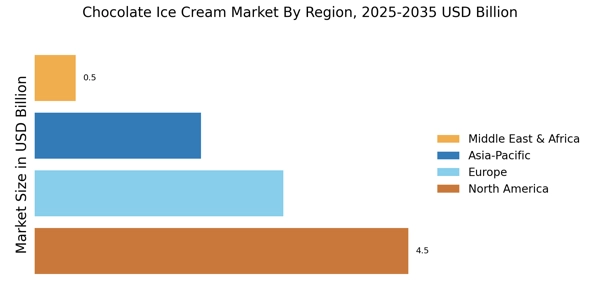
  • North America remains the largest market, while the Asia-Pacific region is emerging as the fastest-growing area for chocolate ice cream consumption.
  • Hard ice cream continues to dominate the market, whereas gelato is gaining traction as the fastest-growing segment.
  • Rising demand for premium products and innovative flavor combinations are key drivers propelling market growth.

Market Size & Forecast

2024 Market Size 10.08 (USD Billion)
2035 Market Size 15.07 (USD Billion)
CAGR (2025 - 2035) 3.72%

Major Players

Unilever (GB), Nestle (CH), General Mills (US), Mars, Incorporated (US), Häagen-Dazs (US), Blue Bell Creameries (US), Breyers (US), Dreyer's (US), Tillamook (US)
Chocolate Ice Cream Market Trends

The Chocolate Ice Cream Market is currently experiencing a dynamic evolution, characterized by shifting consumer preferences and innovative product offerings. As health consciousness rises among consumers, there is a noticeable trend towards premium and organic chocolate ice cream options. This shift suggests that brands are increasingly focusing on high-quality ingredients and sustainable sourcing practices to cater to a more discerning clientele. Additionally, the market is witnessing a surge in plant-based alternatives, reflecting a broader movement towards veganism and lactose-free diets. This diversification in product lines indicates that manufacturers are adapting to meet the varied dietary needs of consumers. Moreover, the Chocolate Ice Cream Market is also influenced by the growing trend of experiential consumption. Consumers are not merely seeking indulgence; they are looking for unique flavors and artisanal experiences. This trend encourages brands to experiment with exotic ingredients and innovative flavor combinations, thereby enhancing the overall consumer experience. Furthermore, the rise of e-commerce platforms has transformed the way chocolate ice cream is marketed and sold, allowing for greater accessibility and convenience. As the market continues to evolve, it appears poised for further growth, driven by these emerging trends and changing consumer dynamics.

Health-Conscious Choices

There is a growing inclination towards healthier options within the Chocolate Ice Cream Market. Consumers are increasingly seeking products that utilize organic ingredients and offer lower sugar content, reflecting a broader trend of health awareness.

Plant-Based Innovations

The emergence of plant-based chocolate ice cream alternatives is reshaping the market landscape. This trend caters to the rising demand for vegan and lactose-free products, appealing to a diverse range of dietary preferences.

Experiential Consumption

The Chocolate Ice Cream Market is witnessing a shift towards experiential consumption, where consumers prioritize unique flavors and artisanal quality. This trend encourages brands to innovate and create memorable tasting experiences.

Chocolate Ice Cream Market Drivers

Innovative Flavor Combinations

Innovation in flavor profiles is a significant driver within the Chocolate Ice Cream Market. Manufacturers are experimenting with unconventional ingredients and flavor pairings, such as chocolate with sea salt, chili, or exotic fruits. This creative approach caters to adventurous consumers who are eager to try new taste experiences. Market data suggests that products featuring unique flavor combinations are gaining traction, with sales in this category increasing by approximately 15% over the past year. As brands continue to push the boundaries of traditional chocolate ice cream, they are likely to attract a broader audience, thus enhancing their competitive edge in the Chocolate Ice Cream Market.

Expansion of Distribution Channels

The Chocolate Ice Cream Market is witnessing an expansion of distribution channels, which is facilitating greater accessibility for consumers. The rise of e-commerce and online grocery shopping has transformed how consumers purchase ice cream, allowing for a wider reach beyond traditional retail outlets. Data shows that online sales of ice cream products have increased by approximately 20% in the past year. Additionally, partnerships with food delivery services are enhancing convenience for consumers. As distribution channels continue to diversify, brands that adapt to these changes are likely to capture a larger market share in the Chocolate Ice Cream Market.

Rising Demand for Premium Products

The Chocolate Ice Cream Market is experiencing a notable shift towards premium and artisanal products. Consumers are increasingly seeking high-quality ingredients and unique flavors, which has led to a surge in the production of gourmet chocolate ice creams. This trend is supported by data indicating that the premium segment of the ice cream market has been growing at a rate of approximately 8% annually. As consumers become more discerning, brands that emphasize quality and craftsmanship are likely to capture a larger share of the market. This demand for premium offerings not only enhances brand loyalty but also allows manufacturers to command higher price points, thereby increasing profitability within the Chocolate Ice Cream Market.

Sustainability and Ethical Sourcing

Sustainability is becoming increasingly important in the Chocolate Ice Cream Market. Consumers are more aware of the environmental impact of their food choices and are actively seeking products that are ethically sourced and produced. This has led to a rise in demand for chocolate ice creams made with sustainably sourced cocoa and environmentally friendly packaging. Market Research Future indicates that products labeled as sustainable can command a premium price, with consumers willing to pay more for brands that align with their values. As sustainability continues to shape consumer preferences, companies that prioritize ethical practices are likely to gain a competitive advantage in the Chocolate Ice Cream Market.

Growing Popularity of Indulgent Treats

The Chocolate Ice Cream Market is benefiting from a cultural shift towards indulgent treats. As consumers seek comfort and pleasure in their food choices, chocolate ice cream has emerged as a favored option. This trend is reflected in market data, which shows that indulgent ice cream products have seen a sales increase of around 10% in recent years. The emotional connection consumers have with chocolate ice cream, often associated with nostalgia and celebration, further fuels this demand. Brands that effectively market their products as indulgent experiences are likely to thrive in the competitive landscape of the Chocolate Ice Cream Market.

Market Segment Insights

By Type: Hard Ice Cream (Largest) vs. Gelato (Fastest-Growing)

The Chocolate Ice Cream Market is characterized by a diverse range of product types, among which Hard Ice Cream accounts for the largest share, thanks to its traditional appeal and established market presence. Soft Serve and Frozen Yogurt also contribute significantly, but Hard Ice Cream leads the sector in popularity. Gelato has emerged as a stimulating contender, drawing attention for its richer flavor and texture. As consumer preferences evolve, these segments illustrate the dynamic nature of the market.

Hard Ice Cream (Dominant) vs. Gelato (Emerging)

Hard Ice Cream remains the dominant segment in the Chocolate Ice Cream Market, widely favored for its creamy texture and rich flavor profile. It appeals to consumers who enjoy indulgent desserts and is often available in an extensive range of flavors, leading to strong brand loyalty. In contrast, Gelato represents the fastest-growing segment due to a surge in demand for premium and artisanal options. Known for its dense and smoother texture, Gelato appeals to health-conscious consumers looking for a gourmet experience. This shift towards Gelato underscores changing consumer tastes and the importance of innovation in flavor and experience.

By Flavor Variants: Milk Chocolate (Largest) vs. Dark Chocolate (Fastest-Growing)

In the Chocolate Ice Cream Market, Milk Chocolate dominates with a significant market share due to its broad appeal and established consumer preference. The creamy texture and sweeter profile of Milk Chocolate make it a mainstream choice. Following closely is Dark Chocolate, which is gaining traction among health-conscious consumers seeking richer flavors with potential health benefits, contributing to its rapid growth.

Milk Chocolate: Dominant vs. Dark Chocolate: Emerging

Milk Chocolate is the cornerstone of the Chocolate Ice Cream Market, cherished for its smooth, sweet flavor and appealing texture that attracts a diverse consumer base. It has consistently been favored by families and younger demographics, serving as a classic indulgence. In contrast, Dark Chocolate, with its deep flavor and lower sugar content, is emerging as a preferred choice for those who prioritize health without sacrificing taste. This shift is supported by rising consumer awareness about the benefits of dark chocolate, such as antioxidants and lower calories, positioning it as a desirable option across various age groups, particularly among millennials and fitness enthusiasts.

By Distribution Channel: Supermarkets (Largest) vs. Online Retail (Fastest-Growing)

In the Chocolate Ice Cream Market, supermarkets continue to hold the largest share of distribution channels, serving as the primary retail outlet for consumers. They offer a wide variety of products and brands, making them a preferred shopping destination for families and individuals. The convenience, coupled with competitive pricing and promotional offers, further solidifies their dominance in the market.

Supermarkets (Dominant) vs. Online Retail (Emerging)

Supermarkets have established themselves as the dominant distribution channel in the chocolate ice cream market due to their extensive reach and ability to cater to a broad customer base. They provide consumers with a one-stop shopping experience, showcasing a wide array of chocolate ice cream options from various brands. On the other hand, online retail is emerging as a fast-growing segment, driven by changing consumer preferences towards convenience and the rise of e-commerce. As more consumers shift towards online shopping, the ease of accessing specialty chocolate ice cream products online has accelerated growth, reflecting a significant trend in consumer behavior.

By Packaging: Multipack (Largest) vs. Single Serve (Fastest-Growing)

The packaging segment of the Chocolate Ice Cream Market is predominantly led by multipack offerings, which have captured significant consumer interest due to their convenience and value proposition. Single serve packaging, while smaller in overall market share, has shown remarkable growth driven by consumer trends favoring on-the-go dessert options. Family size and bulk packaging also hold their respective shares, catering to large gatherings and commercial buyers, but they are not growing as swiftly as single serve. Growth in the packaging segment is primarily influenced by changing consumer lifestyles, where convenience and portion control are becoming more critical. The rising demand for single serve options aligns perfectly with busy lifestyles, making it the fastest-growing segment. On the other hand, multipack products remain a favorite due to their value and variety, appealing to families and value-conscious consumers.

Multipack (Dominant) vs. Single Serve (Emerging)

Multipack packaging is characterized by its bulk offerings, allowing consumers to enjoy a variety of chocolate ice cream flavors at a competitive price. This segment appeals strongly to families and party settings, making it a staple in many households. Multipacks encourage trial across different flavors while providing a cost-effective dessert solution. In contrast, single serve packaging has emerged as a fresh and rapidly gaining segment, appealing primarily to younger consumers and busy professionals seeking dessert options that fit into their on-the-go lifestyles. This segment is increasingly popular in convenience stores and vending machines, capitalizing on the trend of impulsive purchasing and the need for portion control. Together, these two segments highlight the diverse preferences in the packaging landscape of the Chocolate Ice Cream Market.

Get more detailed insights about Chocolate Ice Cream Market

Regional Insights

North America : Market Leader in Chocolate Ice Cream Market

North America is the largest market for chocolate ice cream, holding approximately 45% of the global market share. The region's growth is driven by increasing consumer demand for premium and artisanal ice cream products, alongside a growing trend towards healthier options. Regulatory support for dairy products and food safety standards further catalyze market expansion. The U.S. is the primary contributor, followed by Canada, which holds around 15% of the market share. The competitive landscape in North America is robust, featuring key players such as Unilever, Nestle, and General Mills. These companies dominate the market with innovative flavors and sustainable practices. The presence of brands like Häagen-Dazs and Breyers also enhances market dynamics, catering to diverse consumer preferences. The region's focus on quality and variety positions it as a leader in the chocolate ice cream segment.

Europe : Emerging Trends in Chocolate Ice Cream Market

Europe is witnessing a significant rise in the chocolate ice cream market, accounting for approximately 30% of the global share. The growth is fueled by increasing health consciousness among consumers, leading to a demand for organic and low-calorie options. Regulatory frameworks in the EU promote food quality and safety, which further supports market growth. Countries like Germany and France are the largest markets, with Germany holding about 12% of the market share. The competitive landscape in Europe is characterized by a mix of local and international brands. Key players include Nestle and Unilever, alongside regional favorites like Ben & Jerry's and Häagen-Dazs. The market is also seeing a rise in artisanal brands that focus on unique flavors and high-quality ingredients. This diversity in offerings caters to a wide range of consumer preferences, enhancing market dynamics.

Asia-Pacific : Rapid Growth in Ice Cream Demand

The Asia-Pacific region is emerging as a powerhouse in the chocolate ice cream market, holding approximately 20% of the global share. The growth is driven by rising disposable incomes, urbanization, and changing consumer preferences towards indulgent treats. Countries like China and India are leading this growth, with China alone accounting for about 10% of the market share. Regulatory support for food safety and quality standards is also enhancing market conditions. The competitive landscape in Asia-Pacific is evolving, with both The Chocolate Ice Cream Market share. Key players such as Unilever and Nestle are expanding their presence, while local brands are innovating to cater to regional tastes. The increasing popularity of online retail channels is also facilitating market access, allowing consumers to explore a wider variety of chocolate ice cream products.

Middle East and Africa : Emerging Market Potential

The Middle East and Africa (MEA) region is gradually developing in the chocolate ice cream market, currently holding about 5% of the global share. The growth is driven by increasing urbanization, a young population, and rising disposable incomes. Countries like South Africa and the UAE are leading the market, with South Africa accounting for approximately 3% of the market share. Regulatory frameworks are evolving to support food safety and quality, which is crucial for market expansion. The competitive landscape in MEA is characterized by a mix of local and international brands. Key players include Unilever and local manufacturers who are focusing on flavor innovation and affordability. The region's growing interest in premium products is also paving the way for new entrants, enhancing competition and variety in the chocolate ice cream segment.

Chocolate Ice Cream Market Regional Image

Key Players and Competitive Insights

The Chocolate Ice Cream Market is a dynamic sector characterized by a myriad of competitive forces, including product innovations, branding strategies, and shifting consumer preferences. As one of the most beloved frozen desserts globally, chocolate ice cream presents a lucrative opportunity for both established brands and new entrants. Understanding the competitive landscape is crucial for stakeholders aiming to enhance their market positioning and capitalize on emerging trends such as health-conscious options and premium indulgence experiences.

Companies are increasingly focusing on sustainability and ethical sourcing of ingredients while also leveraging digital marketing and e-commerce platforms to broaden their reach and enhance customer engagement. The competition is not just about flavors and ingredients but also revolves around effective distribution strategies and partnerships that can provide a competitive edge in gaining market share.Lotte Confectionery has established a formidable presence in the Chocolate Ice Cream Market, characterized by a strong commitment to quality and innovation. The company's reputation for producing indulgent chocolate flavors combined with premium ingredients has significantly contributed to its success.

Lotte Confectionery excels in understanding consumer preferences, offering a diverse range of chocolate ice cream products that cater to various demographics and taste profiles. The company’s investments in state-of-the-art manufacturing technologies and research and development help ensure consistent product quality and introduce novel flavors. Furthermore, their robust distribution networks enhance market penetration, allowing Lotte Confectionery to reach a broader audience effectively.

Through strategic marketing initiatives, Lotte Confectionery is solidifying its competitive stance and fostering brand loyalty among chocolate ice cream lovers worldwide.Blue Bell Creameries showcases a charming blend of tradition and quality in the Chocolate Ice Cream Market, known for its rich, creamy, and carefully crafted chocolate ice cream offerings. The company has cultivated a loyal customer base through decades of dedication to premium product quality and authentic flavors. Blue Bell Creameries excels in local distribution, primarily focusing on the southern United States, which enables exclusive brand warmth among its consumers.

Their commitment to freshness is reflected in their manufacturing processes, where they maintain high standards from production to distribution. The brand stands out for its nostalgic marketing that resonates emotionally with consumers, creating strong brand connections. Blue Bell Creameries prioritizes a family-oriented image, reinforcing its market position as a provider of wholesome and comforting chocolate ice cream, which is integral to its enduring appeal in a competitive landscape.

Key Companies in the Chocolate Ice Cream Market market include

Industry Developments

Recent developments in the Chocolate Ice Cream Market have been dynamic, with various companies intensifying their product offerings and marketing strategies. Lotte Confectionery has been expanding its flavor range to cater to shifting consumer preferences, and Blue Bell Creameries has introduced limited-edition chocolate ice cream flavors to stimulate interest. Mars is focusing on sustainability in its chocolate sourcing, which is increasingly important to conscious consumers. Meanwhile, Unilever and its brand Häagen-Dazs have been innovating with dairy-free chocolate ice cream alternatives, tapping into the growing demand for plant-based desserts.

On the acquisition front, Pinnacle Foods recently acquired a chocolate ice cream line from Ferrero, enhancing its portfolio in this competitive market. Similarly, General Mills has explored partnerships to augment its distribution reach for its frozen desserts. The overall growth in market valuation for companies like Talenti and Breyers signifies a robust consumer interest in premium chocolate ice cream products, reflected in rising sales figures. This ongoing competition and innovation within the sector appear to be substantially impacting the market dynamics, with companies striving to stay relevant in a continually evolving landscape.

Future Outlook

Chocolate Ice Cream Market Future Outlook

The Chocolate Ice Cream Market is projected to grow at a 3.72% CAGR from 2024 to 2035, driven by increasing consumer demand for premium products and innovative flavors.

New opportunities lie in:

  • Expansion of plant-based chocolate ice cream lines
  • Development of subscription-based delivery services
  • Collaboration with gourmet brands for co-branded products

By 2035, the market is expected to solidify its position as a leader in the global dessert sector.

Market Segmentation

Chocolate Ice Cream Market Type Outlook

  • Soft Serve
  • Hard Ice Cream
  • Gelato
  • Frozen Yogurt

Chocolate Ice Cream Market Packaging Outlook

  • Multipack
  • Single Serve
  • Family Size
  • Bulk Packaging

Chocolate Ice Cream Market Flavor Variants Outlook

  • Milk Chocolate
  • Dark Chocolate
  • Chocolate Mint
  • Chocolate Fudge

Chocolate Ice Cream Market Distribution Channel Outlook

  • Supermarkets
  • Convenience Stores
  • Online Retail
  • Specialty Stores

Report Scope

MARKET SIZE 202410.08(USD Billion)
MARKET SIZE 202510.46(USD Billion)
MARKET SIZE 203515.07(USD Billion)
COMPOUND ANNUAL GROWTH RATE (CAGR)3.72% (2024 - 2035)
REPORT COVERAGERevenue Forecast, Competitive Landscape, Growth Factors, and Trends
BASE YEAR2024
Market Forecast Period2025 - 2035
Historical Data2019 - 2024
Market Forecast UnitsUSD Billion
Key Companies ProfiledMarket analysis in progress
Segments CoveredMarket segmentation analysis in progress
Key Market OpportunitiesGrowing demand for plant-based chocolate ice cream options presents a unique market opportunity.
Key Market DynamicsRising consumer preference for premium chocolate ice cream drives innovation and competition among manufacturers.
Countries CoveredNorth America, Europe, APAC, South America, MEA

Market Highlights

Author
Snehal Singh
Assistant Manager - Research

High acumen in analyzing complex macro & micro markets with more than 6 years of work experience in the field of market research. By implementing her analytical skills in forecasting and estimation into market research reports, she has expertise in Packaging, Construction, and Equipment domains. She handles a team size of 20-25 resources and ensures smooth running of the projects, associated marketing activities, and client servicing.

Leave a Comment

FAQs

What is the current valuation of the Chocolate Ice Cream Market as of 2024?

The Chocolate Ice Cream Market was valued at 10.08 USD Billion in 2024.

What is the projected market valuation for the Chocolate Ice Cream Market in 2035?

The market is projected to reach 15.07 USD Billion by 2035.

What is the expected CAGR for the Chocolate Ice Cream Market during the forecast period 2025 - 2035?

The expected CAGR for the Chocolate Ice Cream Market during 2025 - 2035 is 3.72%.

Which distribution channel is anticipated to generate the highest revenue in the Chocolate Ice Cream Market?

Supermarkets are expected to generate the highest revenue, with a valuation projected to rise from 4.02 to 5.8 USD Billion.

What are the leading companies in the Chocolate Ice Cream Market?

Key players include Unilever, Nestle, General Mills, Mars, Incorporated, Häagen-Dazs, Blue Bell Creameries, Breyers, Dreyer's, and Tillamook.

How does the performance of hard ice cream compare to soft serve in terms of market valuation?

Hard ice cream had a valuation of 3.02 USD Billion in 2024, which is lower than the soft serve's valuation of 2.52 USD Billion.

What flavor variant of chocolate ice cream is projected to see the most growth by 2035?

Milk chocolate is projected to grow from 3.5 to 5.0 USD Billion, indicating strong demand.

What packaging type is expected to dominate the Chocolate Ice Cream Market?

Single serve packaging is anticipated to dominate, with a projected increase from 3.01 to 4.25 USD Billion.

How does online retail compare to convenience stores in terms of market share for chocolate ice cream?

Online retail is expected to grow from 1.51 to 2.2 USD Billion, while convenience stores are projected to rise from 2.52 to 3.6 USD Billion.

What is the projected growth for chocolate fudge flavor in the Chocolate Ice Cream Market?

Chocolate fudge is expected to grow from 2.08 to 3.57 USD Billion, indicating a robust market presence.

Download Free Sample

Kindly complete the form below to receive a free sample of this Report

Compare Licence

×
Features License Type
Single User Multiuser License Enterprise User
Price $4,950 $5,950 $7,250
Maximum User Access Limit 1 User Upto 10 Users Unrestricted Access Throughout the Organization
Free Customization
Direct Access to Analyst
Deliverable Format
Platform Access
Discount on Next Purchase 10% 15% 15%
Printable Versions