Coffee Machines Market Summary
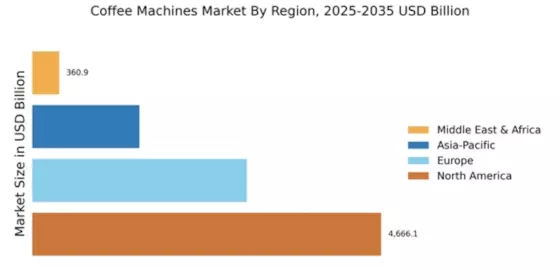
As per MRFR analysis, the Coffee Machines Market Size was estimated at 11.2 USD Billion in 2024. The Coffee Machines industry is projected to grow from 11.7 USD Billion in 2025 to 19.0 USD Billion by 2035, exhibiting a compound annual growth rate (CAGR) of 4.9 % during the forecast period 2025 - 2035. North America holds the largest share of the global Coffee Machines Market at approximately 31%, driven by strong coffee culture, high demand for home brewing solutions, and the growing popularity of specialty coffee experiences. The United States is the leading country within North America, capturing approximately 25% of the global Coffee Machines Market share, as the single largest national market globally with USD 4 Billion in revenue in 2025, supported by strong consumer preference for premium coffee experiences at home and widespread adoption of pod and espresso systems. Household Coffee Machines dominate the Coffee Machines Market as the largest application segment, accounting for an estimated 45% of the global market share, driven by the growing trend of home brewing, the popularity of pod and capsule systems for convenience, and the rise of specialty coffee culture among residential consumers.
Key Market Trends & Highlights
The Coffee Machines Market is experiencing a dynamic shift towards innovation and sustainability.
- Smart coffee machines are gaining traction, reflecting a growing consumer preference for technology integration.
- Sustainability initiatives are becoming increasingly prominent, as manufacturers focus on eco-friendly practices and materials.
- The household segment remains the largest, while the commercial segment is witnessing rapid growth driven by evolving consumer demands.
- Technological advancements and diverse coffee preferences are key drivers propelling market expansion, particularly in North America and Asia-Pacific.
Market Size & Forecast
| 2024 Market Size | 11.2 (USD Billion) |
| 2035 Market Size | 19.0 (USD Billion) |
| CAGR (2025 - 2035) | 4.9 % |
Major Players
Nestle (CH), Keurig Dr Pepper (US), Breville (AU), De'Longhi (IT), Hamilton Beach (US), Philips (NL), Cuisinart (US), Smeg (IT), Rancilio (IT)