Cold Storage Market (2026 - 2035)

Cold Storage Market Research Report Information By Temperature Type (Chilled [0ยฐC to 5ยฐC], Frozen [โˆ’18ยฐC to 0ยฐC], and Deep Frozen [Below โˆ’18ยฐC]), By Application (Food & Beverages, Pharmaceuticals & Healthcare, Chemicals & Industrial, and Others), By Warehouse Type (Bulk Storage Warehouses, Distribution Centers, Production Stores, and Port & Airport Facilities) โ€“ Forecast Till 2035
ID: MRFR/PCM/8517-HCR
111 Pages
Snehal Singh
Last Updated: July 16, 2026
Cold Storage Market
Market Size
Forecast Period2026-2035
CAGR (2026-2035)10.5%
2025 Market SizeUSD 185.0 Billion
2035 Market SizeUSD 501.0 Billion
Key Players
Lineage Logistics
Americold Realty Trust
Nichirei Corporation
United States Cold Storage
NewCold
Emergent Cold Latin America
Opportunities
  • Automated and Robotic Cold Storage Facilities
  • Emerging Market Cold Chain Buildout
  • Pharmaceutical and Life Sciences Specialization

Cold Storage Market Summary

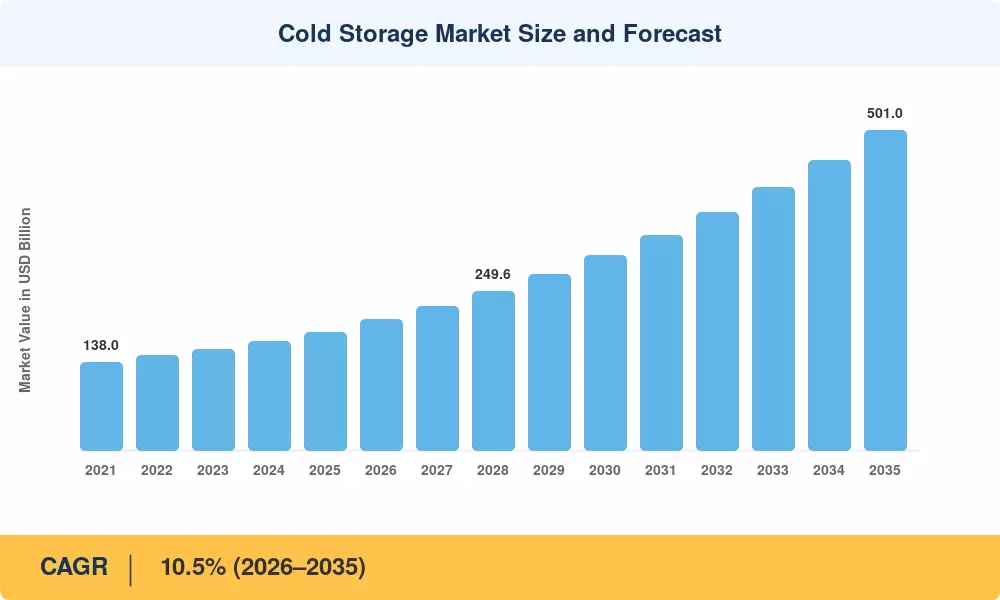
The global Cold Storage Market reached an estimated USD 185.0 billion in 2025 and is projected to grow from USD 204.4 billion in 2026 to USD 501.0 billion by 2035, registering a CAGR of 10.5% during the forecast period (2026โ€“2035). Two forces are accelerating this trajectory: the global expansion of organized retail food distribution โ€” where perishable goods now account for over 40% of grocery revenues in developed economies โ€” and tightening pharmaceutical storage mandates following the WHO's 2023 updated guidelines on temperature-sensitive biologics [1]. Governments across North America, Europe, and Asia have collectively committed over USD 12 billion in public-private cold chain infrastructure programs since 2022 [2].

A sweeping technology shift is reshaping how temperature-controlled facilities operate. Legacy ammonia-based refrigeration systems and manually managed inventory processes are giving way to IoT-enabled monitoring platforms, AI-driven demand forecasting, and natural refrigerant systems using COโ‚‚ and hydrocarbons. The European Commission's revised F-gas Regulation (2024) mandated a 95% phase-down of hydrofluorocarbon use in commercial refrigeration by 2030, forcing operators to accelerate equipment upgrades worth an estimated USD 8.5 billion across the EU alone [3].

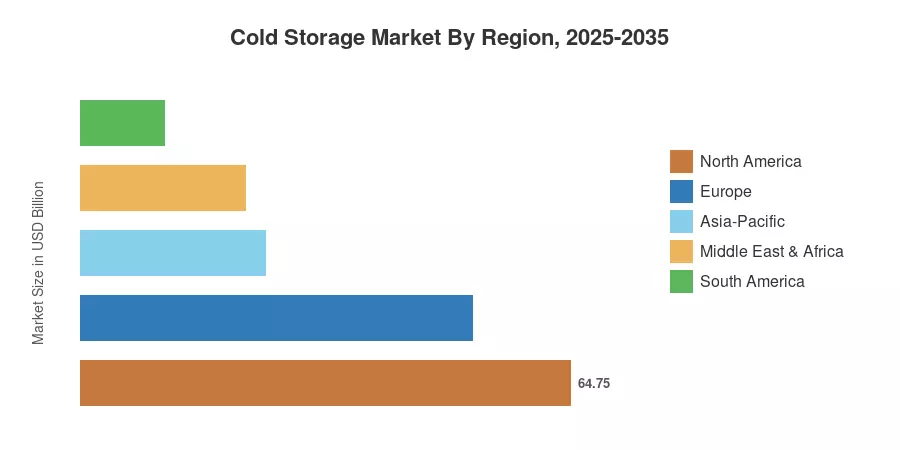
North America commands approximately 35% of the Cold Storage Market, driven by Americold and Lineage Logistics' combined 380+ million cubic feet of capacity. Asia-Pacific is the fastest-growing region at a projected CAGR of 13.2%, fueled by India's Pradhan Mantri Kisan SAMPADA Yojana and China's 14th Five-Year Cold Chain Development Plan. Europe holds the second-largest share at 28%, anchored by stringent food safety regulations and pharmaceutical logistics demand. The decade ahead will see Cold Storage Market investment increasingly tied to sustainability metrics and energy efficiency targets.

ย 

Key Report Takeaways

โ€ข By Temperature Type

  • Frozen storage (โˆ’18ยฐC to 0ยฐC) captures the largest share of the Cold Storage Market at approximately 42% of global revenue, driven by processed food and seafood trade volumes.
  • Deep-frozen storage (below โˆ’18ยฐC) is expanding at a CAGR of 13.1%, reflecting surging demand for biologic drug storage and premium frozen food categories.
  • Chilled storage (0ยฐC to 5ยฐC) is valued at approximately USD 59.2 billion in 2025, underpinned by fresh produce and dairy distribution.

โ€ข By Application

  • Food and beverages represent 68% of the Cold Storage Market by revenue, with meat, poultry, and seafood constituting the largest sub-category.
  • Pharmaceutical and healthcare applications are growing at a CAGR of 14.8%, the fastest among all end-use segments.

โ€ข By Region

  • North America holds a 35% share of the Cold Storage Market, with the United States accounting for over 80% of regional revenue.
  • Asia-Pacific is on track to add approximately USD 95 billion in incremental market value between 2026 and 2035.
  • Europe's Cold Storage Market is valued at approximately USD 51.8 billion in 2025, supported by the EU Green Deal's industrial decarbonization incentives.

ย 

Cold Storage Market Size and Forecast (2021โ€“2035)

Market Research Future's sizing methodology triangulates bottom-up facility capacity data (total cubic feet under refrigeration), warehouse utilization rates, and average revenue per pallet position across 42 countries. Top-down validation cross-references publicly reported revenues of the 20 largest operators with customs trade data on temperature-sensitive goods. Historical figures (2021โ€“2024) reflect actual operator filings and government statistical releases, while the forecast period (2026โ€“2035) applies regression-adjusted growth curves calibrated to GDP, urbanization, and food trade projections from the World Bank and FAO [4].
Cold Storage Market Size and Forecast
Our Impact
Enabled $4.3B Revenue Impact for Fortune 500 and Leading Multinationals
Partnering with 2000+ Global Organizations Each Year
30K+ Citations by Top-Tier Firms in the Industry

Driver Impact Analysis

Driver ~% Impact on CAGR Geographic Relevance Impact Timeline
Expanding organized food retail and e-grocery ~2.8% Global Long-term (โ‰ฅ4 yr)
Pharmaceutical cold chain compliance mandates ~2.2% North America, Europe Medium-term (2โ€“4 yr)
Government cold chain infrastructure programs ~1.8% Asia-Pacific, South America Medium-term (2โ€“4 yr)
Rising frozen and chilled food trade volumes ~1.5% Global Long-term (โ‰ฅ4 yr)
Natural refrigerant transition mandates ~1.0% Europe, North America Short-term (โ‰ค2 yr)
Automation and robotics in warehouse operations ~0.8% North America, Europe, Asia-Pacific Long-term (โ‰ฅ4 yr)
Last-mile cold delivery for direct-to-consumer models ~0.6% North America, Europe Medium-term (2โ€“4 yr)

ย 

Expanding Organized Food Retail and E-Grocery

Global online grocery sales surpassed USD 450 billion in 2024, with perishable categories โ€” fresh produce, dairy, and frozen meals โ€” growing at nearly double the rate of ambient goods. Retailers like Amazon Fresh, Ocado, and JD.com's 7Fresh have invested over USD 6 billion collectively in dedicated micro-fulfillment cold facilities since 2022. This shift from ambient distribution centers to temperature-stratified facilities creates sustained demand for the Cold Storage Market, particularly in urban and peri-urban zones where last-mile freshness guarantees require decentralized cold nodes within 30 minutes of the consumer.

Pharmaceutical Cold Chain Compliance Mandates

The FDA's updated Drug Supply Chain Security Act (DSCSA) enforcement timeline and the EU's GDP Annex 15 qualification requirements have pushed pharmaceutical manufacturers and third-party logistics providers to invest roughly USD 4.2 billion in GxP-compliant cold storage between 2023 and 2025 [9]. Cell and gene therapies, mRNA vaccines, and monoclonal antibodies all require ultra-cold environments (โˆ’80ยฐC to โˆ’20ยฐC), and the clinical pipeline contains over 2,400 temperature-sensitive biologics expected to reach the commercial stage by 2030.

Government Cold Chain Infrastructure Programs

India's Pradhan Mantri Kisan SAMPADA Yojana allocated INR 6,000 crore (approximately USD 720 million) specifically for integrated cold chain development, targeting a 50% reduction in post-harvest losses for fruits and vegetables by 2028 [8]. China's Ministry of Commerce cold chain action plan calls for adding 40 million tons of cold storage capacity during the 14th Five-Year Plan period. These government programs directly expand the addressable Cold Storage Market by creating greenfield capacity in regions where organized cold chain penetration remains below 15%.

Natural Refrigerant Transition Mandates

The European Commission's revised F-gas Regulation imposes an effective ban on high-GWP refrigerants in new commercial refrigeration systems starting 2025, compelling facility operators to adopt COโ‚‚ transcritical, ammonia, and hydrocarbon-based systems [3]. Retrofit and replacement costs average EUR 1.2 million per facility, driving a wave of capital expenditure across approximately 7,000 Cold Storage Market facilities in the EU-27 through 2030.

ย 

Restraints Impact Analysis

Restraint ~% Impact on CAGR Geographic Relevance Impact Timeline
High capital expenditure and long payback periods โˆ’1.2% Global Long-term (โ‰ฅ4 yr)
Energy cost volatility and grid reliability โˆ’0.9% Asia-Pacific, MEA, South America Medium-term (2โ€“4 yr)
Skilled labor shortages for facility operations โˆ’0.7% North America, Europe Medium-term (2โ€“4 yr)
Fragmented cold chain regulations across jurisdictions โˆ’0.5% Asia-Pacific, South America Long-term (โ‰ฅ4 yr)
Land acquisition and zoning constraints near urban centers โˆ’0.4% North America, Europe Short-term (โ‰ค2 yr)

ย 

High Capital Expenditure and Long Payback Periods

Building a modern 100,000-square-foot cold storage facility costs between USD 25 million and USD 45 million, depending on temperature specifications and automation level, with typical payback periods stretching 8โ€“12 years [13]. This capital intensity limits participation to well-capitalized operators and REITs, creating a barrier for mid-market entrants, particularly in emerging economies. Interest rate environments above 5% further compress project-level IRRs, slowing greenfield Cold Storage Market expansion plans.

Energy Cost Volatility

Cold storage facilities use 10โ€“20 times more energy per square foot than ambient warehouses, with electricity accounting for 25โ€“35% of total running expenses [14]. In markets with weak grid infrastructure โ€“ such as South East Asia, Sub-Saharan Africa and parts of Latin America โ€“ operators need to invest in backup diesel generation, lowering margins by a further 8-12%. The 2022-23 gas crisis saw European operatorsโ€™ energy prices jump 60%, squeezing EBITDA margins throughout the industry.

ย 

Skilled Labor Shortages

Specialized training is needed for sophisticated refrigeration systems, IoT-enabled facility controls and hazardous ammonia refrigerants that conventional labor pipelines do not sufficiently deliver [15]. Indeed, the International Institute of Ammonia Refrigeration (IIAR) believes that North America alone is short by an estimated 15,000 skilled refrigeration technicians, leading to increased pay inflation and operational risk for Cold Storage Market players.

ย 

ย 

Cold Storage Market Opportunities

Automated and Robotic Cold Storage Facilities

Fully automated cold storage facilities, including robotic shuttles, automated storage and retrieval systems (AS/RS), and AI-driven inventory management, minimize manpower dependency by up to 80% and have energy efficiency improvements of 30โ€“40% compared to traditional designs [10]. Since 2022, Swisslog, Dematic and KNAPP have installed more than 200 automated cold storage systems globally. Automation represents a $18 billion incremental opportunity in the Cold Storage Market through 2035, spurred by the confluence of labor shortages and increasing throughput requirements.

ย 

Emerging Market Cold Chain Buildout

FAO [18] reports that Sub-Saharan Africa, Southeast Asia and Latin America lose about USD 14 billion yearly in food waste due to insufficient cold chain infrastructure. Cold chain penetration in India is only 6% as opposed to 85% in the US. Government subsidy schemes and development finance organizations, such as the IFC and AfDB are providing concessional funds to Cold Storage Market projects in these regions and creating greenfield opportunities for multinational operators and equipment suppliers.

ย 

Pharmaceutical and Life Sciences Specialization

The biologics drug pipeline โ€” spanning mRNA therapeutics, CAR-T cell therapies, and biosimilars โ€” requires storage at โˆ’20ยฐC to โˆ’80ยฐC with full GDP/GxP traceability [9]. Specialized pharmaceutical cold storage commands revenue per pallet position 2โ€“3 times higher than food-grade facilities. Operators who invest in validated environments, real-time temperature logging, and regulatory audit readiness can capture premium pricing in a sub-segment growing at nearly 15% CAGR.

Data Monetization and Cold Chain Visibility Platforms

Real-time temperature, humidity, and location data generated by IoT sensors across cold chain networks represents an untapped monetization opportunity. Platforms that aggregate this data can offer predictive analytics for spoilage risk, route optimization, and compliance reporting to insurers, food safety regulators, and supply chain finance providers [19]. The Cold Storage Market is positioned to generate over USD 3 billion in data-as-a-service revenues by 2032.

Sustainability-Linked Financing and Green Bonds

Cold storage operators increasingly access sustainability-linked loans and green bonds to fund natural refrigerant conversions, solar rooftop installations, and energy storage systems. Lineage Logistics issued a USD 2.2 billion sustainability-linked bond in 2024, the largest in the logistics sector [20]. As ESG reporting standards tighten under CSRD and SEC climate disclosure rules, Cold Storage Market operators with verified emissions reduction pathways gain preferential cost of capital โ€” a competitive advantage that widens over the forecast period.

ย 

Cold Storage Market Future Outlook

AI-Driven Autonomous Facility Operations

Artificial intelligence will progressively shift cold storage operations from human-supervised to autonomous management by the early 2030s. Machine learning algorithms already optimize compressor cycling patterns and defrost schedules, reducing energy consumption by 15โ€“25% in pilot installations [10]. By 2032, industry analysts project that over 40% of newly constructed cold storage facilities globally will incorporate autonomous inventory management, predictive maintenance, and dynamic energy load balancing โ€” transforming the Cold Storage Market from a labor-intensive real estate play into a technology-driven logistics platform.

Electrification and Renewable Energy Integration

The IEA estimates that refrigeration accounts for approximately 17% of global electricity consumption, with cold storage facilities representing a disproportionate share of industrial demand [14]. Solar rooftop systems, battery energy storage, and grid-interactive demand response programs are enabling facilities to slash electricity costs by 20โ€“35% while meeting Scope 2 emissions targets. Operators in the Cold Storage Market are increasingly pairing natural refrigerant systems with on-site renewable generation to achieve near-zero-carbon operations โ€” a competitive differentiator as tenants and shippers embed sustainability criteria into procurement decisions.

Platform Economics and Asset-Light Models

The traditional Cold Storage Market model โ€” own the building, operate the warehouse, charge per pallet โ€” is evolving toward platform-based orchestration. Digital marketplaces that match available cold storage capacity with short-term demand (analogous to Flexe in ambient warehousing) have attracted over USD 800 million in venture funding since 2023 [19]. This asset-light approach enables food producers and pharmaceutical companies to access cold storage on demand without long-term lease commitments, improving capital efficiency across the value chain.

ESG Reporting and Regulatory Convergence

The Corporate Sustainability Reporting Directive (CSRD) in Europe and proposed SEC climate disclosure rules in the United States will require Cold Storage Market operators to report Scope 1, 2, and 3 greenhouse gas emissions, refrigerant leakage rates, and energy intensity metrics beginning in 2026 [20]. This regulatory convergence creates a competitive bifurcation: operators with auditable ESG data and verified science-based targets will access cheaper capital and win mandates from multinational tenants, while laggards face margin compression and client attrition. By 2030, ESG performance will be as important as location and price in cold storage procurement decisions.

ย 

Cold Storage Market Segmentation

By Temperature Type

Segment Key Metric Primary Demand Driver
Chilled (0ยฐC to 5ยฐC) 32% market share Fresh produce, dairy distribution
Frozen (โˆ’18ยฐC to 0ยฐC) USD 77.7 B (2025) Processed food, seafood, ice cream
Deep Frozen (below โˆ’18ยฐC) CAGR 13.1% Biologics, cell therapies, premium frozen goods

ย 

Frozen storage dominates the Cold Storage Market by revenue, anchored by global trade in frozen seafood, meat, and ready-to-eat meals. The segment benefits from longer shelf-life economics โ€” goods stored at โˆ’18ยฐC can remain commercially viable for 12โ€“24 months, reducing waste and enabling intercontinental supply chains. Major operators like Americold and Lineage dedicate over 55% of their total capacity to frozen storage, with multi-temperature facilities increasingly preferred by tenants seeking operational flexibility.

Deep-frozen storage is the fastest-expanding segment, driven by biopharmaceutical requirements that simply did not exist at scale a decade ago. mRNA vaccine production alone consumed an estimated 15 million cubic feet of ultra-cold storage globally during 2021โ€“2023, and the commercial biologics pipeline promises sustained demand through 2035 [9]. Facility construction costs for deep-frozen environments run 40โ€“60% higher than standard frozen, creating meaningful barriers to entry and premium pricing power for incumbent operators in the Cold Storage Market.

By Application

Segment Key Metric Primary Demand Driver
Food & Beverages 68% market share Organized retail, frozen food exports
Pharmaceuticals & Healthcare CAGR 14.8% Biologics pipeline, GxP mandates
Chemicals & Industrial USD 9.3 B (2025) Specialty chemicals, reagent storage
Others 5% market share Floriculture, cosmetics

ย 

Food and beverages remain the foundational demand driver for the Cold Storage Market, with meat, poultry, and seafood collectively accounting for over 35% of total cold storage revenue. The segment's growth trajectory tracks closely with urbanization rates โ€” every 1% increase in urban population correlates with approximately 1.2% growth in organized cold food distribution in emerging markets [4]. Dairy and fresh produce are the second and third largest sub-categories, with seasonal demand peaks creating utilization challenges that operators increasingly manage through dynamic pricing algorithms.

Pharmaceutical and healthcare cold storage is the fastest-growing application segment. Regulatory requirements under FDA 21 CFR Part 211 and EU GDP guidelines demand validated storage environments with continuous temperature monitoring, deviation alerts, and full audit trails [9]. This compliance overhead translates into revenue per pallet position that is 2.5โ€“3.5 times higher than food-grade Cold Storage Market equivalents, attracting specialized operators like World Courier, Marken, and AmerisourceBergen's dedicated cold chain divisions.

By Warehouse Type

Segment Key Metric Primary Demand Driver
Bulk Storage Warehouses 45% market share Large-scale inventory holding for exporters
Distribution Centers CAGR 12.3% E-commerce fulfillment, last-mile delivery
Production Stores USD 31.5 B (2025) On-site manufacturer cold storage needs
Port & Airport Facilities CAGR 11.0% International trade in perishable goods

ย 

Bulk storage warehouses anchor the Cold Storage Market in terms of sheer capacity, serving agricultural exporters, food processors, and commodity traders who require high-density, long-duration storage. These facilities โ€” typically exceeding 200,000 square feet โ€” operate on thin margins but benefit from economies of scale and long-term lease structures. Distribution centers are gaining share as the Cold Storage Market pivots toward faster inventory turns and smaller, more frequent shipment sizes driven by e-commerce grocery and pharmaceutical last-mile delivery models.

ย 

Regional Market Share Analysis

Region Key Metric Primary Investment Themes
North America 35% market share (2025) Automation retrofits; pharmaceutical specialization
Europe USD 51.8 B (2025) F-gas compliance; multi-temperature facilities
Asia-Pacific CAGR 13.2% (2026โ€“2035) Greenfield capacity; government subsidies
South America USD 11.1 B (2025) Agricultural export corridors; port-side storage
Middle East & Africa CAGR 11.8% (2026โ€“2035) Food import dependency; healthcare logistics
Total USD 185.0 B (2025) โ€”

The Cold Storage Market exhibits significant regional variation shaped by food consumption patterns, regulatory frameworks, and existing infrastructure maturity. North America leads in total revenue, while Asia-Pacific outpaces all regions in capacity expansion.

ย 

North America

Country Key Metric Key Driver
United States 82% of regional revenue Lineage/Americold consolidation; e-grocery
Canada CAGR 9.8% Agricultural exports; pharmaceutical logistics
Mexico USD 2.9 B (2025) Nearshoring; fresh produce export infrastructure

ย 

The United States dominates the North American Cold Storage Market with over 4.3 billion cubic feet of refrigerated warehouse capacity spread across approximately 1,500 facilities [21]. The consolidation wave led by Lineage Logistics โ€” which acquired eight regional operators between 2022 and 2024 โ€” has pushed top-five concentration above 40% in the region. Canada's cold chain investment is increasingly tied to pharmaceutical distribution hubs in Ontario and British Columbia, while Mexico benefits from a USD 1.5 billion nearshoring boom driving demand for cold storage along the U.S.โ€“Mexico border corridor.

Europe

Country Key Metric Key Driver
Germany 22% of regional share Automotive-grade pharma logistics; F-gas retrofit
United Kingdom USD 8.2 B (2025) Post-Brexit supply chain reconfiguration
France CAGR 10.8% Agri-food exports; sustainability mandates
Netherlands 11% of regional share Port logistics hub (Rotterdam); flower/produce trade

ย 

European Cold Storage Market growth is shaped by the twin pressures of environmental regulation and supply chain resilience. The revised F-gas Regulation is accelerating a EUR 10 billion refrigerant transition across the continent [3], while the Farm-to-Fork Strategy's target of halving food waste by 2030 is catalyzing investment in post-harvest cold chain infrastructure across Southern and Eastern Europe. The Netherlands and Belgium serve as critical gateway nodes for temperature-sensitive goods entering the EU via the Port of Rotterdam and Antwerp-Bruges.

Asia-Pacific

Country Key Metric Key Driver
China 38% of regional revenue 14th Five-Year Plan cold chain expansion [22]
India CAGR 15.6% SAMPADA Yojana subsidies; post-harvest loss reduction
Japan USD 7.8 B (2025) Advanced automation; aging population meal delivery
Australia CAGR 10.2% Agricultural export cold corridors

ย 

Asia-Pacific represents the highest-growth opportunity within the Cold Storage Market. China added approximately 12 million tons of new cold storage capacity in 2023 alone, with state-backed logistics parks in Guangdong, Shandong, and Sichuan serving as anchor points [22]. India's cold chain is expanding from a low base โ€” only 6% of perishable produce is currently cold-chain managed โ€” creating immense headroom. Japan's Cold Storage Market is distinguished by its high automation rate, with over 60% of major facilities deploying AS/RS technology.

South America

Country Key Metric Key Driver
Brazil 58% of regional share Meat and poultry export infrastructure
Argentina CAGR 11.4% Agricultural export growth
Chile USD 1.1 B (2025) Seafood and fruit export logistics

ย 

Brazil's position as the world's largest exporter of chicken and a top-three beef exporter underpins its Cold Storage Market dominance in South America. JBS, BRF, and Marfrig operate integrated cold chain networks spanning farm-gate to port, with Santos and Paranaguรก serving as primary export nodes. Chile's seafood industry โ€” particularly salmon farming โ€” drives specialized ultra-cold storage demand along the southern coast.

Middle East & Africa

Country Key Metric Key Driver
UAE 32% of regional share Food import hub; Dubai Logistics Corridor
Saudi Arabia CAGR 13.5% Vision 2030 food security investments
South Africa USD 1.8 B (2025) Retail modernization; pharmaceutical distribution

ย 

The Middle East and Africa Cold Storage Market is driven by near-total food import dependency in the GCC states, where over 85% of food is imported and requires end-to-end temperature management [23]. Saudi Arabia's National Industrial Development and Logistics Program (NIDLP) has earmarked SAR 3.5 billion for food logistics infrastructure, including 15 cold storage mega-facilities planned across Riyadh, Jeddah, and Dammam by 2030.

ย 

Cold Storage Market By Region, 2025-2035

Competitive Benchmarking

The Cold Storage Market is moderately concentrated, with an estimated Herfindahl-Hirschman Index (HHI) of approximately 850โ€“1,100. The top five operators control roughly 28โ€“32% of global revenue, while the remaining market is fragmented across hundreds of regional and single-facility operators. Consolidation has accelerated since 2020, with Lineage Logistics and Americold completing a combined 25+ acquisitions in four years, signaling a clear trend toward scale-driven competitive positioning.

Company Est. Revenue Share Range Key Offerings for Cold Storage Market Strategic Positioning
Lineage Logistics ~10โ€“14% Multi-temperature warehousing, transport, automation Largest global operator; technology-first strategy
Americold Realty Trust ~8โ€“11% REIT-structured cold storage, managed services Largest publicly traded cold storage REIT
Nichirei Corporation ~3โ€“5% Frozen food production and integrated storage Vertically integrated in Japan and SE Asia
United States Cold Storage ~2โ€“4% Public refrigerated warehousing Regional U.S. leader; mid-Atlantic concentration
NewCold ~2โ€“3% Fully automated deep-freeze facilities Technology pioneer; Europe and Australia focus
Emergent Cold Latin America ~1โ€“3% Greenfield cold storage in LatAm markets Emerging market specialist
Swire Cold Storage ~1โ€“2% Temperature-managed warehousing in Asia-Pacific Conglomerate-backed; port logistics integration
Kloosterboer ~1โ€“2% Port-side cold storage; fruit and juice logistics European port gateway specialist
Burris Logistics ~1โ€“2% Warehousing, distribution, and co-packing U.S. East Coast; diversified services
Henningsen Cold Storage ~1โ€“2% Public refrigerated warehousing Pacific Northwest U.S. regional leader

ย 

ย 

Recent News & Developments

  • Lineage Logistics (July 2024 ): Completed IPO on the Nasdaq, raising approximately USD 4.4 billion in the largest U.S. warehouse REIT listing to date, signaling institutional investor confidence in the Cold Storage Market [24].

ย 

  • European Commission (January 2024): Published the revised F-gas Regulation, mandating accelerated phase-down of HFC refrigerants in commercial cold storage systems effective 2025, impacting over 7,000 facilities across the EU-27 [3].

ย 

ย 

ย 

ย 

  • FDA (October 2024): Issued updated guidance on DSCSA cold chain documentation requirements for pharmaceutical manufacturers and 3PL providers, expanding electronic recordkeeping mandates [9].

ย 

Cold Storage Market Report Scope

Parameter Detail
Market Scope Global cold storage facilities including public, private, and semi-private warehouses; chilled, frozen, and deep-frozen temperature classes
Study Period 2021โ€“2035
CAGR 10.5% (2026โ€“2035)
Market Size (2025) USD 185.0 Billion
Market Size (2035) USD 501.0 Billion
Fastest Growing Segment Pharmaceuticals & Healthcare (CAGR 14.8%); Deep Frozen (CAGR 13.1%)
Fastest Growing Region Asia-Pacific (CAGR 13.2%)
Companies Profiled 10 (Lineage Logistics, Americold, Nichirei, USCS, NewCold, Emergent Cold, Swire, Kloosterboer, Burris, Henningsen)
Valuation Currency USD (current prices)

ย 

ย 

FAQs

How do lease structures differ between single-tenant and multi-tenant cold storage facilities?
Single-tenant facilities use triple-net leases spanning 10โ€“15 years with tenant-funded buildouts, while multi-tenant facilities rely on shared-use agreements priced per pallet position per month. Multi-tenant models offer operators higher blended yields but carry greater vacancy risk [13].
What insurance considerations are unique to cold storage operations?
Policies must cover inventory spoilage from equipment failure, ammonia release liability, and business interruption tied to refrigeration system downtime. Premiums typically run 30โ€“50% higher than standard warehouse coverage [17].
How does cold storage REIT valuation methodology differ from conventional industrial REITs?
Analysts apply replacement cost premiums of 40โ€“60% because cold storage construction costs far exceed ambient warehouse builds. Cap rates for Class A cold storage assets trade 75โ€“125 basis points tighter than ambient equivalents [13].
What role do micro-fulfillment cold nodes play in urban e-grocery supply chains?
Urban micro-fulfillment centers under 20,000 square feet provide same-day chilled delivery within a 15-mile radius. They reduce last-mile spoilage rates by 35โ€“45% compared to centralized distribution models [12].
How are natural refrigerant conversions affecting facility operating margins?
COโ‚‚ transcritical systems carry 15โ€“20% higher upfront costs but reduce energy consumption by 10โ€“15% annually. Most operators achieve payback within 4โ€“6 years through lower electricity and regulatory compliance costs [3].
What cybersecurity risks are emerging in IoT-connected cold storage facilities?
Connected sensors and building management systems create attack surfaces for ransomware targeting critical temperature controls. Operators are investing USD 500โ€“800 per connected device annually in OT security monitoring [19].
How do carbon credit programs apply to cold storage refrigerant transitions?
Replacing high-GWP HFC systems with natural refrigerants generates verified carbon offset credits under the Kigali Amendment framework. Early-mover operators have monetized credits worth USD 8โ€“12 per ton COโ‚‚-equivalent avoided [20]. ย  ย 
Author
Author
Author Profile
Snehal Singh LinkedIn
Manager - Research
High acumen in analyzing complex macro & micro markets with more than 6 years of work experience in the field of market research. By implementing her analytical skills in forecasting and estimation into market research reports, she has expertise in Packaging, Construction, and Equipment domains. She handles a team size of 20-25 resources and ensures smooth running of the projects, associated marketing activities, and client servicing.

Research Approach

ย 

Secondary Research

The secondary research process involved comprehensive analysis of regulatory frameworks, cold chain industry databases, logistics publications, and authoritative food safety organizations. Key sources included the US Food & Drug Administration (FDA) Food Safety Modernization Act (FSMA) database, US Department of Agriculture (USDA) Cold Storage reports, European Food Safety Authority (EFSA) guidelines, European Commission Good Distribution Practice (GDP) regulations, International Institute of Refrigeration (IIR), Global Cold Chain Alliance (GCCA) market reports, International Association of Refrigerated Warehouses (IARW) facility databases, World Food Logistics Organization (WFLO) technical standards, International Air Transport Association (IATA) Center of Excellence for Independent Validators (CEIV) Pharma certifications, Parenteral Drug Association (PDA) cold chain guidance, World Health Organization (WHO) Global Health Observatory trade logistics indicators,Organization for Economic Co-operation and Development (OECD) logistics performance indices, Eurostat transport and storage statistics, national food safety authority reports from key markets (CFDA China, FSSAI India, ANMAT Argentina), and cold chain disruption tracking from the International Trade Centre (ITC). These sources were used to collect warehouse capacity statistics, food safety compliance data, pharmaceutical cold chain regulations, automation technology adoption rates, energy efficiency standards, perishable trade flows, and market landscape analysis for refrigerated warehousing, blast freezing operations, temperature-controlled containers, and industrial freezer systems.

ย 

Primary Research

Supply-side and demand-side stakeholders were interviewed during the primary research process to ascertain qualitative and quantitative insights regarding temperature compliance protocols, automation investments, and facility capacity expansion. In addition to energy managers from third-party logistics (3PL) cold storage providers, refrigeration equipment OEMs, insulated panel manufacturers, and automated material handling system vendors, supply-side sources included CEOs, Chief Operating Officers, Vice Presidents of Cold Chain Operations, and Heads of Facility Development. The demand-side sources included Vice Presidents of Supply Chain, Directors of Logistics and Distribution, Procurement Heads for warehousing services, and Quality Assurance. Food processing companies, multinational quick-service restaurant chains, pharmaceutical manufacturers, biotech firms, blood banks & organ transplant centers, e-commerce grocery platforms, and retail supermarket chains employ fleet managers and managers dedicated to cold chain compliance. The primary research validated market segmentation by storage capacity tiers, confirmed facility construction pipelines and automation deployment timelines, and gathered insights on rental rate dynamics, energy cost management, regulatory audit patterns, and pharmaceutical qualification protocols.

Primary Respondent Breakdown:

By Designation: C-level Primaries (40%), Director Level (25%), Others (35%)

By Region: North America (40%), Europe (25%), Asia-Pacific (25%), Rest of World (10%)

ย 

Market Size Estimation

Global market valuation was derived through facility capacity mapping, pallet position analysis, and revenue aggregation across storage types. The methodology included:

Identification of 60+ key operators across North America, Europe, Asia-Pacific, and Latin America, including specialized pharmaceutical cold chain providers and multi-temperature warehousing operators

Product mapping across refrigerated warehouses (public, private, and contractual), blast freezing facilities, industrial freezer systems, and temperature-controlled container infrastructure

Analysis of reported and modeled annual revenues specific to cold storage operations, excluding ambient warehousing and non-temperature-controlled logistics

Coverage of operators representing 65-70% of global refrigerated warehousing capacity in 2024

Extrapolation using bottom-up (pallet capacity ร— utilization rate ร— storage rate by country/region) and top-down (operator revenue validation against publicly disclosed facility portfolios) approaches to derive segment-specific valuations for frozen versus chilled storage, pharmaceutical versus food applications, and capacity tiers ranging from <5,000 pallet positions to >20,000 pallet positions

Cross-validation against pharmaceutical cold chain spending reports and food industry logistics cost structures to ensure alignment with end-user expenditure patterns

Download Free Sample

Kindly complete the form below to receive a free sample of this Report

Download PDF ×

We do not share your information with anyone. However, we may send you emails based on your report interest from time to time. You may contact us at any time to opt-out.
















